Circle gets Abu Dhabi greenlight amid UAE stablecoin and crypto push

cointelegraphPublished on 2025-12-09Last updated on 2025-12-09

Abstract

Circle has received regulatory approval from the Abu Dhabi Global Market (ADGM) to operate as a licensed Money Services Provider, expanding its presence in the UAE. The company also appointed Saeeda Jaffar as managing director for the Middle East and Africa. This move is part of a broader trend of crypto firms, including Tether, Ripple, and Binance, gaining regulatory clearance in Abu Dhabi. The UAE has been advancing its crypto regulatory framework, introducing rules for DeFi and Web3, while also enforcing stricter oversight on unlicensed crypto operations.

Stablecoin issuer Circle has secured regulatory approval to operate as a financial service provider in the Abu Dhabi International Financial Center, deepening its push into the United Arab Emirates.

In an announcement Tuesday, Circle Internet Group said it received a Financial Services Permission license from the Financial Services Regulatory Authority of the Abu Dhabi Global Market (ADGM), the International Financial Centre of Abu Dhabi. This allows the stablecoin issuer to operate as a Money Services Provider in the IFC.

The USDC (USDC) issuer also appointed Saeeda Jaffar as its managing director for Circle Middle East and Africa. The new executive also serves as a senior vice president and group country manager for the Gulf Operation Council at Visa and will be tasked with developing the stablecoin issuer’s regional strategy and partnerships.

Circle co-founder, chairman and CEO Jeremy Allaire said that the relevant regulatory framework “sets a high bar for transparency, risk management, and consumer protection,” adding that those standards are needed if “trusted stablecoins” are going to support payments and finance at scale.
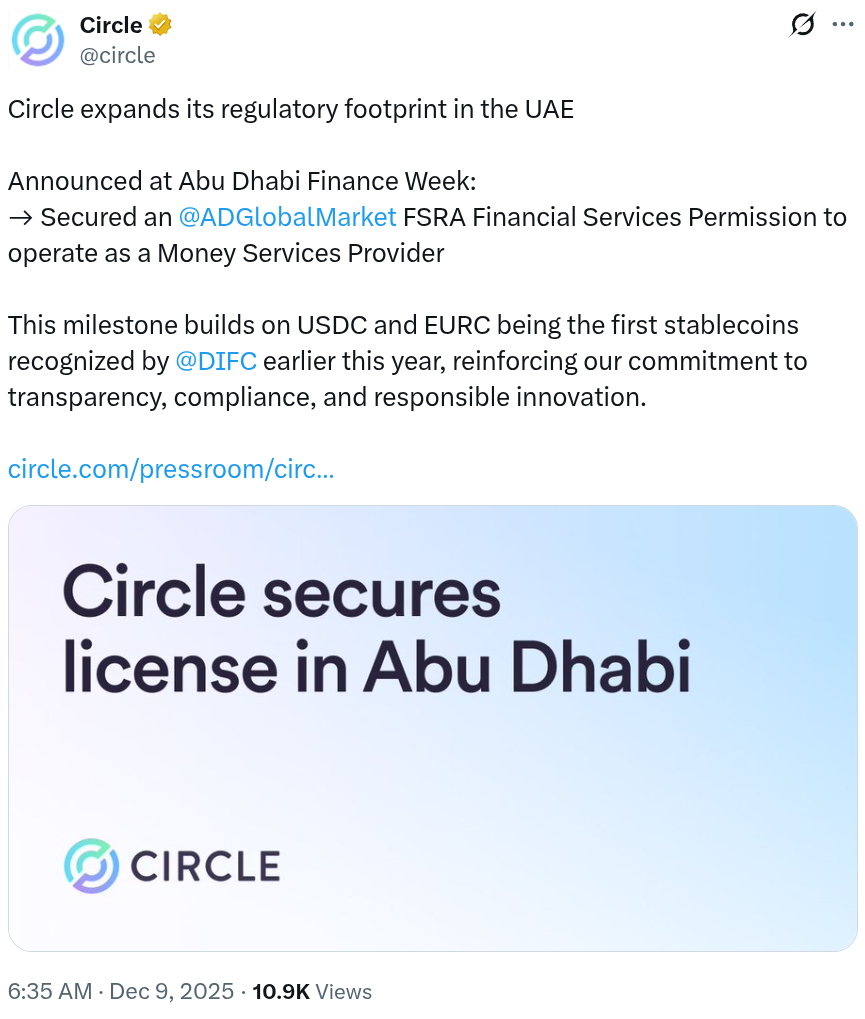
Source: Circle

Related: Abu Dhabi Investment Council triples stake in Bitcoin ETF in Q3: Report

Abu Dhabi awards a wave of licenses

The ADGM has recently awarded licenses for financial operations to a wave of crypto companies. Earlier this week, Tether’s USDt (USDT) — the largest stablecoin by circulation and Circle’s top competitor — secured a regulatory milestone in Abu Dhabi’s international financial center, as did Ripple’s dollar-pegged stablecoin Ripple USD at the end of November.

On Monday, crypto exchange Binance was granted three separate licenses from Abu Dhabi’s financial regulator, allowing it to operate its exchange, clearing house and broker-dealer services. This followed its competitor Bybit receiving regulatory approval in the UAE in early October.

Related: HSBC to bring tokenized deposits to US and UAE as stablecoin race heats up

UAE bets on crypto

The Central Bank of the UAE has been actively reviewing its cryptocurrency regulations. In November, it introduced rules for decentralized finance (DeFi) and the broader Web3 industry.

The newly-introduced Federal Decree Law No. 6 of 2025 brings DeFi platforms, related services and infrastructure providers under the scope of regulations if they enable payments, exchange, lending, custody, or investment services, with licenses now required. Local crypto lawyer Irina Heaver said that “DeFi projects can no longer avoid regulation by claiming they are just code.”

Heaver told Cointelegraph at the end of 2024 that during that year the country cemented its status as a global crypto hub.

In October 2024, the UAE exempted cryptocurrency transfers and conversions from value-added tax, just a month after Dubai’s digital asset regulator announced stricter rules on crypto marketing. Around the same time, local free economic zone Ras Al Khaimah Digital Assets Oasis was also working to introduce a legal framework for decentralized autonomous organizations.

Local regulators were also not shy about enforcing the rules, with Dubai’s Virtual Assets Regulatory Authority cracking down on seven unlicensed crypto businesses, issuing fines and cease-and-desist orders.

Magazine: Review: The Devil Takes Bitcoin, a wild history of Mt. Gox and Silk Road

Related Reads

STRC Breaks Below $95: Why Does It Continue to Depeg? Is There Default Risk?

"STRC Falls Below $95: Why the Persistent Depegging and Is There Default Risk?" The article discusses the recent decline in the price of STRC, a perpetual preferred stock issued by Strategy (MSTR) designed to trade around a $100 par value. As of publication, STRC traded at $94.65, raising market concerns. STRC is described as a high-yield cash flow product, offering an 11.50% annual dividend paid monthly. Its "preferred" status grants it priority over common stock for dividends and in liquidation. Key reasons cited for the price depegging include: 1. **Bitcoin's Price Drop:** MSTR's assets are heavily tied to Bitcoin (BTC), which fell over 21% from its recent high, pressuring all Strategy-related products. 2. **Competitive Pressure:** Rival Strive Asset Management's similar product, SATA, offers daily dividends and has maintained its $100 par value with a ~13% yield. In response, Strategy has proposed changing STRC's dividend frequency from monthly to bi-weekly, pending shareholder vote. 3. **Technical Selling:** A break below $100 may have triggered algorithmic selling and stop-losses, exacerbating the decline. Regarding default risk, the analysis suggests it is currently low. Strategy founder Michael Saylor confirmed the June 2026 dividend rate remains at 11.50% with no cuts or suspensions. The company's massive reserve of 843,706 BTC provides a significant backstop for its obligations. Industry opinions are mixed. Some analysts view the BTC holdings as reliable support for dividends, while critics like Peter Schiff warn of potential dividend cuts leading to price crashes and lawsuits. Others highlight inflation risk and the company's ability to reduce dividends without a formal default. In summary, STRC's drop is attributed to BTC volatility, competition, and technical factors. While immediate default risk appears contained, the product faces challenges from market conditions and competitive dynamics.

marsbit43m ago

STRC Breaks Below $95: Why Does It Continue to Depeg? Is There Default Risk?

marsbit43m ago

AI Trading Cools, South Korean Stocks Plunge 1.8%, Spot Gold Rises 1%, Bitcoin Dives

A sell-off in AI-related stocks, triggered by Broadcom's disappointing earnings forecast, sent shockwaves through global markets. South Korea's KOSPI led Asia's decline, plunging 1.8% as the risks from concentrated chip stock gains and surging leveraged investments came to the fore. The tech-heavy Nasdaq 100 futures fell 0.5% following Broadcom's 14% after-hours plunge, which signaled a slower-than-expected transition to AI clients. This pullback extended Wall Street's weakness, halting the S&P 500's nine-day rally amid hawkish Fed signals and renewed Middle East tensions. South Korean authorities convened an emergency meeting, pledging "immediate measures" against market volatility and warning of record-high stock margin debt. The adjustment rippled across assets: Bitcoin fell to around $64,000, its lowest since February, while safe-haven gold rose 1% on bargain hunting. Oil prices dipped on Middle East ceasefire news. Market analysts noted the sell-off was driven by profit-taking after massive gains, particularly in chip stocks like Samsung and SK Hynix, which now dominate the KOSPI. Wall Street banks are divided on Korea's outlook, with Goldman Sachs raising its target while Citigroup and others warn of overvaluation and a potential bubble. Bridgewater's Ray Dalio noted that great technological shifts often create bubbles. Meanwhile, Fed officials' hints at potential future rate hikes added to the cautious mood ahead of key U.S. jobs data.

华尔街日报1h ago

AI Trading Cools, South Korean Stocks Plunge 1.8%, Spot Gold Rises 1%, Bitcoin Dives

华尔街日报1h ago

Seeking Alpha's Hot Article: Why Might the U.S. Stock Market Crash in June?

In a recent Seeking Alpha article, financial professor and analyst Damir Tokic argues that the US stock market may be poised for a significant crash in June 2026. The core thesis centers on a "mega-bubble" in equities, particularly within the technology sector, which has driven the S&P 500 to near-record valuations, with a Shiller P/E ratio exceeding 40—a level comparable to the 2000 dot-com bubble. Tokic identifies two primary catalysts for a potential collapse. First, he points to unsustainable market exuberance fueled by what he terms the "Trump Stimulus"—massive AI capital expenditure by tech giants, which he believes is politically driven and cannot last. Second, and more urgently, he highlights the escalating Iran war as a critical threat. The ongoing closure of the Strait of Hormuz has created a severe global energy supply crunch. Strategic petroleum reserves are projected to hit critically low operational levels by June, potentially causing oil prices to spike above $200 per barrel and triggering a severe, supply-driven inflationary shock. This scenario, Tokic warns, would force the Federal Reserve's hand. Despite currently maintaining a dovish bias, the Fed would likely be compelled to officially pivot to a hawkish stance at its June FOMC meeting to combat soaring inflation and bond yields. He contends that such a shift—or even a failure to act, which would destroy Fed credibility—could be the trigger that punctures the market bubble. The resulting downturn, he concludes, could rival the bear markets of 2000 and 2008, advising investors to prepare for a major correction.

marsbit1h ago

Seeking Alpha's Hot Article: Why Might the U.S. Stock Market Crash in June?

marsbit1h ago

Trading

Spot
Futures

Hot Articles

How to Buy PUSH

Welcome to HTX.com! We've made purchasing Push Protocol (PUSH) simple and convenient. Follow our step-by-step guide to embark on your crypto journey.Step 1: Create Your HTX AccountUse your email or phone number to sign up for a free account on HTX. Experience a hassle-free registration journey and unlock all features.Get My AccountStep 2: Go to Buy Crypto and Choose Your Payment MethodCredit/Debit Card: Use your Visa or Mastercard to buy Push Protocol (PUSH) instantly.Balance: Use funds from your HTX account balance to trade seamlessly.Third Parties: We've added popular payment methods such as Google Pay and Apple Pay to enhance convenience.P2P: Trade directly with other users on HTX.Over-the-Counter (OTC): We offer tailor-made services and competitive exchange rates for traders.Step 3: Store Your Push Protocol (PUSH)After purchasing your Push Protocol (PUSH), store it in your HTX account. Alternatively, you can send it elsewhere via blockchain transfer or use it to trade other cryptocurrencies.Step 4: Trade Push Protocol (PUSH)Easily trade Push Protocol (PUSH) on HTX's spot market. Simply access your account, select your trading pair, execute your trades, and monitor in real-time. We offer a user-friendly experience for both beginners and seasoned traders.

3.6k Total ViewsPublished 2024.03.29Updated 2026.06.02

How to Buy PUSH

Discussions

Welcome to the HTX Community. Here, you can stay informed about the latest platform developments and gain access to professional market insights. Users' opinions on the price of PUSH (PUSH) are presented below.

活动图片













