China's Export Controls to Japan Create Bottleneck; 'White-Haired Stock God' Serenity Claims South Korea's Foosung to Become a 'Big Winner'

marsbitPublished on 2026-06-15Last updated on 2026-06-15

Abstract

China's export controls on tungsten have triggered a supply crisis in the AI memory chip sector. Japan, accounting for 25% of global WF6 (tungsten hexafluoride) production, faces imminent shutdowns due to shortages of tungsten precursor from China. This forces major Korean chipmakers like Samsung and SK Hynix to urgently seek alternatives. Korean suppliers SK Specialty and Foosung are moving to fill the gap. SK Specialty has signed a long-term contract to supply Samsung with 150 tons of WF6 monthly. Foosung has begun certification with China's CSSC Specialty Gases to start large-scale WF6 imports by August. Market analysts, including social media figure "White-Haired Stock God" Serenity, have labeled Foosung a potential "big winner," with its stock rising significantly. The crisis has led to drastic price increases, with 2026 WF6 contract prices set to rise 70-90%. Japanese suppliers warn their key inventories could be depleted by mid-2026. However, the opportunity for Korean firms hinges on continued access to Chinese tungsten powder—a geopolitical choice rather than a permanent technological advantage. The situation highlights the fragility of the concentrated WF6 supply chain and the strategic risks for downstream chip manufacturers.

Author: Ada, Deep Tide TechFlow

The ripple effects of China's tungsten export controls to Japan have now reached the upstream AI memory chip sector.

Japan's 25% share of global WF6 (tungsten hexafluoride) production capacity has entered a countdown to shutdown, forcing Samsung and SK Hynix to urgently seek alternative supplies overnight. South Korea's SK Specialty signed a long-term contract with Samsung for a monthly supply of 150 tons, while Foosung initiated certification with China's CSSC Specialty Gases, aiming for large-scale imports starting August; 2026 WF6 contract prices have been locked in for increases of 70% to 90%. Japanese suppliers warn that key inventories could be depleted by mid-2026. On social platform X, the 'White-Haired Stock God' Serenity singled out Foosung as a 'big winner,' but the inherent risks in this substitution game are equally clear—Korean manufacturers themselves rely on imports for the tungsten powder needed to produce the gas.

Japan's two main WF6 suppliers, Kanto Denka Kogyo and Central Glass, have notified South Korean clients like Samsung, SK Hynix, and DB HiTek that they cannot guarantee supply after May or June. This is a major blow to the downstream memory chip sector following China's implementation of export controls on tungsten-related items in February 2025.
Chain Reaction from China's APT Export Controls, Japan's WF6 Capacity Feels Pressure First

As early as February 2025, China's Ministry of Commerce and the General Administration of Customs jointly announced the inclusion of tungsten-related items into the dual-use items export control list. The impact of this move is now being fully realized over a year later. According to industry analysis firm CTOL Digital, since the controls took effect, Japan's imports of APT (Ammonium Paratungstate, a precursor to tungsten powder) from China on key trade routes plummeted by up to 70%, a figure that directly chokes the supply chain for Japanese WF6 producers.

The pressure arrived faster than the industry anticipated. According to a report on April 3 by South Korean semiconductor media The Elec, citing multiple industry sources, Kanto Denka and Central Glass have begun notifying South Korean chipmakers like Samsung and DB HiTek of potential imminent supply disruptions. One informed source stated, 'Supply can be maintained with existing tungsten inventories in May and June, but the outlook for the second half is unclear.' Japanese producers have suggested their South Korean clients turn to domestic alternatives, SK Specialty and Foosung.

Japan holds about 25% of the global WF6 supply. This means that a production cut by Japanese firms would instantly remove a quarter of the world's tungsten film precursor. According to information agency SunSirs, Samsung and SK Hynix sourced approximately 80% of their WF6 from Japan in the past, placing them squarely on the front lines of the crisis. Among them, Samsung's exposure is significantly higher than SK Hynix's, as the latter's supply portfolio is more diversified, including SK Specialty, Foosung, and China's Peric Special Gases.

SK Specialty Signs 150-ton Monthly Long-Term Supply Deal with Samsung, Korean Leaders Ramp Up Production

In the face of the crisis, South Korean companies demonstrated exceptional execution speed. According to SunSirs, SK Specialty has signed a long-term supply agreement with Samsung for a monthly volume of 150 tons. This scale is unusual under normal circumstances, as WF6 is a high-purity specialty gas, not a bulk commodity that can be easily scaled up.

SK Specialty is South Korea's largest WF6 supplier and benefits from natural group synergy with downstream clients. It belongs to the SK Group, closely tied to SK Hynix within the same group; now, by adding Samsung to its long-term contract list, it essentially secures positions with both of South Korea's top memory manufacturers.

Time is the scarcest resource in this scramble for orders. WF6 is a highly corrosive, hazardous gas requiring purity levels of 5N to 6N (99.999% to 99.9999%). The certification process for new suppliers typically takes 12 to 18 months, covering process testing, yield verification, equipment adaptation, and more. However, according to The Elec, some foundries are 'shortening or skipping parts of the process' for one reason only: urgency.

Foosung Initiates Certification with CSSC Specialty Gases, Targets Large-Scale Imports Starting August

Foosung (Korean code 093370) is taking another route. This South Korean fluorochemical company, with a market cap of about $1.2 billion, is one of SK Hynix's three existing WF6 suppliers, alongside SK Specialty and China's Peric. Beyond WF6, it is also South Korea's sole producer of anhydrous hydrogen fluoride (HF), the country's second-largest WF6 manufacturer, and the sole producer of battery electrolyte salt LiPF6. Its Ulsan plant integrates three fluorochemical production lines, representing highly concentrated technological assets.

According to industry information cited by SunSirs and futunn among other media, Foosung has initiated the certification process with China Shipbuilding Industry Group's CSSC Specialty Gases, aiming to begin large-scale WF6 imports from August. The hidden implication of this move is worth unpacking: Japan halts WF6 production due to tungsten powder shortages, while South Korea's Foosung turns to importing finished WF6 from China. The same tungsten supply chain is segmented by China's export controls into parts that 'restrict Japan' and 'allow South Korea.'

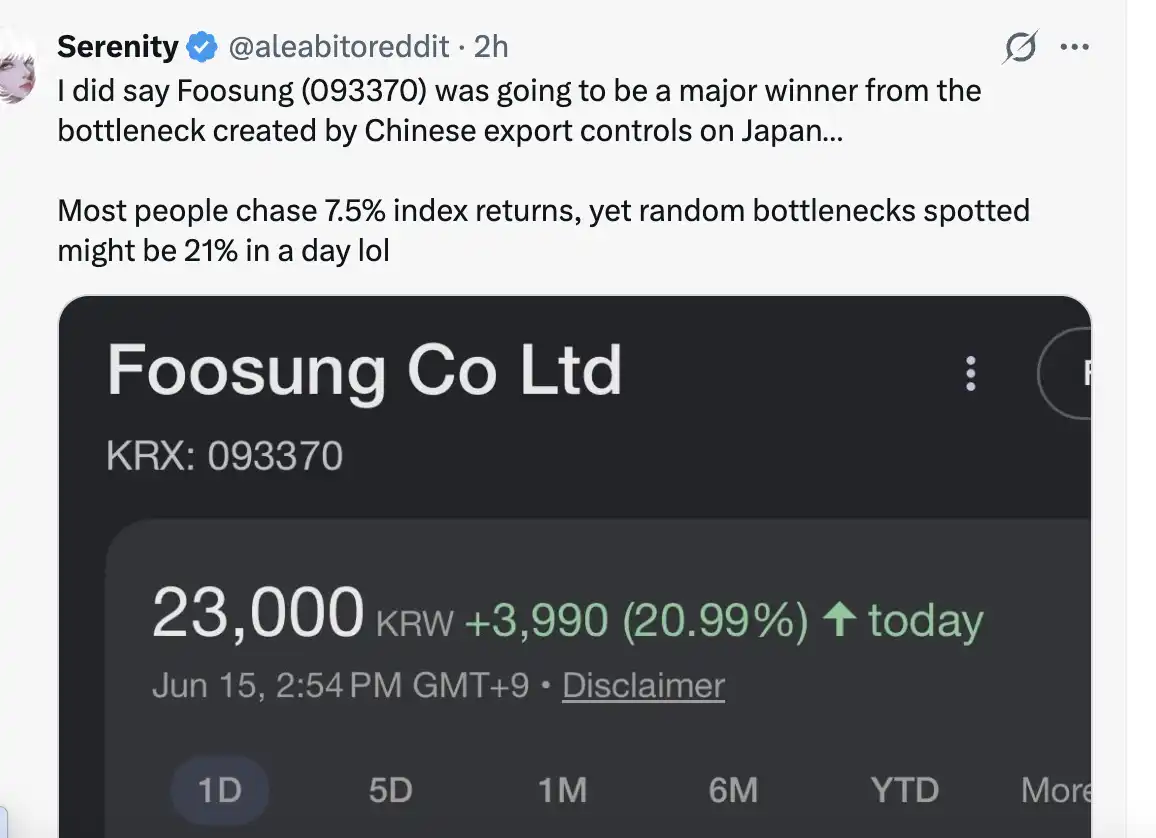
The 'White-Haired Stock God' Serenity on platform X has noted this thread. He posted on June 13, naming Foosung: 'Foosung looks like it will become a huge beneficiary soon. Basically, China's export controls on Japan have caused Japan's WF6 supply chain to collapse, and the 25% of global supply needed by SK Hynix, Samsung, TSMC will have to find alternatives elsewhere.'

The secondary market has already reacted to this logic. According to CTOL Digital, Foosung's stock price has risen approximately 196% over the past 12 months, despite its TTM EPS still being negative.

2026 WF6 Contract Prices to Rise 70% to 90%; Japanese Suppliers Warn of Mid-2026 Inventory Depletion

Price signals at the contract level have already emerged. According to CTOL Digital, South Korea's SK Specialty, Foosung, and Japan's Kanto Denka have formally notified Samsung, SK Hynix, DB HiTek, and Magnachip that 2026 WF6 contract prices will increase by 70% to 90%. This is a collective pricing action within an oligopolistic market, leaving downstream buyers with few alternative options.

An even more cautionary signal comes from the supply side. Also per CTOL Digital, Japanese suppliers have warned that key inventories could be depleted by mid-2026. This implies that even South Korean clients with signed long-term contracts face uncertainty regarding physical deliveries.

The irreplaceability of WF6 is being repriced by the market. Chipmakers cannot simply swap gas cylinders between different suppliers; any deviation in impurities could scrap millions of dollars worth of wafer inventories. This is the fundamental reason for the stringent 12 to 18-month certification process for new suppliers and the underlying logic that sustains the oligopolistic structure.

The stock price reaction is already ahead. According to CTOL Digital, Japan's Kanto Denka's stock price has risen about 374% over the past year, with its market capitalization soaring to 240.3 billion yen and a TTM P/E ratio exceeding 63 times. Foosung's gain in the same period is about 196%, and despite its negative TTM EPS, the market has granted it a significant premium. These valuations reflect not a short-term, event-driven spike but a structural market revaluation of the WF6 oligopoly.

South Korea's Substitution Window Supported by Geopolitics, Not Determined by Technical Barriers

The South Korean companies poised to benefit from Japan's supply disruption are not entirely self-sufficient either. SK Specialty and Foosung, as domestic South Korean WF6 producers, also rely on imported tungsten powder for gas production. The difference so far is that they are being treated differently from their Japanese counterparts. SunSrs states: 'China's export controls have so far primarily targeted Japan. South Korea can still continue importing tungsten powder. This is a geopolitical choice, not a natural outcome of market forces.'

The Chinese domestic supply side is rapidly rising. According to futunn citing industry data, CSSC Specialty Gases will reach a WF6 production capacity of 2,000 tons/year by the end of 2025, with purity reaching 6N levels, and its products have already entered the supply chains of global chipmakers. SunSrs data further indicates that the localization rate of China's fluorine-containing specialty gases has significantly increased to 50% over the past two years.

This reality adds a clear footnote to Foosung's 'winner' narrative. The current window of opportunity is premised on the assumption that 'China continues to allow tungsten powder exports to South Korea,' not locked in by irreplaceable technical barriers. Decision-makers at Samsung and SK Hynix may already be asking themselves the question posed by SunSirs: 'If Japan can be shut down due to raw material shortages, what could prevent South Korea from facing the same fate tomorrow?'

Related Questions

QWhat is WF6 and why is its supply disruption significant for the AI and semiconductor industries?

AWF6 (tungsten hexafluoride) is a high-purity, corrosive specialty gas used as a precursor for tungsten thin films in semiconductor manufacturing, particularly for DRAM and AI memory chips. Its supply disruption is significant because Japan, which accounts for approximately 25% of global WF6 capacity, is facing production shutdowns due to China's export controls on tungsten feedstocks. This directly threatens the supply chains for major memory chipmakers like Samsung and SK Hynix, which heavily rely on Japanese suppliers, potentially causing production bottlenecks and price surges.

QHow are South Korean companies like SK Specialty and Foosung responding to the potential shortage of WF6 from Japan?

ASouth Korean companies are responding by rapidly securing alternative supplies and expanding their roles. SK Specialty has signed a long-term contract with Samsung to supply 150 tons of WF6 per month. Foosung, an existing supplier to SK Hynix, has initiated the qualification process with China's CSSC Specialty Gases to begin large-scale imports of finished WF6 by August 2025. These moves aim to fill the supply gap left by Japanese producers.

QWho is Serenity and what investment thesis did he present regarding Foosung in relation to the supply chain disruption?

ASerenity, a prominent stock commentator known as the 'White-Haired Stock God' on social media platform X, identified South Korean company Foosung as a major potential beneficiary of the supply chain crisis. His thesis is that China's export controls, which crippled Japan's WF6 supply chain, will force major chipmakers (Samsung, SK Hynix, TSMC) to find new sources for the 25% of global WF6 previously supplied by Japan, positioning Foosung to gain significant market share and revenue.

QWhat are the reported projected changes in WF6 contract prices for 2026, and what is driving this increase?

AMajor WF6 suppliers, including SK Specialty, Foosung, and Japan's Kanto Denka, have reportedly notified their customers that contract prices for 2026 will increase by 70% to 90%. This dramatic price hike is driven by the impending supply shortage and the resulting seller's market. With Japanese production shutting down and new supply sources taking time to qualify, the remaining suppliers hold significant pricing power in an oligopolistic market where WF6 is difficult to substitute.

QWhat underlying risk does the article highlight for South Korean companies like Foosung, despite their potential short-term gains?

AThe article highlights that the opportunity for South Korean companies is not based on unassailable technical superiority but on a geopolitical concession. While South Korea can still import tungsten powder from China, Japan cannot. Both SK Specialty and Foosung themselves depend on imported tungsten powder to produce WF6. Therefore, their 'winning' position is contingent on China's continued willingness to supply tungsten to South Korea, making their advantage potentially fragile and subject to future policy shifts by China.

Related Reads

Standard Chartered Bank Places a 40x 'Bet', Calls for UNI to Rise to $100

Standard Chartered Bank’s digital asset research head, Geoff Kendrick, initiated coverage on Uniswap with a highly bullish long-term price target of $100 for its UNI token by 2030—a roughly 40-fold increase from its ~$2.60 trading price at the time of the report. The bank’s thesis hinges on the exponential growth of tokenized real-world assets (RWA), projected to surge from ~$340 billion to $4 trillion by 2028. It expects the share of these assets deployed in DeFi to rise from 3.5% to 30%, driving total DeFi TVL to around $2.7 trillion. As the leading decentralized exchange (DEX), Uniswap is positioned to capture a significant portion of this liquidity influx. A key catalyst is Uniswap’s “fee switch,” activated in late 2024, which directs a portion of protocol fees to UNI token buybacks and burns. This transforms UNI from a pure governance token into a yield-generating, deflationary asset, narrowing its valuation gap with centralized exchanges like Coinbase. The report draws an analogy: Coinbase operates like Netflix (centralized, high-cost), while Uniswap functions like YouTube (open, user-generated, network-effect driven). Despite its dominant market share and recent institutional adoption—such as BlackRock’s BUIDL fund and Fidelity’s stablecoin using Uniswap for liquidity—the path faces challenges. Competition from Solana-based DEXs and aggregators threatens user mindshare, while regulatory delays or setbacks in RWA adoption could slow the projected growth. Furthermore, UNI remains down over 92% from its 2021 peak, reflecting persistent market skepticism. Ultimately, Standard Chartered’s report signals a shift in traditional finance’s perception of DeFi, valuing network effects and cash flow potential. However, realizing the $100 target depends on Uniswap successfully navigating intense competition, regulatory hurdles, and the multi-year timeline for massive tokenized asset adoption.

marsbit9m ago

Standard Chartered Bank Places a 40x 'Bet', Calls for UNI to Rise to $100

marsbit9m ago

For Those Still Obsessed with Altcoins, Just Go All-in on HOOD

Title: "For Those Still Fixated on Altcoins, Just Bet on HOOD" The article argues that Robinhood (HOOD) stock is a compelling alternative for investors still holding onto hopes for altcoin rallies. It highlights HOOD's recent strong performance, briefly touching $100, and expresses continued optimism. The bullish thesis is multi-faceted: HOOD's operational data for May showed record highs in key metrics like total assets and funded customers, though crypto volume was weaker. Positive catalysts include Robinhood launching its own prediction market (Rothera) to capture more revenue, gaining approval to act as an IPO underwriter for major upcoming listings, and being selected to manage the new "Trump Account" government savings program for millions of future US newborns. Insider and institutional buying, along with raised price targets, provide further confidence. The core argument is that HOOD is successfully decoupling from the crypto market's fortunes. While crypto-related revenue was once a major contributor, its share of total revenue has been declining, hitting 13% in Q1 2026. Although HOOD's price historically moved with Bitcoin, a recent divergence is noted. The author posits that Robinhood's growing equity trading, prediction markets, and IPO-related businesses can drive growth independently of a crypto bull market. Thus, HOOD offers asymmetric exposure: it stands to benefit if the crypto market recovers but is no longer wholly dependent on it. For those disillusioned with altcoins' risks, HOOD presents a potentially safer way to maintain exposure to the fintech and speculative trading space.

marsbit18m ago

For Those Still Obsessed with Altcoins, Just Go All-in on HOOD

marsbit18m ago

For Those Still Obsessed with Altcoins, Just Buy HOOD

The author expresses bullish sentiment on Robinhood (HOOD) stock, citing multiple positive catalysts. Recent monthly operational data shows record highs in key metrics like total assets, funded customers, and margin balances. On the news front, Robinhood launched its own prediction market (Rothera), received approval to act as an IPO underwriter, and was selected to manage the new "Trump Accounts" for U.S. newborns, ensuring a long-term user base. Insiders and institutions are also buying or raising price targets. The core investment thesis, however, focuses on HOOD's evolving valuation narrative. Historically viewed as a "crypto proxy," its stock price was highly correlated with Bitcoin and its revenue heavily dependent on cryptocurrency trading fees. Recent data indicates this dependence is waning: crypto-related revenue hit a multi-quarter low of 13% of total revenue in Q1 2026, and the stock price has recently decoupled from BTC's trend. The author argues HOOD is transforming into a more diversified platform. Its growth is now driven by equities, options, prediction markets, and IPO-related services. This reduces its cyclical vulnerability to crypto bear markets. Crucially, if the crypto market recovers, HOOD would still benefit from increased trading activity. Therefore, for investors still hoping for gains from altcoins but concerned about their risks and liquidity, the author suggests HOOD offers a compelling alternative with higher safety margins—it can rise with a crypto bull run but isn't reliant on one.

Odaily星球日报22m ago

For Those Still Obsessed with Altcoins, Just Buy HOOD

Odaily星球日报22m ago

Cryptocurrency & Stock Market Indicator丨SpaceX Discloses Holding 18,712 Bitcoins Worth $1.18 Billion; Strategy Spends $100 Million Two Weeks in a Row to Scoop Up BTC at Low Levels (June 16)

"Coin-Stock Barometer: SpaceX discloses holding 18,712 Bitcoin worth $1.18B; Strategy spends another $100M accumulating BTC (June 16) SpaceX has officially disclosed holding 18,712 Bitcoin in its S-1 filing, valued at ~$1.18B, becoming the 8th largest public company Bitcoin holder. Its average cost is ~$35,000 per BTC. In weekly BTC treasury news, Strategy (formerly MicroStrategy) purchased another 1,587 BTC (~$100M) last week, increasing its total to 846,842 BTC. Mara Holdings added 1,000 BTC. However, Metaplanet and others made no purchases. Nakamoto sold ~600 BTC to repay ~$45M in debt. Global public companies (excluding miners) now hold 1,121,341 BTC. In other crypto treasury developments: - Metaplanet acquired Siiibo Securities to build a Bitcoin-focused financial ecosystem in Japan. - Bitmine increased its ETH holdings by 76,881 last week. - SharpLink's cumulative ETH staking rewards surpassed 21,119 ETH. - Forward Industries' acquisition offers for two SOL treasury companies, including Brera Holdings (holding 2.1M SOL), were rejected. - Tron Inc.'s TRX holdings surpassed 700 million. - Avalanche Treasury Co. (AVAT) begins trading on Nasdaq. - AIFC detailed plans to use WLFI tokens for collateral/loans. Market perspectives on U.S. stocks vary. 'White-Haired Stock God' Serenity sees the current cycle as retail-to-institution transfers, where negative reports may signal institutional accumulation. Morgan Stanley suggests a rotation from tech to cyclical stocks could occur. Citrini believes the U.S. stock market hasn't peaked but expects frequent 10-15% pullbacks in the coming months."

marsbit28m ago

Cryptocurrency & Stock Market Indicator丨SpaceX Discloses Holding 18,712 Bitcoins Worth $1.18 Billion; Strategy Spends $100 Million Two Weeks in a Row to Scoop Up BTC at Low Levels (June 16)

marsbit28m ago

Trading

Spot
Futures

Hot Articles

What is SONIC

Sonic: Pioneering the Future of Gaming in Web3 Introduction to Sonic In the ever-evolving landscape of Web3, the gaming industry stands out as one of the most dynamic and promising sectors. At the forefront of this revolution is Sonic, a project designed to amplify the gaming ecosystem on the Solana blockchain. Leveraging cutting-edge technology, Sonic aims to deliver an unparalleled gaming experience by efficiently processing millions of requests per second, ensuring that players enjoy seamless gameplay while maintaining low transaction costs. This article delves into the intricate details of Sonic, exploring its creators, funding sources, operational mechanics, and the timeline of significant events that have shaped its journey. What is Sonic? Sonic is an innovative layer-2 network that operates atop the Solana blockchain, specifically tailored to enhance the existing Solana gaming ecosystem. It accomplishes this through a customised, VM-agnostic game engine paired with a HyperGrid interpreter, facilitating sovereign game economies that roll up back to the Solana platform. The primary goals of Sonic include: Enhanced Gaming Experiences: Sonic is committed to offering lightning-fast on-chain gameplay, allowing players and developers to engage with games at previously unattainable speeds. Atomic Interoperability: This feature enables transactions to be executed within Sonic without the need to redeploy Solana programmes and accounts. This makes the process more efficient and directly benefits from Solana Layer1 services and liquidity. Seamless Deployment: Sonic allows developers to write for Ethereum Virtual Machine (EVM) based systems and execute them on Solana’s SVM infrastructure. This interoperability is crucial for attracting a broader range of dApps and decentralised applications to the platform. Support for Developers: By offering native composable gaming primitives and extensible data types - dining within the Entity-Component-System (ECS) framework - game creators can craft intricate business logic with ease. Overall, Sonic's unique approach not only caters to players but also provides an accessible and low-cost environment for developers to innovate and thrive. Creator of Sonic The information regarding the creator of Sonic is somewhat ambiguous. However, it is known that Sonic's SVM is owned by the company Mirror World. The absence of detailed information about the individuals behind Sonic reflects a common trend in several Web3 projects, where collective efforts and partnerships often overshadow individual contributions. Investors of Sonic Sonic has garnered considerable attention and support from various investors within the crypto and gaming sectors. Notably, the project raised an impressive $12 million during its Series A funding round. The round was led by BITKRAFT Ventures, with other notable investors including Galaxy, Okx Ventures, Interactive, Big Brain Holdings, and Mirana. This financial backing signifies the confidence that investment foundations have in Sonic’s potential to revolutionise the Web3 gaming landscape, further validating its innovative approaches and technologies. How Does Sonic Work? Sonic utilises the HyperGrid framework, a sophisticated parallel processing mechanism that enhances its scalability and customisability. Here are the core features that set Sonic apart: Lightning Speed at Low Costs: Sonic offers one of the fastest on-chain gaming experiences compared to other Layer-1 solutions, powered by the scalability of Solana’s virtual machine (SVM). Atomic Interoperability: Sonic enables transaction execution without redeployment of Solana programmes and accounts, effectively streamlining the interaction between users and the blockchain. EVM Compatibility: Developers can effortlessly migrate decentralised applications from EVM chains to the Solana environment using Sonic’s HyperGrid interpreter, increasing the accessibility and integration of various dApps. Ecosystem Support for Developers: By exposing native composable gaming primitives, Sonic facilitates a sandbox-like environment where developers can experiment and implement business logic, greatly enhancing the overall development experience. Monetisation Infrastructure: Sonic natively supports growth and monetisation efforts, providing frameworks for traffic generation, payments, and settlements, thereby ensuring that gaming projects are not only viable but also sustainable financially. Timeline of Sonic The evolution of Sonic has been marked by several key milestones. Below is a brief timeline highlighting critical events in the project's history: 2022: The Sonic cryptocurrency was officially launched, marking the beginning of its journey in the Web3 gaming arena. 2024: June: Sonic SVM successfully raised $12 million in a Series A funding round. This investment allowed Sonic to further develop its platform and expand its offerings. August: The launch of the Sonic Odyssey testnet provided users with the first opportunity to engage with the platform, offering interactive activities such as collecting rings—a nod to gaming nostalgia. October: SonicX, an innovative crypto game integrated with Solana, made its debut on TikTok, capturing the attention of over 120,000 users within a short span. This integration illustrated Sonic’s commitment to reaching a broader, global audience and showcased the potential of blockchain gaming. Key Points Sonic SVM is a revolutionary layer-2 network on Solana explicitly designed to enhance the GameFi landscape, demonstrating great potential for future development. HyperGrid Framework empowers Sonic by introducing horizontal scaling capabilities, ensuring that the network can handle the demands of Web3 gaming. Integration with Social Platforms: The successful launch of SonicX on TikTok displays Sonic’s strategy to leverage social media platforms to engage users, exponentially increasing the exposure and reach of its projects. Investment Confidence: The substantial funding from BITKRAFT Ventures, among others, emphasizes the robust backing Sonic has, paving the way for its ambitious future. In conclusion, Sonic encapsulates the essence of Web3 gaming innovation, striking a balance between cutting-edge technology, developer-centric tools, and community engagement. As the project continues to evolve, it is poised to redefine the gaming landscape, making it a notable entity for gamers and developers alike. As Sonic moves forward, it will undoubtedly attract greater interest and participation, solidifying its place within the broader narrative of blockchain gaming.

1.7k Total ViewsPublished 2024.04.04Updated 2024.12.03

What is SONIC

What is $S$

Understanding SPERO: A Comprehensive Overview Introduction to SPERO As the landscape of innovation continues to evolve, the emergence of web3 technologies and cryptocurrency projects plays a pivotal role in shaping the digital future. One project that has garnered attention in this dynamic field is SPERO, denoted as SPERO,$$s$. This article aims to gather and present detailed information about SPERO, to help enthusiasts and investors understand its foundations, objectives, and innovations within the web3 and crypto domains. What is SPERO,$$s$? SPERO,$$s$ is a unique project within the crypto space that seeks to leverage the principles of decentralisation and blockchain technology to create an ecosystem that promotes engagement, utility, and financial inclusion. The project is tailored to facilitate peer-to-peer interactions in new ways, providing users with innovative financial solutions and services. At its core, SPERO,$$s$ aims to empower individuals by providing tools and platforms that enhance user experience in the cryptocurrency space. This includes enabling more flexible transaction methods, fostering community-driven initiatives, and creating pathways for financial opportunities through decentralised applications (dApps). The underlying vision of SPERO,$$s$ revolves around inclusiveness, aiming to bridge gaps within traditional finance while harnessing the benefits of blockchain technology. Who is the Creator of SPERO,$$s$? The identity of the creator of SPERO,$$s$ remains somewhat obscure, as there are limited publicly available resources providing detailed background information on its founder(s). This lack of transparency can stem from the project's commitment to decentralisation—an ethos that many web3 projects share, prioritising collective contributions over individual recognition. By centring discussions around the community and its collective goals, SPERO,$$s$ embodies the essence of empowerment without singling out specific individuals. As such, understanding the ethos and mission of SPERO remains more important than identifying a singular creator. Who are the Investors of SPERO,$$s$? SPERO,$$s$ is supported by a diverse array of investors ranging from venture capitalists to angel investors dedicated to fostering innovation in the crypto sector. The focus of these investors generally aligns with SPERO's mission—prioritising projects that promise societal technological advancement, financial inclusivity, and decentralised governance. These investor foundations are typically interested in projects that not only offer innovative products but also contribute positively to the blockchain community and its ecosystems. The backing from these investors reinforces SPERO,$$s$ as a noteworthy contender in the rapidly evolving domain of crypto projects. How Does SPERO,$$s$ Work? SPERO,$$s$ employs a multi-faceted framework that distinguishes it from conventional cryptocurrency projects. Here are some of the key features that underline its uniqueness and innovation: Decentralised Governance: SPERO,$$s$ integrates decentralised governance models, empowering users to participate actively in decision-making processes regarding the project’s future. This approach fosters a sense of ownership and accountability among community members. Token Utility: SPERO,$$s$ utilises its own cryptocurrency token, designed to serve various functions within the ecosystem. These tokens enable transactions, rewards, and the facilitation of services offered on the platform, enhancing overall engagement and utility. Layered Architecture: The technical architecture of SPERO,$$s$ supports modularity and scalability, allowing for seamless integration of additional features and applications as the project evolves. This adaptability is paramount for sustaining relevance in the ever-changing crypto landscape. Community Engagement: The project emphasises community-driven initiatives, employing mechanisms that incentivise collaboration and feedback. By nurturing a strong community, SPERO,$$s$ can better address user needs and adapt to market trends. Focus on Inclusion: By offering low transaction fees and user-friendly interfaces, SPERO,$$s$ aims to attract a diverse user base, including individuals who may not previously have engaged in the crypto space. This commitment to inclusion aligns with its overarching mission of empowerment through accessibility. Timeline of SPERO,$$s$ Understanding a project's history provides crucial insights into its development trajectory and milestones. Below is a suggested timeline mapping significant events in the evolution of SPERO,$$s$: Conceptualisation and Ideation Phase: The initial ideas forming the basis of SPERO,$$s$ were conceived, aligning closely with the principles of decentralisation and community focus within the blockchain industry. Launch of Project Whitepaper: Following the conceptual phase, a comprehensive whitepaper detailing the vision, goals, and technological infrastructure of SPERO,$$s$ was released to garner community interest and feedback. Community Building and Early Engagements: Active outreach efforts were made to build a community of early adopters and potential investors, facilitating discussions around the project’s goals and garnering support. Token Generation Event: SPERO,$$s$ conducted a token generation event (TGE) to distribute its native tokens to early supporters and establish initial liquidity within the ecosystem. Launch of Initial dApp: The first decentralised application (dApp) associated with SPERO,$$s$ went live, allowing users to engage with the platform's core functionalities. Ongoing Development and Partnerships: Continuous updates and enhancements to the project's offerings, including strategic partnerships with other players in the blockchain space, have shaped SPERO,$$s$ into a competitive and evolving player in the crypto market. Conclusion SPERO,$$s$ stands as a testament to the potential of web3 and cryptocurrency to revolutionise financial systems and empower individuals. With a commitment to decentralised governance, community engagement, and innovatively designed functionalities, it paves the way toward a more inclusive financial landscape. As with any investment in the rapidly evolving crypto space, potential investors and users are encouraged to research thoroughly and engage thoughtfully with the ongoing developments within SPERO,$$s$. The project showcases the innovative spirit of the crypto industry, inviting further exploration into its myriad possibilities. While the journey of SPERO,$$s$ is still unfolding, its foundational principles may indeed influence the future of how we interact with technology, finance, and each other in interconnected digital ecosystems.

57 Total ViewsPublished 2024.12.17Updated 2024.12.17

What is $S$

What is AGENT S

Agent S: The Future of Autonomous Interaction in Web3 Introduction In the ever-evolving landscape of Web3 and cryptocurrency, innovations are constantly redefining how individuals interact with digital platforms. One such pioneering project, Agent S, promises to revolutionise human-computer interaction through its open agentic framework. By paving the way for autonomous interactions, Agent S aims to simplify complex tasks, offering transformative applications in artificial intelligence (AI). This detailed exploration will delve into the project's intricacies, its unique features, and the implications for the cryptocurrency domain. What is Agent S? Agent S stands as a groundbreaking open agentic framework, specifically designed to tackle three fundamental challenges in the automation of computer tasks: Acquiring Domain-Specific Knowledge: The framework intelligently learns from various external knowledge sources and internal experiences. This dual approach empowers it to build a rich repository of domain-specific knowledge, enhancing its performance in task execution. Planning Over Long Task Horizons: Agent S employs experience-augmented hierarchical planning, a strategic approach that facilitates efficient breakdown and execution of intricate tasks. This feature significantly enhances its ability to manage multiple subtasks efficiently and effectively. Handling Dynamic, Non-Uniform Interfaces: The project introduces the Agent-Computer Interface (ACI), an innovative solution that enhances the interaction between agents and users. Utilizing Multimodal Large Language Models (MLLMs), Agent S can navigate and manipulate diverse graphical user interfaces seamlessly. Through these pioneering features, Agent S provides a robust framework that addresses the complexities involved in automating human interaction with machines, setting the stage for myriad applications in AI and beyond. Who is the Creator of Agent S? While the concept of Agent S is fundamentally innovative, specific information about its creator remains elusive. The creator is currently unknown, which highlights either the nascent stage of the project or the strategic choice to keep founding members under wraps. Regardless of anonymity, the focus remains on the framework's capabilities and potential. Who are the Investors of Agent S? As Agent S is relatively new in the cryptographic ecosystem, detailed information regarding its investors and financial backers is not explicitly documented. The lack of publicly available insights into the investment foundations or organisations supporting the project raises questions about its funding structure and development roadmap. Understanding the backing is crucial for gauging the project's sustainability and potential market impact. How Does Agent S Work? At the core of Agent S lies cutting-edge technology that enables it to function effectively in diverse settings. Its operational model is built around several key features: Human-like Computer Interaction: The framework offers advanced AI planning, striving to make interactions with computers more intuitive. By mimicking human behaviour in tasks execution, it promises to elevate user experiences. Narrative Memory: Employed to leverage high-level experiences, Agent S utilises narrative memory to keep track of task histories, thereby enhancing its decision-making processes. Episodic Memory: This feature provides users with step-by-step guidance, allowing the framework to offer contextual support as tasks unfold. Support for OpenACI: With the ability to run locally, Agent S allows users to maintain control over their interactions and workflows, aligning with the decentralised ethos of Web3. Easy Integration with External APIs: Its versatility and compatibility with various AI platforms ensure that Agent S can fit seamlessly into existing technological ecosystems, making it an appealing choice for developers and organisations. These functionalities collectively contribute to Agent S's unique position within the crypto space, as it automates complex, multi-step tasks with minimal human intervention. As the project evolves, its potential applications in Web3 could redefine how digital interactions unfold. Timeline of Agent S The development and milestones of Agent S can be encapsulated in a timeline that highlights its significant events: September 27, 2024: The concept of Agent S was launched in a comprehensive research paper titled “An Open Agentic Framework that Uses Computers Like a Human,” showcasing the groundwork for the project. October 10, 2024: The research paper was made publicly available on arXiv, offering an in-depth exploration of the framework and its performance evaluation based on the OSWorld benchmark. October 12, 2024: A video presentation was released, providing a visual insight into the capabilities and features of Agent S, further engaging potential users and investors. These markers in the timeline not only illustrate the progress of Agent S but also indicate its commitment to transparency and community engagement. Key Points About Agent S As the Agent S framework continues to evolve, several key attributes stand out, underscoring its innovative nature and potential: Innovative Framework: Designed to provide an intuitive use of computers akin to human interaction, Agent S brings a novel approach to task automation. Autonomous Interaction: The ability to interact autonomously with computers through GUI signifies a leap towards more intelligent and efficient computing solutions. Complex Task Automation: With its robust methodology, it can automate complex, multi-step tasks, making processes faster and less error-prone. Continuous Improvement: The learning mechanisms enable Agent S to improve from past experiences, continually enhancing its performance and efficacy. Versatility: Its adaptability across different operating environments like OSWorld and WindowsAgentArena ensures that it can serve a broad range of applications. As Agent S positions itself in the Web3 and crypto landscape, its potential to enhance interaction capabilities and automate processes signifies a significant advancement in AI technologies. Through its innovative framework, Agent S exemplifies the future of digital interactions, promising a more seamless and efficient experience for users across various industries. Conclusion Agent S represents a bold leap forward in the marriage of AI and Web3, with the capacity to redefine how we interact with technology. While still in its early stages, the possibilities for its application are vast and compelling. Through its comprehensive framework addressing critical challenges, Agent S aims to bring autonomous interactions to the forefront of the digital experience. As we move deeper into the realms of cryptocurrency and decentralisation, projects like Agent S will undoubtedly play a crucial role in shaping the future of technology and human-computer collaboration.

731 Total ViewsPublished 2025.01.14Updated 2025.01.14

What is AGENT S

Discussions

Welcome to the HTX Community. Here, you can stay informed about the latest platform developments and gain access to professional market insights. Users' opinions on the price of S (S) are presented below.

活动图片