China Banned Bitcoin — Then One Of Its Highest Courts Just Ruled It’s Protected Property

bitcoinistPublished on 2026-06-08Last updated on 2026-06-08

Abstract

China's Supreme People's Procuratorate has published a landmark case ruling that Bitcoin qualifies as legally protected property under the country's criminal law. The case involved a defendant sentenced to nearly 11 years in prison for stealing 107 Bitcoin, valued based on the proceeds from its sale. Prosecutors successfully argued that Bitcoin holds economic value and can be exclusively controlled, meeting the statutory definition of property. This ruling creates a striking contradiction within China's legal framework, as the country has maintained a comprehensive ban on all cryptocurrency transactions since 2021. Despite this official prohibition, Chinese courts have consistently affirmed Bitcoin's status as protected property in criminal cases. By publishing this case as guidance, the Supreme People's Procuratorate signals to prosecutors nationwide to treat Bitcoin theft as property theft, valued at market rates, directly conflicting with the overarching ban on its use and trade.

China’s Supreme People’s Procuratorate published a landmark case on June 7 in which prosecutors in Qingdao successfully argued that Bitcoin qualifies as legally protected property under the country’s criminal law — sentencing a thief to nearly 11 years in prison for stealing 107 Bitcoin — in a ruling that creates a striking legal contradiction at the heart of Beijing’s five-year-old blanket crypto ban.

The case, published on the Supreme People’s Procuratorate’s official website under the headline “107 Bitcoins Disappeared,” centers on a defendant identified only by the surname Zhang. According to the court documents, Zhang obtained the victim’s cryptocurrency wallet recovery phrase and used it to transfer and sell 107 Bitcoin belonging to the victim — an act the Qingdao prosecutors successfully prosecuted as theft of property under Chinese criminal law, per the SPP’s official account of the case.

Zhang was sentenced to ten years and nine months in prison and fined 100,000 yuan — approximately $13,800 — per the official ruling. The value of the stolen property was calculated based on the 660,000 yuan, or roughly $91,000, that Zhang received from liquidating the Bitcoin after the theft.

The prosecution’s core legal argument was that Bitcoin satisfies the statutory definition of property under Chinese criminal law because it holds demonstrable economic value and can be exclusively controlled by its owner — two criteria that define protectable property interests under the Chinese legal framework.
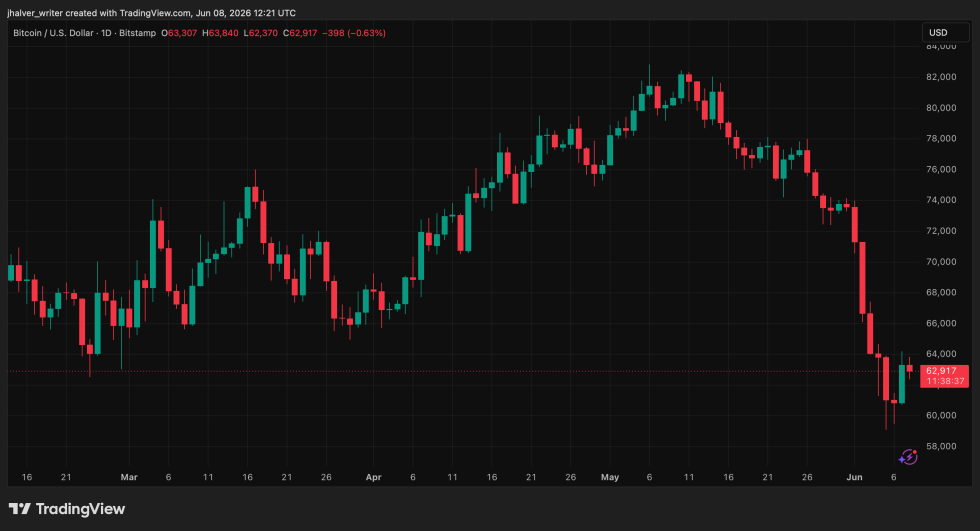
BTC's price records small gains over the weekend, as seen on the daily chart. Source: BTCUSD chart on Tradingview

The Contradiction At The Center Of Chinese Crypto Law

The Qingdao ruling places Beijing’s legal system in an uncomfortable but increasingly documented position. China’s September 2021 blanket ban — jointly issued by ten regulatory bodies including the People’s Bank of China — declared all cryptocurrency transactions illegal, effectively prohibiting trading, exchanges, and mining across the country.

In May 2026, China expanded that crackdown to explicitly cover stablecoins, RWA tokenization, and offshore yuan-pegged digital currencies, with a two-year rectification deadline for all unauthorized cross-border financial channels.

Yet Chinese courts have simultaneously and consistently affirmed Bitcoin’s status as protected property in criminal proceedings. A Shanghai court ruled in 2024 that crypto ownership is legal under Chinese law, per the South China Morning Post. The Shanghai Second Intermediate People’s Court previously described Bitcoin as a “unique and non-replicable” asset with clear financial attributes.

And now the Supreme People’s Procuratorate — China’s highest prosecutorial authority — has published the Qingdao case as a model ruling, signaling to prosecutors nationwide that this is the correct framework for handling Bitcoin theft cases.

Why The SPP Published This Case

Publication by the Supreme People’s Procuratorate is not routine reporting. Cases featured on the SPP’s official platform are selected as guidance for lower-level prosecutors and courts handling similar matters across China’s 34 provincial-level jurisdictions.

By highlighting the Qingdao case, Beijing’s highest prosecutorial body is effectively issuing an instruction: when Bitcoin is stolen, prosecute it as property theft and value it at market rates. That instruction operates regardless of — and in direct tension with — the trading and transaction ban that nominally makes Bitcoin illegal to hold or transfer in China.

The legal architecture this creates is genuinely novel. China simultaneously tells its citizens they cannot buy, sell, or trade Bitcoin — and tells its courts that if someone steals it, the full weight of criminal law will protect the victim’s property rights. The nascent sector has never encountered a major jurisdiction that bans its use and protects its ownership simultaneously at the highest legal level.

This development marks a pivotal and legally complex moment for Bitcoin’s global status. A ruling published by China’s Supreme People’s Procuratorate confirming Bitcoin as legally protected criminal property — in a country that officially bans its use — is not a minor jurisdictional footnote. It is a signal that even the world’s most restrictive crypto regime cannot fully escape the legal reality of what Bitcoin is.

Cover image from Grok, BTCUSD chart from Tradingview

Related Questions

QWhat was the key legal argument used by Qingdao prosecutors to classify Bitcoin as protected property under Chinese criminal law?

AThe prosecution argued that Bitcoin satisfies the statutory definition of property because it holds demonstrable economic value and can be exclusively controlled by its owner — the two key criteria for protectable property interests in China.

QAccording to the article, what is the core contradiction in Chinese law regarding Bitcoin highlighted by this Supreme People's Procuratorate ruling?

AThe contradiction is that while China's 2021 blanket ban prohibits all cryptocurrency transactions, its highest prosecutorial authority has now issued guidance for courts to treat Bitcoin as legally protected property in criminal theft cases, creating a system that bans its use but protects its ownership.

QWhat was the defendant's sentence in the landmark Qingdao Bitcoin theft case published by the Supreme People's Procuratorate?

AThe defendant, identified as Zhang, was sentenced to ten years and nine months in prison and fined 100,000 yuan (approximately $13,800).

QWhat is the significance of the Supreme People's Procuratorate (SPP) publishing this specific case on its official platform?

AThe SPP publishes cases to provide guidance for prosecutors and courts nationwide. By featuring this case, the SPP is effectively instructing legal authorities across China to prosecute Bitcoin theft as property theft and value it at market rates.

QHow did Chinese authorities calculate the value of the stolen property in this case, and what was that value?

AThe value was calculated based on the 660,000 yuan (roughly $91,000) that the defendant, Zhang, received from selling the 107 Bitcoin after the theft.

Related Reads

"119 to 176 Dollars": Behind SpaceX's Listing, MSX Once Again Successfully Executes the Pre-IPO Closed Loop

Following May's 300% gain on Cerebras, MSX delivered another outstanding performance during SpaceX's listing night. On June 12, SpaceX (SPCX) launched on Nasdaq, reaching a high of $176. This marked the successful culmination of MSX's Pre-IPO project launched in March, where users subscribed at $119, achieving gains of approximately 40-48%. This event validated MSX's complete Pre-IPO mechanism, a crucial advantage in a market where access to top-tier private company equity is typically limited to institutions. MSX's model provides a full cycle for users: subscription (at $119 for SpaceX), real-time on-chain portfolio tracking, optional early redemption, seamless conversion to tradable spot assets (SPCX.M) upon IPO, and final settlement in stablecoins. This end-to-end process distinguishes MSX from platforms that faced settlement issues during the SpaceX IPO, highlighting that the core challenge of Pre-IPO is not just access, but a clear exit and conversion path post-listing. This success with SpaceX is MSX's second major Pre-IPO verification, following the Cerebras listing in May, which yielded ~300% returns for early participants. These back-to-back achievements demonstrate MSX's capability to source, structure, and deliver real assets through a replicable on-chain model. The true barrier for Pre-IPO products lies not in providing an entry point, but in ensuring reliable fulfillment from subscription through to post-IPO liquidity. MSX's proven闭环 (closed-loop) process addresses this, offering Web3 users a structured way to access high-growth, pre-public companies in sectors like AI and frontier tech. MSX plans to continue expanding its Pre-IPO portfolio with this focus on authenticity, transparency, and post-listing execution.

Odaily星球日报2h ago

"119 to 176 Dollars": Behind SpaceX's Listing, MSX Once Again Successfully Executes the Pre-IPO Closed Loop

Odaily星球日报2h ago

Trading

Spot
Futures

Hot Articles

What is $BITCOIN

DIGITAL GOLD ($BITCOIN): A Comprehensive Analysis Introduction to DIGITAL GOLD ($BITCOIN) DIGITAL GOLD ($BITCOIN) is a blockchain-based project operating on the Solana network, which aims to combine the characteristics of traditional precious metals with the innovation of decentralized technologies. While it shares a name with Bitcoin, often referred to as “digital gold” due to its perception as a store of value, DIGITAL GOLD is a separate token designed to create a unique ecosystem within the Web3 landscape. Its goal is to position itself as a viable alternative digital asset, although specifics regarding its applications and functionalities are still developing. What is DIGITAL GOLD ($BITCOIN)? DIGITAL GOLD ($BITCOIN) is a cryptocurrency token explicitly designed for use on the Solana blockchain. In contrast to Bitcoin, which provides a widely recognized value storage role, this token appears to focus on broader applications and characteristics. Notable aspects include: Blockchain Infrastructure: The token is built on the Solana blockchain, known for its capacity to handle high-speed and low-cost transactions. Supply Dynamics: DIGITAL GOLD has a maximum supply capped at 100 quadrillion tokens (100P $BITCOIN), although details regarding its circulating supply are currently undisclosed. Utility: While precise functionalities are not explicitly outlined, there are indications that the token could be utilized for various applications, potentially involving decentralized applications (dApps) or asset tokenization strategies. Who is the Creator of DIGITAL GOLD ($BITCOIN)? At present, the identity of the creators and development team behind DIGITAL GOLD ($BITCOIN) remains unknown. This situation is typical among many innovative projects within the blockchain space, particularly those aligning with decentralized finance and meme coin phenomena. While such anonymity may foster a community-driven culture, it intensifies concerns about governance and accountability. Who are the Investors of DIGITAL GOLD ($BITCOIN)? The available information indicates that DIGITAL GOLD ($BITCOIN) does not have any known institutional backers or prominent venture capital investments. The project seems to operate on a peer-to-peer model focused on community support and adoption rather than traditional funding routes. Its activity and liquidity are primarily situated on decentralized exchanges (DEXs), such as PumpSwap, rather than established centralized trading platforms, further highlighting its grassroots approach. How DIGITAL GOLD ($BITCOIN) Works The operational mechanics of DIGITAL GOLD ($BITCOIN) can be elaborated on based on its blockchain design and network attributes: Consensus Mechanism: By leveraging Solana’s unique proof-of-history (PoH) combined with a proof-of-stake (PoS) model, the project ensures efficient transaction validation contributing to the network's high performance. Tokenomics: While specific deflationary mechanisms have not been extensively detailed, the vast maximum token supply implies that it may cater to microtransactions or niche use cases that are still to be defined. Interoperability: There exists the potential for integration with Solana’s broader ecosystem, including various decentralized finance (DeFi) platforms. However, the details regarding specific integrations remain unspecified. Timeline of Key Events Here is a timeline that highlights significant milestones concerning DIGITAL GOLD ($BITCOIN): 2023: The initial deployment of the token occurs on the Solana blockchain, marked by its contract address. 2024: DIGITAL GOLD gains visibility as it becomes available for trading on decentralized exchanges like PumpSwap, allowing users to trade it against SOL. 2025: The project witnesses sporadic trading activity and potential interest in community-led engagements, although no noteworthy partnerships or technical advancements have been documented as of yet. Critical Analysis Strengths Scalability: The underlying Solana infrastructure supports high transaction volumes, which could enhance the utility of $BITCOIN in various transaction scenarios. Accessibility: The potential low trading price per token could attract retail investors, facilitating wider participation due to fractional ownership opportunities. Risks Lack of Transparency: The absence of publicly known backers, developers, or an audit process may yield skepticism regarding the project's sustainability and trustworthiness. Market Volatility: The trading activity is heavily reliant on speculative behavior, which can result in significant price volatility and uncertainty for investors. Conclusion DIGITAL GOLD ($BITCOIN) emerges as an intriguing yet ambiguous project within the rapidly evolving Solana ecosystem. While it attempts to leverage the “digital gold” narrative, its departure from Bitcoin's established role as a store of value underscores the need for a clearer differentiation of its intended utility and governance structure. Future acceptance and adoption will likely depend on addressing the current opacity and defining its operational and economic strategies more explicitly. Note: This report encompasses synthesised information available as of October 2023, and developments may have transpired beyond the research period.

363 Total ViewsPublished 2025.05.13Updated 2025.05.13

What is $BITCOIN

Discussions

Welcome to the HTX Community. Here, you can stay informed about the latest platform developments and gain access to professional market insights. Users' opinions on the price of BTC (BTC) are presented below.

活动图片















