Chainlink sees 480M social engagements: What it means for LINK price next

ambcryptoPublished on 2026-04-06Last updated on 2026-04-06

Abstract

Chainlink (LINK) is gaining significant attention with a 5.24% price surge to $8.97, supported by 480 million social engagements and an 82% rise in positive sentiment. Key drivers include Grayscale’s LINK ETF (GLINK) attracting $82.79 million in net flows, Bitwise’s CLINK ETF adding $11.82 million, Mastercard integrating Chainlink to connect 3.5 billion cards to DeFi, and Coinbase using Chainlink to publish trading data on-chain. However, on-chain metrics show declining active addresses and open interest, suggesting reduced activity and potential short-term caution despite the bullish news.

At press time, the global crypto market cap stood at $2.37 trillion, up 3.04%. Among altcoins, Chainlink [LINK] was gaining notable traction, trading at $8.97 after a 5.24% surge in the past 24 hours.

Meanwhile, social intelligence platform LunarCrush reported an “accelerating 480 million social engagements over the past year,” alongside an 82% rise in positive sentiment toward altcoins.
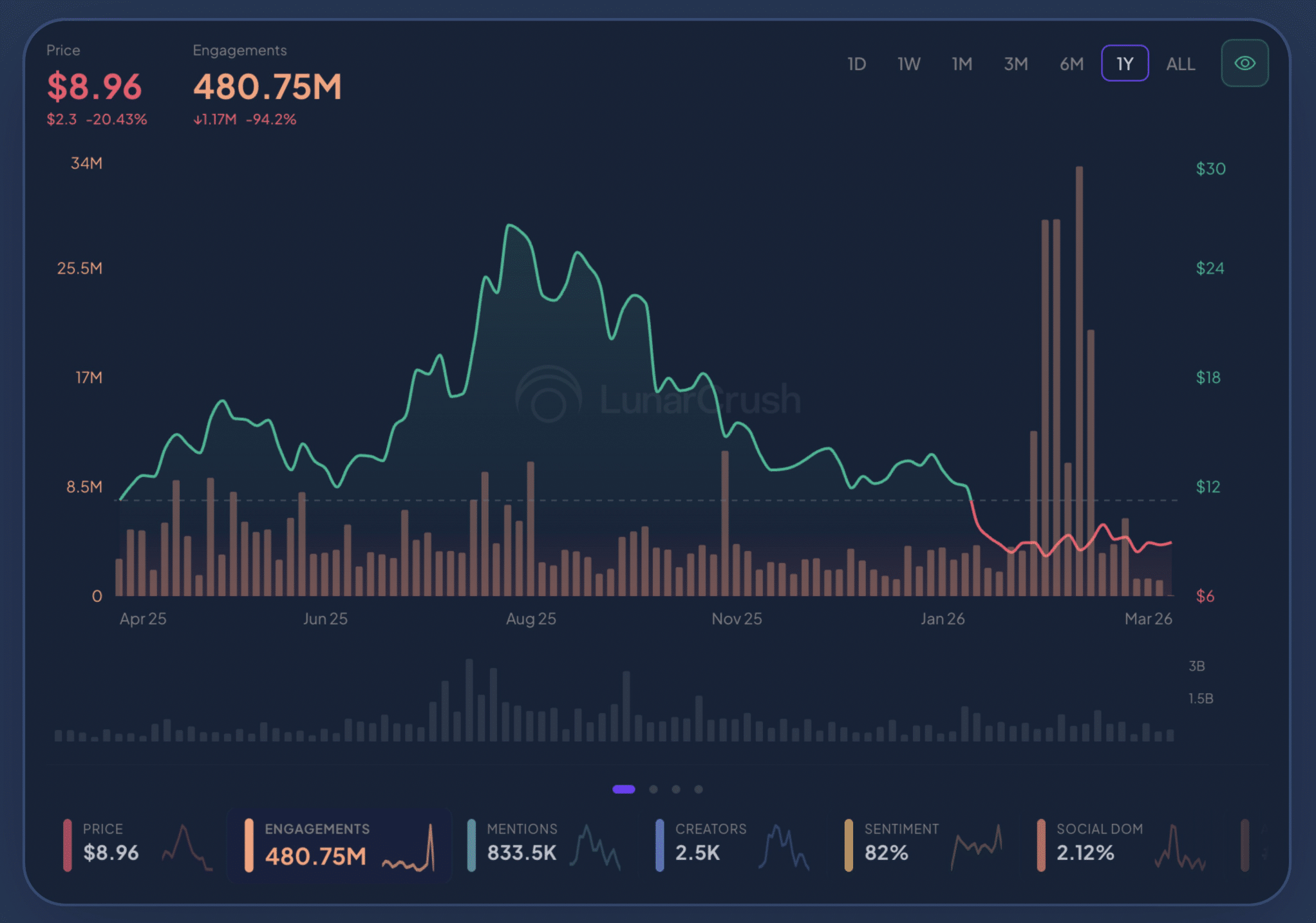
Source: Lunar Crush

What’s behind this surge in hype around Chainlink?

This surge in social engagements is because of three main reasons. Starting with Grayscale’s listing of their first U.S. Chainlink ETF ($GLINK) on NYSE Arca, wherein the ETF pulled in $41 million in just one day. In fact, as of the latest trading data on the 4th of April, GLINK recorded a cumulative net flow of $82.79 million.

Meanwhile, Bitwise’s Chainlink ETF ($CLINK) recorded $11.82 million on the same day in cumulative net flow.
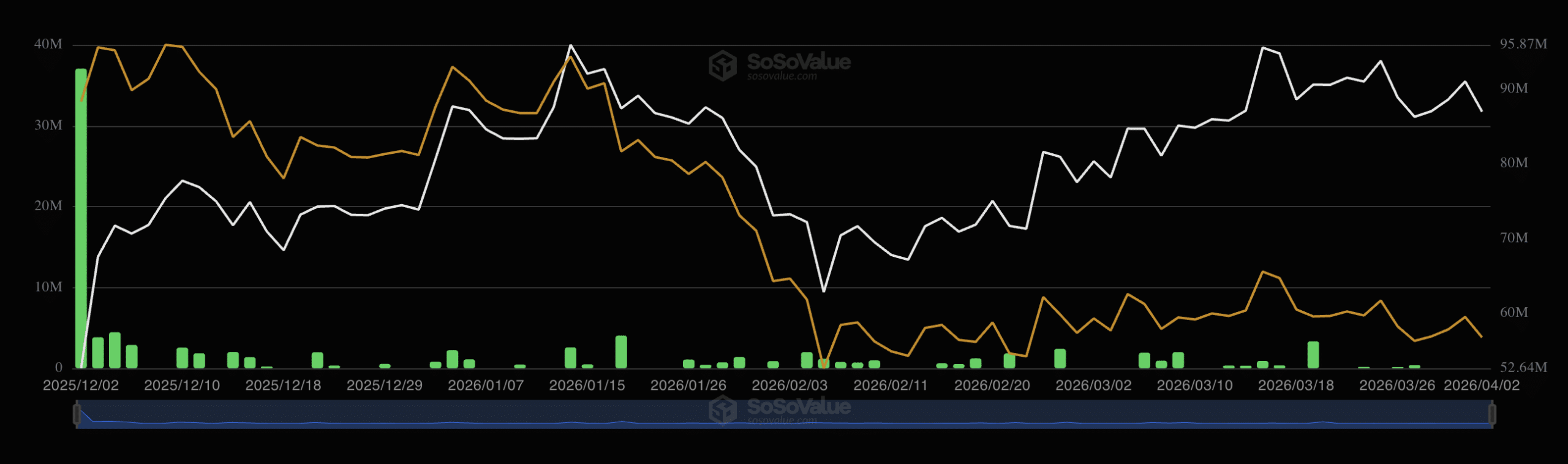
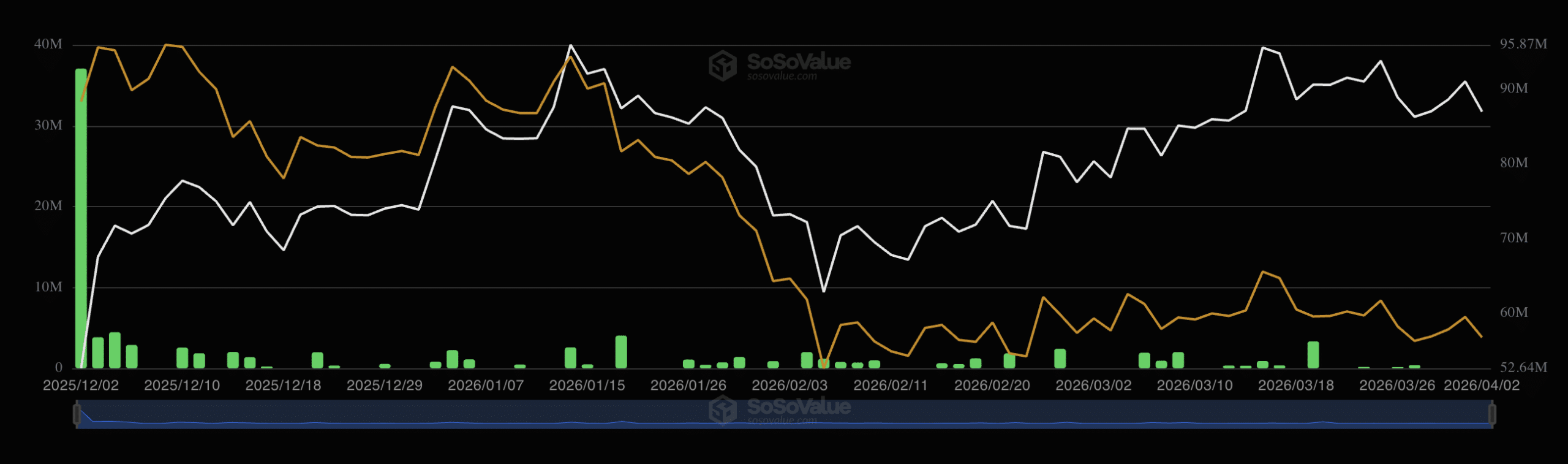
Source: SoSoValue

Secondly, Mastercard chose Chainlink to connect its 3.5 billion cards (off-chain payments) directly to the on-chain DeFi world. With this move, Mastercard holders can access crypto assets directly on-chain with the help of Swapper Finance, leveraging the Uniswap protocol.

Remarking on the same back in 2025, Raj Dhamodharan, executive vice president, Blockchain & Digital Assets at Mastercard, had said,

There’s no doubt about it – people want to be able to easily connect to the digital assets ecosystem, and vice versa.

Chainlink acts as a bridge

Lastly, Coinbase is sending trading data, which includes “order book and perps (perpetual) data on-chain” directly onto the blockchain using Chainlink. This shows how Chainlink is acting as a bridge between the traditional and digital asset classes.

Seeing this hype around LINK, LunarCrush had put it best when it noted,

That’s Wall Street access, mainstream consumer access, and exchange-grade data, all landing in the same cycle.

On-chain further confuses investors

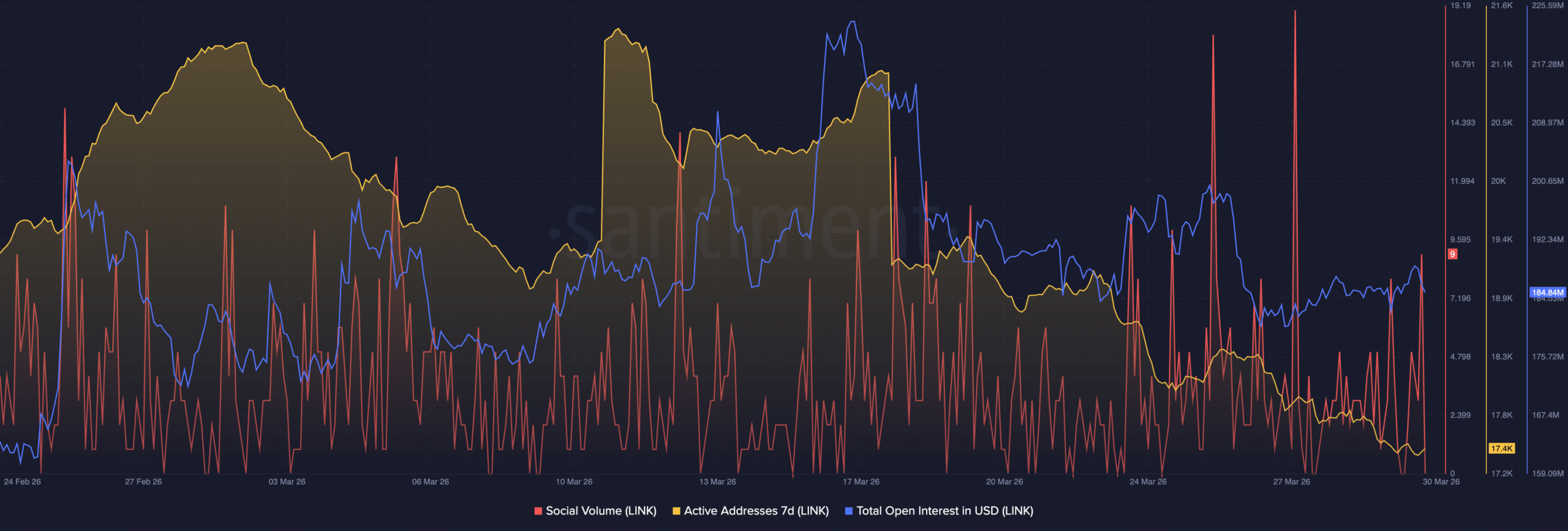
However, on-chain metrics suggest that this hype may be temporary. The chart below by Santiment clearly shows a drop in Active Addresses, and Open Interest.
Source: Santiment

Together, these declines point to reduced on‐chain activity and short‐term positioning. Notably, this coincided with LINK facing the largest inflows this year, wherein around 14.9 million LINK was transferred between wallets.


Final summary

  • Chainlink’s social engagement is breaking records thanks to ETFs, Mastercard, and Coinbase.
  • On-chain metrics are drawing negative concerns rather than positive sentiments.

Trending Cryptos

Related Questions

QWhat is the current price of Chainlink (LINK) and how much has it surged in the past 24 hours?

AChainlink (LINK) is trading at $8.97 after a 5.24% surge in the past 24 hours.

QWhat are the three main reasons behind the surge in social engagements for Chainlink?

AThe three main reasons are: 1) Grayscale's listing of their first U.S. Chainlink ETF (GLINK) on NYSE Arca, 2) Mastercard choosing Chainlink to connect its off-chain payments to the on-chain DeFi world, and 3) Coinbase sending trading data on-chain using Chainlink.

QHow much cumulative net flow did Grayscale's Chainlink ETF (GLINK) record as of April 4th?

AAs of the latest trading data on April 4th, GLINK recorded a cumulative net flow of $82.79 million.

QWhat on-chain metrics suggest that the hype around Chainlink may be temporary?

AOn-chain metrics from Santiment show a drop in Active Addresses and Open Interest, indicating reduced on-chain activity and short-term positioning.

QWhat did LunarCrush note about Chainlink's current cycle?

ALunarCrush noted that Chainlink is experiencing 'Wall Street access, mainstream consumer access, and exchange-grade data, all landing in the same cycle.'

Related Reads

Annual Salary of Millions Competing for Electricians, Meta Rushes to Open Its Own Technical School

The AI boom is facing an unexpected bottleneck: a severe shortage of skilled construction workers and electricians. As tech giants like Meta, OpenAI, and Alphabet race to build massive data centers—such as OpenAI's $16 billion "Stargate" project—they are hitting a critical labor wall. The U.S. needs an estimated 130,000 more electricians, 240,000 construction workers, and 150,000 supervisors by 2030 for AI infrastructure alone, but tens of thousands of electrician jobs go unfilled each year. While AI companies offer high premiums, with electricians earning up to $280,000 annually, worker scarcity still causes massive losses—delays on a single project can cost $14.2 million per month. The complexity of building AI data centers, which require immense power (equivalent to powering hundreds of thousands of homes), sophisticated electrical systems, and advanced liquid cooling solutions, demands highly skilled technicians who are in short supply. To combat this, companies are investing heavily in training. Meta has committed $115 million to a free training school offering tuition, housing, and stipends, targeting 5,000 new workers. OpenAI is partnering with unions to secure skilled labor. These efforts are paying off, with a significant rise in Gen Z interest in trade schools over college. However, the power demands are staggering. AI data centers are driving a rapid surge in electricity consumption, projected to account for up to 12% of U.S. power use by 2028 and raising costs for consumers. Furthermore, the construction boom is project-based, leading to a potential future glut of trained workers once building peaks, which could depress wages industry-wide. The race for AI supremacy now depends as much on skilled hands as on advanced chips.

marsbit1h ago

Annual Salary of Millions Competing for Electricians, Meta Rushes to Open Its Own Technical School

marsbit1h ago

OpenAI No Longer Sells Its Most Expensive Model for Profit

OpenAI is shifting its business strategy away from promoting its most expensive, flagship models for every task. Recent price cuts—80% for GPT-5.6 Luna and 20% for Terra—signal a deeper change: the company now actively advises users that many tasks don't require the most powerful model. Instead, OpenAI recommends a tiered approach: use the high-end GPT-5.6 Sol for complex planning and analysis, then delegate execution to cheaper models like Luna. This mirrors moves by Anthropic, which recently launched Claude Opus 5 at half the price of its top model, Fable 5. Both companies are de-emphasizing flagship models as primary revenue drivers, using them instead for brand prestige and technological showcases. The industry is entering a "mass-market" phase, similar to automotive, where high-volume, cost-effective models handle daily operations and drive scale. OpenAI's price reductions are partly enabled by AI models themselves optimizing underlying code and infrastructure, creating a self-reinforcing cycle of efficiency gains and cost reduction. Competition is shifting from "who is smartest" to "who offers the best value." The goal is no longer selling individual models but fostering widespread API adoption and ecosystem lock-in. By making AI calls cheap and ubiquitous, companies like OpenAI aim to become the indispensable, utility-like infrastructure powering automated workflows—the "water and electricity" of software, quietly embedded everywhere.

marsbit1h ago

OpenAI No Longer Sells Its Most Expensive Model for Profit

marsbit1h ago

Trading

Spot

Hot Articles

How to Buy LINK

Welcome to HTX.com! We've made purchasing ChainLink (LINK) simple and convenient. Follow our step-by-step guide to embark on your crypto journey.Step 1: Create Your HTX AccountUse your email or phone number to sign up for a free account on HTX. Experience a hassle-free registration journey and unlock all features.Get My AccountStep 2: Go to Buy Crypto and Choose Your Payment MethodCredit/Debit Card: Use your Visa or Mastercard to buy ChainLink (LINK) instantly.Balance: Use funds from your HTX account balance to trade seamlessly.Third Parties: We've added popular payment methods such as Google Pay and Apple Pay to enhance convenience.P2P: Trade directly with other users on HTX.Over-the-Counter (OTC): We offer tailor-made services and competitive exchange rates for traders.Step 3: Store Your ChainLink (LINK)After purchasing your ChainLink (LINK), store it in your HTX account. Alternatively, you can send it elsewhere via blockchain transfer or use it to trade other cryptocurrencies.Step 4: Trade ChainLink (LINK)Easily trade ChainLink (LINK) on HTX's spot market. Simply access your account, select your trading pair, execute your trades, and monitor in real-time. We offer a user-friendly experience for both beginners and seasoned traders.

9.9k Total ViewsPublished 2024.03.29Updated 2026.06.02

How to Buy LINK

Discussions

Welcome to the HTX Community. Here, you can stay informed about the latest platform developments and gain access to professional market insights. Users' opinions on the price of LINK (LINK) are presented below.

活动图片