Cardano stuck in 2-month range: Is a long-term bottom in sight for ADA?

ambcryptoPublished on 2026-03-24Last updated on 2026-03-24

Abstract

Cardano (ADA) has been trading within a narrow range for nearly two months, failing to capitalize on the bullish momentum seen in Bitcoin and other altcoins in March. A decisive breakout above $0.30 or below $0.245 is needed to determine its next price trend. Despite underperforming, ADA shows potential long-term bottom signals. Santiment data indicates a -43% 365-day MVRV, reflecting significant losses for holders and placing the asset in a historical buy zone. Additionally, Binance funding rates are at their most negative since mid-2023, suggesting extreme shorting pressure. These conditions have historically preceded market bottoms and could fuel a short squeeze, attracting capital inflows. However, investors should remain cautious. Any significant rally may face selling pressure from profit-taking and investors exiting at breakeven. Key resistance levels to watch are $0.30, $0.315, $0.365, and $0.43, where taking partial profits is advised. A drop below the $0.235–$0.24 range could invalidate the bullish outlook and signal continued seller dominance.

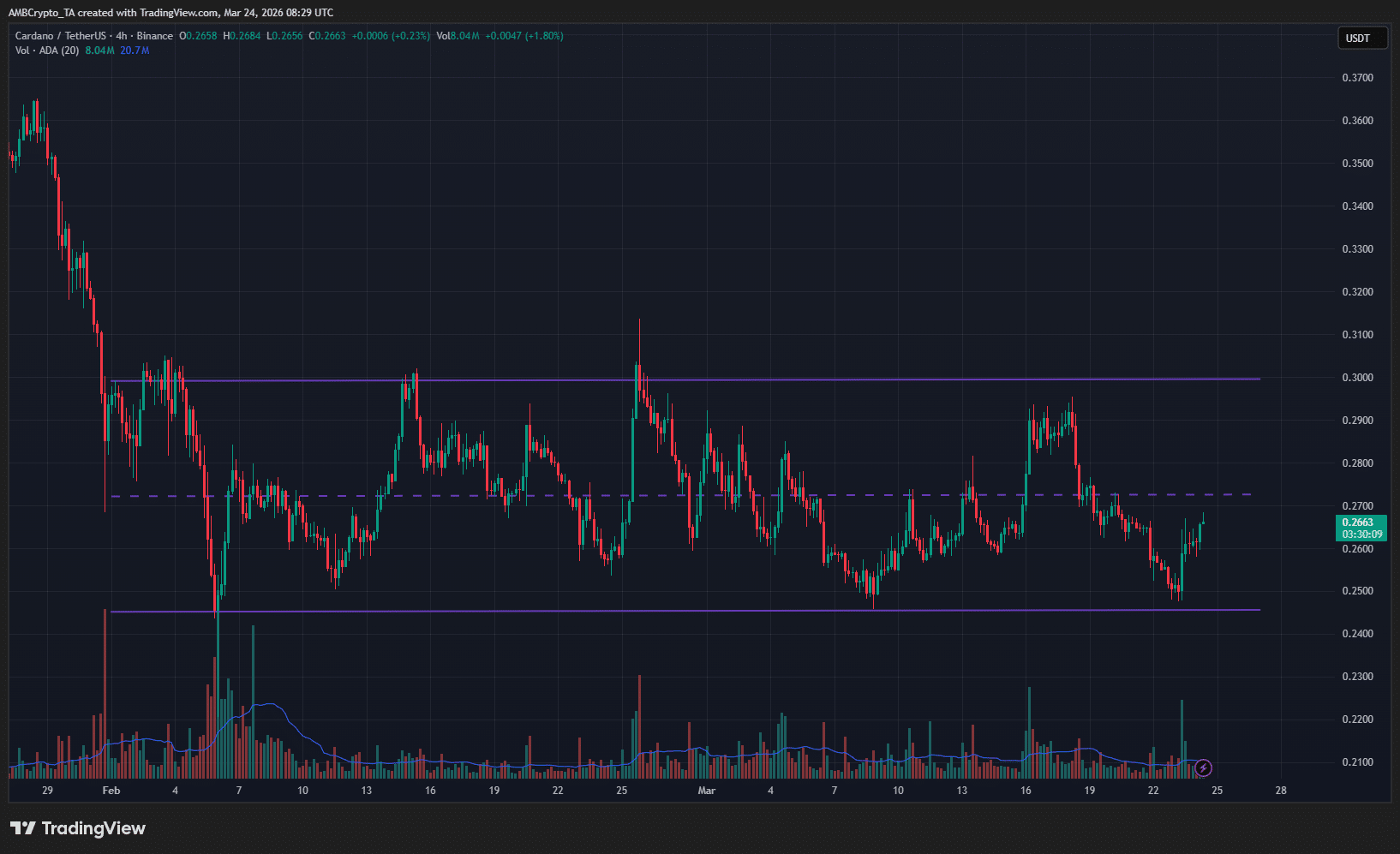
Cardano [ADA] continued to trade within a range. The range was nearly two months old now, and the altcoin does not show any signs of a breakout yet. Even though Bitcoin [BTC] and some altcoins saw a bullish March, Cardano was unable to replicate their gains.
Source: ADA/USDT on TradingView

A move beyond $0.245 or $0.30 is needed for Cardano to establish its next price trend.

Since the 6th of February, the altcoin market (excluding Ethereum [ETH]) has gained 7.91% in cumulative market capitalization. ADA has kept pace with an 8.47% move. Should long-term investors buy the relatively weak Cardano token near its range lows and wait for it to catch up to Bitcoin?

The Cardano opportunity explained
Source: Santiment

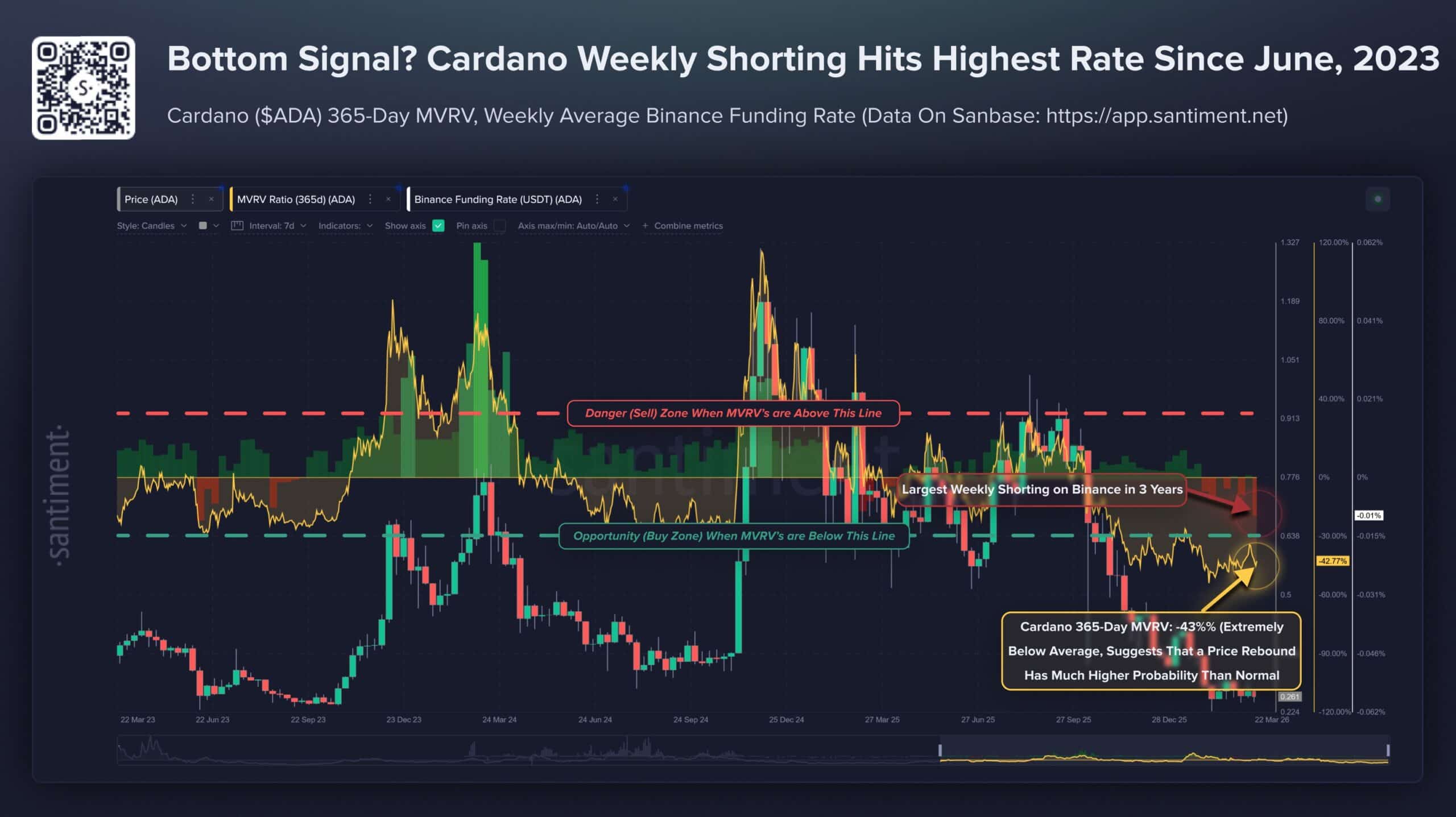
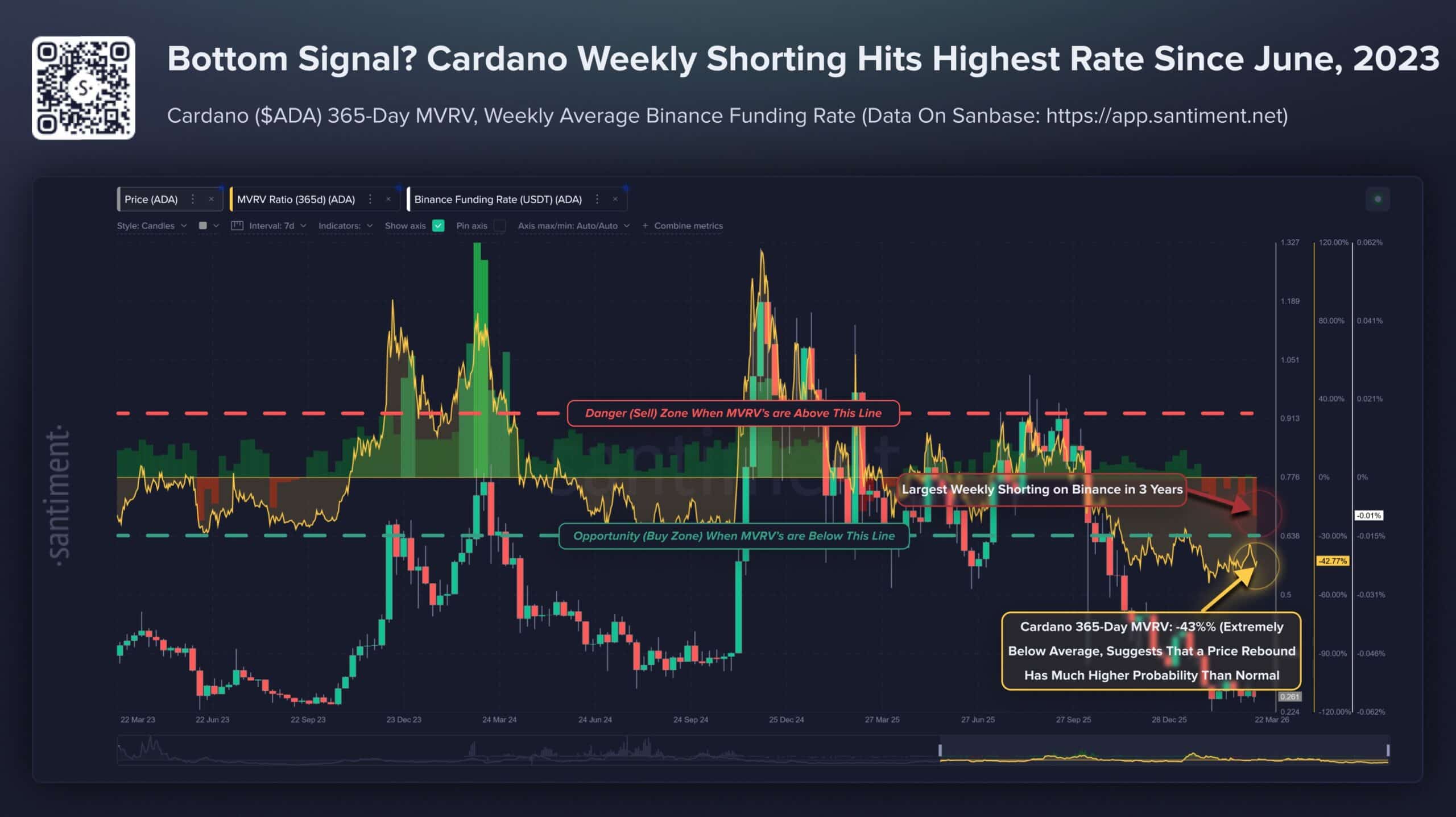
In a post on X, Santiment explained why Cardano was flashing bottom signals. The 365-day MVRV was at -43% and deep within a buy zone. Cardano has shed 71% in value since September 2025.

The MVRV tracks the average profit/loss that holders are at. The metric showed that the past year’s holders were facing a 43% drawdown.

The Binance funding rate was the most negative it has been since June, 2023. This high shorting level meant traders anticipated more losses. Santiment noted that this signal has been a bottom signal historically.

These short positions would provide the fuel for a short squeeze, and the subsequent price gain can capture investor attention and draw capital flows inward.

The combination of a market consensus of further losses and severe yearly holder drawdown could be the long-term bottom signal that Cardano investors are waiting for.

Profit-taking would be important during the next rally

The MVRV was at extremely low levels, but investors should remember the wider crypto bear market. A sizeable rally would likely face selling pressure as holders indulge in profit-taking and underwater investors exit at breakeven.

Investors should keep a close eye on the MVRV values across different timeframes to understand what short and long-term holders are doing.
Source: CoinGlass

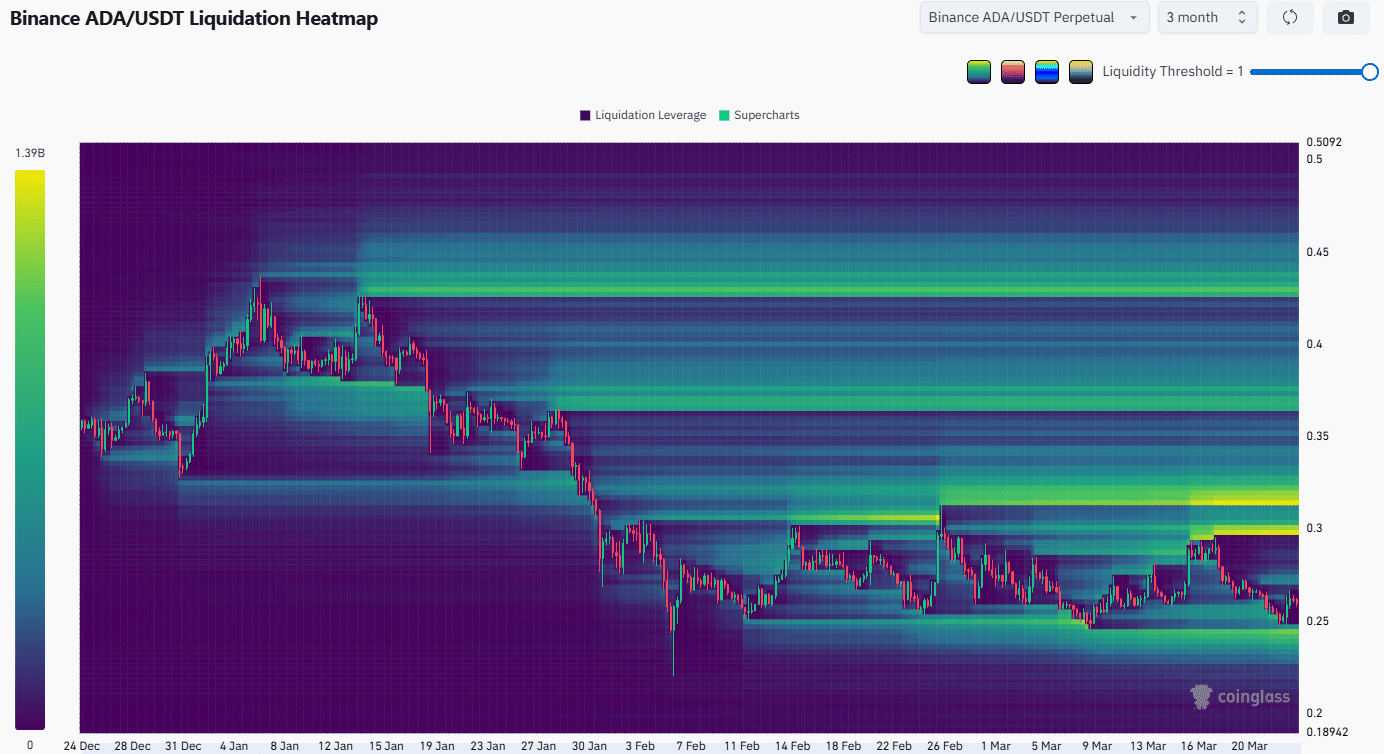
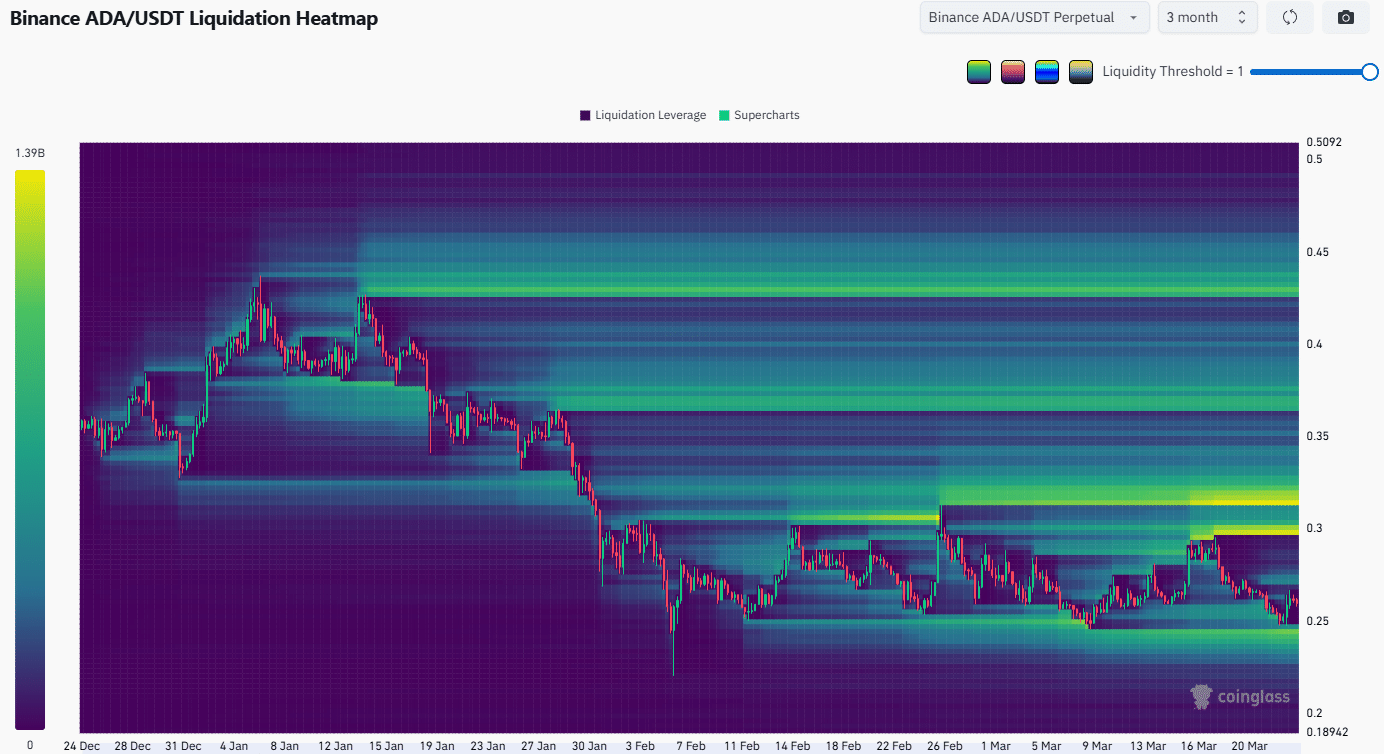
The 3-month liquidation heatmap showed that $0.300, $0.315, $0.365, and $0.430 were the key magnetic zones that the price could be attracted to. Taking partial profits at these levels was a viable option.

To the south, another liquidity cluster lay at $0.240, just below the current range lows. A price drop below $0.235-$0.240 could invalidate the buying opportunity and assert seller dominance.


Final Summary

  • The combination of heavy shorting pressure and deep drawdown for 1-year holders has historically been a market bottom signal.
  • A breakout beyond $0.30, the local range highs, would confirm bullish strength.

Trending Cryptos

Related Questions

QWhat are the key price levels that Cardano (ADA) needs to break to establish its next trend?

AA move beyond $0.245 or $0.30 is needed to establish the next price trend.

QAccording to Santiment, what two key metrics are flashing bottom signals for Cardano?

AThe 365-day MVRV at -43% (indicating deep holder losses) and the most negative Binance funding rate since June 2023 (indicating heavy shorting) are the bottom signals.

QWhy could the high level of short positions potentially lead to a price increase for ADA?

AThe high level of short positions could provide the fuel for a short squeeze, where a price gain forces short sellers to buy back, which can capture investor attention and draw capital inflows.

QWhat is the significance of the $0.235-$0.240 price level mentioned in the article?

AA price drop below the $0.235-$0.240 level could invalidate the current buying opportunity and assert seller dominance, as it is a key liquidity cluster just below the current range lows.

QWhat does the 365-day MVRV (Market Value to Realized Value) ratio of -43% indicate about ADA holders?

AIt indicates that holders who bought ADA in the past year are facing an average unrealized loss of 43%, placing the metric deep within a historical 'buy zone'.

Related Reads

Within Strategy's Framework, STRC's Dividend Yield Remains at 12% as Share Price Stays Below Par Value

Michael Saylor, Executive Chairman of Strategy (MSTR), confirmed that the dividend rate for its STRC perpetual preferred shares will remain at 12.00% through August 2026. The rate has increased from 9% at its July 2025 launch to the current high via a "ratchet" mechanism, which permanently raises the rate by 0.5% whenever the share price falls below $95. This mechanism is intended to push the price back toward its $100 par value and support Strategy's "at-the-market" (ATM) program for issuing new shares to fund Bitcoin purchases. However, the mechanism has not worked as intended. STRC shares closed at $89.46 on July 31, remaining about 10-11% below par value despite the record-high dividend. Competition from rival Strive's higher-yielding SATA securities has pressured demand. The persistent discount has forced Strategy to suspend new STRC issuances via its ATM program, limiting this funding channel for Bitcoin acquisitions. STRC's struggles reflect Bitcoin's own volatility, as the preferred shares historically move in tandem. Analysts have warned the ratchet structure carries long-term, one-way risk. A law firm is investigating Strategy's ability to maintain dividend payments if Bitcoin's price stays low. Retail investors own roughly 83% of outstanding STRC shares, a group seen as prone to panic selling during downturns. In response, Strategy has established financial reserves, including a liquidity cushion covering about 26 months of dividend/interest obligations, and a $2 billion share buyback program alongside a Bitcoin monetization framework, though the company emphasized it is not obligated to sell any Bitcoin.

cryptonews.ru4m ago

Within Strategy's Framework, STRC's Dividend Yield Remains at 12% as Share Price Stays Below Par Value

cryptonews.ru4m ago

Analyst: Bitcoin's Price Will Drop to $60k in August, Then Rebound to $70k

Financial analyst Andrey Poroshin has provided a new forecast for Bitcoin's price dynamics in August. Poroshin, an analyst at the Bitbanker exchange, expects the cryptocurrency market to experience a downturn this month, with prices retesting the $60,000 level due to a lack of supportive macroeconomic catalysts. He noted that the recent US Federal Reserve decision to hold interest rates did not significantly impact the market, while inflation remains above the 2% target. Poroshin stated that Bitcoin is ending July under pressure from moderate volatility and a lack of new macroeconomic stimuli, leading to continued market caution. According to his base scenario, Bitcoin will drop to a range of $60,000 to $62,000 before recovering to $70,000. He pointed out that even $70,000 remains below the cost of mining in the US, which has prompted some miners to shift towards AI data center operations. Poroshin cited the winding down of BitMEX's operations as a potential catalyst for a price rebound, suggesting the exit of weaker players often coincides with market reversals and reduced short-term selling pressure. He believes Bitcoin is currently less susceptible to geopolitical shocks, such as the Iran-US conflict, and does not expect significant market changes in August related to the pending CLARITY Act. Looking ahead, Poroshin forecasts that September will bring more active price fluctuations driven by potential Fed rate decisions and possible discussions or approval of the CLARITY Act.

cryptonews.ru4m ago

Analyst: Bitcoin's Price Will Drop to $60k in August, Then Rebound to $70k

cryptonews.ru4m ago

In Jinjiang, Fujian, a Storage Super Unicorn Lies Quiet

In Fujian's Jinjiang, a city known for sportswear, lies a quiet semiconductor giant: Fujian Jinhua Integrated Circuit Co. (JHICC). Once a promising domestic DRAM manufacturer alongside Yangtze Memory and ChangXin Memory Technologies (CXMT), its journey was derailed in 2018 when the U.S. placed it on an Entity List and filed criminal charges for alleged trade secret theft. This halted production for years. A turning point came in February 2024 when a U.S. federal court found JHICC not guilty. However, it had lost crucial time. While CXMT soared to become a top-valued A-share company in 2024, JHICC, with an estimated valuation of 80 billion RMB, was just restarting. Its current output is primarily customized DDR4 chips, not the advanced DDR5/HBM demanded for AI, but it still benefits from the broader memory chip upcycle. JHICC's story is tied to Chen Zhengkun, a veteran engineer who left Micron to lead the venture. Founded in 2016 with state-backed funding, JHICC partnered with Taiwan's UMC to develop DRAM technology. Rapid progress was cut short by the U.S. actions, which Micron initiated, partly due to its heavy reliance on the Chinese market. Post-sanctions, Chen's team worked to rebuild the production line with reduced reliance on U.S. technology. According to its records, JHICC achieved small-scale production and revenue growth under immense pressure. It now focuses on the stable "niche" DRAM market (e.g., TVs, routers) with a monthly capacity of ~40,000 wafers, aiming for 60,000 by 2026. It holds over 1,000 patents but remains on the Entity List. For Jinjiang, investing in JHICC was a bold industrial leap. The local government provided unwavering financial and logistical support during the crisis, helping the company survive. JHICC has become the anchor for a growing local semiconductor cluster. Though its scale lags behind domestic peers, JHICC's persistence symbolizes a hard-won foothold in a global market long dominated by Samsung, SK Hynix, and Micron. Having missed one boom, it seeks a place in the new AI-driven memory supercycle.

marsbit2h ago

In Jinjiang, Fujian, a Storage Super Unicorn Lies Quiet

marsbit2h ago

Trading

Spot

Hot Articles

Discussions

Welcome to the HTX Community. Here, you can stay informed about the latest platform developments and gain access to professional market insights. Users' opinions on the price of ADA (ADA) are presented below.

活动图片