Cardano Strengthens Cross-Chain Connectivity Across The Blockchain Ecosystem – What This Means For The Network

bitcoinistPublished on 2026-06-01Last updated on 2026-06-01

Abstract

Cardano is making significant progress in cross-chain connectivity, enhancing its interoperability with major networks like Bitcoin, Ethereum, Solana, and Avalanche. This move towards a more integrated multi-chain ecosystem opens new opportunities for users and developers, potentially attracting more inflows and transactions while supporting a Bitcoin DeFi resurgence. The network's focus on security and reliability through its consensus design and continuous operation is highlighted as a key strength in a sector facing outages and attacks. However, ADA's price is testing a critical historical support level around $0.247. A break below could signal a deeper correction, with long-term accumulation targets identified between $0.113 and $0.051.

The blockchain space is broad and complex, but leading networks such as Cardano are navigating this dynamic sector. The network is witnessing one of its most significant moments this year as its connectivity to other chains notably improves, allowing for seamless operations for users.

A Path For Cardano To Become Fully Connected Multi-Chain

Following several upgrades to improve the network, Cardano is now in the spotlight of the blockchain space. A report reveals that Cardano is making major progress toward a more linked blockchain future as its connectivity with other networks keeps getting better.

For years, Wanchain, crypto’s longest-running cross-chain bridge, highlighted that the network was held back due to limited interoperability. However, as seen in recent data, Cardano is now more interconnected than ever before.

Some of the networks Cardano is becoming more connected to include Bitcoin, Ethereum, Solana, and Avalanche, which opens up completely fresh opportunities for its users. By enabling more seamless interaction between users, developers, and assets across various blockchains, improved cross-chain capabilities are assisting the network in expanding outside its native ecosystem.

According to the platform, this improvement in connectivity implies that more opportunities for players to enter Cardano from other major chains across the sector. It also increases the chance for a Bitcoin Decentralized Finance (DeFi) renaissance. At the same time, this development will trigger more inflows, more transactions on the chain, and more opportunities.

This comes as blockchain resilience and reliability are becoming increasingly important in the business, as more blockchains experience frequent outages, attacks, and exploits. For financial settlement, reliability is essential, and security is a requirement. Meanwhile, Dave claims that this is exactly where the Cardano network stands out.

The expert added that the network has been built with both factors at the foundation via its consensus design, staking model, ledger architecture, and years of continuous operation. When a real value is being settled, the system has to remain in a working condition. It must remain secure, predictable, and resilient under pressure, and Cardano has been making efforts to do that over the years.

ADA’s Price At A Critical Level

While the network may be demonstrating strength, Cardano’s price is still in a downward trend. However, Ali Charts, a crypto analyst and investor, revealed that ADA is at a critical moment, testing its most important support level that could determine its next major move.

Since 2021, the altcoin has traded within a multi-year channel, with the definitive floor of this pattern sitting at $0.247, which is acting as a major historical support. This is a significant test of the boundary as the price currently trades down at $0.232.
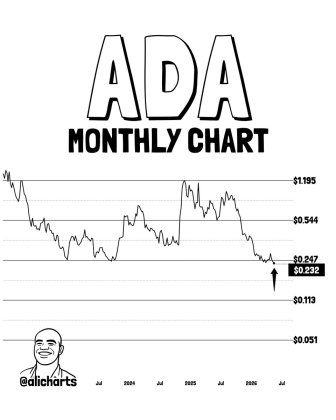
Source: Chart from Ali Charts on X

As the monthly close draws closer, the immediate market structure is changed by holding a stake below $0.247, indicating that a deeper valuation phase is in progress. Should the historical channel floor yield, the upcoming high-conviction macro targets for spot accumulation for the long term are positioned between $0.113 and $0.051.

ADA trading at $0.23 on the 1D chart | Source: ADAUSDT on Tradingview.com

Related Questions

QWhat is the main focus of the article regarding Cardano's recent developments?

AThe main focus is Cardano's significant improvement in cross-chain connectivity, allowing it to interact more seamlessly with other major blockchains like Bitcoin, Ethereum, Solana, and Avalanche.

QAccording to the article, why is increased cross-chain connectivity important for the Cardano network?

AIncreased cross-chain connectivity allows Cardano to expand beyond its native ecosystem, enables more seamless interaction between users, developers, and assets across blockchains, and opens up new opportunities including the potential for a Bitcoin DeFi renaissance, more inflows, and more transactions.

QWhich expert or platform is cited as highlighting Cardano's past interoperability limitations?

AWanchain, crypto's longest-running cross-chain bridge, is cited as having highlighted that Cardano's network was previously held back due to limited interoperability.

QWhat critical price support level is ADA (Cardano's token) testing according to the analyst Ali Charts?

AAccording to Ali Charts, ADA is testing its most important historical support level at $0.247, which has acted as the definitive floor of its multi-year trading channel since 2021.

QWhat are the potential long-term accumulation targets for ADA if it falls below the $0.247 support level?

AIf ADA yields the $0.247 historical channel floor, the upcoming high-conviction macro targets for long-term spot accumulation are positioned between $0.113 and $0.051.
Related Reads

Variant: Three L1 Assets That Could Become Primary Stores of Value

The core belief at Variant is that individuals should own their money, identity, and data. A key framework for evaluating first-layer blockchain (L1) networks is viewing their native tokens as potential stores of value (SOV). A good SOV asset is defined by several key attributes: technical durability (its likelihood to exist and function in 5-10 years), scarcity and predictable inflation, censorship resistance, economic productivity (its utility in facilitating economic activity), memetic strength (widespread social consensus on its value), and liquidity. Based on this framework, three L1 assets are highlighted as leading contenders for becoming major SOVs, each excelling in different dimensions: * **Bitcoin (BTC)** is dominant in memetic strength, widely recognized as "digital gold." Its growing belief network among individuals and institutions reinforces its SOV status. * **Ethereum (ETH)** excels in technical durability and adaptability. Its ability to upgrade and a transparent roadmap provide confidence in its long-term resilience against future challenges. * **Zcash (ZEC)** offers superior censorship resistance and privacy through its shielded pools. This provides individuals with a long-term option to protect assets from confiscation or surveillance. The total market for SOV assets like gold is immense (gold's market cap is ~$31T). Despite often surpassing traditional SOVs on these fundamental metrics, digital assets currently capture only a small fraction of this market, representing a significant opportunity for growth. The article posits that multiple digital SOVs can coexist in this expanding space.

链捕手32m ago

Variant: Three L1 Assets That Could Become Primary Stores of Value

链捕手32m ago

Trading

Spot
Futures

Hot Articles

Discussions

Welcome to the HTX Community. Here, you can stay informed about the latest platform developments and gain access to professional market insights. Users' opinions on the price of ADA (ADA) are presented below.

活动图片