Cardano Sentiment Turns Cautious as NIGHT Token Fallout and $0.45 Resistance Cap Price Action

bitcoinistPublished on 2025-12-13Last updated on 2025-12-13

Abstract

Cardano (ADA) faces a complex mix of technical and sentiment-driven challenges, struggling to break the $0.45 resistance and declining 2% to around $0.42. The drop was influenced by broader market reactions to a Federal Reserve rate cut and exacerbated by the sharp 90% crash of Midnight Network’s NIGHT token, which amplified negative sentiment. With 54% of active positions short, traders expect further downside. Key support lies at $0.42–$0.43, with a potential fall toward $0.38–$0.39 if broken. Technical indicators like MACD and RSI remain bearish. Despite a $750 million inflow to Binance, demand remains modest. Social sentiment has turned cautious due to ADA’s repeated failure at $0.45 and a lack of major ecosystem updates. With no clear internal catalysts, ADA’s near-term direction depends heavily on broader market trends and Bitcoin’s price action.

Cardano is about to end the week with a complex mix of technical pressure, token fallout, and shifting sentiment, as ADA struggles to break beyond its familiar resistance zone.

The market is attempting to digest a sharp correction triggered by wider macro moves, while internal ecosystem developments offer little support. For now, ADA’s direction continues to depend on how well it can hold established support, particularly as market mood turns more cautious.
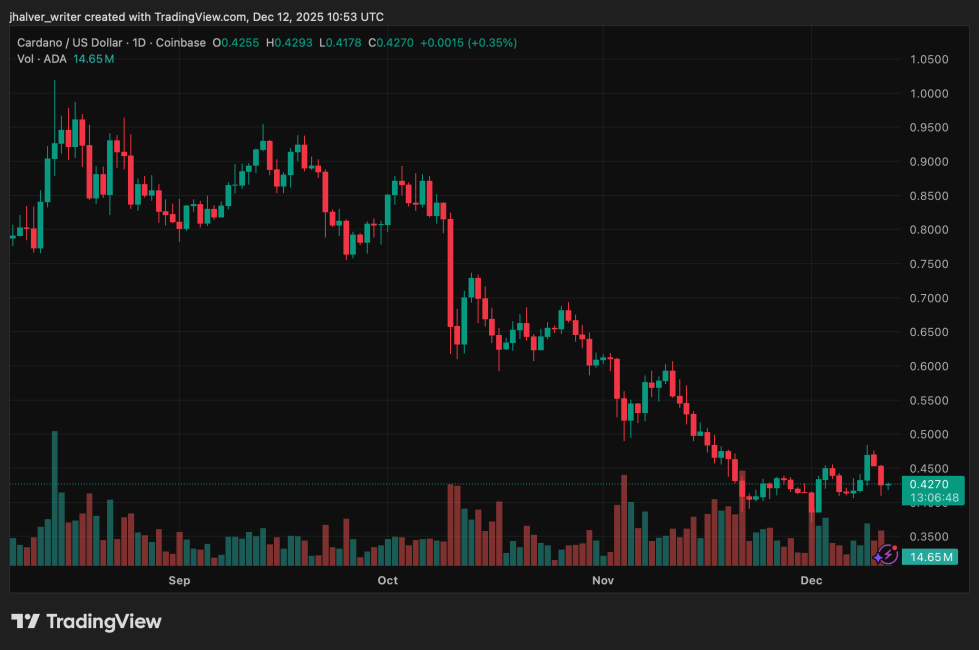
ADA's price trends to the downside on the daily chart. Source: ADAUSD on Tradingview

NIGHT Token Crash Adds Pressure to ADA’s Decline

ADA’s 2% drop to around $0.42 arrived just as the broader market reacted to the recent Federal Reserve rate cut. The decline pushed Cardano below the $0.45 level, a zone it has struggled to reclaim, placing renewed focus on its next support levels.

A major driver of the negative sentiment was the steep decline of Midnight Network’s NIGHT token, which fell roughly 90% from an early surge to $1.50 before settling near $0.05. The sell-off was largely driven by airdrop recipients offloading their allocations immediately after launch.

Despite earlier expectations around Midnight’s debut, the rapid reversal highlighted the speculative nature of the event. Market data also shows that 54% of active positions are leaning short, signaling that traders expect further downside.

Key Support Levels Hold, but Momentum Remains Weak

Cardano’s ADA is now trading near the lower edge of its established range, testing support between $0.42 and $0.43.

Analysts note that this area aligns with a broader weekly support cluster that stretches toward the $0.38–$0.39 region. Technical readings reinforce a cautious outlook, the MACD continues to trend bearish, while the RSI sits near 40, approaching oversold territory.

Traders are watching to see if ADA can stabilize above $0.42. A breakdown could expose the next lower supports, while a reclaim of the $0.45 zone would be required to shift momentum toward $0.48–$0.50.

Despite a recent $750 million inflow to Binance, the market absorbed the volume with limited price reaction, suggesting demand remains modest.

Sentiment Softens as Cardano Repeatedly Fails at $0.45

Social sentiment across major crypto forums has turned noticeably cautious. Conversations remain active, but the tone reflects trader fatigue as ADA continues to struggle against the same resistance.

With no new updates from core Cardano development efforts, including Hydra scaling, Mithril upgrades, or governance milestones, market participants have shifted their focus to external forces, such as BTC’s price direction and overall risk appetite.

ADA trades around $0.41–$0.42 at the time of writing, holding its range but without clear signs of a breakout. Until a fresh catalyst emerges, Cardano is likely to remain in a consolidation phase, with sentiment triggered more by broader market trends than internal progress.

Cover image from ChatGPT, ADAUSD chart from Tradingview

Trending Cryptos

Related Reads

The Networking Game in Silicon Valley's Elite Circles: Those with Connections Get $50 Million, While the Truly Talented Can't Raise Money?

"Silicon Valley's Meritocracy to Relationship Game: How Networks Now Trump Talent." The article argues that Silicon Valley has shifted from a meritocracy to a "kingmaker" system where connections and background outweigh true ability. Key factors driving this change include: 1. **AI-Distorted Expectations:** Unprecedented growth curves (e.g., Anthropic) have led VCs to seek only "sure things" or pattern-match against past successes. 2. **Capital Concentration:** LP funds are concentrated in a few large, multi-stage funds, pushing VCs to overpay for hot deals to secure capital. 3. **VC Professionalization:** The industry has become a standardized career path, attracting conformist "NPCs" rather than independent thinkers. The long IPO timeline incentivizes safe, consensus bets for career advancement over risky, fund-returning outliers. This consensus capital fuels consensus founders. Startups are now a standard career option, with accelerators pressuring uniform ideas (e.g., 81% AI). Founders from elite schools (Stanford, OpenAI) easily raise millions based on pedigree, not proof. Large funds preemptively back "centrally cast" teams with $10-50M war chests to dominate categories, sidelining outsiders. The "kingmaker" strategy has downstream effects: it encourages aggressive, sometimes fraudulent, revenue reporting and allows founders to sell significant secondary shares early, attracting grifters. The author predicts a mean reversion. History shows the hottest trends rarely produce the most valuable companies. They advocate backing underestimated outsiders with "a chip on their shoulder" over anointed insiders, believing true meritocracy will ultimately win. "Those chasing the herd are set up for slaughter."

marsbit10m ago

The Networking Game in Silicon Valley's Elite Circles: Those with Connections Get $50 Million, While the Truly Talented Can't Raise Money?

marsbit10m ago

From 2 Million Monthly Active Users to Zero: Zapper's Demise in the "Maturation" of DeFi

From 2M MAU to Zero: The Demise of Zapper in a Maturing DeFi Landscape On July 8, 2026, Zapper co-founder Seb Audet announced the platform's full shutdown. Once a DeFi star with 2 million monthly active users, $13B in processed transactions, and $16.5M in funding, Zapper's journey ends. Born in 2020 from the merger of DeFiZap and DeFiSnap, Zapper rode the "DeFi Summer" wave. It became essential for users to track complex, multi-protocol yield farming positions across chains. At its peak, it supported 14 chains, 450+ protocols, and 7000+ tokens, with its signature "Zap" feature simplifying multi-step DeFi actions. However, sustainable revenue never materialized. Its primary model—taking small fees from DEX aggregation—faced fierce competition and squeezed margins. Meanwhile, maintaining its extensive, real-time data indexing system was costly. Crucially, the DeFi ecosystem matured, with activity and liquidity concentrating in fewer top protocols. The core demand for a complex, multi-protocol dashboard waned as user behavior simplified. Zapper attempted multiple pivots that failed to gain traction: an NFT-based points system (2021), a social app called Chainchat (2023), and plans for a ZAP token and open protocol (2024). These efforts reflected a persistent "blockchain-native" mindset focused on creating new C端 (consumer) needs rather than addressing existing pain points or bolstering its revenue-generating products. The article contrasts Zapper with DeBank, which successfully narrowed its asset-tracking focus while developing Rabby Wallet—a revenue-stabilizing, competitive product. Zapper's story serves as a cautionary tale for tooling projects: over-immersion in a purist vision, coupled with an inability to adapt business models to market shifts—like the consolidation of DeFi activity—can be fatal, even for once-dominant platforms.

marsbit34m ago

From 2 Million Monthly Active Users to Zero: Zapper's Demise in the "Maturation" of DeFi

marsbit34m ago

Goldman Sachs Bans It, Google Bans It Too: The Gray Zone of Prediction Markets Is Shrinking Fast

Goldman Sachs has updated its personal trading policy, prohibiting employees from trading event contracts on prediction markets involving specific companies (including whether Goldman itself might restructure or initiate acquisitions in a quarter), election outcomes, financial market performance (including Bitcoin prices), macroeconomic data, geopolitical events, and regulatory results for pending M&A deals. Sports and entertainment bets remain allowed. Violations can lead to dismissal or account closure, and the firm may reclaim profits over $200 or donate them to charity. This follows a CFTC case against a Google engineer who allegedly used non-public data to profit $1.2 million on Polymarket. Simultaneously, Google's Chrome Web Store updated its policy, banning extensions that facilitate real-money trading on prediction market outcomes, effective August 1, 2026. While not affecting platforms' websites or mobile apps directly, this restricts a key user access channel. These actions occur amid growing regulatory pressure on prediction markets. The CFTC is investigating Polymarket for alleged misconduct, and a consumer group has filed a lawsuit. Over 30 countries, including Argentina, have blocked access. Despite this, trading volume has hit record highs, and major investments continue, such as ICE's $2 billion stake in Polymarket. The core debate remains whether prediction markets are financial instruments or gambling. CFTC argues for federal oversight as derivatives, while some states seek to regulate them under gambling laws. Multiple fronts—federal probes, political pressure, internal corporate bans, and platform restrictions—are narrowing the operational space for these markets.

Foresight News40m ago

Goldman Sachs Bans It, Google Bans It Too: The Gray Zone of Prediction Markets Is Shrinking Fast

Foresight News40m ago

Trading

Spot

Hot Articles

Discussions

Welcome to the HTX Community. Here, you can stay informed about the latest platform developments and gain access to professional market insights. Users' opinions on the price of ADA (ADA) are presented below.

活动图片