Cardano Payments Roll Out Across 137 SPAR Stores In Switzerland

bitcoinistPublished on 2026-03-06Last updated on 2026-03-06

Abstract

The Cardano blockchain has been integrated into the Swiss financial platform DFX.swiss, enabling its native token ADA to be used for retail payments. As a result, customers can now pay with ADA at 137 SPAR stores across Switzerland through the Open Crypto Pay standard. This integration allows direct payments from native wallets and reduces transaction fees by about two-thirds compared to traditional payment methods. Additionally, DFX.swiss provides a bridge to traditional banking, allowing users to exchange ADA for fiat currencies. Despite this development, ADA’s underperformed recently, declining over 6% in a week as large investors reduced their holdings.

The Cardano blockchain has now been integrated into the DFX.swiss platform, bringing its native token ADA to retail store payments.

Cardano Can Now Be Used To Pay At Certain SPAR Stores In Switzerland

As announced by the Cardano Foundation on its website, the Cardano blockchain has seen integration into DFX.swiss, a digital asset financial services platform based in Switzerland.

With the integration, ADA is now a part of Open Crypto Pay, a payments standard developed by DFX.swiss. “Through the integration of Cardano, customers can now pay with the cryptocurrency ADA in 137 SPAR stores across Switzerland,” explained the announcement. Open Crypto Pay also allows users to use their ADA from their native wallets directly at checkout.

SPAR is a Netherlands-based multinational franchise that provides licensing to independently owned and operated food retail stores. In Switzerland, there are over 350 stores using the branding, but currently, only 137 support payments with DFX.swiss.

According to the Cardano Foundation, Open Crypto Pay can help reduce transactions fees by around two-thirds compared to traditional card and payment providers. “This delivers not only technological innovation, but also clear economic value for retailers,” noted the not-for-profit organization dedicated to the cryptocurrency.

DFX.swiss also provides a direct bridge into the traditional banking infrastructure, enabling users to buy or exchange ADA directly into fiat currencies. Cyrill Thommen, DFX.swiss CEO, said:

With Open Crypto Pay, we demonstrate that Cardano is not only technologically advanced, but also delivers real value in daily payments – for both consumers and merchants.

ADA is now also integrated with the urble app, a savings platform created by Swiss FinTech Brick Towers. DFX.swiss announced a partnership with urble back in January. Ralph Hofacker, Co-CEO of Brick Towers, noted:

The combination of regulated infrastructure and user-centric applications makes it possible to implement saving and payments based on Cardano in a simple way.

ADA Has Declined While Other Digital Assets Have Rallied

Bitcoin and Ethereum have witnessed bullish price action during the past week, but Cardano has shown a different trajectory as the coin has gone down by more than 6% inside the window, reaching the $0.27 level.

Below is a chart that shows how the asset’s trajectory has looked over the past month.

The price of the coin seems to have overall moved sideways in this period | Source: ADAUSDT on TradingView

ADA’s lackluster price action has come as large investors have participated in distribution. Over the past week, whales on the network have shed 230 million tokens (worth more than $63 million right now) from their holdings, as highlighted by analyst Ali Martinez in an X post.
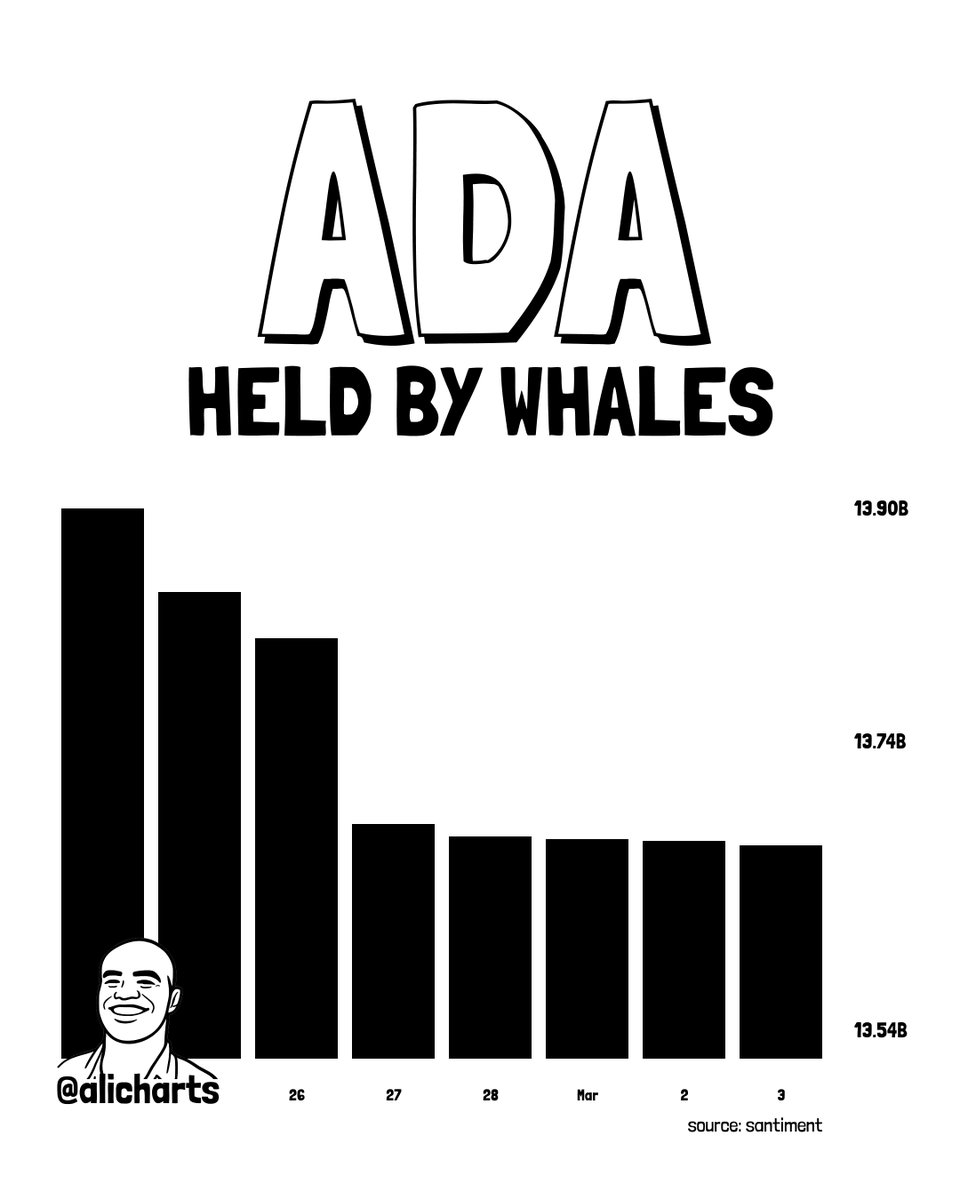
The recent trend in the holdings of the ADA whales | Source: @alicharts on X


Related Questions

QWhat is the significance of Cardano's integration into the DFX.swiss platform?

AThe integration allows the Cardano blockchain's native token, ADA, to be used for retail payments through the Open Crypto Pay standard, enabling customers to pay with ADA in 137 SPAR stores across Switzerland directly from their native wallets.

QHow many SPAR stores in Switzerland currently support payments with ADA through DFX.swiss?

ACurrently, 137 SPAR stores in Switzerland support payments with ADA through the DFX.swiss platform.

QAccording to the Cardano Foundation, what is a key economic benefit of using Open Crypto Pay for retailers?

AOpen Crypto Pay can help reduce transaction fees by around two-thirds compared to traditional card and payment providers, delivering clear economic value for retailers.

QWhat recent partnership did DFX.swiss announce to further integrate ADA into the financial ecosystem?

ADFX.swiss announced a partnership with the urble app, a savings platform created by Swiss FinTech Brick Towers, which now integrates ADA, allowing for simplified saving and payments based on Cardano.

QHow has the price of ADA performed recently compared to other major cryptocurrencies like Bitcoin and Ethereum?

AWhile Bitcoin and Ethereum have witnessed bullish price action, ADA has declined by more than 6% in the past week, reaching the $0.27 level, as large investors (whales) distributed 230 million tokens from their holdings.

Related Reads

The Recursive AI Anthropic Warned About: Tian Yuandong's New Company Has Just Taken the "First Step"

Anthropic recently highlighted the rapid progress toward "recursive self-improvement," where AI systems autonomously design and train their successors. In response, Recursive Superintelligence, a new company co-founded by former Meta researcher Tian Yuan Dong, has publicly demonstrated its first step toward automating AI research. The company released a system designed to autonomously execute the full AI research cycle: generating ideas, implementing code, running experiments, and learning from results. It validated this approach by achieving state-of-the-art results on three diverse benchmarks: 1. **NanoChat Autoresearch:** Optimizing a small language model's validation loss under a fixed 5-minute GPU budget, improving upon the community's best result. 2. **NanoGPT Speedrun:** Reducing the time to train a GPT model to a specific loss on 8 H100 GPUs from 79.7 seconds to 77.5 seconds, beating a highly optimized, human-driven community effort. 3. **SOL-ExecBench:** Improving the overall score on NVIDIA's suite of 235 GPU kernel optimization tasks by 18%, closing the gap to the hardware limit. The system discovered novel optimizations in this highly specialized domain without direct human expertise. Recursive's system operates as a general framework, capable of parallel exploration and cross-task knowledge transfer while incorporating safeguards against reward hacking. The company, backed by $650M in funding and a star-studded team including Richard Socher and Alexey Dosovitskiy, aims to create AI that recursively enhances its own research capabilities. This development represents an early but concrete move toward a new paradigm where AI accelerates its own advancement. It occurs alongside Anthropic's warnings about the need for industry coordination and potential pauses when recursive self-improvement thresholds are reached, highlighting the dual trajectory of rapid technical progress and growing calls for careful stewardship.

marsbit5m ago

The Recursive AI Anthropic Warned About: Tian Yuandong's New Company Has Just Taken the "First Step"

marsbit5m ago

The Gold Buy-on-the-Dip Guide: Watch Interest Rates, Not Just War

"Gold Buying Guide: Focus on Interest Rates, Not Just War" Four months ago, gold buyers likely didn't anticipate buying at a peak that even a war couldn't sustain. After hitting a record high of $5,596 on January 29, gold entered a bear market just 91 days later, its fastest decline since 2008. A key trigger was the Fed's hawkish shift, highlighting that monetary policy, not geopolitics, is the primary driver. The article argues that the traditional "buy gold in turmoil" script has changed. While the US-Iran conflict initially boosted prices, the sustained rally in oil prices heightened inflation fears, forcing central banks to maintain or consider tighter policy. Since gold yields no interest, higher rates increase its opportunity cost, eroding its appeal. This dynamic was evident when gold fell sharply on May 18 despite positive peace talks, as lower oil prices eased inflation and thus rate hike pressures. The recent sell-off is also part of a broader market deleveraging. Correlations between gold, Nasdaq, and Bitcoin spiked as leveraged investors sold liquid assets to cover losses, creating a synchronized downturn. Historically, gold bottoms align with policy shifts, not conflict resolutions. The 2008 and 2022 bear markets ended with shifts to extreme easing and peak inflation expectations, respectively. For potential buyers, the author suggests monitoring three signals: 1) Peak interest rate hike expectations, 2) Reopening of the Strait of Hormuz (to ease oil/inflation pressure), and 3) A return to net inflows for Gold ETFs, indicating the end of forced selling. While predicting the exact bottom is impossible, the author's personal strategy involves scaling into a position across price levels like $4000, $3700, and $3500, committing no more than 30% of the intended total allocation initially, and adding the remainder only if key signals emerge. The core conclusion: In turbulent times, watching interest rates is more crucial than watching wars.

marsbit11m ago

The Gold Buy-on-the-Dip Guide: Watch Interest Rates, Not Just War

marsbit11m ago

Recent On-Chain Review: No Clear Narrative Under U.S. Stock Market Pressure, Just Hype

This article analyzes the current state of the Solana meme coin and community token ecosystem, highlighting a market caught between two dominant forces: attention-based PvP and a gradual return to community-centric projects. The first part explores the "Attention PvP" dynamic, where success is driven by celebrity endorsements, viral events, and speed. Examples include $JOTCHUA, which surged after its meme creator's social media activity, and $WORLDCUP, which outperformed a similar Base chain project ($PITCH) largely due to influencer support. The recent "pump.fun GO" feature, allowing bounty tasks for token promotion, is critiqued for fostering sensationalist and often negative stunts—like people getting token tickers tattooed on their bodies for rewards—reminiscent of old internet shock content. In contrast, the article points to a resurgence of organic, community-driven tokens that survive market volatility through strong holder bases and shared ideology, not just hype. Influencer Ansem is cited, arguing that durable meme coins rely on communities willing to endure losses and promote their core message daily. Examples given are older tokens like $neet (anti-work ethos), $troll, $buttcoin, and $triplet, which have maintained relative price stability. A prime example of this community-build model is the new project $KINS, the token for the browser-based MMORPG Kintara. Its success stems not from advanced graphics but from consistently delivering updates, fostering player trust, and creating genuine engagement (e.g., in-game economies, events, property auctions). It has attracted a growing player base and even notable KOLs as participants, demonstrating that sustainable growth can come from building trust rather than orchestrating pumps. The article concludes by questioning whether the market is ultimately a game of mutual trust or mutual deception, expressing hope that such reflection might lead to a healthier ecosystem.

marsbit11m ago

Recent On-Chain Review: No Clear Narrative Under U.S. Stock Market Pressure, Just Hype

marsbit11m ago

On-Chain Scene on Opening Day: $20 Billion Already Staked, How Do On-Chain Contracts Know Who Wins?

On the opening day of the 2026 World Cup, over $2 billion had already been wagered on just the "tournament winner" contracts on platforms like Polymarket and Kalshi. This article explores how these blockchain-based prediction markets actually function once the games begin. It breaks down the massive volume and explains how single-game and tournament-long contracts are priced, with values moving between 1-99 cents to reflect implied probabilities. A key mechanism highlighted is "elimination zeroing," where a team's "champion yes" contract immediately settles to zero once they are mathematically eliminated. The core technical question answered is: how does a smart contract "know" who won a real-world match? The answer lies in oracles. The article details two primary paradigms: UMA's "optimistic oracle" (used by most of Polymarket), which allows a challenge period after a proposed result, and Chainlink's multi-source data aggregation (used by FIFA partners like ADI Predictstreet), which automates settlement with minimal dispute windows. Finally, the article injects a note of caution, citing research estimating that a significant portion of historical trading volume on these platforms might be "wash trading" to inflate numbers. It concludes by contrasting the legal status of these "event contracts" under CFTC rules in the U.S. versus traditional, state-regulated sports betting. As the tournament progresses, the real-time operation of this multi-billion dollar machine—its settlements, eliminations, and underlying mechanisms—becomes a story as compelling as the football itself.

marsbit26m ago

On-Chain Scene on Opening Day: $20 Billion Already Staked, How Do On-Chain Contracts Know Who Wins?

marsbit26m ago

Trading

Spot
Futures

Hot Articles

Discussions

Welcome to the HTX Community. Here, you can stay informed about the latest platform developments and gain access to professional market insights. Users' opinions on the price of ADA (ADA) are presented below.

活动图片