Cardano Is Already Running Behind 200 German Companies, Foundation CEO Says

bitcoinistPublished on 2026-04-17Last updated on 2026-04-17

Abstract

Cardano Foundation CEO Frederik Gregaard revealed that approximately 200 large German companies are already using Cardano’s blockchain infrastructure—without being aware of it—through agentic AI deployments. These firms leverage Cardano as a security, digital identity, and accountability layer, particularly for verifying AI agents and ensuring data privacy without disclosure. Gregaard emphasized blockchain’s evolving role as a foundational trust layer for AI systems rather than just a payment rail. He noted that regulated stablecoins like USDM are used for microtransactions between AI agents, aligning incentives and enhancing security. He also highlighted Cardano’s regulatory positioning as a commodity, its quantum security features, and potential growth under emerging US and EU legislation. At the time of reporting, ADA was trading at $0.2566.

Cardano is already being used by roughly 200 large companies in Germany through agentic AI deployments, even if those firms do not realize the blockchain is sitting underneath their stack, according to Cardano Foundation CEO Frederik Gregaard. The claim, made during an interview with Jane King on GBBC’s Markets on Chain series from the New York Stock Exchange published April 16, points to a version of blockchain adoption that is less visible to end users but potentially more embedded in enterprise infrastructure.

200 German Companies Use Cardano Without Even Knowing It

Gregaard framed the Cardano Foundation’s role as pushing blockchain into systems people use without necessarily recognizing it. “We have about 200 companies in Germany who live on agentic AI, fairly large companies, and they don’t even know they’re using Cardano as a security layer, as a digital identity layer and as an accountability layer,” he said. “Part of when you have, for instance, agentic AI who’s using data from two different databases, [is] ensuring that the agentic AI is who they say they are, that they have the data they claim without disclosing it, because we want privacy.”

That argument was central to Gregaard’s broader pitch: blockchain, in his view, is becoming an underlying trust and coordination layer for AI-driven systems rather than simply a rails story for tokens or payments. He described a model where users could interact with seamless consumer applications while Cardano handles provenance, identity and compliance in the background. The point was less about visible crypto branding than about infrastructure-level deployment.

Payments still featured prominently. Gregaard said AI agents in some of these systems are already transacting using a regulated stablecoin called USDM, with microtransactions used to meter prompt activity and align incentives between participants. “The AIs are actually paying themselves using regulatory compliant stablecoins,” he said. “There’s a microtransaction happening just to do the prompts. And that’s also part of the security layer, which ensures that one database who has more computing power than the other doesn’t do unlimited prompts and can circumvent the security.”

Why Cardano Could Strive In The EU And US

The interview also tied that enterprise and AI narrative to policy. Gregaard said the US stablecoin framework under the GENIUS Act had moved the market closer to Europe’s MiCA regime, but argued the more consequential shift could come from the Clarity Act. He said he expects that legislation, if passed, to unlock materially broader blockchain usage beyond financial applications, adding that “hundreds of companies” are already waiting on that kind of legal certainty. He further claimed that recent regulatory language had made clear that “Cardano is a commodity,” and suggested the US could move faster than Europe on this front.

Alongside adoption, Gregaard leaned heavily on security. He said Cardano’s on-chain governance model and distributed validator base make it harder to compromise through a single point of failure, a contrast with networks he described as effectively controlled by a small number of insiders. He also argued that Cardano is emerging as a “first level quantum secure environment” through its interoperability with legal entity identity standards, which he said is drawing interest from banks, brokers, exchanges and central securities depositories.

At press time, Cardano traded at $0.2566.
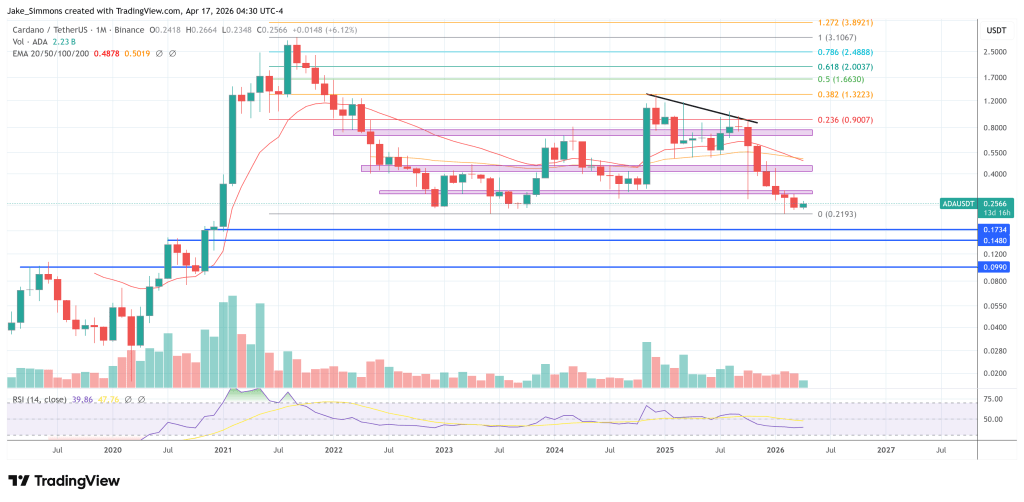
ADA hovers below key resistance, 1-monthly chart | Source: ADAUSDT on TradingView.com

Related Questions

QAccording to the Cardano Foundation CEO, how many large companies in Germany are using Cardano without realizing it, and for what purposes?

AAccording to Cardano Foundation CEO Frederik Gregaard, roughly 200 large companies in Germany are using Cardano as a security layer, a digital identity layer, and an accountability layer in their agentic AI deployments, without even knowing the blockchain is underneath their stack.

QWhat specific type of digital currency are the AI agents using for microtransactions in these systems, and what is its purpose?

AThe AI agents are using a regulated stablecoin called USDM for microtransactions. These microtransactions are used to meter prompt activity and align incentives between participants, and they form part of the security layer to prevent abuse.

QWhat US legislation does Gregaard suggest could unlock significantly broader blockchain usage beyond financial applications?

AGregaard suggests that the Clarity Act, if passed, could unlock materially broader blockchain usage beyond financial applications. He claims that 'hundreds of companies' are waiting for this kind of legal certainty.

QHow does Gregaard contrast Cardano's security model with that of other networks?

AGregaard contrasts Cardano's security by highlighting its on-chain governance model and distributed validator base, which make it harder to compromise through a single point of failure. He contrasts this with networks he describes as effectively controlled by a small number of insiders.

QWhat two key regulatory frameworks does the article mention in the context of stablecoins, and which region does Gregaard suggest might move faster on classifying assets like Cardano?

AThe article mentions the US stablecoin framework under the GENIUS Act and Europe's MiCA regime. Gregaard suggests that the US could move faster than Europe on providing regulatory clarity, recently stating that regulatory language has made clear that 'Cardano is a commodity.'

Related Reads

Reddit Crypto Discussion: Tech Stocks Surge for 8 Months, Is the Crypto Community Starting to 'Accept Fate'?

Reddit Crypto Discussion: Has the Community 'Given Up' as Tech Stocks Soar? A recent post on Reddit's r/CryptoMarkets asking if the crypto market feels "dead" compared to surging tech stocks has sparked intense debate. The discussion highlights a community grappling with underperformance: Bitcoin is down ~44% from its October 2025 high and ~20% YTD in 2026, while the S&P 500 and Nasdaq 100 have gained significantly. The debate features classic opposing views. Some users, citing Bitcoin's history, are "cycle believers" who anticipate a return to form, arguing it has "died" many times before. Others counter that crypto's narratives keep shifting without delivering a stable, compelling real-world use case beyond speculation. A prevalent third view pinpoints AI as the core issue: the tech sector's transformative boom is absorbing all attention and capital, while crypto lacks a comparable, impactful utility. Data supports the pessimistic mood. Bitcoin spot ETFs saw their largest monthly net outflow in May 2026 (~$2.3B), indicating institutional de-risking. The Crypto Fear & Greed Index has fallen to "Fear" levels. When asked about the timing of a potential market rotation back to crypto, answers are uncertain. A key practical point raised is the current high-interest-rate environment, which makes stable yields from cash and bonds attractive, reducing incentive to move into volatile assets like crypto. The underlying anxiety, as one user summarized, is "opportunity cost"—the worry about missing gains elsewhere while waiting for a crypto revival.

marsbit5m ago

Reddit Crypto Discussion: Tech Stocks Surge for 8 Months, Is the Crypto Community Starting to 'Accept Fate'?

marsbit5m ago

Chatbot has been burning money for three years, is it still the 'New Continent' of the AI era?

For years, the AI industry has been guided by a singular "map" — the belief that the AI era's "new continent" would be found in the Chatbot, a super-app akin to the mobile internet's super-apps. This belief was fueled by ChatGPT's explosive 2022 debut. However, three years of heavy investment reveal a different reality: the Chatbot-as-ultimate-entry-point model is struggling. The core issue is economic. Chatbots defy traditional internet economics. Unlike apps with near-zero marginal cost, each AI query consumes significant, expensive compute. More users mean higher costs, not profits. OpenAI, despite ~900M weekly active users, reportedly loses money. The expected network effects and data flywheels that power internet giants are weak in Chatbots, as one user's interactions don't improve another's experience. Monetization is a major hurdle. The subscription model faces low conversion rates, especially in China where users expect AI to be free. The "free + ads" model also struggles. Chatbot interactions often lack commercial intent, and inserting ads compromises the trust essential for an answer engine. Perplexity's minimal ad revenue and subsequent pivot away from ads highlight this difficulty. Switching between Chatbots is easy, making user loyalty low and competition a potential race to the bottom on price. Data suggests the standalone Chatbot's growth is slowing, and user engagement (avg. ~6 mins/day) pales compared to apps like TikTok. The product form itself is limiting; studies show nearly half of interactions are simple Q&A, trapping AI's potential in a passive, single-turn "cage." A contrasting, more successful path is emerging, exemplified by Anthropic. With over 85% of its ~$30B annualized revenue from enterprises, it focuses on AI as a productivity tool, not a companion. The rise of AI Agents (like OpenClaw) and the integration of AI into existing workflows (e.g., Google's AI Overviews, Apple Intelligence in OS) signal a shift. The future may not be a dominant Chatbot app, but AI embedded seamlessly into social apps, operating systems, and hardware — a capability-layer revolution, not a new distribution container. The conclusion is clear: the old "map" centered on a standalone Chatbot super-app is leading to a dead end. To find the true valuable "continent" of the AI era, the industry must update its navigation to prioritize deep integration, practical utility, and sustainable economics over a generic conversation window.

marsbit19m ago

Chatbot has been burning money for three years, is it still the 'New Continent' of the AI era?

marsbit19m ago

TaiJi Completes $3.5 Million Strategic Financing with Participation from Castrum Capital, Becker Ventures, and Coinvestor Ventures

TaiJi, an AI-driven market intelligence platform for Web3, has completed a $3.5 million strategic funding round. The investment was led by Castrum Capital, Becker Ventures, and Coinvestor Ventures. The funds will be allocated to product R&D, upgrading its AI inference engine, building a multi-agent analysis system, improving market data infrastructure, expanding its global community, and advancing ecosystem partnerships, particularly within the BSC ecosystem. TaiJi aims to transform how users understand the Web3 market by moving beyond simple data display. It integrates market data, on-chain signals, liquidity changes, social sentiment, and news events into a unified AI system. This system generates structured event inferences, impact pathways, risk assessments, and follow-up indicators. The platform's core approach involves a multi-agent framework where specialized agents (Market, On-chain, Sentiment, Risk, Event) collaboratively analyze disparate signals to produce coherent market intelligence. Its initial product will feature modules including Market Intelligence, a Scenario Engine for AI-powered event analysis, an Impact Map, Risk Signals, and a personalized user dashboard called "My TaiJi." TaiJi emphasizes that it does not custody user assets, execute trades, provide investment advice, or promise returns. Following this funding round, the company plans to accelerate product development and testing, gradually rolling out its core features to the broader Web3 market.

marsbit1h ago

TaiJi Completes $3.5 Million Strategic Financing with Participation from Castrum Capital, Becker Ventures, and Coinvestor Ventures

marsbit1h ago

Trading

Spot
Futures

Hot Articles

Discussions

Welcome to the HTX Community. Here, you can stay informed about the latest platform developments and gain access to professional market insights. Users' opinions on the price of ADA (ADA) are presented below.

活动图片