Cardano Founder Hoskinson Just Released A Free Book On Zero-Knowledge

bitcoinistPublished on 2026-03-30Last updated on 2026-03-30

Abstract

Cardano founder Charles Hoskinson has released a free, 357-page book titled "Proving Nothing: A Layered Guide to Zero-Knowledge Proof Systems" under a Creative Commons license. Designed as a non-technical introduction, the book uses a seven-layer framework to explain ZK systems, covering topics from cryptography and proof systems to private smart contracts and zkVMs. Hoskinson stated the project aims to address the low understanding of ZK technology and also serves as an introduction to Midnight, Cardano’s privacy-focused network. The book is intended to be a living document, with plans to update it as Midnight develops and new advancements emerge.

Cardano founder Charles Hoskinson has released a free book aimed at explaining zero-knowledge systems to a broader crypto audience, framing it as both an educational project and an on-ramp into Midnight, Cardano’s privacy-focused network. The linked GitHub repository shows the work is being published under a Creative Commons Attribution 4.0 license, while the latest public release is now titled Proving Nothing: A Layered Guide to Zero-Knowledge Proof Systems.

Cardano Founder Drops Free 337-Page ZK Book

In a March 27 livestream, Hoskinson said the project grew out of what he described as a “shockingly low level of understanding” around zero-knowledge proofs and ZK cryptography. “So I wrote a 337 page book over the last few months,” he said. He described it as a non-technical manual, though one that still contains a significant amount of technical material, built around a seven-layer framework for understanding how ZK systems are designed from setup and languages down to proof systems, cryptography, and the verification environment.

That structure is central to the pitch. The Cardano founder said the framework is meant to help readers “understand all ZK systems from that lens,” then move upward into adjacent privacy-enhancing technologies and, eventually, Midnight itself. The repository’s README makes the same case in more formal language, describing the book as a guide to “the entire zero-knowledge stack from the ground up” and arguing that ZK systems do not remove trust so much as decompose it into smaller, testable pieces.

The Midnight angle is not incidental. Hoskinson explicitly presented the book as “a good way of introducing Midnight to people,” and said one chapter is dedicated to the network, even if the broader work is designed as a general introduction to zero-knowledge.

He also said the book goes beyond the seven-layer model into private smart contracts, the Aleo-linked ZEXE model, Midnight’s Kachina system, zkVMs, STARK-to-SNARK pipelines, and the wider market landscape for privacy and proof systems.

That scope has already expanded since the version Hoskinson described on video. The GitHub release notes for v1.10, published on March 30, show the book was renamed from The Seven-Layer Magic Trick to Proving Nothing, and now ships in both EPUB and PDF formats. The file inventory in that release lists a 357-page dark-mode PDF, while the chapter notes show edits and additions across 14 chapters, including sections on zkVMs, market structure, eIDAS 2.0, rollups, and a more detailed Midnight case study.

Hoskinson also made clear that this is not a static publication. “This is the first edition, version 1.01,” he said in the livestream. “I’ll keep adding and changing and work on it throughout the weekends as more things come up and as more stuff in Midnight gets launched, I’ll add to this.” That matters because the book appears designed less as a one-off manifesto than as a living educational document tied to Midnight’s rollout and the broader commercialization of privacy tech.

At press time, Cardano traded at $0.2468.
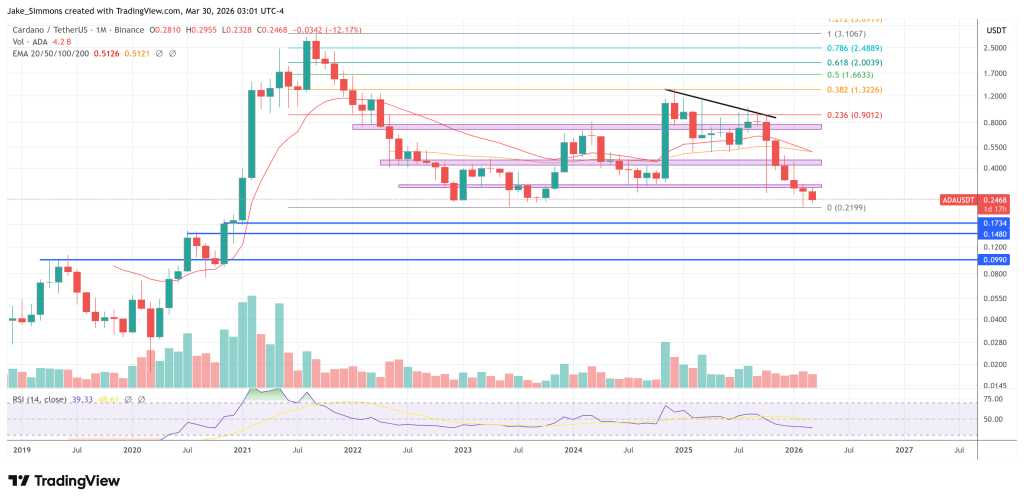
Cardano hovers below key resistance, 1-monthly chart | Source: ADAUSDT on TradingView.com

Related Questions

QWho is the author of the free book on zero-knowledge systems and what is the book's title?

AThe author is Charles Hoskinson, the founder of Cardano, and the book is titled 'Proving Nothing: A Layered Guide to Zero-Knowledge Proof Systems'.

QWhat was the primary motivation for Charles Hoskinson to write this book?

AHe was motivated by what he described as a 'shockingly low level of understanding' around zero-knowledge proofs and ZK cryptography, aiming to provide an educational resource for a broader audience.

QHow is the book structured to help readers understand zero-knowledge systems?

AThe book is built around a seven-layer framework that explains how ZK systems are designed, from setup and languages down to proof systems, cryptography, and the verification environment.

QWhat is the connection between this book and the Midnight network?

AThe book is framed as an educational on-ramp into Midnight, Cardano's privacy-focused network, with one chapter dedicated to it and the broader work designed to introduce people to the technology behind it.

QIs the book a static publication, and what is its current version and format?

ANo, it is a living document that will be updated. The current version at the time of the article is v1.10, and it is available in both EPUB and PDF formats.

Related Reads

Jensen Huang: Vera Rubin Full Mass Production, AI Agent a Key Focus, Challenging Intel to Target the Next-Generation AI PC Gateway

NVIDIA CEO Jensen Huang delivered the keynote speech at GTC Taipei 2026, announcing several major product launches and strategic directions. The company's Vera Rubin architecture is now in full-scale production, with OpenAI, Anthropic, and SpaceX among the first customers. NVIDIA highlighted AI Agent as a key future focus, introducing the Vera CPU designed for AI agents and the Vera BlueField-4 STX for secure, chip-level AI storage processing. A significant move involves challenging Intel in the PC market. NVIDIA, in collaboration with MediaTek, is developing the RTX SPARK PC chip (manufactured by TSMC) for Windows systems, set to launch this fall for laptops and desktops. This signals NVIDIA's push into the next-generation AI PC arena, aiming to provide a vertically integrated core computing platform for the entire Windows ecosystem, similar to Apple's approach. Other announcements include the new Nemotron 3 Ultra AI model and the NVIDIA DSX platform, described as a complete "playbook" for building AI factories, allowing performance simulation and validation before physical deployment. In automotive, the DRIVE Hyperion platform was positioned as a global robotaxi platform, with major Chinese automakers like BYD, Geely, Zeekr, Xiaomi, and Pony.ai already adopting or developing autonomous driving solutions based on it. The Alpamayo 2 super open inference model for robotaxis was also introduced. For robotics, NVIDIA unveiled the Isaac GR00T humanoid robot reference platform for academic research and a large open-source agent tools and skills suite for Physical AI. The company plans to collaborate with global humanoid robot manufacturers, including China's Unitree, whose H2 Plus robot served as the reference hardware for the GR00T platform demonstration.

marsbit21m ago

Jensen Huang: Vera Rubin Full Mass Production, AI Agent a Key Focus, Challenging Intel to Target the Next-Generation AI PC Gateway

marsbit21m ago

Running MoE on Mobile Phones? Meta Proposes MobileMoE, Speeding Up iPhone 16 Pro by 3.8x

Meta's MobileMoE, a mobile-optimized Mixture-of-Experts (MoE) language model architecture, enables efficient on-device large language model (LLM) inference for the first time on commercial smartphones. Designed for decoder-only Transformers, it replaces dense feed-forward layers with MoE layers. Key design choices include 8 experts with granularity g=8, top-4 routing, and a shared expert. The model undergoes a four-stage training process: pre-training, intermediate training, supervised fine-tuning, and quantization-aware training. Results show MobileMoE models, with similar memory footprint, achieve equal or higher average accuracy across 14 foundational benchmarks while using only 1/2 to 1/4 of the FLOPs compared to dense baselines. After INT4 quantization, they remain competitive. Notably, on an iPhone 16 Pro, MobileMoE-S demonstrates significant speedups: up to 3.8x faster in the prompt phase and 2.2-3.4x faster in per-token generation compared to a dense counterpart, with lower peak memory usage. While MobileMoE establishes a new Pareto frontier for on-device LLMs in accuracy-compute trade-offs, particularly excelling in code and math tasks, it currently lags behind models like Qwen3.5 2B in advanced instruction following and knowledge reasoning. Future work includes improving post-training techniques, exploring NPU deployment, and managing the runtime memory sensitivity of MoE models to varying inputs.

marsbit25m ago

Running MoE on Mobile Phones? Meta Proposes MobileMoE, Speeding Up iPhone 16 Pro by 3.8x

marsbit25m ago

Bitcoin's Weak Rebound Fails to Mask Adjustment Trend, HYPE's Top Signal Warns of Short-Term Risks | Invited Analysis

**Title:** Bitcoin's Weak Rebound Fails to Mask Downtrend; HYPE Top Signal Alerts of Short-Term Risks | Exclusive Analysis **Abstract:** This weekly market analysis examines the current technical structures of Bitcoin and HYPE, outlining key trading strategies. Bitcoin's daily chart shows it has broken below the median line of its primary ascending channel, indicating structural weakness. It is currently experiencing a weak rebound within a short-term descending channel, targeting resistance at $75,000-$76,000. Failure to break above this zone could lead to a resumption of the downtrend, testing support at $69,500-$70,500. Trading strategies include positioning for a rebound rejection (Plan A) or a breakdown below key support (Plan B) with controlled short positions. For HYPE, the 4-hour chart reveals a potential seven-wave advance from the May 14 low, now showing signs of exhaustion. A bearish divergence (momentum weakening) has been observed, coupled with a top signal from the proprietary "Spread Trading Model" at potential endpoint 47. The key this week is to monitor if a confirmed top forms here, especially upon a breach of the $62.5-$64.57 support area. If broken, a larger corrective move towards $54-$56.30 is anticipated. The short-term strategy for HYPE focuses on cautious long entries only upon confirmed stabilization within the support zone. The report also details a successful short BTC trade from the previous week, yielding a ~5.07% profit, executed based on model signals and price action. Strict risk management rules, including dynamic stop-loss adjustments, are emphasized.

marsbit42m ago

Bitcoin's Weak Rebound Fails to Mask Adjustment Trend, HYPE's Top Signal Warns of Short-Term Risks | Invited Analysis

marsbit42m ago

Trading

Spot
Futures

Hot Articles

Discussions

Welcome to the HTX Community. Here, you can stay informed about the latest platform developments and gain access to professional market insights. Users' opinions on the price of ADA (ADA) are presented below.

活动图片