Cardano Founder Explains Why Not Sell ADA For NIGHT

bitcoinistPublished on 2025-12-24Last updated on 2025-12-24

Abstract

Cardano founder Charles Hoskinson addressed questions about whether to sell ADA for the new NIGHT token, explaining that Midnight is designed to complement, not replace, Cardano. He described Midnight as a privacy-focused blockchain that enhances Cardano applications with privacy features, helping them compete in DeFi. Hoskinson argued that Cardano's UTXO model makes it a prime destination for Bitcoin capital seeking yield, and that Midnight's privacy tools could attract flows from other chains like XRP. He emphasized that ADA holders receive preferential access to NIGHT airdrops and that Cardano secures the Midnight network. Hoskinson also discussed a "value leakage" theory where Bitcoin DeFi yield, rather than direct selling, could drive capital to Cardano if it offers institutional-grade yield products.

After the successful Midnight (NIGHT) token airdrop, Cardano founder Charles Hoskinson is getting a familiar question from ADA holders: if NIGHT is the new token tied to Cardano’s privacy network, why not sell ADA and move across? In a Dec. 21 appearance on the Discover Crypto podcast, he argued the premise is flawed because Midnight is designed to extend ADA, not replace it.

Why Not Sell Cardano For NIGHT

“They’re complimentary. They do different things,” Hoskinson said. “Midnight is the ChatGPT of privacy. That’s its job. It’s a blockchain to blockchain infrastructure module. So, what Midnight does is it actually makes Cardano applications have privacy.”

That distinction is central to his pitch: Midnight is positioned less as a liquidity siphon and more as an infrastructure module that gives Cardano-native apps a feature set they can use to differentiate in an increasingly crowded DeFi landscape. Hoskinson argued that early adopters are more likely to be Cardano applications precisely because they need a lever to compete for users, rather than larger incumbents elsewhere that tend to be slower-moving.

“Which ones do you think are going to adopt privacy first? Uniswap and PancakeSwap and all these giant things that are slow moving and they’re very conservative because they have a lot of users of value flow,” he said. “No, it’ll be Cardano applications. Because they need to gain users and so this is how they leapfrog the competition.”

From there, Hoskinson broadened the argument into a cross-chain liquidity thesis, leaning heavily on Bitcoin DeFi as a source of potential inflows. He described Bitcoin as relatively “agnostic” capital that will route to wherever yield, credit, and utility are most accessible, and claimed Cardano’s UTXO model makes it a more natural destination than account-based chains.

“When you look at Bitcoin... it doesn’t care if it goes to Ethereum or Solana or Cardano or other places to get yield,” he said. “It’s going to go to the closest continent and the closest continent is Cardano because it’s a UTXO system and Bitcoin is UTXO system. So through Cardano DeFi in particular upgraded with Midnight suddenly Bitcoin’s going to get privacy preserving yield and credit.”

He added that the same privacy-preserving yield concept could extend beyond Bitcoin. “And it’s the same for XRP and these other things,” Hoskinson said, arguing that Midnight’s privacy tooling is intended to “hybridize” on-chain and off-chain infrastructure rather than “steal TVL or steal luster from other systems.”

In practical terms, Hoskinson also tied the ADA-versus-NIGHT decision to distribution and security. He emphasized that Cardano “launched Midnight,” framing it as evidence the ecosystem can execute large-scale initiatives while positioning ADA holders for preferential participation.

“If you’re an ADA holder, you get first access to all of these things and you get the largest proportion of the airdrop,” he said. “And also, Cardano secures Midnight. So, that means ADA holders get NIGHT tokens.”

How High Can ADA Go?

Hoskinson was also pressed on Cardano price expectations. While he refrained to name any price targets, he used that moment to lay out what he described as a “value leakage” theory tied to Bitcoin’s institutional bid. He said Bitcoin is the only asset he feels comfortable forecasting with any confidence, arguing that large allocators are structurally “stuck” in Bitcoin exposure via ETFs and buy-and-hold mandates, which changes the old cycle mechanic where retail would rotate profits from BTC into alts.

In that setup, he suggested the main route for capital to spill from Bitcoin into other ecosystems is not spot rotation, but Bitcoin DeFi yield: if Cardano can offer yield and credit inside a risk profile that institutional holders can tolerate, demand can “leak” outward from BTC without investors selling BTC outright. That is the basis for his view that chains embracing Bitcoin DeFi could move more in sync with Bitcoin, while others could remain decorrelated, even if Bitcoin continues higher.

The broader message was less about discouraging trading behavior and more about presenting a structural rationale for staying exposed to ADA. In Hoskinson’s framing, Midnight is not meant to displace ADA; it is meant to expand the set of use cases Cardano applications can offer, while keeping ADA holders economically involved through security ties and token distribution.

At press time, ADA traded at $0.36.
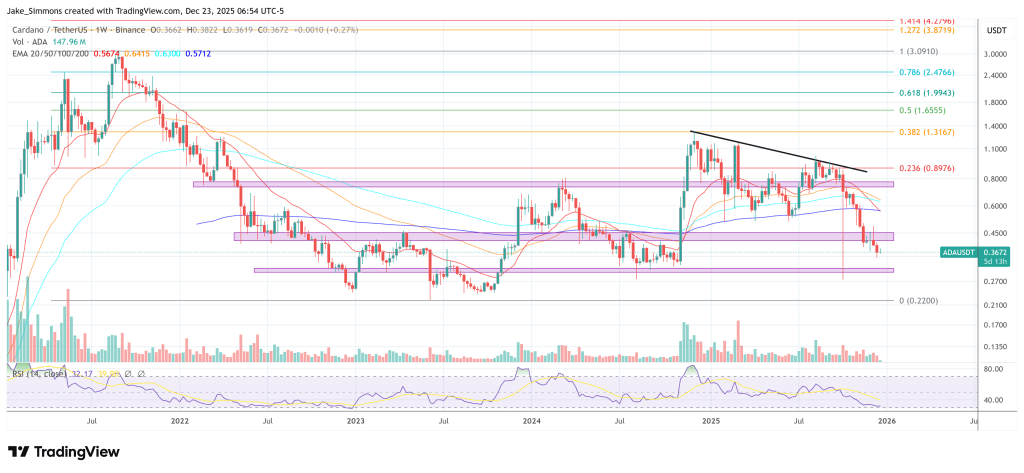
ADA turns support into resistance, 1-week chart | Source: ADAUSDT on TradingView.com

Trending Cryptos

Related Questions

QAccording to Charles Hoskinson, why is it a flawed premise to sell ADA for NIGHT?

AHe argues the premise is flawed because Midnight is designed to extend the Cardano ecosystem, not replace it. They are complimentary systems that do different things, with Midnight acting as a privacy module for Cardano applications.

QWhat analogy does Hoskinson use to describe the Midnight network?

AHoskinson describes Midnight as 'the ChatGPT of privacy,' positioning it as a blockchain-to-blockchain infrastructure module that provides privacy features.

QHow does Hoskinson connect Cardano's UTXO model to attracting Bitcoin capital?

AHe states that Bitcoin's capital is 'agnostic' and will go to wherever yield is most accessible. He claims Cardano is the 'closest continent' for Bitcoin because both use a UTXO model, making it a more natural destination for Bitcoin's yield-seeking capital than account-based chains.

QWhat advantages does Hoskinson say ADA holders have regarding the Midnight (NIGHT) token?

AHe states that ADA holders get first access to all ecosystem initiatives and the largest proportion of the NIGHT airdrop. He also emphasizes that Cardano secures the Midnight network, meaning ADA holders are economically involved and receive NIGHT tokens.

QWhat is Hoskinson's 'value leakage' theory concerning Bitcoin and other cryptocurrencies like ADA?

AHis theory is that large institutional investors are structurally 'stuck' in Bitcoin via ETFs and hold mandates. Therefore, capital spills into other ecosystems not through spot rotation (selling BTC for alts), but through Bitcoin DeFi yield. If Cardano can offer yield in a risk profile institutions tolerate, demand can 'leak' from BTC without investors having to sell their Bitcoin.

Related Reads

The Verdict in Choi Tae-won's Divorce Case: Revealing the Inheritance Undercurrent Behind SK Hynix's Trillion-Won Empire

SK Group Chairman Chey Tae-won's high-profile divorce case, involving a record 1.38 trillion won settlement, has drawn attention to the succession plans for Korea's second-largest conglomerate, especially its crown jewel, SK hynix. Unlike traditional chaebol scripts centered on the eldest son, Chey's three children from his marriage to former President Roh Tae-woo's daughter, Roh Soh-yeong, are carving distinct, non-traditional paths. Eldest daughter Chey Yun-jung (b. 1989) is seen as the most evident successor. With a scientific and consulting background, she holds executive roles at SK bioscience and SK Inc.'s growth support department, focusing on future strategy and biopharma. Her marriage is to an AI infrastructure entrepreneur, not a traditional business alliance. Second daughter Chey Min-jung (b. 1991) took a unique route, voluntarily serving as a South Korean naval officer, including an anti-piracy deployment. She later worked on policy and strategy for SK hynix in Washington D.C. before co-founding an AI-driven healthcare startup. She married a former U.S. Marine Corps officer, connecting her to U.S. defense and policy circles—networks crucial for a global semiconductor giant. The only son, Chey In-geun (b. 1995), who studied physics like his father, worked briefly at SK E&S before joining McKinsey. Despite fitting the traditional "heir" profile as the eldest son, he remains silent and holds no public position or shares in SK, suggesting the old succession playbook is obsolete. As SK hynix's valuation soars, becoming a geopolitical asset in the AI era, the heirs' legitimacy is no longer automatic. They must prove themselves in fields like AI biotech, global policy, and strategic consulting. Their marriages also reflect new elite networks in tech and defense, not old political alliances. Their inheritance is the complex challenge of navigating a globalized, tech-driven world, not just a corporate throne.

marsbitYesterday 09:06

The Verdict in Choi Tae-won's Divorce Case: Revealing the Inheritance Undercurrent Behind SK Hynix's Trillion-Won Empire

marsbitYesterday 09:06

From OpenSea to OpenRouter: Is Alex Atallah Repeating His 'Exit at the Peak' Playbook?

From OpenSea to OpenRouter: Is Alex Atallah Repeating His "Exit at the Peak" Playbook? According to the Wall Street Journal, payments giant Stripe is in talks to acquire the AI model aggregation platform OpenRouter in a potential deal valuing the company near $100 billion. This would mark founder Alex Atallah's second creation of a company reaching a $100 billion valuation, following his co-founding of NFT marketplace OpenSea. OpenRouter, founded just over three years ago, has grown rapidly by acting as a unified gateway for developers to access over 400 AI models. It currently has about 10 million users and processes over 200 trillion tokens monthly. While the platform's annualized revenue is around $50 million, its valuation has skyrocketed from $1.3 billion in March 2026. The potential acquisition by Stripe, a company OpenRouter's founder once likened it to, represents a major expansion into AI infrastructure for the payments leader. This move echoes Atallah's previous timing with OpenSea, where he departed before the NFT market's significant downturn. For OpenRouter, selling now may be strategic. Despite its scale, its business model—charging a 5-5.5% fee on AI inference calls—faces pressure from competition, open-source models, and potential price wars among model providers, limiting its profitability narrative for an IPO. A key asset for potential acquirers like Stripe is OpenRouter's vast repository of real-world AI usage data, which offers unique insights into model performance and developer preferences that are difficult to replicate. Whether this potential deal signifies a new valuation benchmark for AI infrastructure or another market peak signal remains to be seen.

链捕手Yesterday 08:42

From OpenSea to OpenRouter: Is Alex Atallah Repeating His 'Exit at the Peak' Playbook?

链捕手Yesterday 08:42

Trading

Spot

Hot Articles

Discussions

Welcome to the HTX Community. Here, you can stay informed about the latest platform developments and gain access to professional market insights. Users' opinions on the price of ADA (ADA) are presented below.

活动图片