Cardano Breaks Governance Deadlock With New Constitutional Committee

bitcoinistPublished on 2025-12-18Last updated on 2025-12-18

Abstract

Cardano has resolved a governance deadlock by ratifying a new Constitutional Committee (CC) member through an on-chain vote. The CC, essential for evaluating constitutionality and approving upgrades, budgets, and parameter changes, had been left without a quorum after a mid-term departure. This stalled key governance actions, including treasury withdrawals, budget approvals, and protocol upgrades. The newly elected member, Cardano Curia, was selected off-chain and ratified with over 80% support from delegate representatives (DReps) and sufficient stake pool operator (SPO) backing. The restoration reactivates the CC, allowing Cardano's governance processes to resume normal operation and preventing further delays in network upgrades.

Cardano has moved to resolve a governance bottleneck by ratifying an on-chain vote to restore its Constitutional Committee (CC) to functional capacity, a procedural step that matters because the CC is required to evaluate constitutionality and ratify many categories of governance actions, including upgrades, budgets, and parameter changes.

Intersect, which coordinates parts of Cardano’s governance process, said on X: “On the 7th day of GA... We hit the Epoch’s end. DReps at 80%. Stake pools supporting- It looks like we have a new CC. Ratified. Thank you to everyone who reviewed, voted, and wrote rationales,Santa has been notified.”

Why The Cardano Governance Was Stuck

Cardano’s governance model is tripartite: delegate representatives (DReps), stake pool operators (SPOs), and the Constitutional Committee. The CC plays a gatekeeping role: it judges whether on-chain actions are constitutional and ratifies decisions needed for the network to adapt.

That mechanism stalled after an unexpected mid-term departure left the CC below its minimum operational size. The Cardano Atlantic Council retired mid-term in epoch 597, opening a seat and reducing the committee below quorum. The consequence was that the Cardano CC could not ratify key actions, even as the chain continued to operate normally at the protocol level.

The vote asked DReps and SPOs to ratify a newly elected CC member and restore the committee to full capacity. The candidate, Cardano Curia, was selected off-chain through a DRep vote using the Ekklesia tool, with on-chain ratification required to formalize the result.

The governance materials described the restoration as bringing the CC back to seven members and activating a clarified alternate-member process to handle future vacancies with less disruption. Approval thresholds were set at 67% from DReps and 51% support from SPOs. Intersect’s update indicates those thresholds were met as the epoch ended.

Why This Was Treated As Urgent

The vote was framed as more than housekeeping because an undersized CC effectively blocks major governance flows. Without quorum: Treasury withdrawals couldn’t proceed, the Critical Integrations Budget could not pass, hard forks could not be ratified, delaying network upgrades and several categories of governance actions were blocked, leaving only a limited subset able to move forward.

There was also a timing element: delays risk actions expiring, which would force a repeat of the voting process and extend the governance backlog. With the restoration ratified, Cardano’s governance process can resume normal throughput — reopening the path for upgrades, budget approvals, and protocol changes that depend on a functioning Constitutional Committee.

At press time, Cardano traded at $0.38.
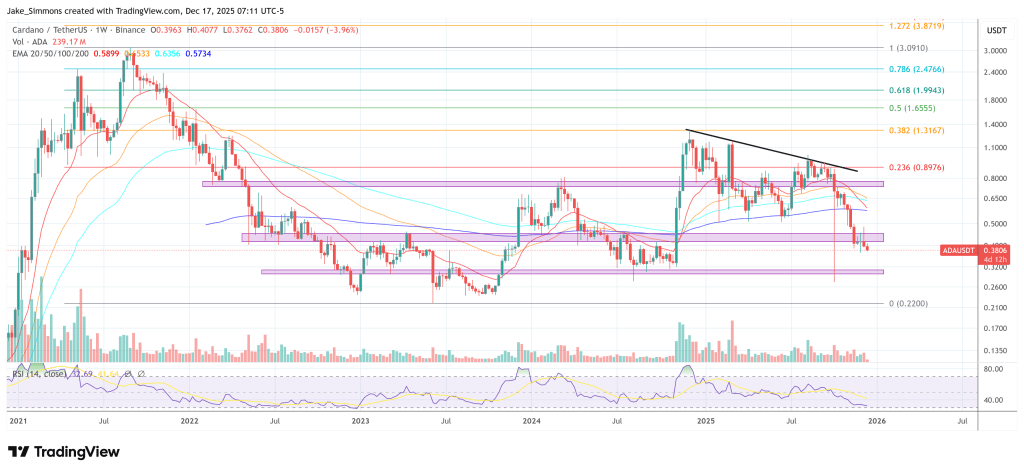
ADA falls below key support, 1-week chart | Source: ADAUSDT on TradingView.com

Trending Cryptos

Related Reads

The Biggest AI Black Hole: After Anthropic's Annual Revenue Hits $1 Trillion, Compute Power Prices Soar 10x

The article explores the potential for a dramatic surge in compute prices driven by the AI industry's explosive growth. It highlights a provocative prediction by tech podcaster Dwarkesh Patel: if AI labs like Anthropic continue their rapid revenue growth (projected to reach $1 trillion annually) while compute supply only expands at about 3x per year, the price of computing power could skyrocket by 10x or more. The core argument is a paradigm shift: GPUs are transitioning from mere hardware tools to carriers of "digital labor." If a single H100 GPU can host an AI agent capable of replacing a top-tier software engineer (with a Silicon Valley salary of $250k), its economic value should be recalibrated accordingly. Currently, the annual rental cost of an H100 is around $16k, creating a massive 15x valuation gap—a "labor arbitrage black hole." This imbalance stems from a critical mismatch: AI capabilities and commercial revenue are growing faster than the physical infrastructure (chips, data centers) can be built. With compute supply constrained by physical limits like chip manufacturing capacity, and demand soaring, prices are pressured upward. The piece further argues that expensive compute incentivizes using the most capable (and expensive) AI models, as cheaper, less efficient models waste more costly compute time—a phenomenon linked to the Alchian-Allen effect. Counterarguments are noted, suggesting AI's value may be capped in physical-world applications and that history often disproves predictions of resource scarcity. However, the response is that compute supply lacks the elasticity of traditional commodities. The conclusion is that before compute potentially becomes cheap and abundant, the industry may face an intense period of compute inflation and an arms race for this strategic resource.

marsbit30m ago

The Biggest AI Black Hole: After Anthropic's Annual Revenue Hits $1 Trillion, Compute Power Prices Soar 10x

marsbit30m ago

China's 'Bio DeepSeek' Emerges: 4 Oxford Prodigies Let AI Take Over Life Science

China's 'Biology DeepSeek' Emerges: Four Oxford Alumni Aim to Let AI Take Over Life Sciences Following DeepSeek-V4-Flash's global impact, a Chinese counterpart for life sciences has arrived. Jindu Bio, founded by four Oxford University alumni, has developed GeneLLM, a multi-omics large language model. Published in top journals *Nature Communications* and *Advanced Science*, GeneLLM is the first model pre-trained directly on raw omics data, aiming to understand the "language" and "system" of life. GeneLLM treats the four RNA bases (A, U, G, C) as fundamental tokens, learning from raw sequencing data without relying on pre-defined annotations. It uses a Transformer architecture to predict the next base, processing trillions of RNA reads. With versions ranging from 1.5 billion to 30 billion parameters, it achieves high accuracy in disease prediction with significantly lower-cost, shallow-depth sequencing, making precision medicine more accessible. Beyond the model, Jindu Bio is building BioFord Harness, an infrastructure to connect AI with physical labs. This system translates scientific intent into executable commands for various lab equipment, manages scheduling, and creates a data feedback loop. Its platform features five collaborative AI agents for literature review, experimental design, scientific reasoning, lab scheduling, and data analysis, drastically speeding up research cycles. Crucially, it turns all experimental data—including failures—into valuable learning material. The founding team combines expertise in bioengineering, AI, computational biology, and business. After initial challenges in securing funding, the company completed four financing rounds in 2023 following China's national push for "AI+" initiatives, supported by prominent investors like Sequoia Capital China and Gaotegaj Investment. In the broader AI for BioScience landscape, Jindu carves a unique niche. Unlike digital-only AI scientists or capital-intensive fully automated labs, it focuses on the "last mile" of infrastructure—orchestrating the entire research workflow by bridging AI models with existing laboratory hardware. Its long-term vision is to build an intelligent operating system for life sciences, defining a new, scalable paradigm for scientific discovery.

marsbit30m ago

China's 'Bio DeepSeek' Emerges: 4 Oxford Prodigies Let AI Take Over Life Science

marsbit30m ago

NVIDIA Has Moved the Mountain

**Title: NVIDIA Moves the Mountain** This article analyzes a dramatic two-day reversal in the AI and semiconductor stock markets, driven by a key announcement from NVIDIA. On Monday, August 3rd, Asian markets fell sharply, led by a crash in South Korean leveraged ETFs and panic selling in semiconductors. This spilled over to China's A-share market, where major indices dropped and semiconductor stocks like GigaDevice were hammered despite buyback announcements. The outlook for optical modules (a key AI infrastructure component) appeared bleak, weighed down by rumors of delays in CPO (Co-Packaged Optics) technology adoption. The turnaround came from the U.S. market later that same day. NVIDIA announced its Vera Rubin platform and, crucially, its senior VP declared that CPO technology had entered mass production and would be widely deployed in AI factories in the second half of the year. This directly countered the "CPO delay" narrative. Positive capex data from U.S. cloud giants added to the bullish sentiment. On Tuesday, August 4th, A-shares surged, particularly the ChiNext and STAR boards. The market saw heavy volume with over 2.2 trillion yuan in turnover. Optical module and CPO concept stocks skyrocketed, with leaders like Zhongji Innolight soaring over 13%. The rally was concentrated in growth sectors like tech and communications, while traditional "old economy" stocks like Kweichow Moutai declined. The article also notes other key developments: * A strong earnings report and raised guidance from WuXi AppTec sparked a rally in the CXO (pharma outsourcing) sector. * Mixed signals from the Middle East regarding the Strait of Hormuz. * New Chinese policies supporting the semiconductor industry and Hong Kong-China market cooperation. * Significant inflows into equity ETFs in July, suggesting institutional buying. The piece concludes by highlighting upcoming catalysts: AMD and SpaceX earnings, the potential reopening of the Strait of Hormuz, and NVIDIA's upcoming financial report later in August, which will be the next major test for the AI investment theme.

marsbit35m ago

NVIDIA Has Moved the Mountain

marsbit35m ago

Trading

Spot

Hot Articles

Discussions

Welcome to the HTX Community. Here, you can stay informed about the latest platform developments and gain access to professional market insights. Users' opinions on the price of ADA (ADA) are presented below.

活动图片