Buterin Says Ethereum Must Rethink Its Future: Here’s Why

bitcoinistPublished on 2026-03-07Last updated on 2026-03-07

Abstract

Vitalik Buterin urges the Ethereum ecosystem to embrace bold innovation at the application layer while maintaining uncompromising core guarantees at the base layer. He emphasizes that censorship resistance, open source, privacy, and security (CROPS) are non-negotiable for Ethereum's L1. Buterin calls for a fundamental rethink of applications, wallets, and culture, suggesting AI will play a major role in next-generation wallets—though high-value transactions should still require user confirmation. He also highlights the need for privacy-first design, rethinking L2 scaling solutions, and breaking away from "respectable" cultural norms to unlock greater creativity. Buterin challenges builders to imagine Ethereum's application layer from a blank slate, free from current path dependencies.

Vitalik Buterin is urging the Ethereum ecosystem to get bolder about what it builds on top of the chain—while drawing a hard line around the base layer’s core guarantees—arguing that a first-principles reset on applications, wallets, and even culture could be necessary for Ethereum’s next phase.

In a post on X, the Ethereum co-founder said “it’s healthy for us in the Ethereum world to have a more bold and open mindset,” especially on the application layer and “how we see ourselves in the world.” That openness, he argued, should not drift into ambiguity about what Ethereum’s L1 is supposed to protect.

“We should not compromise on core properties: censorship resistance, open source, privacy, security (CROPS),” Buterin wrote. “We should not have ‘open mindedness’ of the type that leaves people with no confidence of what security properties the L1 will still have one year from now.” He added that Ethereum should not backslide into questioning fundamentals like whether “light clients” should “trustlessly verify correctness of the chain.”

Where the rethink should happen, in his framing, is the interface between Ethereum and users: the application stack, its assumptions, and the social conventions that shape what builders consider “serious” work.

Ethereum AI Wallets, But With Guardrails

Buterin tied part of the shift to AI, floating a scenario where “wallets as browser extensions and mobile extensions are dead within a year?” On Farcaster, he made the point more directly: “Pretty obvious that the next iteration of wallets will heavily involve AI.”

Still, he stressed that higher-value usage can’t simply outsource trust to a model. “I would not trust an LLM with multi-million transactions or funds,” he wrote, describing what he sees as the “optimal workflow” for large transfers: “AI proposes a plan, local light client simulates it, you see the action and the simulated outcome and manually confirm it.”

The pay-off, he suggested, is that moving away from today’s dapp-heavy interaction model could reduce risk. If done “conservatively with lots of emphasis on security,” Buterin argued, removing dapp UIs “from the picture completely” could eliminate “a large number of attack vectors (for both theft and privacy).”

‘Rip Off The Suit And Tie’

Buterin pointed to privacy as a recent example of Ethereum changing its priorities at the application layer. He described last year’s “shift to thinking about privacy as a first-class consideration,” which, he argued, implies “a radically different Ethereum application stack” because “the entire stack so far has not been built around privacy.” This year, he said, that has expanded into “growing work on the networking side of privacy, both inside the EF and outside.”

He also sketched more provocative app-layer thought experiments, including whether “the rest of defi is basically just universal futures markets on top of a good decentralized oracle and letting users self-organize on top of that,” and even whether “the ideal decentralized oracle is just a SNARK over M-of-N small LLMs over zk-TLSes of some major news sites?” In his view, AI pushes “applications” away from discrete products with discrete UIs and toward a continuous space—making “build fewer apps and rely on users to self-organize around them” a pattern that could expand.

On scaling, he said Ethereum is also “rethinking from zero the role of L2s, and what kind of L2s are actually most synergistic and additive to Ethereum,” framing it as another area where past assumptions may no longer hold.

Buterin framed culture as a non-technical constraint that can quietly narrow what gets built. Referencing “the whole milady thing,” he argued the subtext is to “rip off the suit and tie,” describing a deliberately irreverent break from “respectable” postures: “Take the preconception that you are ‘respectable’, write it down on a piece of paper, crumble it up and burn it. The psychological baptism of doing this leads to the intellectual baptism of unlocking greater creativity and expanding overton windows.”

He closed his X post with a challenge to builders: stop iterating one step at a time from today’s usage patterns and instead imagine Ethereum’s application layer as if starting from a blank page. “If YOU had to write the section of the 2014 Ethereum whitepaper that talked about applications... what would you write?” he asked, urging people to “mark all path-dependence concerns down to zero” and see what new designs emerge.

At press time, ETH traded at $2,050.
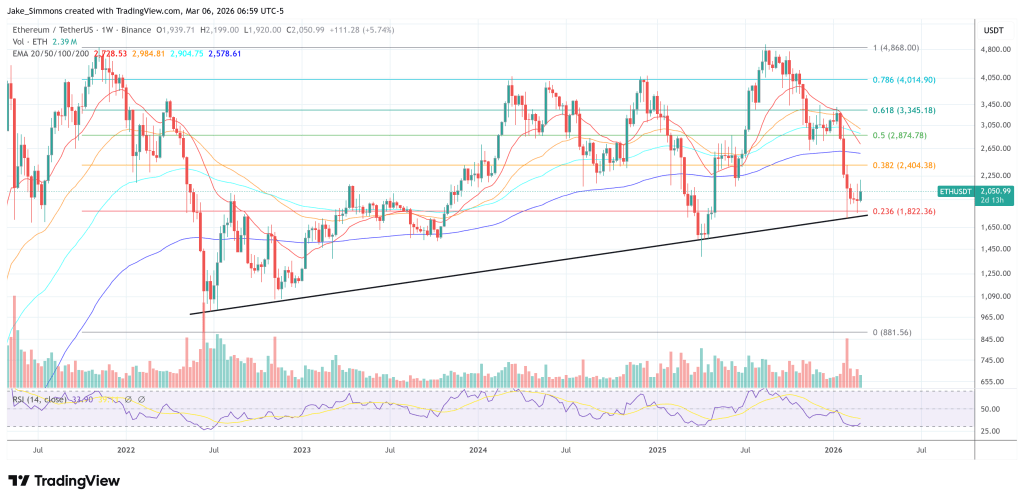
ETH remains above the black trendline, 1-week chart | Source: ETHUSDT on TradingView.com

Related Questions

QWhat core properties does Vitalik Buterin say Ethereum should not compromise on?

AButerin stated that Ethereum should not compromise on censorship resistance, open source, privacy, and security, which he refers to as 'CROPS'.

QHow does Buterin propose integrating AI into Ethereum wallets for large transactions?

AButerin suggests an optimal workflow where AI proposes a transaction plan, a local light client simulates it, and the user manually confirms after reviewing the action and simulated outcome, rather than fully trusting an LLM with high-value transactions.

QWhat cultural shift does Buterin advocate for in the Ethereum ecosystem?

AButerin advocates for a cultural shift away from 'respectable' postures, encouraging builders to 'rip off the suit and tie' by discarding preconceptions of respectability to unlock greater creativity and expand Overton windows.

QAccording to Buterin, what area of Ethereum is being 'rethought from zero' regarding its role and synergy?

AButerin mentioned that Ethereum is rethinking the role of Layer 2s (L2s) from zero, including what kinds of L2s are most synergistic and additive to the ecosystem.

QWhat challenge does Buterin pose to builders at the end of his post?

AButerin challenges builders to imagine Ethereum's application layer from a blank slate, asking what they would write in the applications section of the 2014 whitepaper if they ignored path-dependence and current usage patterns.

Related Reads

Huang Renxun Dramatically 'Saves' South Korean Stock Market

In early June, South Korea's stock market experienced a sharp decline, with the KOSPI index dropping over 5% and triggering a trading halt. Amid this volatility, NVIDIA CEO Jensen Huang's visit to Seoul provided a dramatic boost to market sentiment. During his trip, Huang held a dinner meeting with SK Group Chairman Chey Tae-won and SK Hynix CEO Kwak Noh-Jung. He announced that NVIDIA's new Vera CPU would utilize SK Hynix DRAM and confirmed a multi-year technical collaboration between the two companies. This partnership aims to co-develop next-generation memory for NVIDIA's AI infrastructure roadmap, covering products from data center supercomputers to personal AI devices. Huang also publicly commented that AI company stocks were attractively priced. A key announcement was that NVIDIA's upcoming Vera Rubin AI supercomputer systems will use HBM4 memory, with supply qualifications granted to all three major suppliers: SK Hynix, Samsung Electronics, and Micron Technology. Despite this multi-sourcing strategy, Huang warned that the industry-wide chip shortage, affecting everything from wafers to packaging, is expected to persist for several years due to relentless demand from global AI factory construction. The collaboration extends beyond memory supply. SK Hynix will employ NVIDIA's AI platforms and Omniverse digital twin technology to enhance its own semiconductor design, simulation, and manufacturing processes, aiming for more autonomous factory operations. This visit builds upon a prior October 2025 agreement for SK Group to build a large-scale AI data center using over 50,000 NVIDIA GPUs. Huang's itinerary also included meetings with other Korean giants like Hyundai, LG, and Samsung, indicating NVIDIA's broader strategy to deepen ties with South Korea's tech industry.

链捕手4h ago

Huang Renxun Dramatically 'Saves' South Korean Stock Market

链捕手4h ago

When Inference Becomes a Scarce Resource, Who Captures the Value?

When Inference Becomes the Scarce Resource, Who Captures the Value? The core AI bottleneck has shifted from model training to inference (runtime execution). While concerns persisted about an "AI compute gap"—initially a $200B, now a $600B problem—the market is now recognizing that the solution and value lie in the inference layer. Nvidia's financial restructuring around "serving tokens" and Cerebras's successful IPO highlight this shift. Inference is a recurring, usage-based cost, estimated to be 10-50x larger than the one-time training market, especially with the rise of agentic AI. The inference stack spans six layers: silicon (e.g., Nvidia), bare metal (e.g., CoreWeave), GPU rental/aggregation, deployment/optimization, model APIs, and end applications. Most companies operate in one layer. However, Hyperbolic uniquely spans three layers (GPU rental, deployment, and model APIs) without owning any hardware. It aggregates fragmented GPU supply from multiple cloud providers into a standardized pool, offering developers the cheapest available compute through intelligent routing. Its multi-cloud aggregation creates a data moat and a flywheel: more supply leads to better pricing data and liquidity, attracting more developers and providers. In contrast, applications like Venice operate at the top of the stack, reselling privacy-wrapped inference but remaining dependent on and constrained by the underlying compute costs they purchase. As inference demand explodes, value accrues not just to consumer applications but increasingly to the aggregation and routing layer that captures their cost of revenue. The coming potential GPU oversupply reinforces this dynamic. While hardware owners may suffer from depreciation, asset-light aggregators like Hyperbolic benefit from price arbitrage, routing workloads to the cheapest available capacity. The ultimate winner in the inference economy may not be the entity with the most GPUs, but the one that can most efficiently discover, aggregate, and route the world's fragmented compute.

链捕手4h ago

When Inference Becomes a Scarce Resource, Who Captures the Value?

链捕手4h ago

Trading

Spot
Futures

Hot Articles

Discussions

Welcome to the HTX Community. Here, you can stay informed about the latest platform developments and gain access to professional market insights. Users' opinions on the price of ETH (ETH) are presented below.

活动图片
















