BSC Pop-up Store Style Memes: How Can They Compete with Solana?

比推Published on 2026-01-13Last updated on 2026-01-13

Abstract

The crypto market's high-beta phase has reignited the meme coin frenzy, with Solana and Binance Smart Chain (BSC) emerging as two dominant but divergent ecosystems. Solana leverages its high-speed, low-cost infrastructure (0.4s transaction time, ~$0.005 fees) and culture-first approach, epitomized by platforms like pump.fun, where memes evolve from community-driven narratives and often face rapid failure—over 98% of projects eventually collapse. Its top meme tokens, like BONK and WIF, thrive on viral momentum and decentralized innovation, but the ecosystem is highly competitive and transient. BSC, in contrast, relies heavily on central figures like CZ and He Yi, and its EVM compatibility attracts event-driven, sentiment-heavy trading—particularly within Chinese-speaking communities. While BSC memes can achieve rapid, concentrated pumps, they often lack longevity without ongoing influencer support. Data from Dexscreener (as of Jan 12, 2026) highlights key differences: Solana recorded 26.92M transactions ($8.65B volume) vs. BSC’s 5.9M ($7.80B), reflecting Solana’s retail-heavy, high-frequency trading versus BSC’s大户-dominated, narrative-centric rallies. Ultimately, Solana’s strength lies in its resilient, tool-rich culture, while BSC excels in short-term, liquidity-injected opportunities. The choice between chains depends on risk appetite: probability and algorithms on Solana, versus community sentiment and timing on BSC.

Since the beginning of this year, the crypto market has once again entered a "high-beta" phase.

With the resurgence of risk appetite, meme coins—a highly volatile, high-return asset class—have returned to the center stage, becoming the most fiercely contested direction for capital.

Unlike before, this round of meme trends has not shown a pattern of "one chain dominating." Solana and Binance Smart Chain (BSC), two mainstream public chains, are now clearly diverging in the meme track:

On one side is Solana, known for its speed, toolchain, and community culture;

On the other is BSC, which leverages the personal influence of CZ/He Yi, its infrastructure, and the sentiment of the Chinese-speaking community.

Data from CryptoQuant shows that the proportion of meme coins in the altcoin market has risen to 3.2%, hitting a record high. Against this backdrop, the meme ecosystems of Solana and BSC are evolving along two distinct paths.

Principles and Mechanisms: Speed First or Compatibility First

The divergence between the two chains' meme ecosystems first stems from differences in their underlying design philosophies.

Solana, based on a hybrid consensus mechanism of Proof of History (PoH) and Proof of Stake (PoS), emphasizes extreme performance: average transaction confirmation time is about 0.4 seconds, and the fee per transaction is as low as $0.005–0.01.

This near-instant settlement experience makes Solana a natural breeding ground for high-frequency trading and emotional diffusion.

On Solana, meme gameplay is closer to "productized issuance." Represented by pump.fun, projects use bonding curves for early price discovery and "graduate" to mainstream DEXs once热度 reaches a threshold. This mechanism encourages rapid experimentation, giving rise to representative tokens like BONK and WIF, which emerged from community memes.
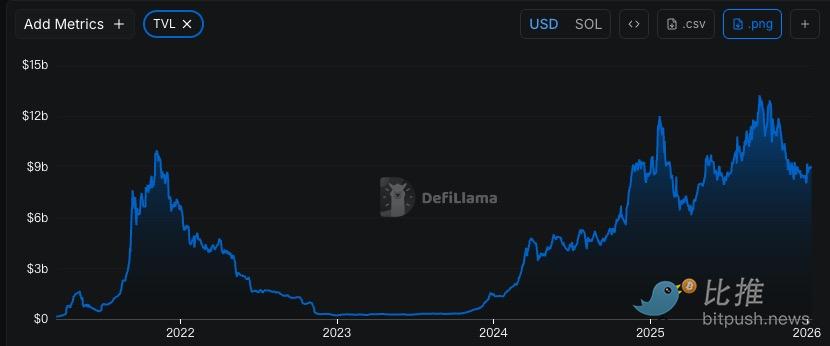
As of now, Solana's ecosystem TVL is approximately $9.0014 billion, still leading among meme-related public chains.

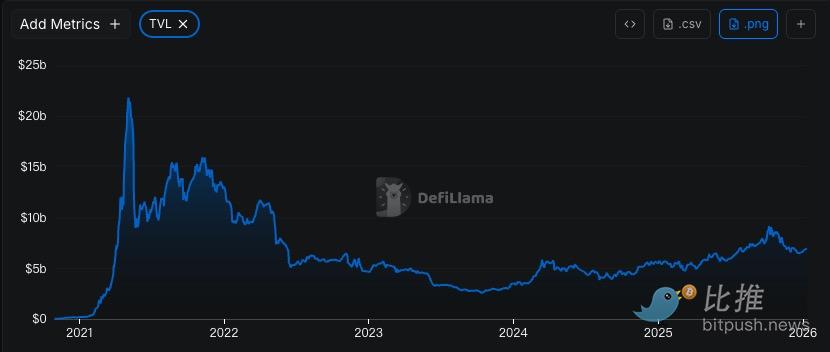
In contrast, BSC opts for compatibility and stability. Its EVM architecture inherits Ethereum's development habits, and with the support of the Binance ecosystem, transaction costs, though slightly higher, remain acceptable. Meme issuance on BSC is more direct—often skipping complex price curves and directly establishing liquidity pools on DEXs like PancakeSwap, making it more suitable for projects that rely on single narratives to gain momentum quickly. Currently, BSC's TVL is about $6.0932 billion, slightly lower than Solana's.
Playstyle Clash: Community Consensus vs. Event-Driven

The differences in mechanisms also shape completely different player behaviors.

On Solana, the vitality of a meme depends on "the spreadability of the meme." Narratives often ferment on X (formerly Twitter), relying on community二次创作 and meme fission to attract attention. Some projects叠加AI, NFT, and other elements to extend their lifecycle, but high freedom also means a high淘汰率—data shows that over 98% of meme projects on Solana ultimately go to zero, with the survivors being the few that have truly formed cultural认同.

BSC's gameplay is closer to "event-driven." Rallies are often ignited by statements from key figures like CZ and He Yi, characterized by straightforward narratives, concentrated情绪, and rapid price increases, but often with limited sustainability. Under the intensive interaction of the Chinese-speaking community, projects can achieve price explosions in a short time, but once the heat subsides, capital can quickly withdraw.

Data Comparison

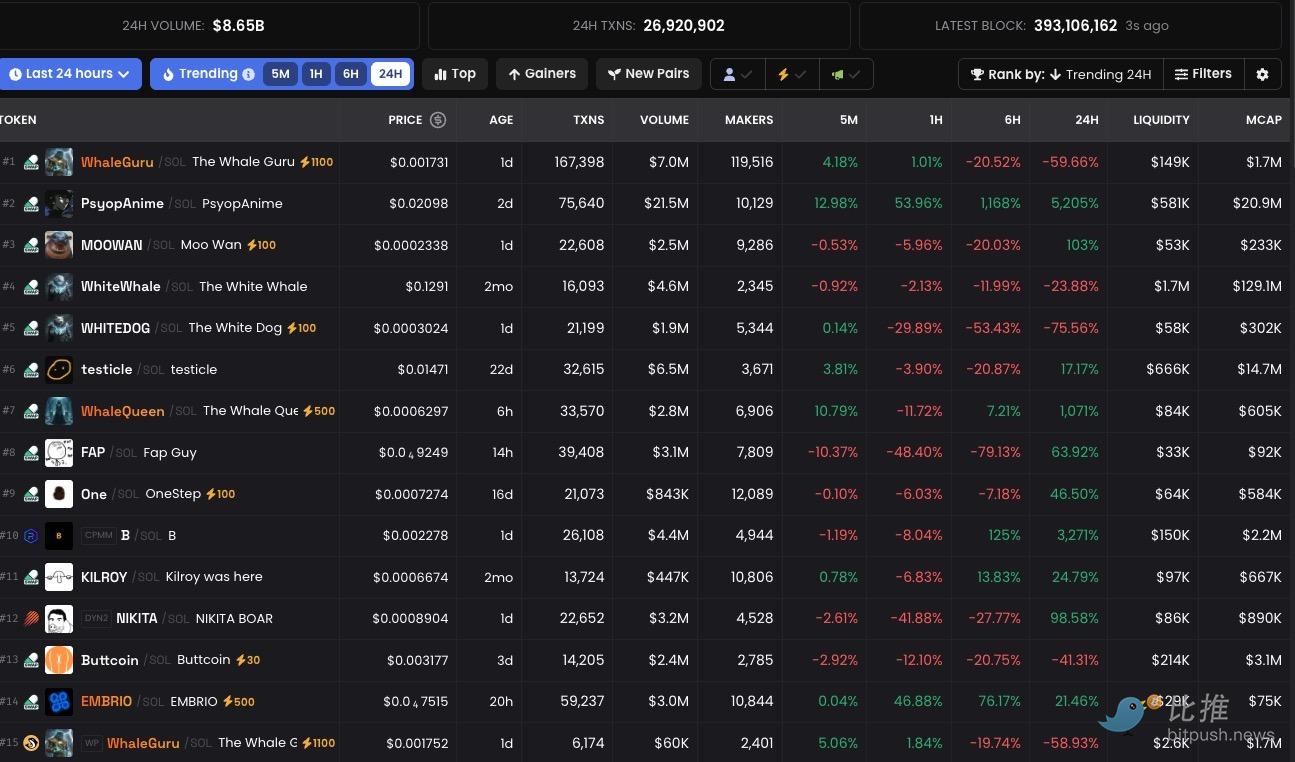
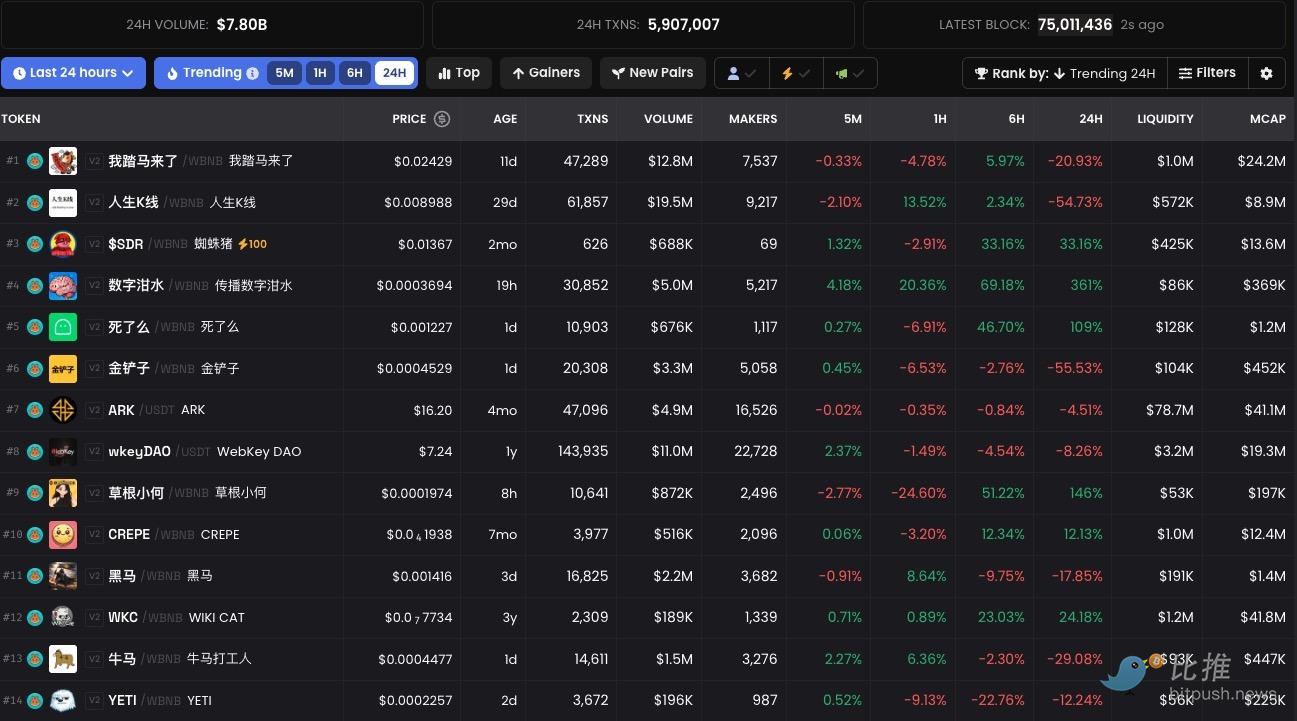
Through real-time data monitoring from Dexscreener as of the time of writing (January 12, 2026), we can clearly see the "capital性格" of the two ecosystems:
Turnover Efficiency: High-Frequency PvP vs. Whale Game

Solana (King of Turnover): 24-hour trading volume of $8.65B, supported by 26.92 million transactions.

Solana's per-transaction amount is extremely small, with the chain filled with millisecond-level sniper bots. On average, each热门代币 has over 110,000 participants (Makers). This极致PvP environment means capital flows extremely fast, with little沉淀.

BSC (Whale Hub): 24-hour trading volume of $7.80B, with only 5.9 million transactions.

The average per-transaction amount on BSC far exceeds that of Solana. Taking the热门币 "我踏马来了" (I'm F*cking Coming) as an example, it had only about 7,500 participants in 24 hours, indicating that BSC is more dominated by "whale communities," with concentrated筹码结构, making rallies more targeted when they occur.

Token Age (Days): Harvesting Machine vs. Reservoir

Solana (Extremely New): The Top 15 list is almost entirely dominated by tokens "born within 24 hours" (e.g., WhaleGuru, MOOWAN, NIKITA, etc.). This reflects Solana's极强的流量爆发力 and extremely short narrative lifespan, with capital constantly searching for the next "5-minute" opportunity.

BSC (Relatively "Long-Lived"): The list includes tokens that have survived for 3 years (WKC), 1 year (wkeyDAO), 4 months (ARK), and 11 days ("我踏马来了"). This proves that BSC's Meme tokens are relatively more resilient; once they form a community or "power narrative," they can persist longer.

Market Cap (MCAP) Distribution:

Solana:

Super Blue-Chip: WhiteWhale's market cap is as high as $129.1M, leading the pack.

Long Tail: Beyond the top four, market caps quickly fall below $1M (e.g., FAP, EMBRIO are only in the tens to hundreds of thousands of dollars). This shows that Solana's流量极度偏爱 the top "survivors," while the remaining 99% are just along for the ride.

BSC:

Strong Middle Tier: 7 of the top 15 tokens on the list have a market cap exceeding $10M (e.g., ARK, 我踏马来了, wkeyDAO, SDR). This "olive-shaped" structure indicates that BSC capital prefers to cluster in already successful mid-sized projects, offering相对更高 safety.

Who Can Go Further?

It's not hard to see that Solana's commercial value lies in "infrastructure empowering culture." It attracts global retail investors with extremely low barriers. Although highly泡沫化, its efficiency in decentralized innovation makes it more resilient in the long cycle.

BSC's business logic, however, is "opportunistic amplification." It uses centralized leverage to quickly inject liquidity and connect with the Asian market. But this logic also exposes its fragility: when hotspots fade or "core figures" go silent, the ecosystem easily falls into a "vacuum period" of discontinuity, making it hard for Memes to survive through community autonomy without official光环.

As observed by KOL miragemunny: "BSC is currently in a phase of flash-in-the-pan speculation, while Solana's meme culture and toolchain are the result of years of沉淀."
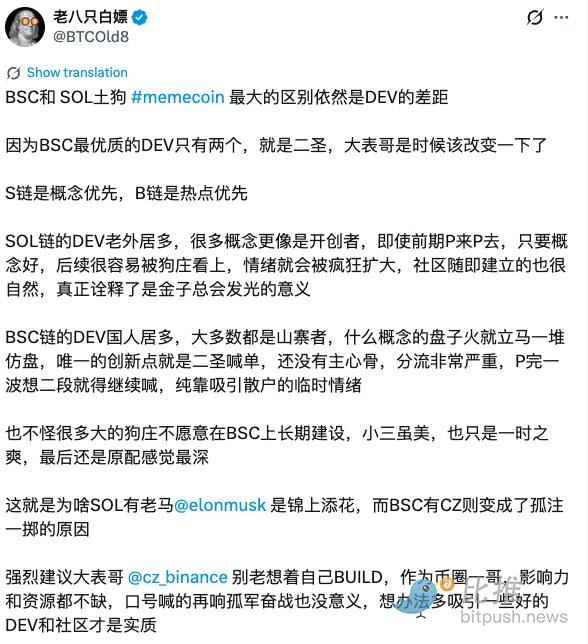
Chinese-speaking KOL 老八只白嫖 (@BTCOld8)直言 (stated bluntly) that BSC needs to attract more developers, not just rely on hotspot rotation.

In 2026, the meme track may enter a new phase of "情绪, liquidity, and toolchain叠加" (superposition of sentiment, liquidity, and toolchains).

For investors, the key may not lie in judging which chain will "definitely win," but in understanding the completely different rhythms of the two ecosystems: on Solana, you play probability and algorithms; on BSC, you play another kind of "interpersonal relations."

However, in the end, in the world of memes, the narrative determines how high you can fly, while liquidity determines how long you can last.

Author: Bootly


Twitter:https://twitter.com/BitpushNewsCN

Bitpush TG Discussion Group:https://t.me/BitPushCommunity

Bitpush TG Subscription: https://t.me/bitpush

Original article link:https://www.bitpush.news/articles/7602035

Trending Cryptos

Related Questions

QWhat are the key differences in the underlying design philosophy between Solana and BSC for meme coin ecosystems?

ASolana prioritizes speed and performance with its Proof of History (PoH) + Proof of Stake (PoS) hybrid consensus, offering near-instant settlement (0.4s) and ultra-low fees ($0.005–0.01). BSC focuses on compatibility and stability through its EVM architecture, inheriting Ethereum's development habits, with slightly higher but still acceptable costs.

QHow do the meme coin 'playstyles' differ between Solana and BSC according to the article?

AOn Solana, meme coin success depends on 'meme spreadability' and cultural identity, often starting from Twitter and relying on community creation and memetic fission. On BSC, the playstyle is more 'event-driven,' ignited by key figures like CZ or He Yi, characterized by straightforward narratives, concentrated emotion, and rapid price surges, but often with limited sustainability.

QWhat does the data reveal about the trading volume and number of transactions on Solana versus BSC?

ASolana had a 24-hour trading volume of $8.65B supported by 26.92 million transactions, indicating high-frequency, small-sized trades. BSC had a 24-hour volume of $7.80B from only 5.9 million transactions, showing larger average trade sizes and more concentrated,大户 (big player) participation.

QWhat is the contrast in the 'Age' or longevity of top meme coins between the two chains?

ASolana's top meme coins are extremely new, with the top 15 often being less than 24 hours old, reflecting fast turnover. BSC's top meme coins show more longevity, with examples surviving for 3 years, 1 year, 4 months, or 11 days, indicating a greater ability to form lasting communities or narratives.

QHow does the market capitalization (MCAP) distribution differ between Solana and BSC meme ecosystems?

ASolana's MCAP distribution is top-heavy with a 'super blue-chip' like WhiteWhale at $129.1M, followed by a steep drop-off where most other top coins have MCAPs below $1M. BSC's distribution is more robust in the middle, with 7 of the top 15 coins having MCAPs over $10M, forming a more 'olive-shaped' structure suggesting stronger community holding in mid-sized projects.

Related Reads

Wall Street's Most Famous 'Cassandra' Now Has His Sights Set on Nvidia

Michael Burry, the famed "Big Short" investor, has once again captured Wall Street's attention with a series of short positions against major tech and semiconductor stocks, most notably Nvidia. In late June and July, through his "Cassandra Unchained" newsletter, Burry disclosed short bets against Nvidia, Tesla, Applied Materials, Caterpillar, the SOXX semiconductor ETF, and later, Micron Technology. His core thesis revolves around potential distortions in the AI infrastructure boom, specifically questioning whether extended depreciation schedules (e.g., 6 years vs. a realistic 2-3 years for AI chips) by cloud giants like Microsoft and Google artificially inflate profits. He also raises concerns about possible "off-balance-sheet circular financing," where chip demand might be propped up by vendor-backed funding to clients. Nvidia's stock experienced volatility following these disclosures, briefly dipping but largely holding near Burry's reported entry points, leaving his positions roughly flat or slightly underwater as of late July. This move is part of a pattern for Burry, whose track record since his legendary 2008 bet is mixed. He has faced notable losses, such as on Tesla in 2021, while scoring on broader market turns like the 2020 pandemic crash. His methodology focuses intensely on free cash flow and scrutinizing original financial documents to spot overvaluation and structural risks, but it often struggles with timing the market. The article contrasts Burry's stance with other prominent investors. Steve Eisman, another "Big Short" figure, is not shorting Nvidia, citing strong fundamentals but expressing nervousness about sustainability. Jim Chanos agrees with the broad "accounting mismatch" concern—comparing it to the dot-com bubble—but targets financial leverage in private equity firms rather than the chip stocks themselves. While Nvidia's short interest remains relatively low at 1.3-1.4% of float, the massive stock size means absolute short losses have been significant, exceeding $5 billion earlier this year. The piece concludes that for ordinary investors, the key takeaway is not replicating specific short bets but learning from the critical frameworks these investors use: questioning rosy accounting, identifying structural vulnerabilities, and maintaining skepticism during market euphoria, even if pinpointing the exact catalyst for a downturn remains elusive.

marsbit26m ago

Wall Street's Most Famous 'Cassandra' Now Has His Sights Set on Nvidia

marsbit26m ago

Weekly Selection丨Epic Stock Market Volatility, Changxin Tech's IPO Reshapes Storage Landscape, Saylor Aims to Re-Anchor STRC Around September 8th

PANews Weekly Digest: Market Turmoil, Tech Breakthroughs, and Crypto Developments. The week saw significant volatility across global markets. South Korea's KOSPI index experienced extreme turbulence, including multiple trading halts, largely driven by sharp declines in AI hardware stocks like SK Hynix. In contrast, China's Changxin Xinqiao (CXC) achieved a landmark IPO with a market cap surpassing 4 trillion yuan, marking a major success for the domestic DRAM industry after a decade of losses. In the crypto and Web3 space, several key narratives emerged. AI is driving demand for new infrastructure, with projects like AI agent wallets and programmable payments gaining traction, attracting interest from firms like Coinbase. The Bitcoin mining sector is pivoting, with companies like MARA focusing on energy management as electricity becomes a core AI-era asset. Meanwhile, the RWA (Real World Assets) sector faces a "utilization puzzle," with hundreds of billions in on-chain assets remaining dormant. Notable market movements included a historic single-day surge of over 17% for the KOSPI index and a significant migration of $16.5 billion in staked ETH within the Lido ecosystem. Michael Saylor announced a target to re-peg the STRC stablecoin around September 8th. Other highlights include discussions on Ethereum's ambitious 2030 roadmap for scaling and privacy, analysis showing high protocol revenues not always translating to token price gains, and warnings from Citi about potential extreme commodity price shocks by late 2026.

marsbit31m ago

Weekly Selection丨Epic Stock Market Volatility, Changxin Tech's IPO Reshapes Storage Landscape, Saylor Aims to Re-Anchor STRC Around September 8th

marsbit31m ago

When the Market Begins to Question AI Capex: A Full Analysis of Q2 Earnings Reports from Five Tech Giants

In late July 2026, five major US tech giants—Alphabet, Intel, Microsoft, Meta, and Apple—released their Q2 earnings reports. While all companies exceeded revenue and profit expectations, driven by strong AI-related business growth, investor reactions diverged sharply due to concerns over escalating AI capital expenditures (capex) and their impact on free cash flow. Alphabet reported strong revenue growth and a surging cloud business, but its stock fell after announcing a doubled year-on-year capex and negative quarterly free cash flow for the first time. Intel posted its strongest revenue growth in over 15 years, but its stock experienced volatile trading after significantly raising its full-year capex guidance. Microsoft saw its stock surge after beating estimates and, crucially, lowering its capex forecast while projecting positive free cash flow. Meta faced the most severe sell-off as its profits declined despite revenue beats, with free cash flow plunging over 90% and its capex guidance raised. Apple reported record June-quarter results, but its stock plummeted after providing Q4 revenue guidance that fell short of expectations, citing supply chain constraints and forex headwinds. The overall takeaway is that the market's focus has shifted from validating AI demand to scrutinizing the timeline for returns on massive AI investments. Companies demonstrating a clearer path to managing capex and preserving free cash flow, like Microsoft, were rewarded, while those signaling continued aggressive spending faced investor skepticism.

Odaily星球日报41m ago

When the Market Begins to Question AI Capex: A Full Analysis of Q2 Earnings Reports from Five Tech Giants

Odaily星球日报41m ago

a16z: From Companies to DAOs, DUNA May Become the Next Generation Organizational Form

This article, "From Companies to DAOs: How DUNA Could Become the Next Organizational Form," traces the 500-year evolution of business collaboration. It begins with medieval structures like the *commenda* and Florentine *compagnia*, which exposed partners to personal risk. The modern corporation, exemplified by the Dutch East India Company (VOC), was a revolutionary leap, enabling large-scale, capital-intensive ventures by offering limited liability and reducing coordination costs. However, corporations introduced new challenges like principal-agent problems and bureaucratic overhead. The piece argues that software and internet-native protocols are now reducing these traditional overheads. Decentralized Autonomous Organizations (DAOs) emerged as a new model for coordination without centralized management. Yet, DAOs face a significant legal vacuum: they lack legal recognition, leaving members exposed to unlimited personal liability, and their tokens are vulnerable to being classified as securities under unclear regulations (e.g., the Howey Test). This has forced projects into suboptimal workarounds like offshore foundations. The article identifies the Decentralized Unincorporated Nonprofit Association (DUNA) as a potential solution. Recently legalized in states like Wyoming, the DUNA provides a legal wrapper for decentralized networks. It grants key protections—legal personality, limited liability, and perpetual existence—to a group without imposing a traditional hierarchical management structure. This allows token-holder communities to govern, hold assets, and contract as a single legal entity, aligning with their decentralized nature. While DUNA doesn't solve all governance challenges or magically resolve securities law questions, it represents a crucial step. It fills the legal recognition gap, offering a native legal form for internet-scale, decentralized collaboration and extending the separation of personal risk from organizational venture into a new domain.

marsbit1h ago

a16z: From Companies to DAOs, DUNA May Become the Next Generation Organizational Form

marsbit1h ago

2026 Mid-Year Report On-Chain RWA: Tokenized Stock Market Cap Doubles in a Year, But 90% of Rights Are Hollow Shells

The 2026 Mid-Year Report on On-Chain RWA highlights a significant growth in tokenized stock market capitalization, which nearly doubled from $951 million in March to $1.89 billion by July. However, the report reveals a fundamental contradiction in this "layer 2.5" ecosystem: products with the strongest legal foundation (like regulated U.S. infrastructure) lack liquidity and distribution, while freely tradable offshored wrapper products often lack substantive ownership rights. The increase is driven largely by a few products (SECZ, FGRS, STRCx) and platforms (Ondo, xStocks, Securitize collectively hold over 85% share). While distributed value across networks like Ethereum, Solana, and BNB Chain has grown, the market remains fragmented. Products referencing the same underlying asset (e.g., Apple stock) are distinct legal liabilities with different intermediaries and jurisdictional rules, offering varying degrees of legal claim. The report cautions that headline numbers are misleading, as they reflect changes in distributed token value—driven by issuance, conversions, and price movements—not pure investor inflows. True "canonical shares" with legal ownership, wide wallet distribution, institutional liquidity, and independent on-chain price discovery do not yet exist at scale. Tokenized treasuries show stronger product-market fit, and ETFs may be easier to scale than single stocks. The core takeaway is a trade-off: legal certainty versus liquidity and composability.

marsbit2h ago

2026 Mid-Year Report On-Chain RWA: Tokenized Stock Market Cap Doubles in a Year, But 90% of Rights Are Hollow Shells

marsbit2h ago

Trading

Spot

Hot Articles

Discussions

Welcome to the HTX Community. Here, you can stay informed about the latest platform developments and gain access to professional market insights. Users' opinions on the price of SOL (SOL) are presented below.

活动图片