Boycott Urged For CLARITY Act Draft: Expert Raises Concerns Over Banks Manipulation

bitcoinistPublished on 2026-01-15Last updated on 2026-01-15

Abstract

The CLARITY Act draft faces strong opposition from crypto advocates who argue that banking lobbyists have manipulated the bill to undermine the industry. A key point of contention is a ban on stablecoin issuers, like Circle and Ripple, from offering yield payments to passive token holders. Market expert Nick Cash urges a boycott, warning this gives traditional institutions a competitive advantage and threatens DeFi innovation. Banking groups claim such yields risk financial stability by potentially drawing deposits away from insured banks. However, crypto advocates, including the Blockchain Association's Summer Mersinger, counter that this is anti-competitive and stifles consumer choice. Data indicates strong public support (nearly 4-to-1) for allowing stablecoin rewards, with little desire for government restrictions. The act's future remains uncertain as debates over banking oversight in crypto continue.

As the anticipated markup of the CLARITY Act approaches, supporters of the digital asset market are raising alarms over the latest draft of the bill. They claim that the revisions pushed by banking lobbyists threaten to undermine the principles of the cryptocurrency industry.

Ban On Yield Payments In CLARITY Act

In a recent post on social media platform X (formerly Twitter), market expert Nick Cash vocalized his strong opposition, stating that the current iteration of the CLARITY Act must be boycotted.

He described it as a mechanism for banks to manipulate the future of cryptocurrencies, portraying their influence as a detrimental force for innovation in the sector.

The revised version of the CLARITY Act, which serves as a comprehensive crypto market structure bill, introduces significant restrictions on stablecoin issuers like Circle and Ripple. Notably, these firms will be prohibited from offering yield back to passive token holders.

Title IV of the Digital Asset Market Consumer Protection Act (DAMCA) outlines how regulated banking institutions can interact with digital assets, mandating that stablecoin issuers—defined by the GENIUS Act—cannot make interest payments to holders.

Under the proposed changes, while stablecoin issuers would still be able to provide rewards tied to specific actions (such as account openings and cashback), the ban on yield payments poses a serious concern for the crypto industry, which has consistently viewed yield protection as a non-negotiable issue.

Cash argues that the modifications may leave crypto-native issuers positioned at a competitive disadvantage against traditional banks. He warned that such restrictions could severely impact decentralized finance (DeFi) and the overall cryptocurrency landscape.

Expressing his frustration, Cash stated that those supporting the revised bill are essentially siding with banks and undermining the crypto movement.

Strong Public Support For Stablecoin Rewards

Banking institutions have argued that allowing these interest payments could lead to a significant outflow of deposits from insured banks, threatening overall financial stability.

In contrast, crypto advocates counter that blocking crypto exchanges from paying interest on stablecoins is anti-competitive and detrimental to innovation. Summer Mersinger, CEO of the Blockchain Association, articulated her stance, asserting:

What is threatening progress is not a lack of policymaker engagement, but the relentless pressure campaign by the Big Banks to rewrite this bill to protect their own incumbency.

She highlighted that the demand to eliminate stablecoin rewards aims to restrict consumer choice and stifle innovative financial products before they have the chance to compete.

Amid this ongoing CLARITY Act debate, Stuart Alderoty, Chief Legal Officer at Ripple, weighed in, emphasizing that American consumers value their freedom to choose.

He referenced new data from The National Cryptocurrency Association, which indicates a strong public preference—nearly 4-to-1—in favor of allowing stablecoin rewards, along with little appetite for government intervention to curb them.

Ultimately, the future of the CLARITY Act remains uncertain as stakeholders continue to voice their concerns about the implications of increased banking oversight on the cryptocurrency market.

The daily chart shows the surge in the total crypto market cap above $3.2 trillion. Source: TOTAL on TradingView.com

Featured image from DALL-E, chart from TradingView.com

Related Questions

QWhat is the main concern raised by market expert Nick Cash regarding the revised CLARITY Act draft?

ANick Cash argues that the revised CLARITY Act is a mechanism for banks to manipulate the future of cryptocurrencies, which undermines innovation and places crypto-native issuers at a competitive disadvantage against traditional banks.

QWhat specific restriction on stablecoin issuers is introduced in the revised bill's Title IV of DAMCA?

ATitle IV of the Digital Asset Market Consumer Protection Act (DAMCA) mandates that stablecoin issuers, as defined by the GENIUS Act, are prohibited from making interest payments (yield) to passive token holders.

QAccording to banking institutions, why should stablecoin issuers be banned from offering yield payments?

ABanking institutions argue that allowing interest payments on stablecoins could lead to a significant outflow of deposits from insured banks, threatening overall financial stability.

QWhat does the new survey data from The National Cryptocurrency Association reveal about public opinion on stablecoin rewards?

AThe survey indicates strong public support, with nearly a 4-to-1 ratio in favor of allowing stablecoin rewards, and little appetite for government intervention to curb them.

QHow does Summer Mersinger, CEO of the Blockchain Association, characterize the banks' efforts to rewrite the CLARITY Act?

ASummer Mersinger describes it as a 'relentless pressure campaign by the Big Banks to rewrite this bill to protect their own incumbency,' which she believes stifles innovation and restricts consumer choice.

Related Reads

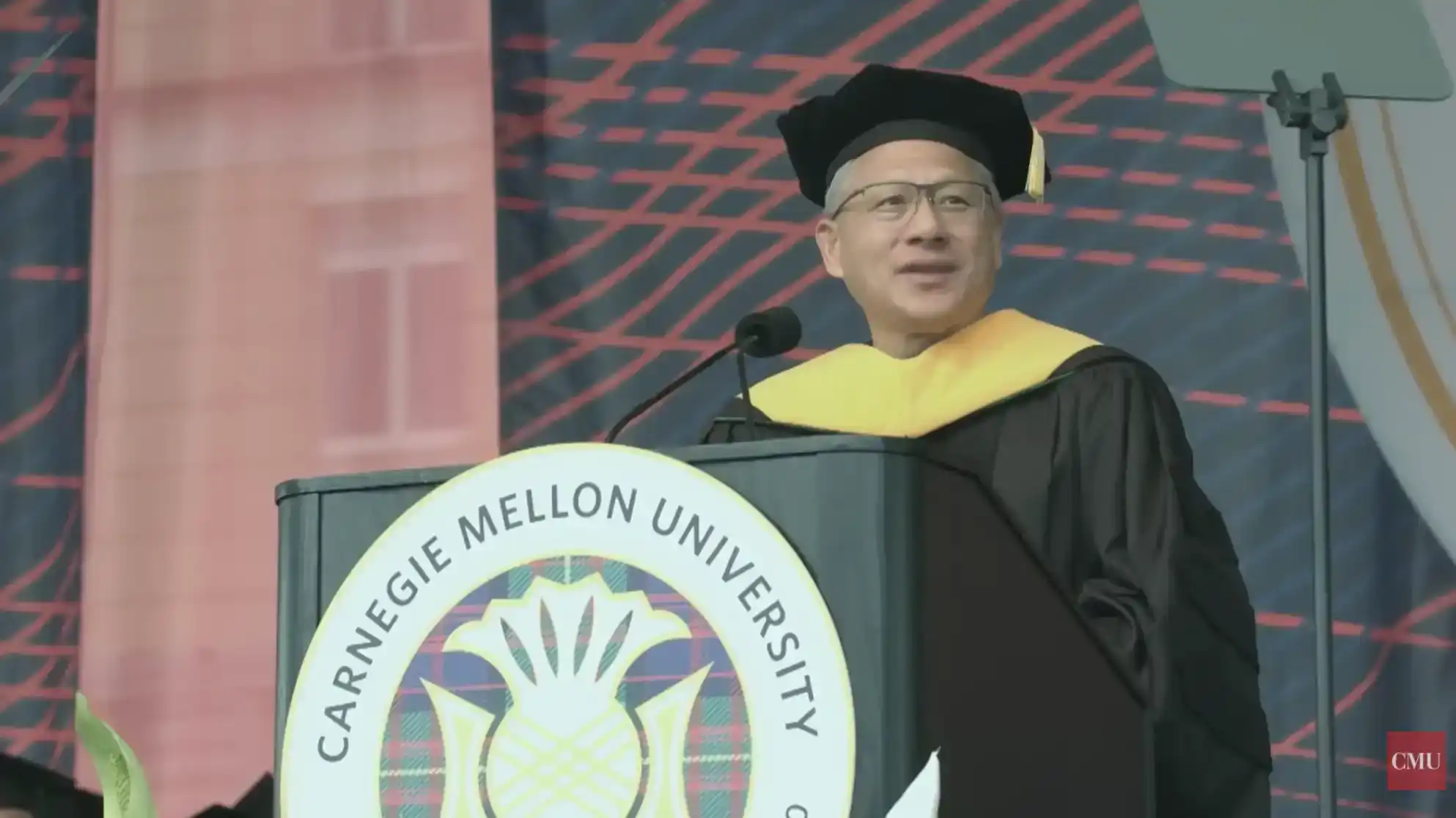
Jensen Huang's CMU Speech: In the AI Era, Don't Just Watch, Build

Jensen Huang, CEO of NVIDIA and a first-generation immigrant, delivered the commencement address to Carnegie Mellon University's class of 2026. He shared his personal journey from a humble background to founding NVIDIA, emphasizing resilience, learning from failure, and the responsibility that comes with leadership. Huang framed the present moment as the dawn of the AI revolution, a shift he believes is more profound than previous computing waves. He described AI as fundamentally resetting computing—moving from human-written software to machines that understand, reason, and use tools. This will create a new industry for generating intelligence and transform every sector. While acknowledging AI's potential to automate tasks and displace some jobs, Huang distinguished between the *tasks* of a job and its core *purpose*. He argued AI will augment human capability, not replace humans. The real risk, he stated, is not AI itself, but people being left behind by those who effectively use AI. He presented AI as a generational opportunity for massive infrastructure investment—in chip factories, data centers, energy grids, and advanced manufacturing—that could re-industrialize nations like the U.S. and bridge the digital divide by making computing and intelligent tools accessible to all. Huang called for a balanced approach: advancing AI safely and responsibly, establishing prudent policies, ensuring broad access, and encouraging universal participation. He urged the graduates not to fear the future but to engage with optimism and ambition, reminding them of CMU's motto, "My heart is in the work." His core message was clear: this is their moment to actively build and shape the AI-powered future, not merely observe it.

marsbit24m ago

Jensen Huang's CMU Speech: In the AI Era, Don't Just Watch, Build

marsbit24m ago

The Era Has Arrived Where Human Writers Must Prove They Are Not Machines

The article describes an era where AI-generated content is flooding the market, forcing human authors to prove they are not machines. It begins with the example of dozens of AI-written, error-ridden biographies of Henry Kissinger appearing on Amazon within hours of his death, a pattern repeated for other deceased celebrities and even living experts who find fraudulent books under their names. This spam content has exploded, with monthly new book releases on platforms like Amazon reaching 300,000 by late 2025. The issue spans genres, from suspiciously high proportions of AI-written teen romance and self-help books to dangerous, AI-generated foraging guides containing lethal advice. The platforms' automated review systems, designed to catch plagiarism and banned words, are ill-equipped to detect AI-generated text that avoids these pitfalls while being nonsensical or fraudulent. The problem has infiltrated traditional publishing. A major publisher, Hachette, had to recall a bestselling horror novel after AI detection tools suggested 78% of its content was machine-generated. An acclaimed European philosophy book was later revealed to be entirely written by AI under a fake author persona. In response, authors are fighting back. At the 2026 London Book Fair, 10,000 writers published a blank book titled "Don't Steal This Book" containing only their signatures—using emptiness as a protest weapon in an age of AI overproduction. Initiatives like the "Human Author Certification" program have emerged, ironically placing the burden on humans to prove their work is not machine-made. The article warns of a vicious cycle: AI-generated low-quality books pollute the data used to train future AI models, leading to "model collapse" and an ever-worsening flood of digital waste, eroding trust in publishing and devaluing human creativity.

marsbit49m ago

The Era Has Arrived Where Human Writers Must Prove They Are Not Machines

marsbit49m ago

Trading

Spot
Futures
活动图片