Blockworks: Strategy 2026 Bitcoin Accumulation Logic Has Changed

marsbitPublished on 2026-02-22Last updated on 2026-02-22

Abstract

Strategic Shift in MicroStrategy's Bitcoin Accumulation Strategy by 2026 MicroStrategy, holding nearly 680,000 BTC, is undergoing a significant shift in its financing model for Bitcoin acquisitions. Unlike the low-to-zero interest convertible bonds used in 2024-2025, the company is now turning to higher-cost preferred shares and dilutive common stock offerings (ATM issuances). This change is driven by the narrowing premium of its stock price relative to its Bitcoin NAV (mNAV), making previous low-cost financing less effective. While MicroStrategy resumed purchases in early 2026, buying 1,283 BTC, its deployment of capital has become more intermittent. The new financing structure increases costs and risks diluting the Bitcoin-per-share ratio, constraining the firm's ability to sustain large, consistent buying pressure. Consequently, its influence on Bitcoin's price is expected to diminish, making ETF flows and broader crypto market sentiment more dominant price drivers. MicroStrategy remains a key market indicator, but its buying activity will be less impactful and more sporadic.

Author: Blockworks

Compiled by: Deep Tide TechFlow

Deep Tide Guide: Strategy holds nearly 680,000 Bitcoins, but its financing model is quietly shifting. From zero-coupon convertible bonds in 2024 to high-cost preferred shares and dilutive stock issuances in 2026, the Bitcoin content per share is being diluted. This article breaks down the actual impact of this structural change on the BTC price—notably, its buying will shift from continuous to intermittent.

Strategy Executive Chairman Michael Saylor | DAS 2025 New York Summit, Photo: Mike Lawrence for Blockworks

Strategy has re-emerged as a visible treasury buyer in the Bitcoin market, but the financing context is vastly different compared to 2024-2025.

At the end of December last year, Strategy completed a round of financing but barely deployed the funds into Bitcoin. From December 29 to 31, the company sold 1,255,911 MSTR, raising a net $195.9 million, yet only bought 3 Bitcoins. Deployment resumed in January: from January 1 to 4, it sold another 735,000 shares, raising a net $116.3 million, and bought 1,283 Bitcoins at an average price of $90,391 per coin, spending $116 million. Total holdings thus rose to 673,783 Bitcoins.

A more critical signal lies in the change in financing structure. From 2024 to early 2025, Strategy financed through low-cost convertible bonds—cash coupons as low as 0.625% to 2.25%, and later issued multiple zero-coupon convertible bonds. This strategy worked best when MSTR traded at a premium to Bitcoin NAV (mNAV > 1), as the equity option value itself was attractive.
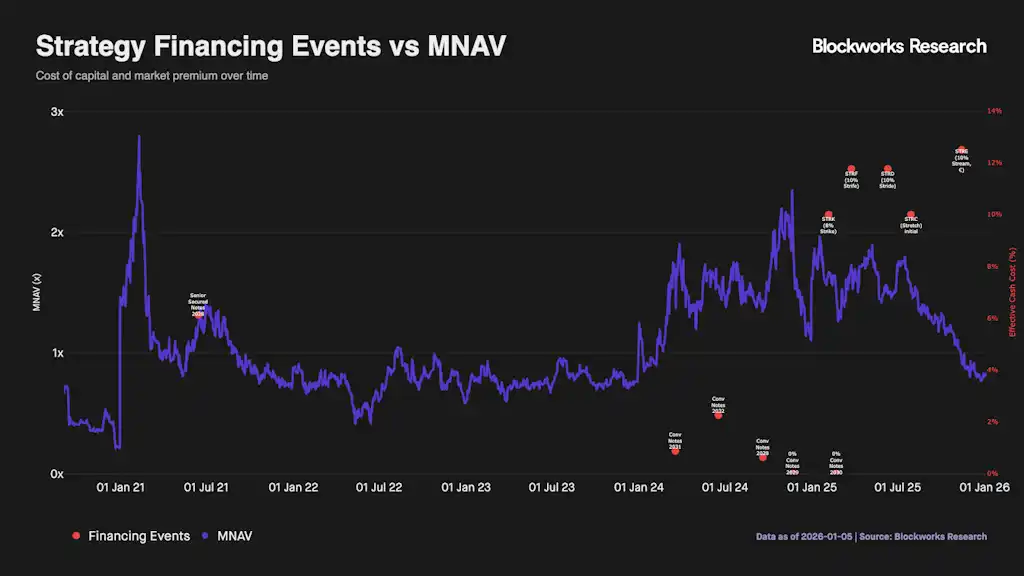
Over a longer time frame, the marginal buying in 2025 was essentially a two-horse race: spot ETFs and Strategy. Looking at the cumulative accumulation chart, Strategy was on par with ETF inflows for a significant portion of the year, meaning its influence on price at certain stages was comparable to that of the ETF group.
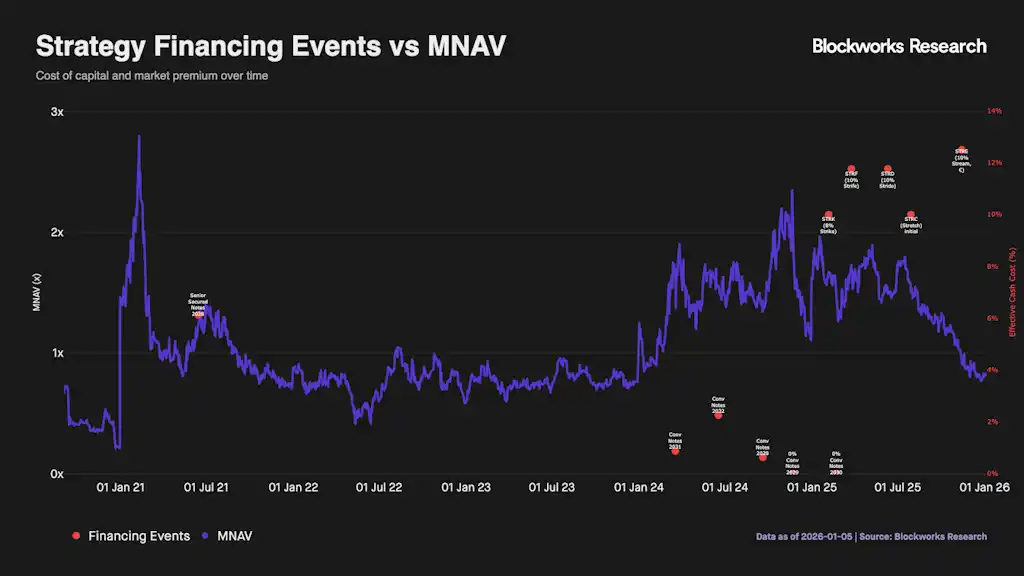
Conditions in 2026 are significantly weaker. As mNAV narrows, the financing method has shifted to preferred shares with double-digit costs and dilutive ATM common stock offerings. It is difficult for Strategy to continue large-scale purchases without worsening the Bitcoin content per share. Strategy remains a barometer of market sentiment, but its buying pressure will be more moderate and intermittent. ETF fund flows and overall crypto market risk appetite will become more reliable price determinants.


Related Questions

QHow has MicroStrategy's financing model for Bitcoin acquisition changed from 2024 to 2026?

AMicroStrategy's financing model has shifted from low-cost convertible bonds (with cash coupons of 0.625% to 2.25%, and even zero-coupon bonds) in 2024-2025 to higher-cost preferred stock and dilutive ATM common stock offerings in 2026.

QWhat impact does the change in MicroStrategy's financing have on its Bitcoin holdings per share?

AThe shift to higher-cost preferred stock and dilutive ATM common stock offerings makes it difficult for MicroStrategy to continue large-scale Bitcoin purchases without worsening the Bitcoin content per share, leading to potential dilution.

QHow did MicroStrategy's Bitcoin purchasing behavior change in late December and early January according to the article?

AIn late December, MicroStrategy sold shares and raised $195.9 million but only bought 3 Bitcoin. In early January, it sold more shares, raised $116.3 million, and used approximately $116 million to buy 1,283 Bitcoin at an average price of $90,391 per Bitcoin.

QWhat was the significance of MicroStrategy's buying pressure in 2025 compared to Bitcoin ETFs?

AIn 2025, MicroStrategy's marginal buying pressure was often on par with that of spot Bitcoin ETFs, meaning it had a comparable influence on Bitcoin's price at certain stages.

QWhat are the expected characteristics of MicroStrategy's future Bitcoin buying pressure in 2026?

AIn 2026, MicroStrategy's buying pressure is expected to be more moderate and intermittent, with ETF flows and overall crypto market risk appetite becoming more reliable determinants of Bitcoin's price.

Related Reads

Has the 'Digital Gold' Narrative for BTC Failed?

**Title: Has the "Digital Gold" Narrative for Bitcoin Failed?** The article argues that Bitcoin's "digital gold" narrative remains valid despite a recent sharp price decline (from a peak near $126k in Oct 2025 to briefly under $61k in Feb 2026). It presents a long-term investment framework based on three core points: **1. Viewing Bitcoin as an Asset:** Bitcoin is presented as a superior potential store of value compared to gold. Key arguments are its absolute scarcity (21 million cap), superior portability, and transparent auditability via its public ledger. While acknowledging its current use in early, volatile stages (~3-4% global adoption), the author draws parallels to the early, disruptive phases of the internet and e-commerce. **2. Understanding the Recent Downturn:** The current ~50% correction is framed as a predictable, consensus-driven cycle following its post-halving peak (the 2024 halving preceded the Oct 2025 high). A crucial factor is a historic "changing of hands": the influx of new institutional buyers via ETFs allowed early, low-cost holders (miners, OG believers) to take profits. The author notes that while severe, Bitcoin's historical drawdowns (e.g., 93% in 2011, 77% in 2021-22) have been progressively smaller, suggesting maturing holder structure and decreasing volatility over time. **3. The Long-Term Perspective:** The long-term thesis hinges on Bitcoin capturing a portion of gold's market value. With Bitcoin's market cap at ~$1.4 trillion (at $70k) versus gold's ~$20 trillion, significant upside potential exists if the "digital gold" narrative is partially realized. However, the author strongly cautions that short-term risks remain, the bottom is unpredictable, and high volatility is inherent. The real risk is not Bitcoin failing but poor personal position management (over-leverage, wrong capital) and a lack of deep understanding, which can force investors out during severe downturns. The conclusion uses Amazon's 95% crash post-2000 dot-com bubble and subsequent 42x recovery as an analogy. The ultimate question is not if Bitcoin's price will rise, but if an investor's strategy and conviction can withstand the volatility to see the long-term play out. The recent divergence (gold up, Bitcoin down) is posed not as a narrative failure, but as potential evidence of this ongoing, painful transition from a speculative asset to a mainstream allocation.

marsbit6h ago

Has the 'Digital Gold' Narrative for BTC Failed?

marsbit6h ago

Has BTC's 'Digital Gold' Narrative Failed?

The article discusses Bitcoin's "digital gold" narrative, its recent price drop, and long-term outlook through the perspective of "Jason". It argues the narrative is not a failure but that Bitcoin represents a superior, new asset class due to its fixed supply (21 million), portability, and auditability. The piece compares its current ~3-4% global adoption rate to early internet/e-commerce, suggesting significant growth potential. Regarding the 2025-2026 price decline (from ~$126k to briefly under $61k), the author views it as a predictable, consensus-driven sell-off within Bitcoin's ~4-year cycle post-halving, exacerbated by a major "handover" from early, low-cost holders to new institutional buyers via ETFs. A key observation is that historical peak-to-trough drawdowns have lessened over time (e.g., 93% in 2011 to ~50% in 2026), indicating maturing volatility as holder structure changes. For the long term, the author uses a simple framework: Bitcoin's total market cap (~$1.4T at $70k) is only about 7% of gold's (~$20T). Even capturing 30-50% of gold's value would imply substantial upside. However, the article strongly cautions against viewing this as investment advice, emphasizing extreme volatility and the critical importance of risk management, position sizing, and deep fundamental understanding to survive severe drawdowns. It concludes by drawing a parallel to Amazon's 95% crash in 2000 and subsequent 42x recovery, stressing that the key is surviving market cycles to realize long-term potential.

链捕手6h ago

Has BTC's 'Digital Gold' Narrative Failed?

链捕手6h ago

From Code to Cognition: A Ten-Thousand-Word Guide to the Evolution of the Robot Brain

"From Code to Cognition: The Evolution of Robot Brains" The journey of robotic intelligence has shifted dramatically from manually coded systems to AI-driven brains. For decades, robots relied on layered software stacks—perception, state estimation, planning, control—each handcrafted. While predictable, they lacked adaptability. The 2010s saw deep learning revolutionize perception (e.g., object detection) and control (via reinforcement learning), but learned skills remained narrow. The arrival of Large Language Models (LLMs) marked a turning point. LLMs acted as high-level planners, interpreting natural language instructions and generating sequences of actions for traditional robotic systems to execute. However, true integration came with Visual-Language-Action (VLA) models, which fused vision, language, and motion prediction into a single network. Pioneered by models like RT-2 and open-source projects like OpenVLA, VLAs enable robots to reason and act directly from visual input and commands. The most advanced humanoid robots now employ a "dual-brain" architecture: a slow-thinking, large VLA (System 2) for reasoning and planning, and a fast-reacting, small network (System 1) for high-frequency motion control, sometimes with an even lower-level System 0 for balance. This split balances cognition with the physics of real-time movement. Computation is split between onboard hardware (e.g., NVIDIA Jetson) for safety-critical control loops and cloud/edge servers for non-critical tasks like learning and interfaces. A crucial driver is the open-source ecosystem—models like GR00T and OpenVLA allow startups to build upon pre-trained brains and fine-tune them with their own data, accelerating development. Despite progress, current systems struggle with recovery from errors, sample inefficiency, and long-horizon tasks. This has spurred the rise of **World Models**—neural networks that predict the consequences of actions. By simulating possible futures before acting (like NVIDIA Cosmos or Meta V-JEPA), robots can plan, recover, and generalize better. This represents the next frontier: shifting intelligence from learned reactions to an internal model of physics and cause-and-effect. The field is rapidly evolving. While not yet at its "ChatGPT moment," the convergence of cheaper hardware, scalable simulation, and world models points toward robots that are increasingly capable, adaptive, and useful. The question is shifting from "what can robots do?" to "what *should* they do?"

marsbit7h ago

From Code to Cognition: A Ten-Thousand-Word Guide to the Evolution of the Robot Brain

marsbit7h ago

Trading

Spot
Futures

Hot Articles

What is $BITCOIN

DIGITAL GOLD ($BITCOIN): A Comprehensive Analysis Introduction to DIGITAL GOLD ($BITCOIN) DIGITAL GOLD ($BITCOIN) is a blockchain-based project operating on the Solana network, which aims to combine the characteristics of traditional precious metals with the innovation of decentralized technologies. While it shares a name with Bitcoin, often referred to as “digital gold” due to its perception as a store of value, DIGITAL GOLD is a separate token designed to create a unique ecosystem within the Web3 landscape. Its goal is to position itself as a viable alternative digital asset, although specifics regarding its applications and functionalities are still developing. What is DIGITAL GOLD ($BITCOIN)? DIGITAL GOLD ($BITCOIN) is a cryptocurrency token explicitly designed for use on the Solana blockchain. In contrast to Bitcoin, which provides a widely recognized value storage role, this token appears to focus on broader applications and characteristics. Notable aspects include: Blockchain Infrastructure: The token is built on the Solana blockchain, known for its capacity to handle high-speed and low-cost transactions. Supply Dynamics: DIGITAL GOLD has a maximum supply capped at 100 quadrillion tokens (100P $BITCOIN), although details regarding its circulating supply are currently undisclosed. Utility: While precise functionalities are not explicitly outlined, there are indications that the token could be utilized for various applications, potentially involving decentralized applications (dApps) or asset tokenization strategies. Who is the Creator of DIGITAL GOLD ($BITCOIN)? At present, the identity of the creators and development team behind DIGITAL GOLD ($BITCOIN) remains unknown. This situation is typical among many innovative projects within the blockchain space, particularly those aligning with decentralized finance and meme coin phenomena. While such anonymity may foster a community-driven culture, it intensifies concerns about governance and accountability. Who are the Investors of DIGITAL GOLD ($BITCOIN)? The available information indicates that DIGITAL GOLD ($BITCOIN) does not have any known institutional backers or prominent venture capital investments. The project seems to operate on a peer-to-peer model focused on community support and adoption rather than traditional funding routes. Its activity and liquidity are primarily situated on decentralized exchanges (DEXs), such as PumpSwap, rather than established centralized trading platforms, further highlighting its grassroots approach. How DIGITAL GOLD ($BITCOIN) Works The operational mechanics of DIGITAL GOLD ($BITCOIN) can be elaborated on based on its blockchain design and network attributes: Consensus Mechanism: By leveraging Solana’s unique proof-of-history (PoH) combined with a proof-of-stake (PoS) model, the project ensures efficient transaction validation contributing to the network's high performance. Tokenomics: While specific deflationary mechanisms have not been extensively detailed, the vast maximum token supply implies that it may cater to microtransactions or niche use cases that are still to be defined. Interoperability: There exists the potential for integration with Solana’s broader ecosystem, including various decentralized finance (DeFi) platforms. However, the details regarding specific integrations remain unspecified. Timeline of Key Events Here is a timeline that highlights significant milestones concerning DIGITAL GOLD ($BITCOIN): 2023: The initial deployment of the token occurs on the Solana blockchain, marked by its contract address. 2024: DIGITAL GOLD gains visibility as it becomes available for trading on decentralized exchanges like PumpSwap, allowing users to trade it against SOL. 2025: The project witnesses sporadic trading activity and potential interest in community-led engagements, although no noteworthy partnerships or technical advancements have been documented as of yet. Critical Analysis Strengths Scalability: The underlying Solana infrastructure supports high transaction volumes, which could enhance the utility of $BITCOIN in various transaction scenarios. Accessibility: The potential low trading price per token could attract retail investors, facilitating wider participation due to fractional ownership opportunities. Risks Lack of Transparency: The absence of publicly known backers, developers, or an audit process may yield skepticism regarding the project's sustainability and trustworthiness. Market Volatility: The trading activity is heavily reliant on speculative behavior, which can result in significant price volatility and uncertainty for investors. Conclusion DIGITAL GOLD ($BITCOIN) emerges as an intriguing yet ambiguous project within the rapidly evolving Solana ecosystem. While it attempts to leverage the “digital gold” narrative, its departure from Bitcoin's established role as a store of value underscores the need for a clearer differentiation of its intended utility and governance structure. Future acceptance and adoption will likely depend on addressing the current opacity and defining its operational and economic strategies more explicitly. Note: This report encompasses synthesised information available as of October 2023, and developments may have transpired beyond the research period.

363 Total ViewsPublished 2025.05.13Updated 2025.05.13

What is $BITCOIN

Discussions

Welcome to the HTX Community. Here, you can stay informed about the latest platform developments and gain access to professional market insights. Users' opinions on the price of BTC (BTC) are presented below.

活动图片