Blockchain Association says no to expanding stablecoin yield prohibition

cointelegraphPublished on 2025-12-19Last updated on 2025-12-19

Abstract

The Blockchain Association, along with over 125 crypto industry groups, has written to the US Senate Committee on Banking opposing a proposed expansion of the ban on offering yield rewards to stablecoin holders. The letter argues that extending the prohibition—originally targeting stablecoin issuers under the GENIUS Act to include third-party platforms—would stifle innovation, increase market concentration, and unfairly disadvantage crypto services compared to traditional financial providers like banks and credit card companies that offer similar rewards. The Association contends that stablecoin rewards help consumers offset inflation and are a standard feature of competitive markets. It also challenges banking industry claims that yield-bearing stablecoins threaten bank lending, stating there is no evidence to support such concerns. Additionally, the letter comes as the FDIC proposes rules allowing banks to issue stablecoins through subsidiaries, subject to reserve requirements and regulatory oversight.

The Blockchain Association, a non-profit crypto advocacy organization, wrote a letter to the US Senate Committee on Banking, signed by over 125 crypto industry groups and companies, opposing the ban on third-party service providers and platforms offering customer rewards to stablecoin holders.

Expanding the prohibition on stablecoin issuers sharing yield directly with customers, outlined in the GENIUS stablecoin regulatory framework, to include third-party service providers stifles innovation and leads to “greater market concentration,” the letter said.

The letter compared the rewards offered by crypto platforms to those offered by credit card companies, banks and other traditional payment providers.
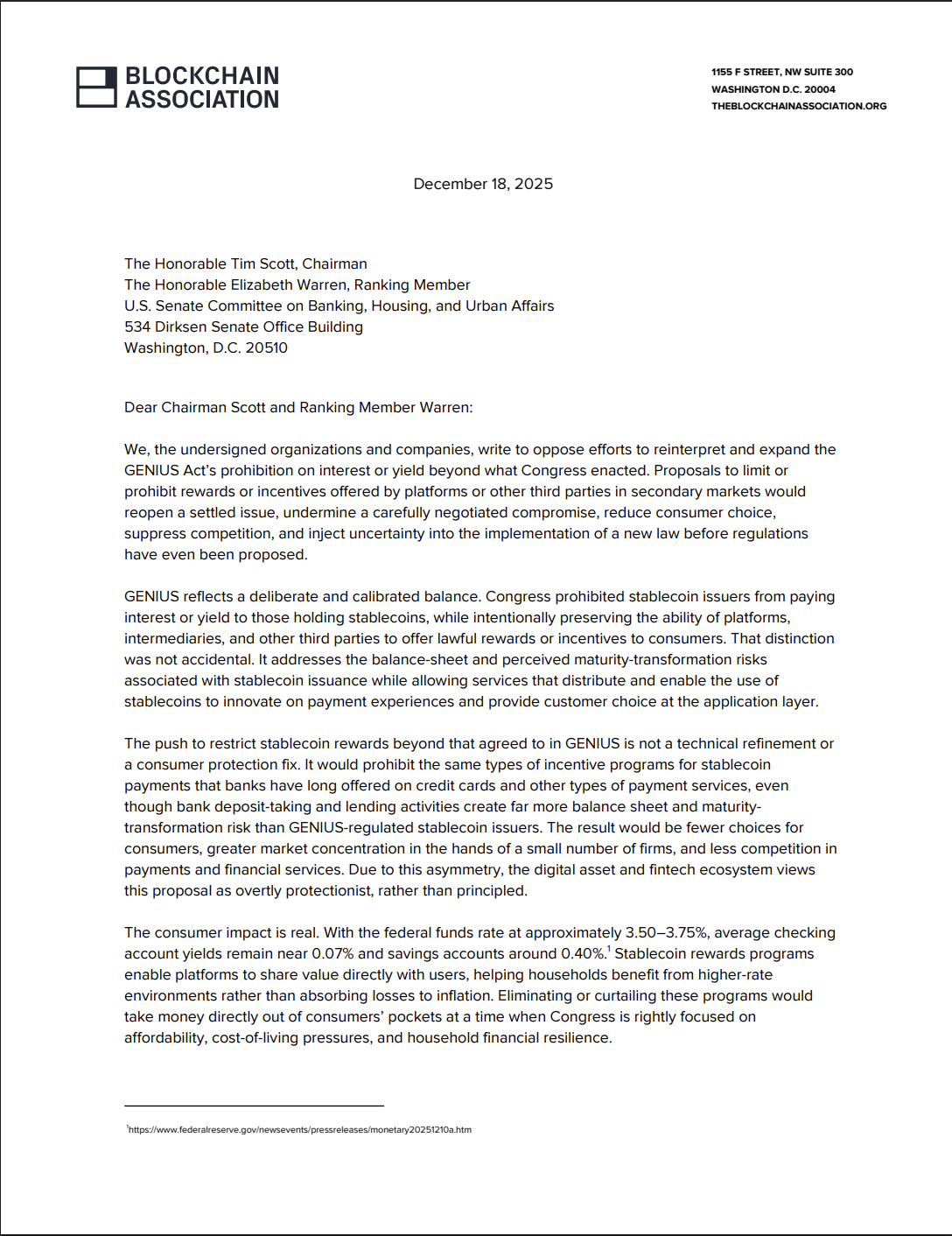
The letter opposes efforts to stop crypto platforms from sharing yield with customers. Source: The Blockchain Association

Prohibiting crypto platforms from offering similar rewards for stablecoins gives an unfair advantage to incumbent financial service providers, the Blockchain Association said.

“The potential benefits of payment stablecoins will not be realized if these types of payments cannot compete on a level playing field with other payment mechanisms. Rewards and incentives are a standard feature of competitive markets.”

The Blockchain Association has issued several statements and letters pushing back against efforts to prohibit crypto platforms from sharing yield-bearing opportunities with customers, arguing that these rewards help consumers offset inflation.

Related: Bank of Canada lays out criteria for ‘good money’ stablecoins

FDIC paves the way for banks to issue stablecoins, industry group says stables aren’t a threat

The Federal Deposit Insurance Corporation (FDIC), the US regulatory agency that oversees and insures the banking sector, published a proposal on Tuesday that would allow banks to issue stablecoins through subsidiaries.

Under the proposal, both the bank and its stablecoin subsidiary would be subject to FDIC rules and assessments for financial fitness, including reserve requirements.
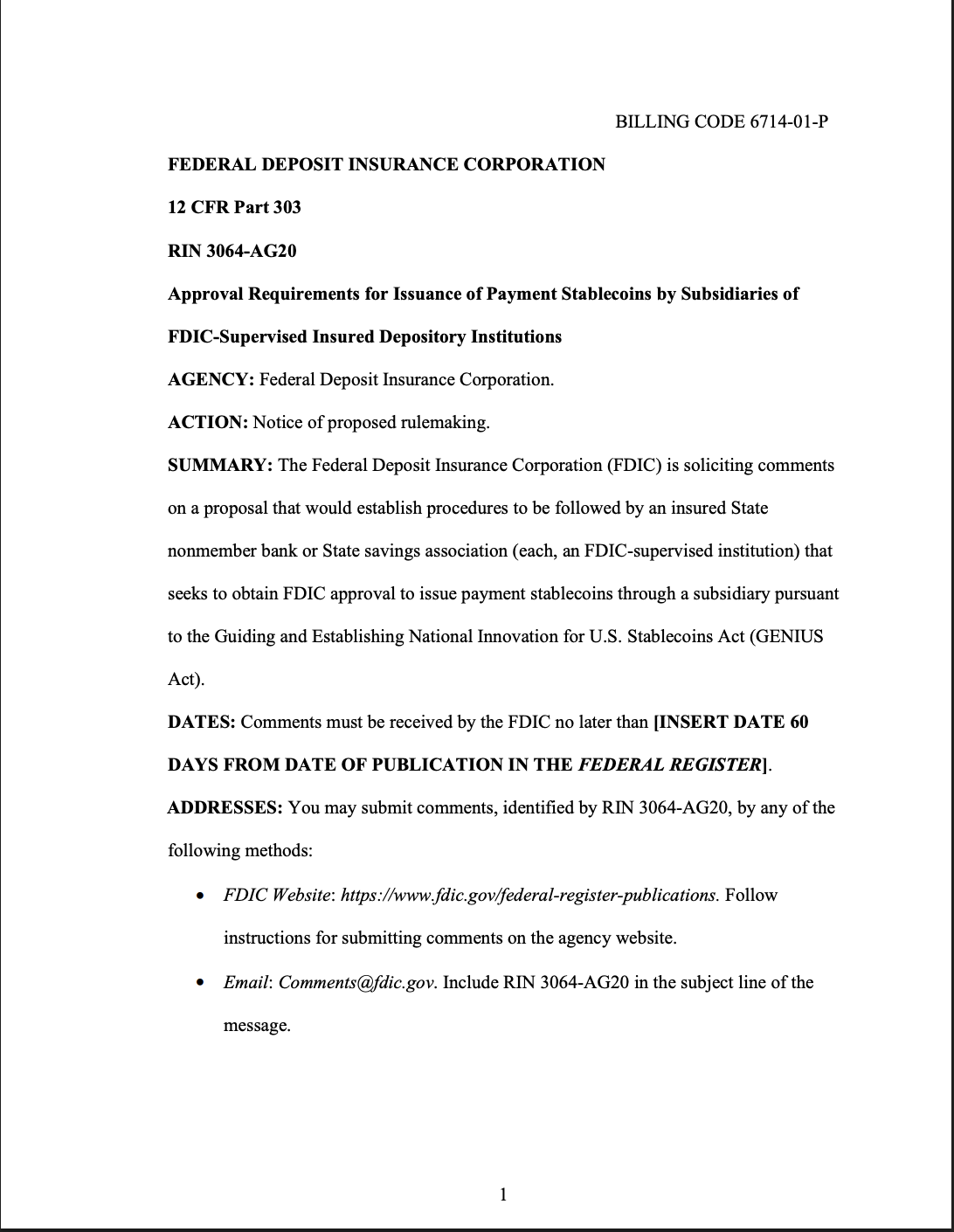
The FDIC proposal to allow banks to issue stablecoins. Source: FDIC

The Blockchain Association continues to push back on claims that yield-bearing stablecoins and sharing rewards with customers threaten the banking sector and bank lending.

“Evidence does not support claims that stablecoin rewards threaten community banks or lending capacity,” the Blockchain Association said, adding that it is difficult to make the case that bank lending is actually constrained by customer deposits.

Despite this, the banking industry has lobbied against yield-bearing stablecoins and crypto platforms sharing yield with clients over fears that interest offered on digital asset products will erode the market share of banks.

Magazine: Unstablecoins: Depegging, bank runs and other risks loom

Related Questions

QWhat is the Blockchain Association's main argument against expanding the stablecoin yield prohibition to third-party service providers?

AThe Blockchain Association argues that expanding the prohibition to third-party service providers stifles innovation, leads to greater market concentration, and gives an unfair advantage to traditional financial service providers by preventing crypto platforms from competing on a level playing field.

QHow does the Blockchain Association compare the rewards offered by crypto platforms to those in traditional finance?

AThe letter compares the rewards offered by crypto platforms to the rewards offered by credit card companies, banks, and other traditional payment providers, stating that such incentives are a standard feature of competitive markets.

QWhat recent proposal did the FDIC make regarding banks and stablecoins?

AThe FDIC published a proposal that would allow banks to issue stablecoins through subsidiaries, with both the bank and its subsidiary being subject to FDIC rules, assessments for financial fitness, and reserve requirements.

QWhat is the banking industry's primary concern regarding yield-bearing stablecoins, according to the article?

AThe banking industry fears that the interest offered on digital asset products like yield-bearing stablecoins will erode their market share, leading them to lobby against these products and platforms sharing yield with clients.

QWhat reason does the Blockchain Association give for supporting the ability of platforms to share yield with stablecoin holders?

AThe Blockchain Association argues that these rewards help consumers offset inflation and are necessary for the potential benefits of payment stablecoins to be realized in a competitive market.

Related Reads

Within Strategy's Framework, STRC's Dividend Yield Remains at 12% as Share Price Stays Below Par Value

Michael Saylor, Executive Chairman of Strategy (MSTR), confirmed that the dividend rate for its STRC perpetual preferred shares will remain at 12.00% through August 2026. The rate has increased from 9% at its July 2025 launch to the current high via a "ratchet" mechanism, which permanently raises the rate by 0.5% whenever the share price falls below $95. This mechanism is intended to push the price back toward its $100 par value and support Strategy's "at-the-market" (ATM) program for issuing new shares to fund Bitcoin purchases. However, the mechanism has not worked as intended. STRC shares closed at $89.46 on July 31, remaining about 10-11% below par value despite the record-high dividend. Competition from rival Strive's higher-yielding SATA securities has pressured demand. The persistent discount has forced Strategy to suspend new STRC issuances via its ATM program, limiting this funding channel for Bitcoin acquisitions. STRC's struggles reflect Bitcoin's own volatility, as the preferred shares historically move in tandem. Analysts have warned the ratchet structure carries long-term, one-way risk. A law firm is investigating Strategy's ability to maintain dividend payments if Bitcoin's price stays low. Retail investors own roughly 83% of outstanding STRC shares, a group seen as prone to panic selling during downturns. In response, Strategy has established financial reserves, including a liquidity cushion covering about 26 months of dividend/interest obligations, and a $2 billion share buyback program alongside a Bitcoin monetization framework, though the company emphasized it is not obligated to sell any Bitcoin.

cryptonews.ru30m ago

Within Strategy's Framework, STRC's Dividend Yield Remains at 12% as Share Price Stays Below Par Value

cryptonews.ru30m ago

Analyst: Bitcoin's Price Will Drop to $60k in August, Then Rebound to $70k

Financial analyst Andrey Poroshin has provided a new forecast for Bitcoin's price dynamics in August. Poroshin, an analyst at the Bitbanker exchange, expects the cryptocurrency market to experience a downturn this month, with prices retesting the $60,000 level due to a lack of supportive macroeconomic catalysts. He noted that the recent US Federal Reserve decision to hold interest rates did not significantly impact the market, while inflation remains above the 2% target. Poroshin stated that Bitcoin is ending July under pressure from moderate volatility and a lack of new macroeconomic stimuli, leading to continued market caution. According to his base scenario, Bitcoin will drop to a range of $60,000 to $62,000 before recovering to $70,000. He pointed out that even $70,000 remains below the cost of mining in the US, which has prompted some miners to shift towards AI data center operations. Poroshin cited the winding down of BitMEX's operations as a potential catalyst for a price rebound, suggesting the exit of weaker players often coincides with market reversals and reduced short-term selling pressure. He believes Bitcoin is currently less susceptible to geopolitical shocks, such as the Iran-US conflict, and does not expect significant market changes in August related to the pending CLARITY Act. Looking ahead, Poroshin forecasts that September will bring more active price fluctuations driven by potential Fed rate decisions and possible discussions or approval of the CLARITY Act.

cryptonews.ru31m ago

Analyst: Bitcoin's Price Will Drop to $60k in August, Then Rebound to $70k

cryptonews.ru31m ago

Trading

Spot
活动图片





