Author: @BlazingKevin_, Blockbooster Researcher
The integration of Web3 and AI is moving beyond its early stages. The market's scrutiny of the AI crypto sector is shifting from early "concept hype" to "fundamentals and technological implementation." In this transition, projects demonstrating exceptional resilience and technological breakthroughs are reshaping the market's valuation framework.
1 Bittensor Firmly Secures Its Leading Position
The total market capitalization of the current AI cryptocurrency sector is approximately $17.46 billion, with a 24-hour trading volume nearing $1.94 billion. Within this sector, Bittensor (TAO) holds the top spot with a market cap of about $3.43 billion. It commands nearly 19.6% of the entire AI crypto market share, establishing an absolute leading position.
A horizontal comparison with core competitors intuitively illustrates its niche:
| Competitor | Token | Market Cap (Billion USD) | Core Positioning | Differentiation from TAO |
|---|---|---|---|---|
| Bittensor | TAO | 34.3 | Decentralized AI Incentive Network | |
| NEAR Protocol | NEAR | 14.9 | High-Performance L1 Public Chain | General-purpose public chain, AI is part of its ecosystem |
| Render Network | RENDER | 8.64 | Decentralized GPU Rendering/Computing | Pure computing infrastructure, no AI quality incentives |
| Fetch.ai (ASI) | FET | 5.33 | Autonomous AI Agent Network | Focuses on AI application layer, not underlying model training |
| Akash Network | AKT | 1.26 | Decentralized Cloud Computing Marketplace | General-purpose computing market, lacks complex AI consensus mechanism |
Core Competitive Barriers
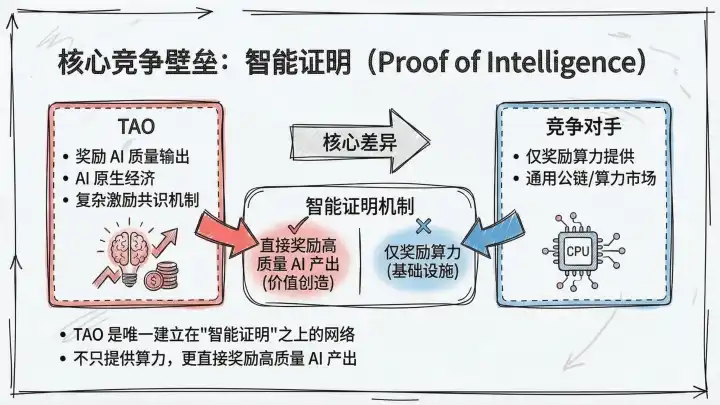
Bittensor's core competitive barrier is its innovative "Proof of Intelligence" network. It moves beyond the framework of merely providing computing power. The network introduces a complex incentive mechanism that directly rewards the output of high-quality AI models. This positioning is unique among competitors and is extremely difficult to simply replicate.
2 Validation of Real "Value Creation" Ability and Reshaping of Valuation Logic
Setting aside grand technological visions, the key to testing a Web3 protocol's ability to weather market cycles is its real business development and revenue generation capability.
In the crypto market, Bittensor demonstrates rare, real value creation ability. According to Q1 2026 data, the Bittensor network generated approximately $43 million in revenue from real AI customers (not fake transactions generated by token incentives). This figure already surpasses the annual revenue of many traditional Web3 protocols.
Core Valuation Metrics (As of March 29, 2026):
| Metric | Value | Explanation |
|---|---|---|
| Circulating Market Cap | ~$3.42B | Based on ~10.78M circulating supply |
| Fully Diluted Valuation (FDV) | ~$6.68B | Based on 21M total supply |
| Q1 2026 Real Revenue | ~$43M | Non-token incentive, paid by real AI customers |
| Annualized Revenue Projection | ~$172M | Linear extrapolation based on Q1 data |
| Price-to-Sales Ratio (P/S) | ~20x | Based on Circulating Market Cap / Annualized Revenue |
| FDV / Annualized Revenue | ~39x | Based on FDV / Annualized Revenue |
| Subnet Ecosystem Total Market Cap | ~$1.47B | Total market cap of dTAO Alpha tokens |
Traditional centralized AI infrastructure companies typically command 15-25x forward revenue valuations in the private market. Bittensor possesses attributes of high liquidity premium, network effects, and scarcity narrative. Its current ~20x P/S multiple is within a reasonable, even undervalued, range. The total market capitalization of subnet tokens within its ecosystem has reached $1.47 billion. This ecological structure feeds back into the value capture of the mainnet TAO.
3 The Breakthrough of SN3
Financial data establishes the lower bound for the protocol's valuation. The technological breakthrough in decentralized training completely opens up the imagination space for its market capitalization.
The core driver of TAO's counter-trend rise this time is by no means mere capital speculation. The underlying technology has achieved a historic breakthrough. Its valuation logic has fundamentally shifted from "narrative-driven" to "product-driven".
3.1 Covenant-72B Validates Feasibility of Decentralized Training
On March 10, 2026, the Bittensor ecosystem subnet Templar (SN3) and its backing team, Covenant Labs, published a technical report on arXiv. The team announced the successful completion of pre-training for the Covenant-72B large language model. This is the largest-scale dense architecture model trained to date in a completely decentralized, permissionless internet environment.
The model boasts 72 billion parameters, trained on 1.1 trillion tokens. Its MMLU score reaches 67.1, with baseline performance comparable to Meta's LLaMA-2-70B. The model broke through the communication bandwidth bottleneck of decentralized training. The introduction of the SparseLoCo algorithm played a key role. Nodes only need to transmit 1%-3% of the core gradient components and perform 2-bit quantization, achieving over 146x data compression (compressing 100MB of data to less than 1MB). Even under ordinary internet bandwidth, computational utilization remains as high as 94.5%. This milestone proves that globally distributed, heterogeneous computing power can produce cutting-edge models with commercial competitiveness. This technical solution frees itself from reliance on expensive InfiniBand dedicated lines and centralized supercomputing clusters.
The success of Covenant-72B quickly caused a stir in the traditional AI community:
- High praise from an Anthropic co-founder: On March 16, Jack Clark extensively cited this breakthrough in his research report. He characterized it as "challenging AI political economy through distributed training." He noted it is a technology worth continuous tracking and predicted that device-side AI will widely adopt such decentralized training models in the future.
- Jensen Huang's "Folding@home" analogy: On March 20, on the All-In VC podcast, Chamath introduced Bittensor's technological achievements to NVIDIA CEO Jensen Huang. Huang responded positively. He compared it to a "modern version of Folding@home" and affirmed the necessity for the coexistence of open-source and distributed models.
3.2 SN3's Two Core Components: Solving Communication Efficiency and Incentive Compatibility
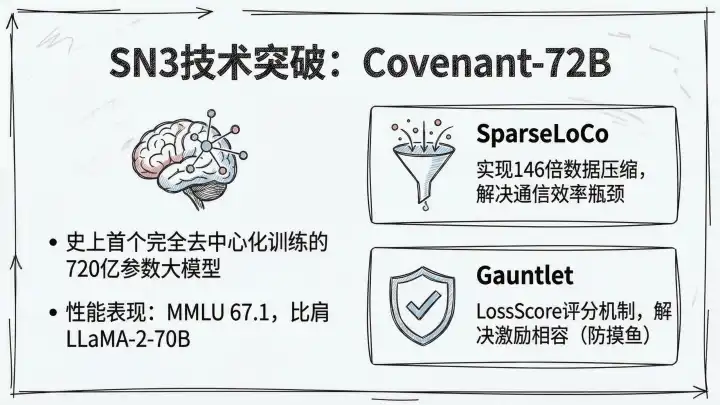
Dozens of mutually distrusting nodes, with varying hardware and network quality, collaboratively train the same 72B model. SN3 relies on two core components to solve the problems of communication bandwidth and malicious behavior:
- SparseLoCo (Solves Communication Efficiency): Traditional distributed training requires synchronizing the full gradient at every step, involving massive data. SparseLoCo allows each node to run 30 steps of internal optimization (AdamW) locally. The node then compresses and uploads the resulting "pseudo-gradient." The system employs Top-k sparsification (retaining only 1%-3% of core gradient components), error feedback, and 2-bit quantization. This process achieves over 146x data compression (compressing 100 MB data to under 1 MB). The system maintains a computational utilization rate of 94.5% even on ordinary internet (110 Mbps upload, 500 Mbps download). Each round of communication takes only 70 seconds.
- Gauntlet (Solves Incentive Compatibility): This component runs on the Subnet 3 blockchain. It is responsible for verifying the quality of the pseudo-gradient submitted by each node. The system tests the "degree of model loss reduction after applying the node's gradient" (LossScore) using a small batch of data. It also checks if the node is training with the allocated data (preventing cheating). Each aggregation round only selects the gradients from the highest-scoring nodes. This mechanism fundamentally solves the problem of "how to prevent miners from slacking off" in decentralized scenarios.
4 Subnet Ecosystem and the Super Leverage of the dTAO Mechanism
Bittensor introduced the dynamic TAO (dTAO) mechanism in 2025. This mechanism played a key "amplifier" role in this price surge. dTAO allows each subnet to issue its own independent Alpha token. Subnets establish liquidity pools with TAO through an Automated Market Maker (AMM) mechanism.
4.1 The Leverage Effect of Subnet Tokens
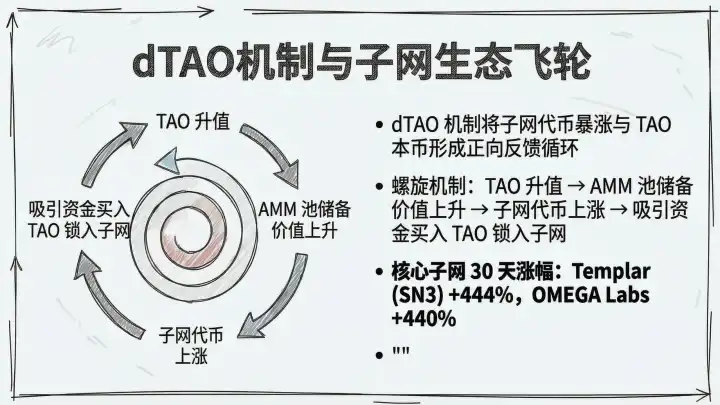
Under the dTAO mechanism, the price of a subnet token is directly determined by the amount of TAO staked in that subnet's pool. An appreciation of the TAO base currency drives up the underlying reserve value of all subnets. Subnet token prices passively rise accordingly. The暴涨 (soaring price) of subnet tokens attracts more speculative and staking funds to buy TAO and lock it into subnets. This forms a strong positive feedback loop.
| Core Subnet Token | 30-Day Price Increase | Core Business Focus |
|---|---|---|
| Templar (SN3) | +444% | Large Model Distributed Pre-training |
| OMEGA Labs | +440% | Multimodal Data Collection & Mining |
| Level 114 | +280% | - |
| BitQuant | +230% | - |
| Targon | +166% | Computing Power & Inference Services |
As the data in the table above shows, directly stimulated by the success of Covenant-72B, the SN3 (Templar) token surged over 440% in a single month. Its market capitalization reached $130 million. This wealth creation effect at the subnet level became apparent. The total market cap of subnet tokens reached $1.47 billion by the end of March. Daily trading volume exceeded $118 million. This effect acts as a "super leverage," transmitting massive buy-side pressure back to the TAO base currency.
4.2 Vertical Ecosystem Integration
While operating SN3, Covenant Labs has also布局 (laid out) SN39 (Basilica, focused on computing services) and SN81 (Grail, focused on reinforcement learning post-training and evaluation). This vertical integration covers the entire process from pre-training to alignment optimization. This layout demonstrates to the market the complete decentralized AI industry chain闭环 (closed loop) already formed within the Bittensor ecosystem.
5 Token Distribution & On-Chain Health
According to the latest on-chain data from taostats and CoinMarketCap as of March 29, 2026, the health of the Bittensor network can be deeply evaluated from the following dimensions:
| On-Chain Metric | Data Performance | Evaluation & Insight |
|---|---|---|
| Staking Rate | 68% - 75% of Circulating Supply | An extremely high staking rate (~7.34M TAO locked) significantly reduces the actual circulating supply. A strong supply squeeze effect is formed, supporting a price appreciation spiral. |
| Subnet Activity | 128 Active Subnets | A prosperous ecosystem. Top subnets like Templar (SN3) and Targon (SN4) have independent market caps in the hundreds of millions of dollars. The data proves the success of subnet tokens as "leveraged bets" under the dTAO mechanism. |
| Alpha Token Total Market Cap | ~$1.47B | This data has grown over 50x since the launch of dTAO, reflecting high market recognition of the subnet ecosystem and providing sustained demand support for the mainnet TAO. |
| Validator Concentration | Top validators hold major weight | tao.bot, Taostats, Opentensor Foundation, etc., hold relatively high weights. A certain degree of centralization objectively exists, but it also reflects the deep commitment of core builders to the network. |
| Daily Trading Volume | ~$241M | Trading Volume / Market Cap ratio is ~7.03%. Liquidity is extremely abundant. Market trading is active with high participation from institutions and retail. |
| AI Agents Deployed (90 days) | 14,500 | Reflects the growth in actual network usage, an important metric for measuring real demand. |
Comprehensive On-Chain Data Evaluation:
Bittensor's on-chain data exhibits the characteristics of an extremely healthy economy. A high staking rate locks liquidity. Real revenue supports the fundamentals. The dTAO mechanism stimulates subnet innovation. Continuous supply-side tightening (including halving and high staking) combined with sustained demand-side growth (covering institutional entry and strengthened AI narrative) constructs a highly advantageous price dynamics model.
6 Valuation Concerns
It is important to note that the transparency of on-chain data is mainly on the supply side; the off-chain nature of the demand side (real AI service call volume) remains a significant information blind spot:
Risk One: High Token Subsidies Mask Real Business Costs The current low-cost services of most subnets heavily rely on TAO token inflation subsidies. Taking the top inference subnet Chutes (SN64) as an example, the ratio of its issuance subsidy to external revenue is as high as 22-40:1. Factoring out token subsidies, its real service pricing far exceeds that of centralized competitors. Compared to platforms like Together.ai, its service premium is 1.6 to 3.5 times higher. The continued progression of subsequent halving cycles will fully expose the fragility of this business model.
Risk Two: Lack of Business Moat Makes Users Highly Prone to Churn The Bittensor network primarily provides open-source models and standardized APIs. This model is fundamentally different from traditional cloud giants like AWS. The ecosystem internally lacks proprietary platforms, deep enterprise integration, or data flywheel effects—traditional forms of "lock-in effect." Developer migration costs are extremely low. Once token subsidies recede, price-sensitive B2B users will quickly churn. Lower-cost centralized computing platforms will easily capture this fleeing traffic.
Risk Three: Valuation Dislocation Risk After Data Scrutiny Regarding the aforementioned Q1 revenue of $43 million, some cautious institutional research offers截然不同的 (starkly different) calculation models. After剔除 (removing) related-party transactions within the ecosystem and subsidies, and only counting rigorously verified real external fiat revenue, the network's annualized revenue scale might plummet to the range of $3 million to $15 million. Using this "de-watered" real revenue base, the network's actual Price-to-Sales (P/S) multiple would soar to an extremely dangerous range of 175-400x. The risk of a valuation bubble burst objectively exists.