Bitmine Increases Holdings to 5.7 Million ETH, Included in Russell 1000 Index, Tom Lee Says Only One Step Away from '5% Target'

marsbitPublished on 2026-06-30Last updated on 2026-06-30

Abstract

Bitmine Increases Ethereum Holdings, Nears 5% Supply Target and Joins Russell 1000 Bitmine Immersion Technologies (BMNR) acquired an additional 27,084 ETH last week, bringing its total holdings to 5,700,040 ETH, which represents 4.7% of Ethereum's total supply. This puts the company at 94% of its goal to own 5% of ETH's circulating supply. Despite a challenging week where ETH price fell 8% and BMNR's stock dropped 13%, Bitmine continues its accumulation strategy, with Chairman Tom Lee attributing the market weakness to quarter-end "window dressing" by investors. In a significant development, Bitmine was added to the Russell 1000 large-cap index on June 26. Lee expects this inclusion to attract hundreds of institutional investors, as passive funds and ETFs rebalance to match the index. The company's total assets, including crypto, cash, and securities, stand at $9.8 billion. Of its ETH holdings, 4,879,157 are currently staked, generating an estimated annualized revenue of $211 million. Lee projects this could rise to $246 million once all ETH is staked through its MAVAN network. Bitmine remains the world's largest corporate Ethereum treasury and the second-largest overall corporate crypto treasury, behind Strategy's substantial Bitcoin holdings. Lee reaffirmed the company's commitment to steady buying throughout 2026, expressing belief that the crypto market is still in the early stages of a spring cycle. At the time of writing, ETH was trading around $1,565, while BMNR st...

Author: Naga Avan-Nomayo

Compiled by: Deep Tide TechFlow

Deep Tide Guide: Last week, Bitmine, the world's largest corporate Ethereum treasury, purchased another 27,084 ETH, bringing its total holdings to 5.7 million, accounting for 4.7% of the total ETH supply—only 6% away from Tom Lee's goal of 'acquiring 5% of the supply.' During the same week, ETH price fell by 8%, BMNR stock dropped 13%, and it is down over 90% from its peak. Bitmine was also included in the Russell 1000 large-cap index, which Lee believes will attract hundreds of billions in passive institutional capital. Whether the logic of continuous buying can withstand the sustained price decline is the focus of this earnings review.

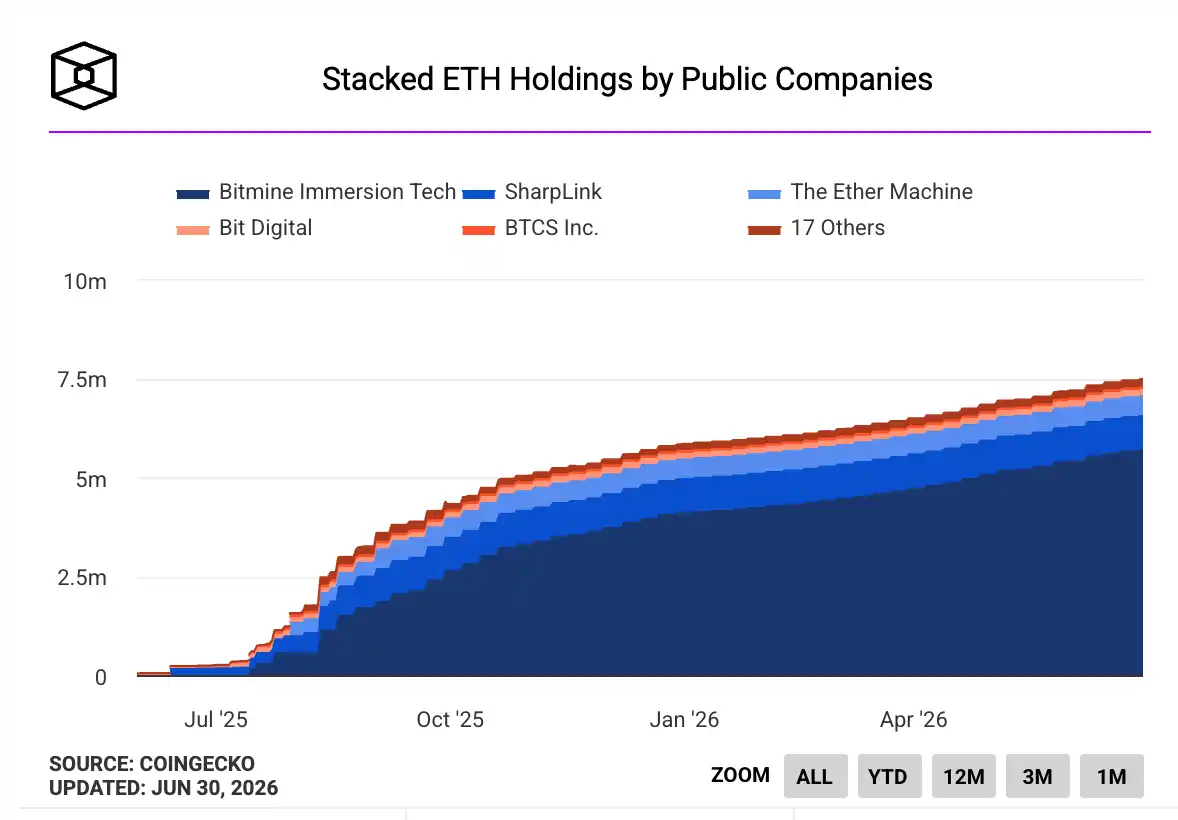
Bitmine Immersion Technologies (BMNR) increased its holdings by 27,084 ETH over the past week, bringing its total holdings to 5,700,040 ETH, achieving 94% of the goal to 'own 5% of the circulating supply of ETH.'

As of June 28, Bitmine's 5.7 million ETH holdings, valued at $1,569 per ETH, account for 4.7% of the total ETH supply. The current total ETH supply is 120.7 million. The company disclosed these figures on Monday.

Total crypto assets, cash, marketable securities, and 'moonshot' positions amount to $9.8 billion. This includes a $180 million stake in Beast Industries, a $74 million stake in Eightco Holdings, and $555 million in cash and marketable securities.
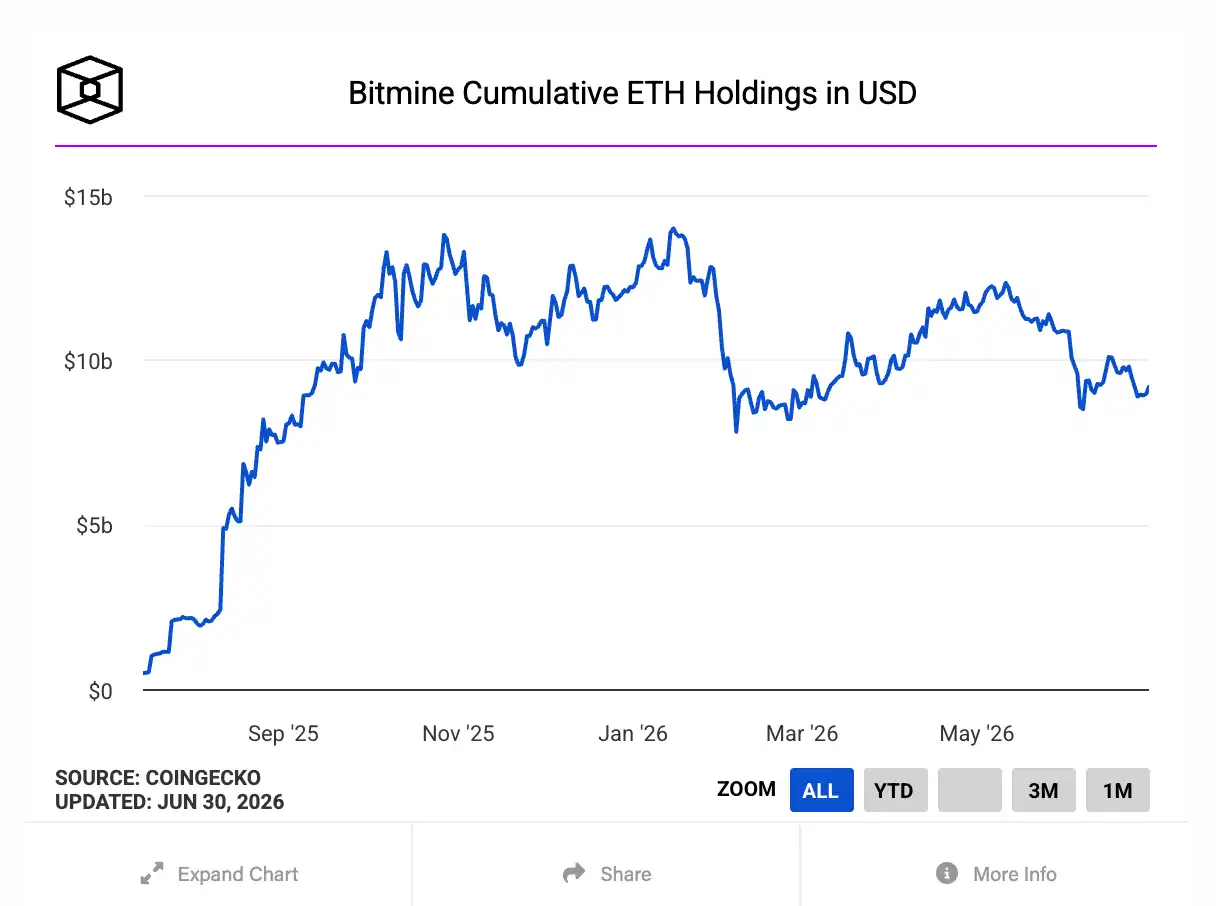
Caption: Growth of Bitmine's ETH holdings

Original chart, data source The Block

ETH Down 8% in a Week, Lee Attributes It to Quarter-End Portfolio Rebalancing

'It's been a tough week for crypto investors, with ETH down 8%. Even though Ethereum has seen several positive developments during this period, such as the establishment of Ethlabs and even the Bank of England softening its stance on stablecoins,' said Chairman Tom Lee.

Lee attributed the price weakness to quarter-end 'window dressing,' where investors sell off assets that have declined over the past three months to improve their portfolio appearance. Bitmine's buying pace slowed this week compared to the previous week when it bought 52,203 ETH in one go.

'Throughout 2026, we will maintain a steady pace of buying,' Lee said. 'We believe we are still in the early stages of a crypto spring. Bitmine is expected to achieve the '5% alchemy' goal within 2026.'

Inclusion in Russell 1000, Lee Focuses on Passive Fund Rebalancing

On June 26, as part of the annual reconstitution of the Russell indices, Bitmine was added to the Russell 1000 large-cap index.

Lee said this inclusion is expected to bring hundreds of billions of institutional investors into the stock. The reason is that passive funds and ETFs will rebalance according to index changes—according to estimates by the Investment Company Institute (ICI), such funds typically hold 18% to 20% of a company's outstanding shares.

Of the 5.7 million ETH, 4,879,157 ETH are currently staked, valued at approximately $7.7 billion as of June 28. Lee stated that the annualized revenue from this staking is projected to be $211 million.

Lee also mentioned that once all ETH is fully staked through MAVAN (Bitmine's institutional-grade validator network) and its staking partners, based on a 7-day annualized yield of 2.75%, the projected annualized staking rewards would rise to $246 million.

Bitmine remains the world's largest corporate Ethereum treasury and the second-largest corporate crypto treasury overall. Ahead of it is Strategy, which holds 847,363 BTC, worth approximately $50 billion (data from The Block).
Caption: Ranking of corporate crypto treasury sizes

Original chart, data source The Block

At the time of writing, ETH is priced at around $1,565 (according to The Block price page). BMNR was trading around $13.56 on Monday, down about 13% over the past week and more than 90% below its 52-week high of $161.00.


Trending Cryptos

Related Questions

QHow many ETH did Bitmine add to its holdings in the past week, and what is its new total holding?

AIn the past week, Bitmine added 27,084 ETH to its holdings. Its new total holding is 5,700,040 ETH.

QWhat percentage of ETH's total supply does Bitmine's current holding represent, and how close is it to Tom Lee's stated goal?

ABitmine's current holding of 5.7 million ETH represents 4.7% of the total ETH supply. This means it is 94% complete towards Tom Lee's goal of owning 5% of the supply, leaving just a 6% gap.

QWhat major stock index recently added Bitmine, and what potential effect does Tom Lee associate with this inclusion?

ABitmine was recently added to the Russell 1000 large-cap stock index. Tom Lee believes this inclusion will bring in hundreds of institutional investors through passive funds and ETFs that rebalance according to the index.

QAccording to Tom Lee, what was the primary reason for the 8% price drop in ETH over the past week?

ATom Lee attributed the 8% price drop in ETH over the past week to "window dressing" at the end of the financial quarter, where investors sell underperforming assets to improve their portfolio's appearance.

QWhat is the estimated annual staking revenue from Bitmine's currently staked ETH, and what is the projected revenue if all its ETH is staked?

AThe annual staking revenue from Bitmine's currently staked ETH is estimated at $211 million. If all its ETH is staked, the projected annual staking reward, based on a 7-day annualized yield of 2.75%, would be approximately $246 million.

Related Reads

Upbit is Anxious: A Hasty Counterattack Aimed at Regaining Stablecoin Market Share

Title: Upbit's Rushed Counterattack to Reclaim Stablecoin Market Share Facing a dramatic shift in South Korea's stablecoin market, leading exchange Upbit launched a promotional campaign from July 26 to August 9, waiving the 0.05% trading fee for stablecoins paired with the Korean Won (KRW) and rapidly listing new stablecoins like RLUSD and USDG. This move is a direct response to its plummeting market share in this sector. Historically a duopoly with Bithumb, the market has been reshaped since October 2025 when Coinone permanently removed fees for USDC trading. By June 2026, Coinone led with 34.8% of stablecoin volume, followed by Bithumb (31.1%) and Upbit (30.1%). This contrasts sharply with the overall crypto market, where Upbit commands 60%. The data shows stablecoin demand is highly sensitive to fees, as users primarily buy them to transfer capital overseas for derivatives trading or forex arbitrage. South Korean exchanges have seen a net outflow of stablecoins for 18 consecutive months, totaling approximately 14.9 trillion KRW, underscoring their role as a cross-border capital conduit. Upbit's limited-time promotion initially boosted its daily stablecoin volume by 162%, but the surge was almost entirely in USDT (98.1% of volume). The newly listed stablecoins saw negligible, fleeting interest. Furthermore, the promotional effect quickly waned in the second week, with volume dropping 33% on weekdays. A concurrent weakening of the KRW also contributed to the trading spike, independent of the fee waiver. The analysis suggests that once the promotion ends, Upbit is unlikely to retain its temporary gains unless it matches Coinone's permanent zero-fee policy, forcing a choice between market share and fee revenue. Upbit's strategic push may be less about immediate profit and more about preparing for future regulatory shifts. With South Korea's *Digital Asset Basic Act* on the horizon, which will regulate KRW-backed stablecoins, and following Dunamu's (Upbit's parent) integration into Naver Financial to build a payment ecosystem, securing a dominant position in the dollar stablecoin distribution channel holds long-term strategic value. However, potential regulatory conflicts could prevent Upbit from listing a future Naver-issued KRW stablecoin, making the current fight for dollar stablecoin flow even more critical.

marsbit13m ago

Upbit is Anxious: A Hasty Counterattack Aimed at Regaining Stablecoin Market Share

marsbit13m ago

Michael Saylor Compares Bitcoin and Gold!

Michael Saylor, founder of MicroStrategy, argues that Bitcoin fundamentally changes how wealth is stored and transferred by transforming digital scarcity into economic value. He describes Bitcoin as the first digital monetary network, combining computers, digital networks, and cryptography. It digitizes monetary assets, allowing their supply to be controlled by public protocols rather than institutions, thus converting economic value into information transmissible over global networks. Comparing Bitcoin to gold, Saylor states that while increasing Bitcoin's supply is harder, its integration with software and transfer is easier. He highlights Bitcoin's proof-of-work mechanism, which ties it to the physical world by consuming real energy to secure the ledger, making past transactions immutable. This creates a shared security system involving miners, energy companies, and investors. Saylor suggests "digital monetary energy" is a more accurate term than "digital gold." He emphasizes that the Bitcoin network is an adaptive ecosystem of miners, nodes, developers, and users. Its core design is intentionally simple, focused on maintaining a secure ledger for scarce digital assets, with complex functionalities built in higher-layer applications. This architecture allows Bitcoin to serve as a foundation for transmitting value and fostering innovation in payments and financial services. Saylor notes Bitcoin's deeper impact lies in creating digital sovereignty, where private keys give individuals permissionless control over their economic power, with ownership verified mathematically, not by institutions. He concludes that while gold's physical scarcity makes it money, Bitcoin's digital scarcity does the same, characterizing Bitcoin as the monetary energy of the digital age.

cryptonews.ru1h ago

Michael Saylor Compares Bitcoin and Gold!

cryptonews.ru1h ago

Trading

Spot

Hot Articles

Discussions

Welcome to the HTX Community. Here, you can stay informed about the latest platform developments and gain access to professional market insights. Users' opinions on the price of ETH (ETH) are presented below.

活动图片













