Bitcoin’s Security Model May Shift As Quantum Computing Moves Forward: Analyst

bitcoinistPublished on 2026-01-08Last updated on 2026-01-08

Abstract

Coinbase research lead David Duong warns that quantum computing advancements could threaten Bitcoin's security and economic model. Two primary risks exist: quantum computers could break cryptographic signatures to steal funds from addresses with exposed public keys (about 33% of Bitcoin's supply), and they could dominate mining by solving proofs of work much faster. While current quantum machines are not yet capable, experts are preparing for "Q-day" by developing quantum-resistant cryptography and promoting best practices like avoiding address reuse. The transition would require broad consensus and remains a complex, long-term challenge rather than an immediate threat.

A Coinbase research lead has warned that advances in quantum computing could pose wider risks to Bitcoin than simple wallet theft.

According to David Duong, the company’s global head of investment research, future quantum machines might be able to break the cryptographic signatures that secure transactions and could also give quantum-powered miners a big speed edge — two separate threats that would touch both user funds and Bitcoin’s economic model.

Quantum Risk Moves Beyond Keys

Duong said about one-third of the Bitcoin supply may be structurally exposed because their public keys are already visible on the blockchain. That figure is close to 33%, or about 6.51 million BTC, held in address types where public keys are revealed and could, in theory, be derived into private keys by a powerful enough quantum computer. Reports have highlighted that this exposure comes mostly from address reuse and older wallet formats.
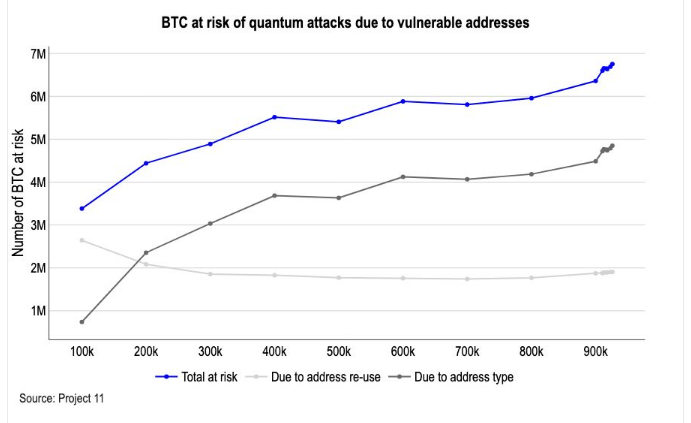
Experts Say Two Main Technical Threats Exist

One threat is to signatures. Quantum algorithms such as Shor’s could, at scale, recover private keys from public keys, letting attackers sign transactions and drain funds.

The second is a possible mining problem: a sufficiently fast quantum miner might find proofs of work much faster than classic rigs, upsetting incentives and block production. Duong and others stress the signature risk is nearer-term in theory, because it only requires cracking signatures tied to revealed public keys.

What The Industry Is Doing

Based on reports, the conversation has already reached fund managers and standards bodies. Some institutional filings have started to flag quantum risk, and NIST and other bodies are pushing work on post-quantum cryptography for broader systems.

BTCUSD trading at $92,010 on the 24-hour chart: TradingView

Engineers in the crypto space are looking at migration paths that would swap in quantum-resistant schemes, though any such change to Bitcoin would be complex and would require wide agreement.

A Long-Term Problem, Not An Immediate One

Duong and other commentators note that today’s quantum machines are far too small and noisy to crack Bitcoin’s cryptography. The warnings are about a possible future point often called “Q-day,” when a machine large and stable enough could run Shor’s and related algorithms at scale. Timelines vary widely among experts; some expect decades, others say the gap is shrinking faster than many predicted.

According to industry sources, coins that remain in addresses that have already allowed vulnerability of public keys are the most exposed if a well-architectured quantum machine is deployed. That makes best practices — like avoiding address reuse and moving old balances to fresh, quantum-resistant addresses once those are available — sensible steps. But there is no simple, one-click fix for the whole ecosystem, experts say.

Featured image from Peter Hansen/Getty Images, chart from TradingView

Related Questions

QWhat are the two main quantum computing threats to Bitcoin mentioned by the Coinbase research lead?

AThe two main threats are: 1) Quantum algorithms like Shor's could recover private keys from public keys, allowing attackers to steal funds. 2) A quantum-powered miner could find proofs of work much faster, disrupting Bitcoin's incentives and block production.

QApproximately how much Bitcoin is structurally exposed to quantum risk due to visible public keys?

AApproximately 33% of the Bitcoin supply, or about 6.51 million BTC, is structurally exposed because their public keys are already visible on the blockchain.

QWhat is the industry doing to address the potential threat of quantum computing to cryptography?

AThe industry is looking at migration paths to quantum-resistant cryptographic schemes. Standards bodies like NIST are pushing work on post-quantum cryptography, and some institutional filings have started to flag quantum risk.

QWhy is the signature risk from quantum computing considered a nearer-term threat than the mining risk?

AThe signature risk is considered nearer-term in theory because it only requires cracking the cryptographic signatures tied to public keys that are already revealed on the blockchain, whereas the mining risk requires a machine fast enough to consistently outperform the entire network.

QWhat are some recommended best practices for users to protect their Bitcoin from future quantum threats?

ARecommended best practices include avoiding address reuse and moving old balances to fresh, quantum-resistant addresses once they become available and are considered secure.

Related Reads

Dalio Warns: AI Boom Shows Signs of a Bubble, Day of Reckoning Will Be the Time of Burst

Ray Dalio, founder of Bridgewater Associates, warns that the current artificial intelligence investment boom shows classic signs of a bubble, which he expects will eventually burst. In a Bloomberg Television interview, he noted that great technological revolutions often lead to capital inflows that create bubbles, making it difficult for investors and companies to calibrate their spending accurately—either overspending to capture market share or underspending and losing their competitive position. This caution comes amid significant rallies in AI-related assets, particularly chipmakers, driven by soaring demand for data centers and high-bandwidth chips, raising debates about overheating valuations. In contrast, Nvidia CEO Jensen Huang recently asserted that investors embracing the AI wave would see "crazy" returns and dismissed concerns over return on investment for data center spending as outdated. Dalio, however, focuses on the risks in the profit realization phase. He argues that bubbles tend to show signs of破裂 when markets transition from investment to the need for tangible returns, describing the burst as a process of converting paper wealth into cash. While acknowledging AI's intrinsic value, he expressed concern over the future profitability of some AI companies, suggesting the market is repeating a familiar pattern. The 76-year-old billionaire, who fully exited Bridgewater in 2025, has a net worth estimated at $21.5 billion according to the Bloomberg Billionaires Index.

marsbit37m ago

Dalio Warns: AI Boom Shows Signs of a Bubble, Day of Reckoning Will Be the Time of Burst

marsbit37m ago

Privacy Coin Crisis of Confidence! ZEC Plunges Over 56% in a Single Day

Zcash (ZEC), a leading privacy-focused cryptocurrency, experienced a severe crash on June 5th, plummeting over 56% in a single day and erasing nearly two months of gains. The flash crash was triggered by the disclosure of a critical zero-knowledge proof vulnerability within Zcash's Orchard privacy pool, which had existed since the pool's launch in May 2022. The flaw theoretically allowed an attacker to forge unlimited ZEC undetectably due to the pool's privacy features. The vulnerability was discovered on May 29th by independent security researcher Taylor Hornby during a proactive audit commissioned by Shielded Labs, utilizing AI-assisted analysis. The Zcash development team responded swiftly, implementing an emergency soft fork to disable Orchard transactions on June 2nd and executing a permanent hard fork fix (NU6.2) on June 3rd. Despite the technical fix, a major crisis of confidence emerged. The core issue is that Orchard's privacy design makes it cryptographically impossible to prove whether the vulnerability was exploited over the past four years, casting permanent doubt on the historical supply integrity of ZEC. While Shielded Labs argues exploitation was unlikely, the inability to provide definitive proof has severely damaged market trust. This sentiment was exacerbated when BitMEX co-founder Arthur Hayes, a prominent ZEC supporter, announced he was selling his entire position. He stated that privacy assets require "perfect security" rather than "probable safety." The combined effect of the disclosure and Hayes's exit ignited widespread panic selling, leading to massive liquidations and significant price decline. Analysts note the event highlights a fundamental tension within privacy coins: the conflict between verifiable supply and cryptographic privacy.

链捕手40m ago

Privacy Coin Crisis of Confidence! ZEC Plunges Over 56% in a Single Day

链捕手40m ago

Trading

Spot
Futures

Hot Articles

What is $BITCOIN

DIGITAL GOLD ($BITCOIN): A Comprehensive Analysis Introduction to DIGITAL GOLD ($BITCOIN) DIGITAL GOLD ($BITCOIN) is a blockchain-based project operating on the Solana network, which aims to combine the characteristics of traditional precious metals with the innovation of decentralized technologies. While it shares a name with Bitcoin, often referred to as “digital gold” due to its perception as a store of value, DIGITAL GOLD is a separate token designed to create a unique ecosystem within the Web3 landscape. Its goal is to position itself as a viable alternative digital asset, although specifics regarding its applications and functionalities are still developing. What is DIGITAL GOLD ($BITCOIN)? DIGITAL GOLD ($BITCOIN) is a cryptocurrency token explicitly designed for use on the Solana blockchain. In contrast to Bitcoin, which provides a widely recognized value storage role, this token appears to focus on broader applications and characteristics. Notable aspects include: Blockchain Infrastructure: The token is built on the Solana blockchain, known for its capacity to handle high-speed and low-cost transactions. Supply Dynamics: DIGITAL GOLD has a maximum supply capped at 100 quadrillion tokens (100P $BITCOIN), although details regarding its circulating supply are currently undisclosed. Utility: While precise functionalities are not explicitly outlined, there are indications that the token could be utilized for various applications, potentially involving decentralized applications (dApps) or asset tokenization strategies. Who is the Creator of DIGITAL GOLD ($BITCOIN)? At present, the identity of the creators and development team behind DIGITAL GOLD ($BITCOIN) remains unknown. This situation is typical among many innovative projects within the blockchain space, particularly those aligning with decentralized finance and meme coin phenomena. While such anonymity may foster a community-driven culture, it intensifies concerns about governance and accountability. Who are the Investors of DIGITAL GOLD ($BITCOIN)? The available information indicates that DIGITAL GOLD ($BITCOIN) does not have any known institutional backers or prominent venture capital investments. The project seems to operate on a peer-to-peer model focused on community support and adoption rather than traditional funding routes. Its activity and liquidity are primarily situated on decentralized exchanges (DEXs), such as PumpSwap, rather than established centralized trading platforms, further highlighting its grassroots approach. How DIGITAL GOLD ($BITCOIN) Works The operational mechanics of DIGITAL GOLD ($BITCOIN) can be elaborated on based on its blockchain design and network attributes: Consensus Mechanism: By leveraging Solana’s unique proof-of-history (PoH) combined with a proof-of-stake (PoS) model, the project ensures efficient transaction validation contributing to the network's high performance. Tokenomics: While specific deflationary mechanisms have not been extensively detailed, the vast maximum token supply implies that it may cater to microtransactions or niche use cases that are still to be defined. Interoperability: There exists the potential for integration with Solana’s broader ecosystem, including various decentralized finance (DeFi) platforms. However, the details regarding specific integrations remain unspecified. Timeline of Key Events Here is a timeline that highlights significant milestones concerning DIGITAL GOLD ($BITCOIN): 2023: The initial deployment of the token occurs on the Solana blockchain, marked by its contract address. 2024: DIGITAL GOLD gains visibility as it becomes available for trading on decentralized exchanges like PumpSwap, allowing users to trade it against SOL. 2025: The project witnesses sporadic trading activity and potential interest in community-led engagements, although no noteworthy partnerships or technical advancements have been documented as of yet. Critical Analysis Strengths Scalability: The underlying Solana infrastructure supports high transaction volumes, which could enhance the utility of $BITCOIN in various transaction scenarios. Accessibility: The potential low trading price per token could attract retail investors, facilitating wider participation due to fractional ownership opportunities. Risks Lack of Transparency: The absence of publicly known backers, developers, or an audit process may yield skepticism regarding the project's sustainability and trustworthiness. Market Volatility: The trading activity is heavily reliant on speculative behavior, which can result in significant price volatility and uncertainty for investors. Conclusion DIGITAL GOLD ($BITCOIN) emerges as an intriguing yet ambiguous project within the rapidly evolving Solana ecosystem. While it attempts to leverage the “digital gold” narrative, its departure from Bitcoin's established role as a store of value underscores the need for a clearer differentiation of its intended utility and governance structure. Future acceptance and adoption will likely depend on addressing the current opacity and defining its operational and economic strategies more explicitly. Note: This report encompasses synthesised information available as of October 2023, and developments may have transpired beyond the research period.

363 Total ViewsPublished 2025.05.13Updated 2025.05.13

What is $BITCOIN

Discussions

Welcome to the HTX Community. Here, you can stay informed about the latest platform developments and gain access to professional market insights. Users' opinions on the price of BTC (BTC) are presented below.

活动图片