Bitcoin's Decline Led to MARA's Quarterly Loss of $611 Million

cryptonews.ruPublished on 2026-08-07Last updated on 2026-08-07

Abstract

Major U.S. mining company MARA Holdings reported a net loss of $611.3 million for Q2 2026, a sharp reversal from an $808.2 million profit in the same period last year. Management attributed the loss primarily to a 28% year-over-year decline in the average Bitcoin price, which drove revenue down 27% to $174.9 million and resulted in approximately $343 million in unrealized losses on its Bitcoin holdings. Despite the financial setback, MARA increased its Bitcoin production by 3% to 2,422 BTC, achieving its highest output in 1.5 years. The company sold 2,213 BTC during the quarter, reducing its reserve to 35,577 BTC. MARA is actively diversifying, shifting energy assets toward AI computing. Key initiatives include a pending $1.5 billion acquisition of the Long Ridge energy complex in Ohio and securing a Texas site with potential access to 2 GW of power. Peer miner CleanSpark also reported a Q2 net loss of $239.8 million, compared to a profit a year earlier, with revenue falling to $138 million. The company cited a $116.3 million Bitcoin impairment loss. CleanSpark highlighted its portfolio of connected energy assets and recently signed a 20-year, $6.6 billion lease agreement in Sandersville. Following the earnings reports on August 6, MARA's stock fell 5.2%, while CleanSpark's shares dropped over 6%.

The largest U.S. mining company, MARA Holdings, concluded the second quarter with a net loss of $611.3 million, compared to a profit of $808.2 million for the same period in 2025.

MARA's Q2 2026 Shareholder Letter is here.

Read the full report: https://t.co/HRvpUHvI8S pic.twitter.com/Op9ics7f5V

— MARA (@MARA) August 6, 2026

Management cited the drop in the price of the leading cryptocurrency as the primary reason for the negative results. The average Bitcoin price was 28% lower than the previous year — as a result, MARA's revenue fell by 27%, from $238.5 million to $174.9 million. Concurrently, the value of the coin inventory on the balance sheet decreased: a paper revaluation of digital assets resulted in approximately $343 million in losses.

The remaining portion came from depreciation charges, one-time write-offs, and operating expenses.

The adjusted EBITDA metric declined to a negative $360.9 million, compared to a profit of $1.2 billion recorded a year earlier.

"Two factors defined the quarter. On one hand, Bitcoin's price environment created challenging conditions for revenue. On the other hand, we used this period for a fundamental restructuring of the energy portfolio and optimization of the capital structure," stated MARA's CFO Salman Khan during a conference call with analysts.

MARA's quarterly loss amounted to $1.3 billion

Production, however, increased

In the second quarter, MARA increased its mining output to 2422 $BTC — 3% higher than the figure from a year ago and the best result in the past year and a half. The deployed computing power increased by 22%, reaching 70.3 EH/s, while the cost per petahash per day decreased by 4% — to $27.7.

Over the three months, the company sold 2213 $BTC at an average price of $73,078. The Bitcoin reserve on the balance sheet decreased by 29% — to 35,577 $BTC (~$2.1 billion).

The company is currently reorienting its energy assets for AI computations. MARA is finalizing a deal to acquire the Long Ridge energy complex in Ohio for $1.5 billion — upon approval by the Federal Energy Regulatory Commission, the facility will be able to provide up to 600 MW of capacity for AI workloads.

In July, a site in Matagorda County (Texas) with potential access to 2 GW by April 2028 was added to the portfolio. By the end of the year, management expects to sign at least two lease agreements for AI infrastructure and high-performance computing.

"Bitcoin mining remains our foundation. We are convinced that digital infrastructure, combined with Exaion and technological initiatives, will allow us to expand the value created on this basis," noted MARA's Chairman and CEO Fred Thiel.

CleanSpark's Results

CleanSpark generated $138 million in revenue compared to $198.6 million a year earlier. The net loss was $239.8 million, compared to a profit of $257.4 million for the same period last year. The adjusted EBITDA metric fell to a negative $113 million.

Today $CLSK reported financial results for fiscal third quarter 2026 (ended 6/30/26):

*Signed 20-year $6.6 billion triple-net lease at Sandersville with high investment-grade tenant
*Ordered and pre-paid all long-lead items to meet Sandersville RFS date
*Anticipated equity... pic.twitter.com/NcL3aBZbpm

— CleanSpark Inc. (@CleanSpark_Inc) August 6, 2026

The loss from the revaluation of the leading cryptocurrency for the quarter was estimated by the company at $116.3 million. As of June 30, the balance sheet included $202.6 million in cash and Bitcoin worth $814.9 million, with total assets of $2.7 billion, long-term debt of $1.8 billion, and working capital of $761 million.

CleanSpark controls over 1.8 GW of energy capacity, land, and data centers. In July, the company signed a twenty-year, $6.6 billion lease agreement for a facility in Sandersville with a high investment-grade tenant.

"Despite the challenging current economics of Bitcoin mining, we have a portfolio of rare grid-connected energy assets and multiple paths to their commercialization," noted CleanSpark's President and CFO Gary Vecchiarelli.

Following trading on August 6th, MARA shares fell by 5.2%, and CleanSpark shares by more than 6%.
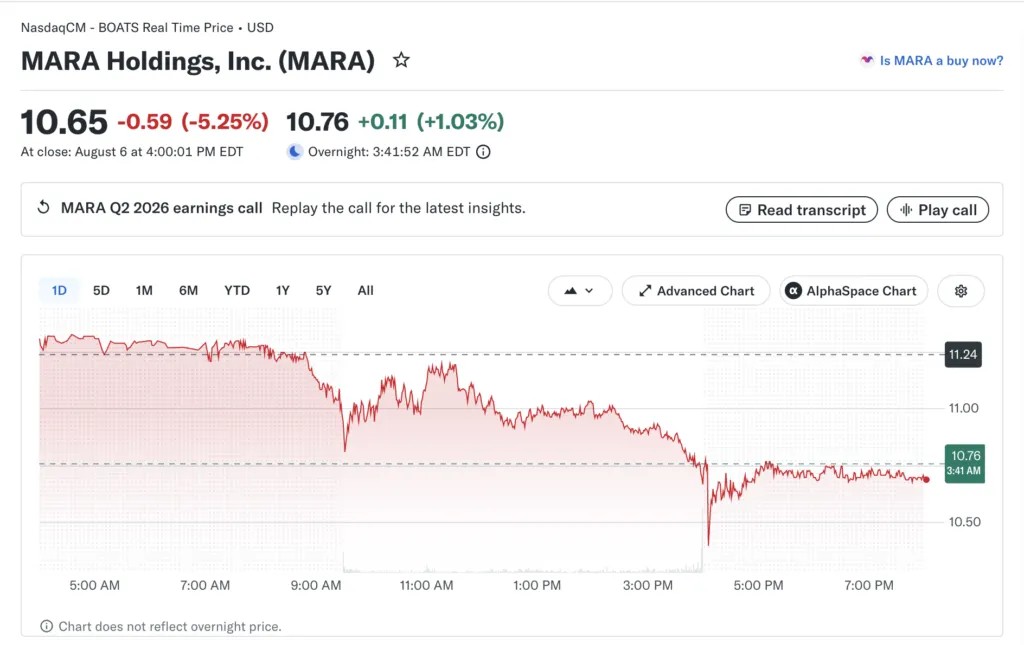
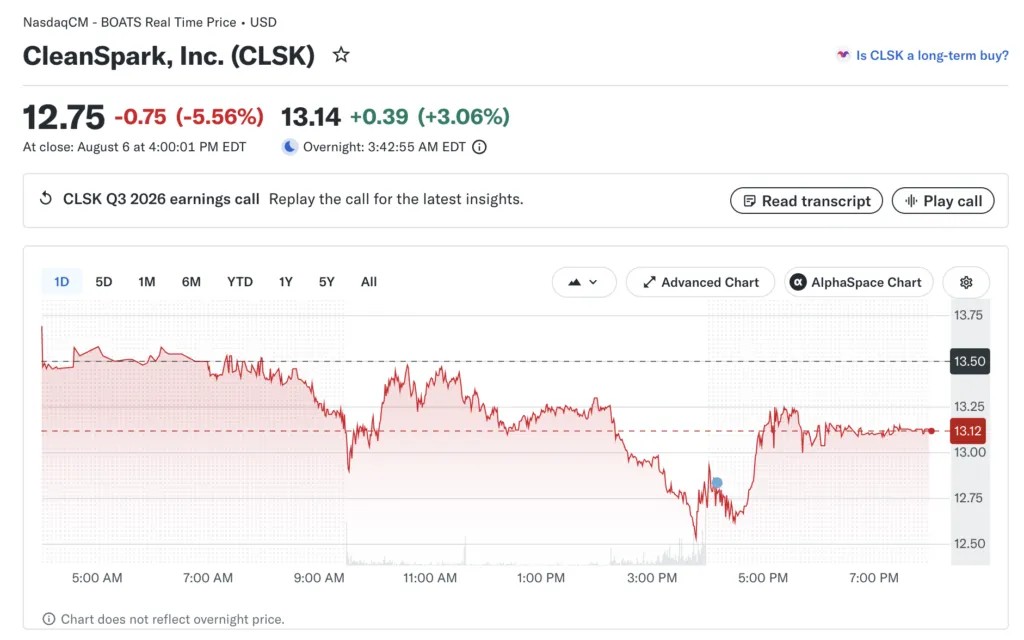
Source: Yahoo Finance.

Recall that in recent years, major Bitcoin miners have accelerated the conversion of energy sites into data centers for AI amidst pressure on mining profitability.

Miners have intensified the competition for electricity
end-content

Trending Cryptos

Related Questions

QWhat was the main reason for MARA Holdings' $611.3 million net loss in Q2 2026 according to the article?

AThe primary reason cited for MARA's net loss was the decline in the price of Bitcoin, which was on average 28% lower than the previous year. This led to a drop in revenue and resulted in significant paper losses from the revaluation of their Bitcoin holdings.

QHow did MARA's Bitcoin mining production change in Q2 2026 compared to the previous year?

ADespite the financial loss, MARA increased its Bitcoin mining production in Q2 2026 to 2,422 BTC, which was 3% higher than the same period the previous year and marked its best result in the last year and a half.

QWhat strategic shift is MARA undertaking regarding its energy assets, as mentioned in the article?

AMARA is reorienting its energy assets towards AI computing. Key moves include acquiring the Long Ridge energy complex in Ohio for $1.5 billion and securing a site in Matagorda County, Texas, with potential access to 2 GW of power, aiming to lease infrastructure for AI and high-performance computing.

QWhat were CleanSpark's financial results for its fiscal third quarter 2026?

AFor its fiscal third quarter 2026, CleanSpark reported revenue of $138 million (down from $198.6 million year-over-year) and a net loss of $239.8 million (compared to a profit of $257.4 million the previous year). Its adjusted EBITDA also fell to negative $113 million.

QHow did the stock prices of MARA and CleanSpark react to their earnings reports on August 6, 2026?

AFollowing their earnings reports on August 6, 2026, MARA's stock price fell by 5.2%, and CleanSpark's stock price dropped by more than 6%.

Related Reads

Footage of the detention of employees of fraudulent crypto exchanges in Moscow published

Russian security services (FSB) have detained over 20 employees of cryptocurrency exchange offices in Moscow City. These offices were allegedly used by Ukrainian call centers to launder money stolen from Russian citizens. The detainees were forced to work as freelance employees after being deceived. In one case, a victim was falsely informed by fraudsters posing as Russian authorities that a power of attorney was issued in his name. To cancel it, he was told to withdraw all his money and then work as an "external employee" to help detain other fraudsters. The man admitted to acting on instructions from individuals claiming to be from Rosfinmonitoring and the FSB. Other detainees described meeting clients, accepting and counting cash, converting it to cryptocurrency, and transferring it to specified crypto wallets. One claimed the exchange handled about 30 clients daily with a turnover reaching $1-2 million, while another estimated the average money turnover could reach $30 million. The FSB reported shutting down nine channels for transferring funds abroad via cryptocurrency. The victims, including pensioners, were constantly in contact with the call center, followed step-by-step instructions, and were unaware of the illicit nature of their actions. Young people from Russian regions with low financial literacy, seeking easy money, were recruited remotely to work in these crypto exchanges.

cryptonews.ru24m ago

Footage of the detention of employees of fraudulent crypto exchanges in Moscow published

cryptonews.ru24m ago

Trading

Spot

Hot Articles

What is $BITCOIN

DIGITAL GOLD ($BITCOIN): A Comprehensive Analysis Introduction to DIGITAL GOLD ($BITCOIN) DIGITAL GOLD ($BITCOIN) is a blockchain-based project operating on the Solana network, which aims to combine the characteristics of traditional precious metals with the innovation of decentralized technologies. While it shares a name with Bitcoin, often referred to as “digital gold” due to its perception as a store of value, DIGITAL GOLD is a separate token designed to create a unique ecosystem within the Web3 landscape. Its goal is to position itself as a viable alternative digital asset, although specifics regarding its applications and functionalities are still developing. What is DIGITAL GOLD ($BITCOIN)? DIGITAL GOLD ($BITCOIN) is a cryptocurrency token explicitly designed for use on the Solana blockchain. In contrast to Bitcoin, which provides a widely recognized value storage role, this token appears to focus on broader applications and characteristics. Notable aspects include: Blockchain Infrastructure: The token is built on the Solana blockchain, known for its capacity to handle high-speed and low-cost transactions. Supply Dynamics: DIGITAL GOLD has a maximum supply capped at 100 quadrillion tokens (100P $BITCOIN), although details regarding its circulating supply are currently undisclosed. Utility: While precise functionalities are not explicitly outlined, there are indications that the token could be utilized for various applications, potentially involving decentralized applications (dApps) or asset tokenization strategies. Who is the Creator of DIGITAL GOLD ($BITCOIN)? At present, the identity of the creators and development team behind DIGITAL GOLD ($BITCOIN) remains unknown. This situation is typical among many innovative projects within the blockchain space, particularly those aligning with decentralized finance and meme coin phenomena. While such anonymity may foster a community-driven culture, it intensifies concerns about governance and accountability. Who are the Investors of DIGITAL GOLD ($BITCOIN)? The available information indicates that DIGITAL GOLD ($BITCOIN) does not have any known institutional backers or prominent venture capital investments. The project seems to operate on a peer-to-peer model focused on community support and adoption rather than traditional funding routes. Its activity and liquidity are primarily situated on decentralized exchanges (DEXs), such as PumpSwap, rather than established centralized trading platforms, further highlighting its grassroots approach. How DIGITAL GOLD ($BITCOIN) Works The operational mechanics of DIGITAL GOLD ($BITCOIN) can be elaborated on based on its blockchain design and network attributes: Consensus Mechanism: By leveraging Solana’s unique proof-of-history (PoH) combined with a proof-of-stake (PoS) model, the project ensures efficient transaction validation contributing to the network's high performance. Tokenomics: While specific deflationary mechanisms have not been extensively detailed, the vast maximum token supply implies that it may cater to microtransactions or niche use cases that are still to be defined. Interoperability: There exists the potential for integration with Solana’s broader ecosystem, including various decentralized finance (DeFi) platforms. However, the details regarding specific integrations remain unspecified. Timeline of Key Events Here is a timeline that highlights significant milestones concerning DIGITAL GOLD ($BITCOIN): 2023: The initial deployment of the token occurs on the Solana blockchain, marked by its contract address. 2024: DIGITAL GOLD gains visibility as it becomes available for trading on decentralized exchanges like PumpSwap, allowing users to trade it against SOL. 2025: The project witnesses sporadic trading activity and potential interest in community-led engagements, although no noteworthy partnerships or technical advancements have been documented as of yet. Critical Analysis Strengths Scalability: The underlying Solana infrastructure supports high transaction volumes, which could enhance the utility of $BITCOIN in various transaction scenarios. Accessibility: The potential low trading price per token could attract retail investors, facilitating wider participation due to fractional ownership opportunities. Risks Lack of Transparency: The absence of publicly known backers, developers, or an audit process may yield skepticism regarding the project's sustainability and trustworthiness. Market Volatility: The trading activity is heavily reliant on speculative behavior, which can result in significant price volatility and uncertainty for investors. Conclusion DIGITAL GOLD ($BITCOIN) emerges as an intriguing yet ambiguous project within the rapidly evolving Solana ecosystem. While it attempts to leverage the “digital gold” narrative, its departure from Bitcoin's established role as a store of value underscores the need for a clearer differentiation of its intended utility and governance structure. Future acceptance and adoption will likely depend on addressing the current opacity and defining its operational and economic strategies more explicitly. Note: This report encompasses synthesised information available as of October 2023, and developments may have transpired beyond the research period.

1.6k Total ViewsPublished 2025.05.13Updated 2025.05.13

What is $BITCOIN

Discussions

Welcome to the HTX Community. Here, you can stay informed about the latest platform developments and gain access to professional market insights. Users' opinions on the price of BTC (BTC) are presented below.

活动图片