Bitcoin’s BIP-110 enters mandatory signaling with miner support below 3%

cointelegraphPublished on 2026-08-08Last updated on 2026-08-08

Abstract

Bitcoin Improvement Proposal (BIP) 110 entered its mandatory-signaling phase at block 961,632. However, miner support stands at only 2.53% (51 of 2,016 blocks), far below the 55% threshold required for early activation. Enforcing nodes now reject blocks that do not signal support, leading to a minor chain split, though the unsupported branch quickly fell behind the dominant chain. The proposal, authored by pseudonymous developer Dathon Ohm, aims to impose temporary, roughly one-year restrictions on certain data types (like inscriptions) within Bitcoin blocks to reduce node operational costs. Critics, including notable figures like Michael Saylor and Adam Back, argue it could fracture the network. With minimal miner backing, a sustained rival chain is unlikely. The situation tests whether a contentious change can proceed without broad miner consensus. Proponents have also discussed a proof-of-work change contingency plan if miner opposition persists.

Bitcoin Improvement Proposal 110 entered its mandatory-signaling phase at block 961,632 on Saturday, with miners signaling support in just 51 of the preceding 2,016 blocks, or 2.53%, well below the 55% threshold required for early activation, according to the BIP-110 monitor.

Starting at block 961,632, nodes enforcing BIP-110 began rejecting blocks that did not set version bit 4, while ordinary Bitcoin nodes continued accepting both signaling and non-signaling blocks. A minority BIP-110 branch subsequently emerged, but quickly fell behind the dominant chain.

The low signaling rate makes a sustained rival chain unlikely without substantially greater miner participation. With relatively little mining support, a BIP-110 branch could advance slowly or stop producing blocks altogether.

The milestone tests whether supporters can advance a contentious consensus change without broad miner backing, potentially separating enforcing nodes from the dominant chain and escalating a dispute over how Bitcoin’s block space should be used.

BIP-110 seeks temporary limits on Bitcoin data

Written by pseudonymous developer Dathon Ohm, BIP-110 proposes additional consensus restrictions lasting roughly one year.

It would limit most new output scripts to 34 bytes, cap OP_RETURN outputs at 83 bytes, restrict certain data pushes and witness elements to 256 bytes, and temporarily limit several Taproot features. Unspent transaction outputs created before activation would be exempt.

Supporters said the restrictions would discourage inscriptions and other non-monetary data that increase storage and bandwidth costs for node operators.

The proposal’s critics, including Strategy Executive Chairman Michael Saylor and Blockstream CEO Adam Back, have argued that the proposal could divide Bitcoin and cause nodes to reject transactions permitted under the network’s existing rules.

Related: Bitcoin nodes running BIP-110 crosses 2% as spam wars heat up

The proposal uses version bit 4 for miner signaling. Its deployment schedule sets blocks 961,632 through 963,647 as a mandatory-signaling window, during which nodes enforcing BIP-110 reject blocks that do not carry the signal.

The specification defines block 963,648 as the beginning of its locked-in state and block 965,664 as the point when its transaction restrictions take effect.

BIP-110 proponents have also discussed a more extensive fallback. On Aug. 1, Bitcoin developer Chris Guida rebased preliminary code for a proof-of-work change originally written by Bitcoin Knots maintainer Luke Dashjr.

Guida described the code at the time as a contingency if miners opposed BIP-110, but said no activation date had been set.

Magazine: 10 weirdest things ever tokenized... including farts

Trending Cryptos

Related Questions

QWhat is the purpose of BIP-110 according to the article?

ABIP-110 proposes additional, temporary consensus restrictions to limit certain types of non-monetary data on Bitcoin, such as inscriptions, which are seen as increasing storage and bandwidth costs for node operators.

QWhat was the miner support percentage for BIP-110 at the start of its mandatory-signaling phase, and how does it compare to the required threshold?

AAt the start of the mandatory-signaling phase, miners signaled support in just 2.53% of the preceding blocks, which is well below the 55% threshold required for early activation.

QWhat specific restrictions does BIP-110 propose to impose on Bitcoin?

ABIP-110 proposes to limit most new output scripts to 34 bytes, cap OP_RETURN outputs at 83 bytes, restrict certain data pushes and witness elements to 256 bytes, and temporarily limit several Taproot features. Unspent transaction outputs created before activation would be exempt.

QWhat is a key criticism of BIP-110 mentioned in the article?

ACritics, including Michael Saylor and Adam Back, argue that the proposal could divide Bitcoin and cause nodes to reject transactions that are currently permitted under the network's existing rules.

QWhat action did nodes enforcing BIP-110 begin taking starting at block 961,632?

AStarting at block 961,632, nodes enforcing BIP-110 began rejecting blocks that did not set the specific version bit 4 to signal support for the proposal.

Related Reads

Bitcoin's ECX Hard Fork to Introduce Three New Versions Throughout October

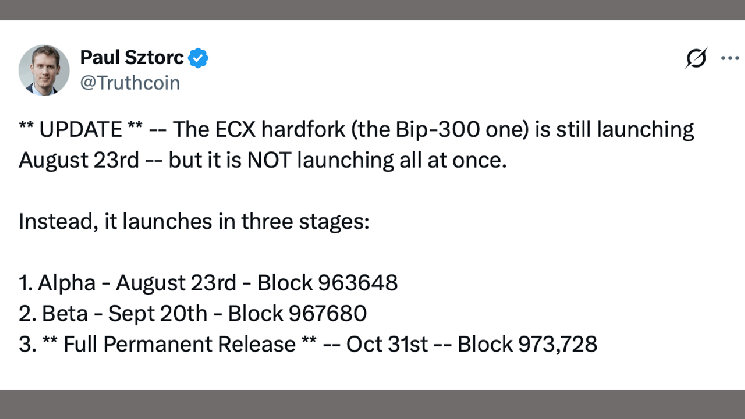
Bitcoin developer Paul Stortz, behind the Drivechain and BIP 300 proposals, has announced a hardfork for a new blockchain called ECX. Scheduled for October 31st (the 18th anniversary of the Bitcoin whitepaper), ECX will copy Bitcoin's full transaction history at a specific block height, crediting nearly all Bitcoin holders with an equal amount of ECX coins without altering the Bitcoin network itself. The launch will be executed in three phases. An "alpha" version is set for August 23rd (block 963,648), followed by a "beta" version on September 20th (block 967,680). The final mainnet launch is planned for October 31st (block 973,728). Coins accumulated during the alpha and beta phases can later be burned or swapped for real ECX. Stortz cites several reasons for the phased rollout: to address potential software bugs (including those possibly found by AI), allow an early market price to form for ECX before mining difficulty stabilizes, and let traders test and speculate. He described it as a "safety net" to manage any major issues and to demonstrate the chain's functionality. A key detail is that replay protection—a mechanism to prevent a transaction from being valid on both the Bitcoin and ECX chains—will remain optional, not automatic. The official ECX wallet software will apply this protection and warn users; Stortz warned that transactions ignoring this warning will be replayed on ECX, effectively tracking a user's spent bitcoins to their new owner unless a deliberate split is made. Stortz has given holders and exchanges 12 weeks from the alpha launch to prepare, during which they must decide on practical matters like running the wallet software to split their BTC and ECX holdings and how exchanges will credit the new asset to clients. The announcement comes as Bitcoin also faces another potential fork related to BIP-110.

cryptonews.ru41m ago

Bitcoin's ECX Hard Fork to Introduce Three New Versions Throughout October

cryptonews.ru41m ago

Trading

Spot

Hot Articles

What is $BITCOIN

DIGITAL GOLD ($BITCOIN): A Comprehensive Analysis Introduction to DIGITAL GOLD ($BITCOIN) DIGITAL GOLD ($BITCOIN) is a blockchain-based project operating on the Solana network, which aims to combine the characteristics of traditional precious metals with the innovation of decentralized technologies. While it shares a name with Bitcoin, often referred to as “digital gold” due to its perception as a store of value, DIGITAL GOLD is a separate token designed to create a unique ecosystem within the Web3 landscape. Its goal is to position itself as a viable alternative digital asset, although specifics regarding its applications and functionalities are still developing. What is DIGITAL GOLD ($BITCOIN)? DIGITAL GOLD ($BITCOIN) is a cryptocurrency token explicitly designed for use on the Solana blockchain. In contrast to Bitcoin, which provides a widely recognized value storage role, this token appears to focus on broader applications and characteristics. Notable aspects include: Blockchain Infrastructure: The token is built on the Solana blockchain, known for its capacity to handle high-speed and low-cost transactions. Supply Dynamics: DIGITAL GOLD has a maximum supply capped at 100 quadrillion tokens (100P $BITCOIN), although details regarding its circulating supply are currently undisclosed. Utility: While precise functionalities are not explicitly outlined, there are indications that the token could be utilized for various applications, potentially involving decentralized applications (dApps) or asset tokenization strategies. Who is the Creator of DIGITAL GOLD ($BITCOIN)? At present, the identity of the creators and development team behind DIGITAL GOLD ($BITCOIN) remains unknown. This situation is typical among many innovative projects within the blockchain space, particularly those aligning with decentralized finance and meme coin phenomena. While such anonymity may foster a community-driven culture, it intensifies concerns about governance and accountability. Who are the Investors of DIGITAL GOLD ($BITCOIN)? The available information indicates that DIGITAL GOLD ($BITCOIN) does not have any known institutional backers or prominent venture capital investments. The project seems to operate on a peer-to-peer model focused on community support and adoption rather than traditional funding routes. Its activity and liquidity are primarily situated on decentralized exchanges (DEXs), such as PumpSwap, rather than established centralized trading platforms, further highlighting its grassroots approach. How DIGITAL GOLD ($BITCOIN) Works The operational mechanics of DIGITAL GOLD ($BITCOIN) can be elaborated on based on its blockchain design and network attributes: Consensus Mechanism: By leveraging Solana’s unique proof-of-history (PoH) combined with a proof-of-stake (PoS) model, the project ensures efficient transaction validation contributing to the network's high performance. Tokenomics: While specific deflationary mechanisms have not been extensively detailed, the vast maximum token supply implies that it may cater to microtransactions or niche use cases that are still to be defined. Interoperability: There exists the potential for integration with Solana’s broader ecosystem, including various decentralized finance (DeFi) platforms. However, the details regarding specific integrations remain unspecified. Timeline of Key Events Here is a timeline that highlights significant milestones concerning DIGITAL GOLD ($BITCOIN): 2023: The initial deployment of the token occurs on the Solana blockchain, marked by its contract address. 2024: DIGITAL GOLD gains visibility as it becomes available for trading on decentralized exchanges like PumpSwap, allowing users to trade it against SOL. 2025: The project witnesses sporadic trading activity and potential interest in community-led engagements, although no noteworthy partnerships or technical advancements have been documented as of yet. Critical Analysis Strengths Scalability: The underlying Solana infrastructure supports high transaction volumes, which could enhance the utility of $BITCOIN in various transaction scenarios. Accessibility: The potential low trading price per token could attract retail investors, facilitating wider participation due to fractional ownership opportunities. Risks Lack of Transparency: The absence of publicly known backers, developers, or an audit process may yield skepticism regarding the project's sustainability and trustworthiness. Market Volatility: The trading activity is heavily reliant on speculative behavior, which can result in significant price volatility and uncertainty for investors. Conclusion DIGITAL GOLD ($BITCOIN) emerges as an intriguing yet ambiguous project within the rapidly evolving Solana ecosystem. While it attempts to leverage the “digital gold” narrative, its departure from Bitcoin's established role as a store of value underscores the need for a clearer differentiation of its intended utility and governance structure. Future acceptance and adoption will likely depend on addressing the current opacity and defining its operational and economic strategies more explicitly. Note: This report encompasses synthesised information available as of October 2023, and developments may have transpired beyond the research period.

1.7k Total ViewsPublished 2025.05.13Updated 2025.05.13

What is $BITCOIN

Discussions

Welcome to the HTX Community. Here, you can stay informed about the latest platform developments and gain access to professional market insights. Users' opinions on the price of BTC (BTC) are presented below.

活动图片