Bitcoin: What ‘a cooler than expected CPI print’ means for BTC’s $70K retest

ambcryptoPublished on 2026-07-15Last updated on 2026-07-15

Abstract

Bitcoin's rally on July 14th followed a cooler-than-expected CPI report, which sharply reduced market expectations for a Fed rate hike and improved risk sentiment. Analysts suggest this macro shift, combined with rising long positions and positive ETF inflows, could support a break above $66,000 and a retest of the $70,000-$75,000 range by month-end. On-chain fundamentals strengthen the outlook, with growth in wallets holding 1+ BTC and significant WBTC exchange outflows indicating accumulation. The alignment of improving macro conditions, technicals, and fundamentals underpins a bullish quarter-end target of $100,000.

Is Bitcoin’s 4.37% rally on the 14th of July the first real sign of a bottom forming?

From the macro standpoint, BTC’s rally followed a cooler-than-expected CPI report, marking a key recalibration point for investors. Few signals highlight this shift better.

According to FedWatch data, the market is now pricing just a 16.6% chance of a rate hike at the upcoming FOMC meeting, down sharply from 41.7% the day before the report.

At the same time, the Crypto Fear and Greed Index is now just six points away from entering the “Neutral” zone, a level it hasn’t reached since mid-May. Together, these signals point to improving risk appetite, giving Bitcoin a strong macro backdrop as it tests higher resistance levels.

Supporting this view, Matt Mena, Senior Crypto Research Strategist at 21Shares, shared his month-end outlook for Bitcoin with AMBCrypto:

This may be the push we need to finally break the $64k level and push towards $66k as Bitcoin within the last 3 years on average has returned +2.8% after a cooler than expected CPI print as it is a barometer of risk. A break of about $66k will set us up to retest $70k and possibly even $75k by month’s end – a level we haven’t seen since late May.

In essence, the CPI report has clearly shifted market expectations.

Against this backdrop, Glassnode’s latest data on Bitcoin’s long positioning starts to make more sense.

The report shows long positions have climbed back to levels last seen when BTC traded around $83k, suggesting traders are aggressively rebuilding leverage long exposure as bullish sentiment returns.

However, the bigger question is whether the improving macro backdrop and the rise in the Fear and Greed Index are enough to confirm a Bitcoin [BTC] bottom.

If not, this spike in long positioning could simply be another wave of overleveraged bets, increasing the risk of a bull trap. Notably, this is where the growing alignment between Bitcoin’s technicals and on-chain fundamentals begins to matter.

Bitcoin’s fundamentals hint at a stronger recovery

Interestingly, the market is already pricing in a $100k quarter-end target for Bitcoin.

The key takeaway? The target isn’t based on sentiment alone. Mena believes that improving on-chain fundamentals are starting to support Bitcoin’s recovery, suggesting the current setup goes beyond a CPI-driven rally.

He told AMBCrypto:

With Spot Bitcoin ETFs turning positive with $400m in net flows in the last week alone, and potential progress on the CLARITY Act, fundamentals and technicals are starting to align for a $100k push by quarter-end, setting up a potential retest of the $126k all-time high by year-end or early 2027.

Notably, the on-chain data already backs this view. Crypto analyst Ali Martinez noted that the number of wallets holding at least 1 BTC has grown by nearly 0.4% since June, with more than 4,000 new holders joining the network.

At the same time, Wrapped Bitcoin [WBTC] has seen a sharp rise in exchange outflows.
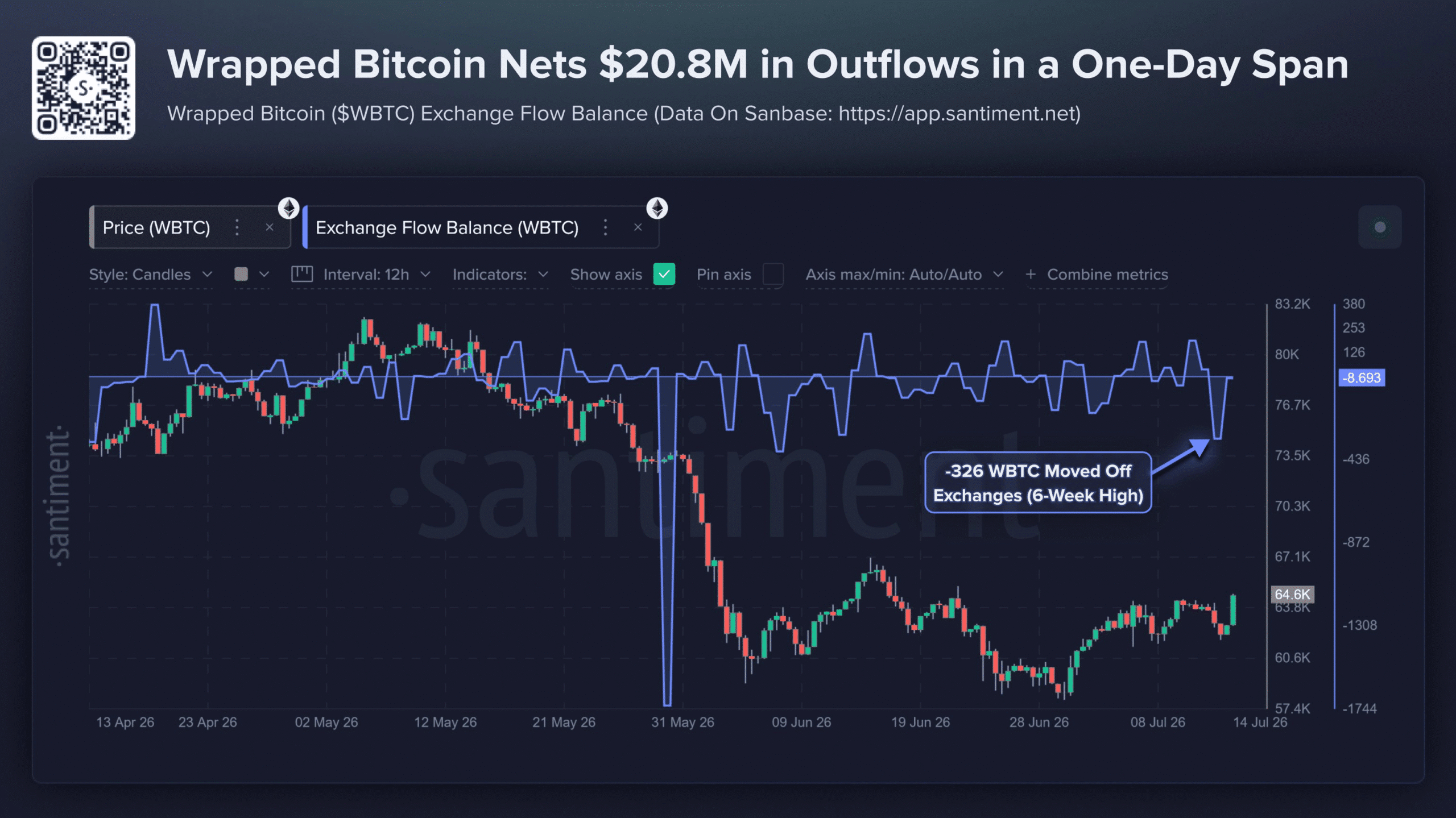
Source: Santiment

As the chart shows, around 326 WBTC left exchanges in a single day, marking the largest net outflow since June. Since WBTC is a key source of Bitcoin liquidity, these outflows suggest more investors are moving their holdings into DeFi protocols, reinforcing the growing fundamental strength behind Bitcoin’s rally.

Taken together, the $100k BTC target no longer looks far-fetched. The macro backdrop has improved, technicals are building, and fundamentals continue to strengthen.

If this trend holds, Bitcoin could break above $66k in the near term, opening the door for a move toward the $70k-$75k range by month-end.


Final Summary

  • Bitcoin’s macro outlook is improving, with a softer CPI report and rising risk appetite boosting bullish sentiment.
  • On-chain data remains strong, supporting the case for a break above $66k and a move toward $70k-$75k.


Trending Cryptos

Related Questions

QWhat does the article suggest is the key macro event that triggered Bitcoin's rally on July 14th?

ABitcoin's rally was triggered by a cooler-than-expected U.S. Consumer Price Index (CPI) report, which signaled easing inflation and shifted market expectations away from an aggressive Federal Reserve interest rate hike.

QAccording to Matt Mena, what is the significance of a 'cooler than expected CPI print' for Bitcoin's historical price action?

AMatt Mena states that over the last three years, Bitcoin has on average returned +2.8% after a cooler-than-expected CPI print, as it acts as a barometer of risk, improving investor sentiment and risk appetite.

QWhat are the two key pieces of on-chain evidence mentioned that support a strengthening Bitcoin recovery?

AThe two key on-chain pieces of evidence are: 1) An increase in the number of wallets holding at least 1 BTC (up nearly 0.4% since June). 2) A sharp rise in WBTC exchange outflows, indicating investors are moving holdings into DeFi protocols, reducing available liquidity on exchanges.

QWhat potential price targets for Bitcoin are discussed in the article for the near term and by the end of the quarter?

AFor the near term, the article discusses breaking above $66k to retest the $70k-$75k range by month's end. By the end of the quarter, the potential target mentioned is $100k, with a possible retest of the $126k all-time high by year-end or early 2027.

QWhat cautionary note does the article raise regarding the observed spike in Bitcoin long positions?

AThe article cautions that the spike in long positions could represent another wave of overleveraged bets rather than confirmation of a market bottom, increasing the risk of a bull trap where the price rallies briefly before falling again.

Related Reads

Wall Street Unanimously Bullish: ASML's Capacity Surge, The 'Peak Theory' for Memory Can Be Put to Rest

Wall Street is collectively bullish on ASML after the company reported a far-better-than-expected Q2 and significantly raised its full-year guidance, while providing a rare 2027-2028 capacity expansion roadmap. Key financials surpassed consensus: Q2 revenue of €9.3B beat estimates, with gross margin at 54%. The company raised its 2026 revenue outlook to €43-€45B and expects Q3 revenue of €11-€12B. Most notably, management outlined aggressive capacity increases for both Low-NA EUV and immersion DUV systems. EUV capacity is projected to reach ~85 units in 2027 (up ~30% from 2026) and potentially ~110 in 2028. DUV capacity is set to rise to ~169 units in 2027 and ~220 in 2028. These targets exceed prior market expectations, leading analysts to significantly revise up 2028 earnings estimates, with JPMorgan suggesting EPS could surpass €65. Major banks including Goldman Sachs, JPMorgan, and Barclays maintained Buy/Overweight ratings. Analysts view the roadmap as a direct rebuttal to narratives about an AI-driven demand peak or an imminent memory price top. ASML stated that AI demand is accelerating expansion in both logic (for nodes like 2nm) and memory segments (driven by DDR/HBM shortages and the transition to more EUV-intensive nodes like 1c/1d DRAM). This structural shift, alongside the high wafer intensity of HBM production, is seen extending the memory upcycle. While most reactions were positive, some nuance existed on whether the 2027 EUV guidance was sufficiently aggressive versus heightened expectations. Overall, the results are seen as validating sustained AI-driven demand and ASML's unrivaled position as the key beneficiary of the industry's advanced node transition.

链捕手1h ago

Wall Street Unanimously Bullish: ASML's Capacity Surge, The 'Peak Theory' for Memory Can Be Put to Rest

链捕手1h ago

The Invisible Crypto Empire of Japan's Financial Giant SBI

In a series of concentrated moves, Japanese financial conglomerate SBI Holdings is aggressively expanding its digital asset footprint. Over three weeks, it executed three major strategic investments: a 46.7 billion yen ($289 million) full acquisition of Japanese licensed exchange Bitbank, a $76 million lead investment in the institutional crypto platform EDX Markets' Series C round, and an exclusive $125 million investment in DeFi risk analytics firm Gauntlet. This was followed by a strategic partnership announced on July 13 with the Solana Foundation to build Japan's on-chain financial markets. SBI, a long-time crypto industry participant through joint ventures and minority stakes, has recently shifted to a lead investor role, signaling a more assertive strategy. These investments target three distinct segments: the retail market in Japan (via Bitbank), U.S. institutional infrastructure (via EDX), and on-chain asset management and risk control (via Gauntlet). Concurrently, SBI is solidifying its position in the stablecoin and settlement layer space. It launched Japan's first trust-structured yen stablecoin, JPYSC, and secured the exclusive distribution for Ripple's RLUSD stablecoin on its SBI VC Trade platform. The partnership with Solana aims to leverage the blockchain's scalability for tokenizing real-world assets (RWA) and building cross-border payment networks. Analysts interpret SBI's moves as building the essential "pipes" for a next-generation, end-to-end digital asset financial system, spanning issuance, settlement, infrastructure, and distribution. Some view the timing—during a market downturn—as a strategic long-term play to acquire assets at lower valuations ahead of anticipated regulatory shifts in Japan. SBI's stated goal is a comprehensive on-chain transformation, providing a full suite of services from exchange to tokenization. By leading investments rather than fully acquiring companies like EDX and Gauntlet, SBI aims to secure a pivotal strategic position while preserving their neutrality to collaborate with other global financial giants.

链捕手2h ago

The Invisible Crypto Empire of Japan's Financial Giant SBI

链捕手2h ago

Trading

Spot

Hot Articles

What is $BITCOIN

DIGITAL GOLD ($BITCOIN): A Comprehensive Analysis Introduction to DIGITAL GOLD ($BITCOIN) DIGITAL GOLD ($BITCOIN) is a blockchain-based project operating on the Solana network, which aims to combine the characteristics of traditional precious metals with the innovation of decentralized technologies. While it shares a name with Bitcoin, often referred to as “digital gold” due to its perception as a store of value, DIGITAL GOLD is a separate token designed to create a unique ecosystem within the Web3 landscape. Its goal is to position itself as a viable alternative digital asset, although specifics regarding its applications and functionalities are still developing. What is DIGITAL GOLD ($BITCOIN)? DIGITAL GOLD ($BITCOIN) is a cryptocurrency token explicitly designed for use on the Solana blockchain. In contrast to Bitcoin, which provides a widely recognized value storage role, this token appears to focus on broader applications and characteristics. Notable aspects include: Blockchain Infrastructure: The token is built on the Solana blockchain, known for its capacity to handle high-speed and low-cost transactions. Supply Dynamics: DIGITAL GOLD has a maximum supply capped at 100 quadrillion tokens (100P $BITCOIN), although details regarding its circulating supply are currently undisclosed. Utility: While precise functionalities are not explicitly outlined, there are indications that the token could be utilized for various applications, potentially involving decentralized applications (dApps) or asset tokenization strategies. Who is the Creator of DIGITAL GOLD ($BITCOIN)? At present, the identity of the creators and development team behind DIGITAL GOLD ($BITCOIN) remains unknown. This situation is typical among many innovative projects within the blockchain space, particularly those aligning with decentralized finance and meme coin phenomena. While such anonymity may foster a community-driven culture, it intensifies concerns about governance and accountability. Who are the Investors of DIGITAL GOLD ($BITCOIN)? The available information indicates that DIGITAL GOLD ($BITCOIN) does not have any known institutional backers or prominent venture capital investments. The project seems to operate on a peer-to-peer model focused on community support and adoption rather than traditional funding routes. Its activity and liquidity are primarily situated on decentralized exchanges (DEXs), such as PumpSwap, rather than established centralized trading platforms, further highlighting its grassroots approach. How DIGITAL GOLD ($BITCOIN) Works The operational mechanics of DIGITAL GOLD ($BITCOIN) can be elaborated on based on its blockchain design and network attributes: Consensus Mechanism: By leveraging Solana’s unique proof-of-history (PoH) combined with a proof-of-stake (PoS) model, the project ensures efficient transaction validation contributing to the network's high performance. Tokenomics: While specific deflationary mechanisms have not been extensively detailed, the vast maximum token supply implies that it may cater to microtransactions or niche use cases that are still to be defined. Interoperability: There exists the potential for integration with Solana’s broader ecosystem, including various decentralized finance (DeFi) platforms. However, the details regarding specific integrations remain unspecified. Timeline of Key Events Here is a timeline that highlights significant milestones concerning DIGITAL GOLD ($BITCOIN): 2023: The initial deployment of the token occurs on the Solana blockchain, marked by its contract address. 2024: DIGITAL GOLD gains visibility as it becomes available for trading on decentralized exchanges like PumpSwap, allowing users to trade it against SOL. 2025: The project witnesses sporadic trading activity and potential interest in community-led engagements, although no noteworthy partnerships or technical advancements have been documented as of yet. Critical Analysis Strengths Scalability: The underlying Solana infrastructure supports high transaction volumes, which could enhance the utility of $BITCOIN in various transaction scenarios. Accessibility: The potential low trading price per token could attract retail investors, facilitating wider participation due to fractional ownership opportunities. Risks Lack of Transparency: The absence of publicly known backers, developers, or an audit process may yield skepticism regarding the project's sustainability and trustworthiness. Market Volatility: The trading activity is heavily reliant on speculative behavior, which can result in significant price volatility and uncertainty for investors. Conclusion DIGITAL GOLD ($BITCOIN) emerges as an intriguing yet ambiguous project within the rapidly evolving Solana ecosystem. While it attempts to leverage the “digital gold” narrative, its departure from Bitcoin's established role as a store of value underscores the need for a clearer differentiation of its intended utility and governance structure. Future acceptance and adoption will likely depend on addressing the current opacity and defining its operational and economic strategies more explicitly. Note: This report encompasses synthesised information available as of October 2023, and developments may have transpired beyond the research period.

809 Total ViewsPublished 2025.05.13Updated 2025.05.13

What is $BITCOIN

Discussions

Welcome to the HTX Community. Here, you can stay informed about the latest platform developments and gain access to professional market insights. Users' opinions on the price of BTC (BTC) are presented below.

活动图片