Bitcoin Weakness Persists: Stablecoin Supply Signals Risk-Off Environment

bitcoinistPublished on 2026-02-13Last updated on 2026-02-13

Abstract

Bitcoin continues to face selling pressure below $70,000 amid weakening liquidity and a risk-off market environment. Key indicators, including the Stablecoin Supply Ratio (SSR) Oscillator and the 30-day change in USDT market capitalization, signal ongoing weakness. The SSR has turned negative again after a brief positive period in January, suggesting Bitcoin is underperforming relative to stablecoins. Meanwhile, USDT’s market cap change has dropped to approximately -$2.87 billion, indicating capital outflows from crypto. These trends imply that January’s recovery lacked sustained liquidity support, and without renewed stablecoin inflows, Bitcoin remains vulnerable to near-term downside pressure.

Bitcoin remains under selling pressure below the $70,000 level as the market confronts renewed uncertainty and weakening liquidity conditions. The inability to reclaim this key psychological threshold has reinforced a cautious tone among investors, with price action reflecting a broader struggle across risk assets. While volatility remains elevated, the current environment suggests that market participants are increasingly focused on liquidity trends and capital flows rather than short-term price momentum alone.

An analysis by Axel Adler highlights two important liquidity indicators pointing to ongoing market weakness. The Stablecoin Supply Ratio (SSR) Oscillator has moved back into negative territory after briefly turning positive in January, indicating that Bitcoin continues to underperform relative to stablecoin dynamics. Historically, positive SSR readings have coincided with stronger price appreciation, while persistent negative readings tend to align with periods of price stagnation or decline.
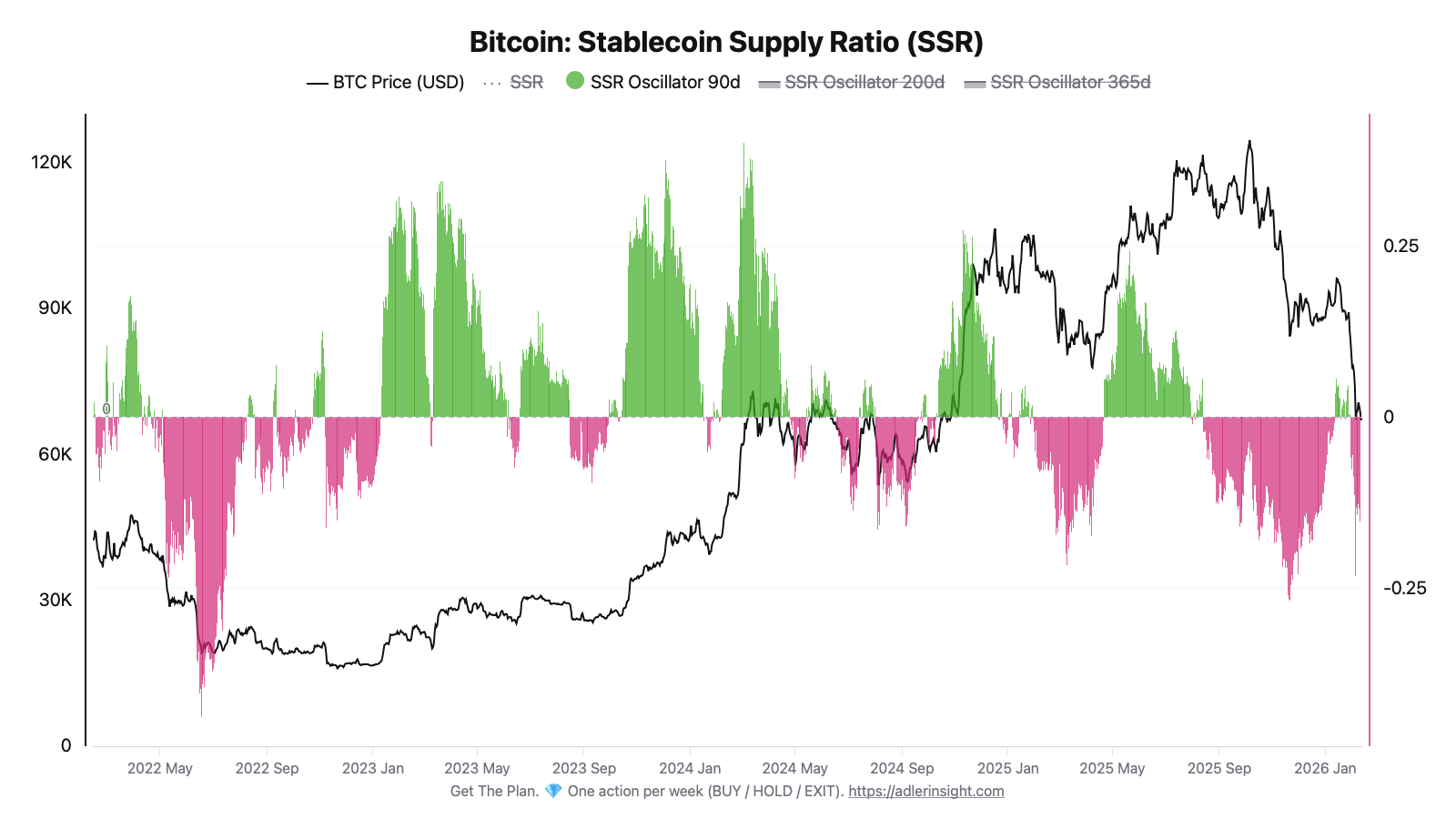
Bitcoin Stablecoin Supply Ratio (SSR) | Source: CryptoQuant

At the same time, the 30-day change in USDT market capitalization has fallen to approximately -$2.87 billion, signaling capital outflows from the crypto ecosystem. Together, these indicators suggest that January’s attempted recovery lacked sustained liquidity support. Unless stablecoin inflows return and the SSR oscillator stabilizes in positive territory for several weeks, the broader market context may remain risk-off, leaving Bitcoin vulnerable to continued pressure in the near term.

Stablecoin Liquidity Trends Reinforce Bitcoin Market Weakness

Axel Adler’s analysis emphasizes the importance of stablecoin liquidity as a leading indicator for Bitcoin market conditions. The 30-day change in USDT market capitalization functions as a directional gauge of dollar liquidity entering or leaving the crypto ecosystem. Positive readings typically signal fresh capital inflows that can support price appreciation, while negative values indicate liquidity contraction and reduced risk appetite among market participants.
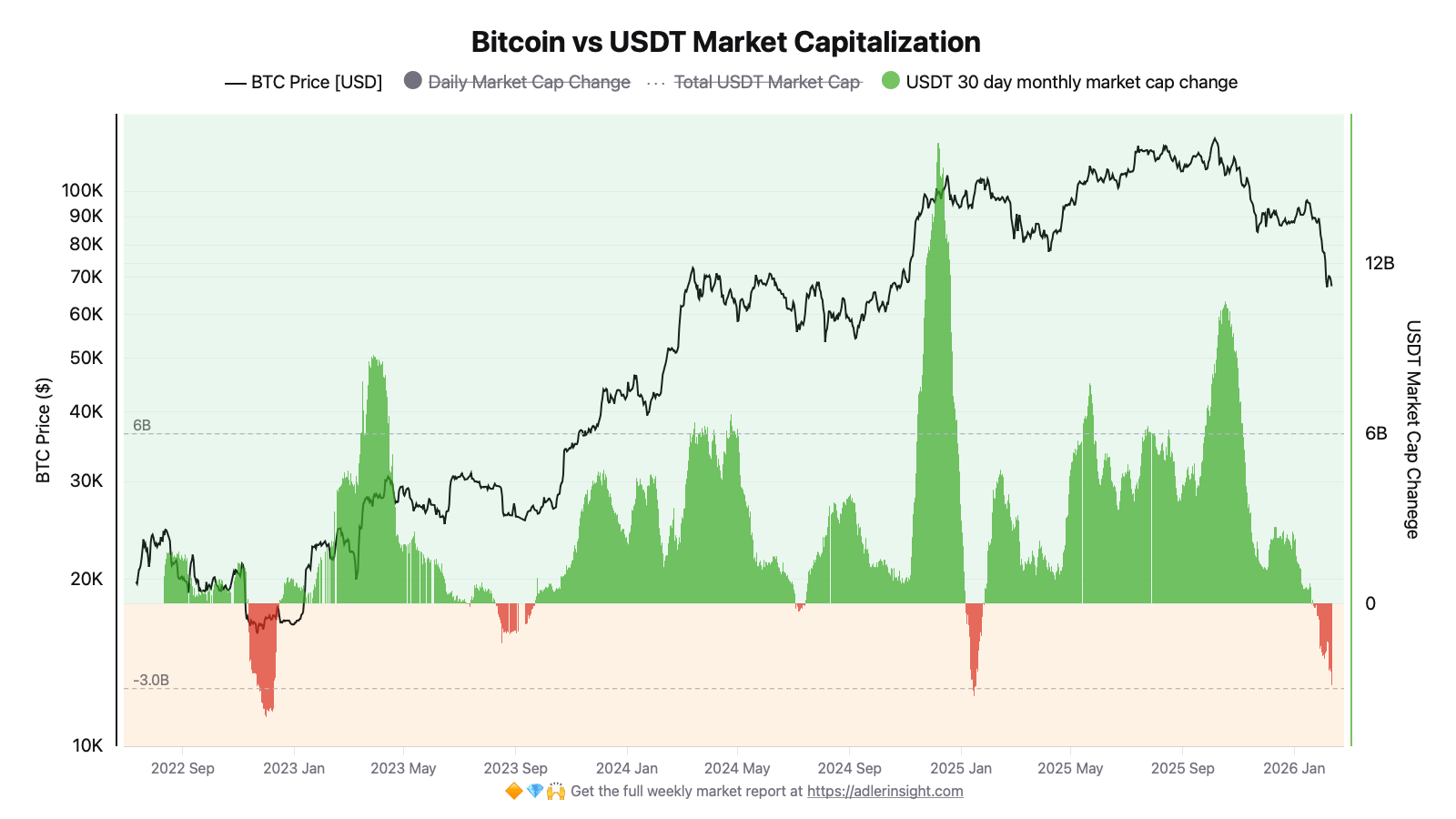
Bitcoin vs USDT Market Capitalization | Source: CryptoQuant

According to the data, January briefly showed signs of recovery. The 30-day USDT market cap change moved into positive territory, reaching approximately $1.4 billion during the first week of the month. This inflow coincided with the Stablecoin Supply Ratio (SSR) Oscillator’s attempt to move into positive territory, alongside a short-term rebound in Bitcoin price. However, the trend reversed later in January, and the latest reading near -$2.87 billion confirms renewed capital outflows.

The alignment between these two indicators appears consistent rather than coincidental. Liquidity inflows helped support January’s temporary recovery, while the return of outflows accompanied the subsequent market weakness.

As long as the 30-day USDT change remains negative, a sustained SSR recovery appears unlikely. Together, these signals suggest the market has shifted back into a risk-off environment, reinforcing the view that the recent rebound lacked durable liquidity support.


Related Questions

QWhat are the two key liquidity indicators mentioned in the article that signal Bitcoin's ongoing market weakness?

AThe two key liquidity indicators are the Stablecoin Supply Ratio (SSR) Oscillator moving back into negative territory and the 30-day change in USDT market capitalization falling to approximately -$2.87 billion.

QAccording to the analysis, what does a negative reading on the 30-day USDT market cap change indicate for the crypto market?

AA negative reading on the 30-day USDT market cap change indicates capital outflows from the crypto ecosystem, signaling liquidity contraction and reduced risk appetite among market participants.

QWhat is the significance of the Stablecoin Supply Ratio (SSR) Oscillator being in positive territory?

AHistorically, positive SSR readings have coincided with stronger Bitcoin price appreciation, indicating that Bitcoin is performing well relative to stablecoin dynamics.

QWhy does the article suggest that January's attempted market recovery ultimately failed?

AJanuary's attempted recovery failed because it lacked sustained liquidity support, as the initial positive trends in USDT inflows and the SSR oscillator reversed later in the month, confirming renewed capital outflows.

QWhat condition does the article state is necessary for the broader market context to shift away from a 'risk-off' environment?

AThe article states that stablecoin inflows need to return and the SSR oscillator must stabilize in positive territory for several weeks for the broader market context to shift away from a risk-off environment.

Related Reads

How to Do Research Well: Deliberately Practice the Real Skills That Matter

No one truly teaches you how to do research. You're often given a desk, a pre-selected problem, and vague instructions to "create something new." Consequently, many people reverse-engineer the job based on visible outputs—papers, posts, announcements—learning only how to *appear* like a researcher rather than how to *become* one. True research capability is built from stacking small, trainable skills, nearly all of which can be developed through deliberate practice. **Pick Your Own Problem:** Most researchers absorb problems from advisors or trends, lacking the underlying reasoning. Choosing a problem you genuinely care about, as John Schulman advises, leads to original work. Develop "taste" like a muscle: predict experiment outcomes, guess paper results from methods, and track which findings remain important over time. **Upgrade Your Inputs:** Relying on shared reading lists (arXiv hot lists, filtered group chats) leads to unoriginal conclusions. Undervalued old literature often holds crucial insights (e.g., MoE, LSTM, backpropagation). Richard Sutton's "The Bitter Lesson" or Claude Shannon's 1952 talk on creative thinking are more predictive than lengthy modern surveys. Breadth matters as much as depth: draw from neuroscience, mechanism design, hardware knowledge, and honest statistics. Read papers directly, especially appendices and limitations sections. **Write Everything Down:** As Paul Graham noted, writing exposes flaws in seemingly mature ideas. Writing is the cheapest defense against self-deception. Following Feynman's principle, Darwin programmatically wrote down facts contradicting his theory to combat memory bias. Maintain a detailed log of hypotheses, setups, predictions, results, and updated understandings. Reviewing past logs fosters essential humility.

marsbit59m ago

How to Do Research Well: Deliberately Practice the Real Skills That Matter

marsbit59m ago

Following US Ban on Fable 5, Zhipu AI's Stock Soars 47%

On June 15th, shares of Zhipu AI surged dramatically on the Hong Kong stock market, peaking at a 47.6% gain before closing 32.82% higher. This sharp increase was directly triggered by two recent industry events. On June 12th, Anthropic announced it was suspending global access to its latest flagship models, Claude Fable 5 and Claude Mythos 5, to comply with a U.S. government export control order. The next day, Zhipu AI announced it would open access to its latest open-source flagship model, GLM-5.2, under the permissive MIT license. The Anthropic incident highlighted a critical issue beyond raw model capability: the risk of sudden, unpredictable loss of access to advanced AI models, especially for developers and enterprises deeply integrated with them. This has shifted industry and market focus toward factors like stability, sustainable access, and controllability. Zhipu's move, promoting "frontier intelligence for all," positions its openly available model as a reliable and accessible alternative. The GLM-5.2 model emphasizes "Long Horizon Task" capabilities with a 1M context window, targeting complex, multi-step coding and engineering workflows where maintaining context is crucial. Analysts note this event exposes the risk of dependency on closed-source models subject to single jurisdictional controls, potentially accelerating a shift toward domestic base models and localized deployments. The market's reaction signals a new valuation dimension in AI: providers who can offer stable, long-term, and sustainably accessible AI capabilities are gaining strategic importance.

marsbit1h ago

Following US Ban on Fable 5, Zhipu AI's Stock Soars 47%

marsbit1h ago

Fully Entering the AI Era: Alipay Bets on Conversation, WeChat Holds Fast to Social

In May 2026, Alipay announced over 300 million AI payment transactions. Shortly after, WeChat opened its mini-programs for AI integration, sparking controversy by requiring developer source code access. This highlights their diverging approaches to AI integration. Alipay is testing "Project Treasure," an optional AI-native interface replacing traditional app grids with a conversational window. Users can command complex tasks (e.g., "book a ride and order coffee") handled end-to-end by AI. This shift follows an abandoned standalone AI app, focusing instead on enhancing its existing user base. For unmodified mini-programs, Alipay's AI uses "screen-reading" to simulate user interactions, bypassing the need for developer overhaul. It also introduced "Token Pay" for micro-transactions and "AI Wallets" for autonomous agent spending. WeChat, prioritizing its core social function, is taking an embedded approach. Its AI agent will operate within existing contexts like group chats and official accounts, assisting without a separate interface. To enable this, WeChat offers developers two paths: granting source code access for direct AI control ("Automatic Mode") or manually encapsulating services into standardized "Skills." Both place significant burden on developers. Key differences emerge in handling legacy services: WeChat demands developer cooperation (code or labor), while Alipay's screen-reading offers immediate, if potentially less stable, compatibility. Alipay's 3 billion AI transactions demonstrate user acceptance of AI-driven commercial actions. The divergent strategies may reshape mini-program ecosystems—Alipay passively "AI-fying" services, WeChat potentially favoring resource-rich developers—and set competing technical standards. Ultimately, the competition centers on where users entrust the command to "help me get things done."

marsbit1h ago

Fully Entering the AI Era: Alipay Bets on Conversation, WeChat Holds Fast to Social

marsbit1h ago

Trading

Spot
Futures

Hot Articles

What is $BITCOIN

DIGITAL GOLD ($BITCOIN): A Comprehensive Analysis Introduction to DIGITAL GOLD ($BITCOIN) DIGITAL GOLD ($BITCOIN) is a blockchain-based project operating on the Solana network, which aims to combine the characteristics of traditional precious metals with the innovation of decentralized technologies. While it shares a name with Bitcoin, often referred to as “digital gold” due to its perception as a store of value, DIGITAL GOLD is a separate token designed to create a unique ecosystem within the Web3 landscape. Its goal is to position itself as a viable alternative digital asset, although specifics regarding its applications and functionalities are still developing. What is DIGITAL GOLD ($BITCOIN)? DIGITAL GOLD ($BITCOIN) is a cryptocurrency token explicitly designed for use on the Solana blockchain. In contrast to Bitcoin, which provides a widely recognized value storage role, this token appears to focus on broader applications and characteristics. Notable aspects include: Blockchain Infrastructure: The token is built on the Solana blockchain, known for its capacity to handle high-speed and low-cost transactions. Supply Dynamics: DIGITAL GOLD has a maximum supply capped at 100 quadrillion tokens (100P $BITCOIN), although details regarding its circulating supply are currently undisclosed. Utility: While precise functionalities are not explicitly outlined, there are indications that the token could be utilized for various applications, potentially involving decentralized applications (dApps) or asset tokenization strategies. Who is the Creator of DIGITAL GOLD ($BITCOIN)? At present, the identity of the creators and development team behind DIGITAL GOLD ($BITCOIN) remains unknown. This situation is typical among many innovative projects within the blockchain space, particularly those aligning with decentralized finance and meme coin phenomena. While such anonymity may foster a community-driven culture, it intensifies concerns about governance and accountability. Who are the Investors of DIGITAL GOLD ($BITCOIN)? The available information indicates that DIGITAL GOLD ($BITCOIN) does not have any known institutional backers or prominent venture capital investments. The project seems to operate on a peer-to-peer model focused on community support and adoption rather than traditional funding routes. Its activity and liquidity are primarily situated on decentralized exchanges (DEXs), such as PumpSwap, rather than established centralized trading platforms, further highlighting its grassroots approach. How DIGITAL GOLD ($BITCOIN) Works The operational mechanics of DIGITAL GOLD ($BITCOIN) can be elaborated on based on its blockchain design and network attributes: Consensus Mechanism: By leveraging Solana’s unique proof-of-history (PoH) combined with a proof-of-stake (PoS) model, the project ensures efficient transaction validation contributing to the network's high performance. Tokenomics: While specific deflationary mechanisms have not been extensively detailed, the vast maximum token supply implies that it may cater to microtransactions or niche use cases that are still to be defined. Interoperability: There exists the potential for integration with Solana’s broader ecosystem, including various decentralized finance (DeFi) platforms. However, the details regarding specific integrations remain unspecified. Timeline of Key Events Here is a timeline that highlights significant milestones concerning DIGITAL GOLD ($BITCOIN): 2023: The initial deployment of the token occurs on the Solana blockchain, marked by its contract address. 2024: DIGITAL GOLD gains visibility as it becomes available for trading on decentralized exchanges like PumpSwap, allowing users to trade it against SOL. 2025: The project witnesses sporadic trading activity and potential interest in community-led engagements, although no noteworthy partnerships or technical advancements have been documented as of yet. Critical Analysis Strengths Scalability: The underlying Solana infrastructure supports high transaction volumes, which could enhance the utility of $BITCOIN in various transaction scenarios. Accessibility: The potential low trading price per token could attract retail investors, facilitating wider participation due to fractional ownership opportunities. Risks Lack of Transparency: The absence of publicly known backers, developers, or an audit process may yield skepticism regarding the project's sustainability and trustworthiness. Market Volatility: The trading activity is heavily reliant on speculative behavior, which can result in significant price volatility and uncertainty for investors. Conclusion DIGITAL GOLD ($BITCOIN) emerges as an intriguing yet ambiguous project within the rapidly evolving Solana ecosystem. While it attempts to leverage the “digital gold” narrative, its departure from Bitcoin's established role as a store of value underscores the need for a clearer differentiation of its intended utility and governance structure. Future acceptance and adoption will likely depend on addressing the current opacity and defining its operational and economic strategies more explicitly. Note: This report encompasses synthesised information available as of October 2023, and developments may have transpired beyond the research period.

364 Total ViewsPublished 2025.05.13Updated 2025.05.13

What is $BITCOIN

Discussions

Welcome to the HTX Community. Here, you can stay informed about the latest platform developments and gain access to professional market insights. Users' opinions on the price of BTC (BTC) are presented below.

活动图片