Bitcoin Treasury Demand Dominated By Strategy As Others’ Share Drops 99%

bitcoinistPublished on 2026-03-27Last updated on 2026-03-27

Abstract

Bitcoin treasury demand is now overwhelmingly dominated by Strategy, which accounted for 98% of corporate purchases over the past month. While other companies have seen their buying share collapse by 99% to just 1,000 BTC, Strategy continued its aggressive accumulation, adding 45,000 BTC and now holding over 3.8% of the entire Bitcoin supply. This highlights a high concentration of corporate holdings with no broad demand from other firms. However, US spot Bitcoin ETFs have recently seen five consecutive weeks of net inflows, potentially signaling a return of institutional interest. Bitcoin is currently trading around $69,300.

Data shows Strategy is currently the main driver of corporate Bitcoin demand, as other companies have seen their purchase share shrink to just 2%.

Strategy Behind Most Of The Bitcoin Treasury Buying From The Past Month

In a new post on X, on-chain analytics firm CryptoQuant has highlighted how Bitcoin treasury demand is now being driven entirely by Strategy. Treasury companies refer to corporates that keep BTC on their balance sheet as a way of providing their investors with indirect exposure to the cryptocurrency. This model was popularized by Strategy, which, under the leadership of Michael Saylor, has aggressively accumulated BTC.

While the cryptocurrency sector has gone through a bearish shift recently, the firm hasn’t lost its conviction, with regular purchases only continuing. As a result of this steady accumulation, Strategy today controls over 3.8% of the entire Bitcoin supply in circulation, making it by far the largest digital asset treasury company in the world.

It would appear, though, that while the company hasn’t faltered by the change of winds in the market, the same hasn’t been true for the other corporate investors.
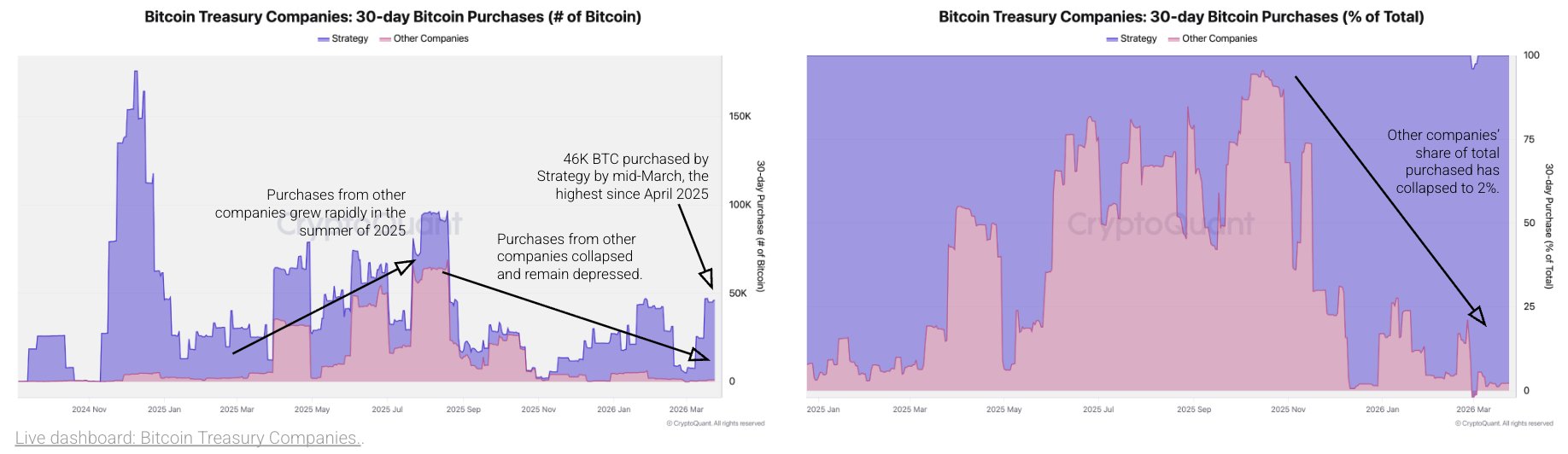
How purchases from BTC treasury companies have changed over the past year | Source: CryptoQuant on X

As is visible in the data shared by CryptoQuant, the middle portion of 2025 saw a rapid expansion of Bitcoin purchases from companies other than Strategy. These buys meant that total corporate demand far outweighed the accumulation from Saylor’s firm alone.

As the market has gone downhill, however, buying from other companies has dried up. In the past month, Strategy bought about 45,000 BTC, but purchases from other companies totaled just 1,000 BTC. This reflects a collapse of a whopping 99% for the latter.

In percentage terms, Strategy’s buying made up for 98% of the corporate demand from the last 30 days, once again capturing the current asymmetry in the sector. “With ~76% of holdings, the industry is highly concentrated; there is no broad corporate demand right now,” noted the analytics firm.

That said, while Bitcoin treasury companies other than Strategy may have paused accumulation, it doesn’t mean that the firm is the sole treasury buyer in the entire digital asset sector. Bitmine, the largest public holder of Ethereum, has also continued to make regular purchases recently.

Another source of institutional demand in the market today is the US spot exchange-traded funds (ETFs), exchange vehicles that allow traders to invest in BTC without directly having to interact with blockchain infrastructure.

Earlier, these funds were facing net outflows, but recently, the weekly netflow has managed to get a green streak going, according to data from SoSoValue. These recent small but steady inflows could be an early sign that some institutional interest may be pouring back into Bitcoin.
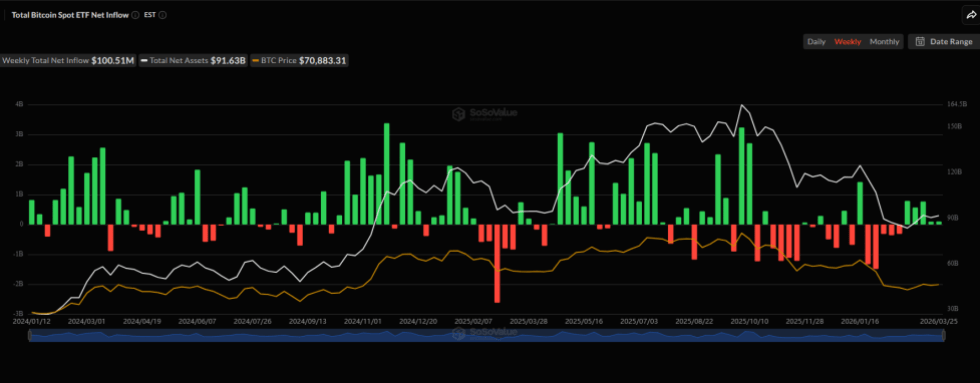
Looks like the last five weeks have all seen net inflows | Source: SoSoValue

BTC Price

At the time of writing, Bitcoin is floating around $69,300, down 3% over the last 24 hours.

The trend in the price of the coin over the last five days | Source: BTCUSDT on TradingView


Trending Cryptos

Related Questions

QAccording to the article, which company is currently the main driver of corporate Bitcoin treasury demand?

AStrategy is currently the main driver of corporate Bitcoin treasury demand.

QWhat percentage of the total corporate Bitcoin demand from the last 30 days did Strategy account for?

AStrategy accounted for 98% of the total corporate Bitcoin demand from the last 30 days.

QHow much did the purchase share from other companies (non-Strategy) change, as mentioned in the data?

AThe purchase share from other companies collapsed by 99%, shrinking to just 2% of the total.

QBesides corporate treasuries, what is another source of institutional demand for Bitcoin mentioned in the article?

AAnother source of institutional demand mentioned is the US spot exchange-traded funds (ETFs).

QWhat is the approximate price of Bitcoin at the time the article was written?

AAt the time of writing, Bitcoin was floating around $69,300.

Related Reads

BIT Research: Liquidity is Disappearing, Will Bitcoin Replay the Bottoming Pattern of 2022?

The crypto market is currently in an adjustment phase driven by policy expectations and liquidity shifts. Despite a brief rebound fueled by geopolitical easing and SpaceX's strong IPO performance, unexpectedly hawkish signals from new Fed Chair Kevin Warsh have removed anticipated easing support. Concurrently, stablecoin liquidity is shrinking, with insufficient new capital inflows, pushing the market into a typically quiet summer period. Pricing lacks catalysts for a sustained rally. Daily trading volume has significantly contracted, stablecoin growth has slowed markedly, and the supportive effect of Strategy's (formerly MicroStrategy) STRC preferred stock-financed Bitcoin purchases is fading. Amid policy uncertainty, seasonal weakness, and liquidity contraction, Bitcoin faces near-term downward pressure. Warsh's hawkish pivot and refusal to provide a clear policy outlook have increased risk premiums, historically unfavorable for Bitcoin. Technically, the trend remains bearish below $73,700, with $62,446 as critical support. A break below could accelerate declines, though a prolonged consolidation phase, similar to 2022's bottoming process, is possible. Liquidity is a core constraint. Current daily volume is around $500 billion, roughly 25% of the peak during the July-Oct 2025 rally. The 12-month growth rates for USDT and USDC have fallen to ~20%, with 6-month growth near zero, indicating weak new inflows. Bitcoin ETF and Strategy-driven inflows have also weakened, with a 30-day rolling net outflow. With inflation at 4.2% above the Fed's target, combined hawkish policy, seasonal factors, and liquidity shortages challenge Bitcoin's ability to hold above $60,000. However, this adjustment phase may be forming a cyclical low this summer, potentially setting the stage for the next bull cycle.

marsbit27m ago

BIT Research: Liquidity is Disappearing, Will Bitcoin Replay the Bottoming Pattern of 2022?

marsbit27m ago

Who Makes the Best Use of Claude Code? The Answer Might Not Be Programmers

Claude Code Usage Report Summary (Based on ~400k sessions) Core Finding: In agentic programming with Claude Code, a clear division of labor has emerged: humans primarily decide *what* to build (planning decisions), while Claude decides *how* to build it (execution decisions). Key Insights: 1. **Effectiveness is not limited to programmers.** In code-generation tasks, success rates for users in non-technical fields (law, finance, management, research) are nearing those of software engineers. What matters most is the user's domain expertise and understanding of the problem to be solved. 2. **Domain expertise drives success and efficiency.** Sessions where users exhibited "expert" proficiency in the task's domain saw verified success rates double compared to "novice" sessions. Experts also delegated more work per instruction, with Claude executing more actions and producing more output. 3. **AI is amplifying, not replacing, domain knowledge.** Claude Code lowers the *implementation* barrier, not the *judgment* barrier. The value of knowing the "what" and "why" is increasing relative to just knowing the "how" to code. 4. **Usage is evolving.** Over a 7-month period (Oct '25 - Apr '26), the share of sessions for debugging halved, while use for software operations, data analysis, and non-code writing roughly doubled. The estimated economic value of typical tasks increased by ~25%. Conclusion: The data suggests coding agents are making programming background less critical for completing technical tasks. However, they reward and amplify deep domain understanding. The ability to successfully direct an AI agent stems more from mastery of a specific field than from coding skill itself. The primary gains come from being competent in a domain; deep specialization adds only marginal additional advantage. This may signal a shift where software creation becomes integrated into various professions.

marsbit1h ago

Who Makes the Best Use of Claude Code? The Answer Might Not Be Programmers

marsbit1h ago

Trading

Spot
Futures

Hot Articles

What is $BITCOIN

DIGITAL GOLD ($BITCOIN): A Comprehensive Analysis Introduction to DIGITAL GOLD ($BITCOIN) DIGITAL GOLD ($BITCOIN) is a blockchain-based project operating on the Solana network, which aims to combine the characteristics of traditional precious metals with the innovation of decentralized technologies. While it shares a name with Bitcoin, often referred to as “digital gold” due to its perception as a store of value, DIGITAL GOLD is a separate token designed to create a unique ecosystem within the Web3 landscape. Its goal is to position itself as a viable alternative digital asset, although specifics regarding its applications and functionalities are still developing. What is DIGITAL GOLD ($BITCOIN)? DIGITAL GOLD ($BITCOIN) is a cryptocurrency token explicitly designed for use on the Solana blockchain. In contrast to Bitcoin, which provides a widely recognized value storage role, this token appears to focus on broader applications and characteristics. Notable aspects include: Blockchain Infrastructure: The token is built on the Solana blockchain, known for its capacity to handle high-speed and low-cost transactions. Supply Dynamics: DIGITAL GOLD has a maximum supply capped at 100 quadrillion tokens (100P $BITCOIN), although details regarding its circulating supply are currently undisclosed. Utility: While precise functionalities are not explicitly outlined, there are indications that the token could be utilized for various applications, potentially involving decentralized applications (dApps) or asset tokenization strategies. Who is the Creator of DIGITAL GOLD ($BITCOIN)? At present, the identity of the creators and development team behind DIGITAL GOLD ($BITCOIN) remains unknown. This situation is typical among many innovative projects within the blockchain space, particularly those aligning with decentralized finance and meme coin phenomena. While such anonymity may foster a community-driven culture, it intensifies concerns about governance and accountability. Who are the Investors of DIGITAL GOLD ($BITCOIN)? The available information indicates that DIGITAL GOLD ($BITCOIN) does not have any known institutional backers or prominent venture capital investments. The project seems to operate on a peer-to-peer model focused on community support and adoption rather than traditional funding routes. Its activity and liquidity are primarily situated on decentralized exchanges (DEXs), such as PumpSwap, rather than established centralized trading platforms, further highlighting its grassroots approach. How DIGITAL GOLD ($BITCOIN) Works The operational mechanics of DIGITAL GOLD ($BITCOIN) can be elaborated on based on its blockchain design and network attributes: Consensus Mechanism: By leveraging Solana’s unique proof-of-history (PoH) combined with a proof-of-stake (PoS) model, the project ensures efficient transaction validation contributing to the network's high performance. Tokenomics: While specific deflationary mechanisms have not been extensively detailed, the vast maximum token supply implies that it may cater to microtransactions or niche use cases that are still to be defined. Interoperability: There exists the potential for integration with Solana’s broader ecosystem, including various decentralized finance (DeFi) platforms. However, the details regarding specific integrations remain unspecified. Timeline of Key Events Here is a timeline that highlights significant milestones concerning DIGITAL GOLD ($BITCOIN): 2023: The initial deployment of the token occurs on the Solana blockchain, marked by its contract address. 2024: DIGITAL GOLD gains visibility as it becomes available for trading on decentralized exchanges like PumpSwap, allowing users to trade it against SOL. 2025: The project witnesses sporadic trading activity and potential interest in community-led engagements, although no noteworthy partnerships or technical advancements have been documented as of yet. Critical Analysis Strengths Scalability: The underlying Solana infrastructure supports high transaction volumes, which could enhance the utility of $BITCOIN in various transaction scenarios. Accessibility: The potential low trading price per token could attract retail investors, facilitating wider participation due to fractional ownership opportunities. Risks Lack of Transparency: The absence of publicly known backers, developers, or an audit process may yield skepticism regarding the project's sustainability and trustworthiness. Market Volatility: The trading activity is heavily reliant on speculative behavior, which can result in significant price volatility and uncertainty for investors. Conclusion DIGITAL GOLD ($BITCOIN) emerges as an intriguing yet ambiguous project within the rapidly evolving Solana ecosystem. While it attempts to leverage the “digital gold” narrative, its departure from Bitcoin's established role as a store of value underscores the need for a clearer differentiation of its intended utility and governance structure. Future acceptance and adoption will likely depend on addressing the current opacity and defining its operational and economic strategies more explicitly. Note: This report encompasses synthesised information available as of October 2023, and developments may have transpired beyond the research period.

401 Total ViewsPublished 2025.05.13Updated 2025.05.13

What is $BITCOIN

Discussions

Welcome to the HTX Community. Here, you can stay informed about the latest platform developments and gain access to professional market insights. Users' opinions on the price of BTC (BTC) are presented below.

活动图片