Bitcoin Trading On Binance Cools Off: Spot Volume Falls Sharply To Multi-Year Lows

bitcoinistPublished on 2026-03-25Last updated on 2026-03-25

Abstract

Bitcoin briefly rebounded to retest $71,000, but trading activity on Binance has cooled significantly. Spot volume on the exchange has dropped sharply to multi-year lows, losing over $52 billion and marking the lowest levels since the 2023 bear market. This decline reflects reduced market participation and signals underlying weakness. The cooling activity occurs amid a tense macroeconomic backdrop, with the Fed turning more assertive, persistent inflation, and growing stagflation concerns. Despite this, institutional interest remains, as evidenced by MicroStrategy's recent purchase of an additional 1,031 BTC. Analysts note that while the short-term signal is negative, such periods often create long-term opportunities.

As the Monday market section nears completion, Bitcoin saw a brief rebound, allowing the crypto king to retest the $71,000 price level once again. BTC’s price may have slightly bounced back up to pivotal levels, but trading activity on cryptocurrency exchanges appears to have significantly cooled down, suggesting underlying weakness in market participation.

Binance Sees Major Drop In Bitcoin Spot Volume

Bitcoin’s price and its trading activity, particularly on cryptocurrency exchanges, are moving in separate directions. On Binance, the world’s largest trading platform, trading activity around BTC is currently demonstrating signs of a notable cool down.

After his research, Darkfost, a verified author at the CryptoQuant platform and data analyst, shared that the BTC spot volume on Binance has fallen sharply, reaching multi-year lows. As of Monday, the spot volume lost over $52 billion, marking its lowest level since the 2023 bear market.

This sharp drop points to a major reduction in market participation, as retail and institutional investors appear to be stepping back in the face of uncertain conditions. In the past, this type of development was known for triggering periods of heightened volatility, making this a crucial moment in BTC’s journey.
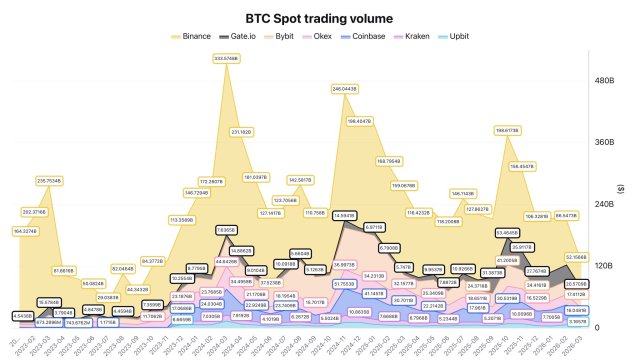
Source: Chart from Darkfost on X

With this, March is shaping up to record the lowest spot trading volume on Binance since September 2023. The market is currently experiencing conditions that match the previous bear market, with $52 billion in spot volume lost on Binance.

According to Darkfost, the decline in spot volumes on Binance reflects the current lack of investor interest in the market, and this signal remains negative in the short term. However, these kinds of difficult periods are typically associated with deep correction phases that end up creating genuine opportunities for investors with a long-term perspective.

Policymakers Are Shifting Toward A More Assertive Tone

What makes this even more interesting is the fact that it is taking place within a tense geopolitical and economic backdrop. Thus, the markets are increasingly pricing in the possibility of a less favorable macroeconomic environment.

During the latest Federal Reserve (FED) meeting at the Federal Open Market Committee, the tone of policymakers became noticeably more hawkish. At the same time, the labor market is flashing signs of weakness and can no longer be supported by rate cuts, as inflation remains persistent.

With Q4 GDP (Gross Domestic Product) increasing by +0.7%, this is compounded by an already visible economic slowdown, which will require confirmation from upcoming Q1 GDP figures, increasing worries about stagflation. Meanwhile, the United States long-term yields are experiencing a spike.

Furthermore, the US dollar is strengthening, and these signals are collectively pointing to a deterioration in the macroeconomic environment, which risk assets are beginning to feel. In this context, Darkfost highlighted that the risk aversion of investors is becoming increasingly evident, and Bitcoin is being directly affected.

Despite ongoing tensions, institutional demand for BTC has not entirely faded. Michael Saylor’s Strategy recently acquired an additional 1,031 BTC at $74,326 per coin, bringing their total holdings to 762,099 BTC, purchased at $75,694 per coin. At the current pace, Adam Livingston predicts that the company could hit the 1 million BTC mark in October this year.

BTC trading at $71,198 on the 1D chart | Source: BTCUSDT on Tradingview.com

Related Questions

QWhat has happened to Bitcoin spot trading volume on Binance according to the article?

ABitcoin spot trading volume on Binance has fallen sharply, losing over $52 billion and reaching multi-year lows, marking its lowest level since the 2023 bear market.

QWho provided the research and data on the decline in Binance's BTC spot volume?

AThe research was provided by Darkfost, a verified author and data analyst at the CryptoQuant platform.

QWhat does the sharp drop in spot volume on Binance indicate about market participation?

AThe sharp drop points to a major reduction in market participation, as both retail and institutional investors appear to be stepping back due to uncertain conditions.

QAccording to the article, what broader economic factors are contributing to a risk-averse environment?

AFactors include a more hawkish tone from the Federal Reserve, a weakening labor market, persistent inflation, an economic slowdown signaled by Q4 GDP, rising long-term yields, and a strengthening US dollar, all pointing to a deteriorating macroeconomic environment.

QDespite the overall cooling market, which institution continued to acquire Bitcoin and how much did they purchase?

AMichael Saylor's company, MicroStrategy, acquired an additional 1,031 BTC at $74,326 per coin, bringing their total holdings to 762,099 BTC.

Related Reads

The Macroeconomic Underpinnings of Africa's Payment Market Landscape

The African payments market, characterized by the world's highest mobile money penetration and fastest-growing cryptocurrency adoption, is not a coincidence but a macroeconomic necessity driven by deep structural factors. Two key drivers create this landscape: (1) Africa's heavy reliance on commodity exports, trade, and remittances, generating massive cross-border settlement and remittance demand; and (2) chronically underdeveloped financial infrastructure, exacerbated by international bank de-risking, foreign exchange mismanagement, and persistent inflation. This vacuum has allowed mobile money and crypto to thrive. Mobile money platforms replace banks for domestic payments, while cryptocurrencies serve as a store of value against local currency depreciation and a low-cost medium for cross-border exchange. A crucial division lies along the Sahara Desert. North Africa is integrated into the oil-anchored MENA framework, while Sub-Saharan Africa (SSA), plagued by dollar shortages and fragmented currencies, has become a natural, massive market for mobile money and crypto. Nigeria, Kenya, and South Africa are global leaders in adoption. The SSA economy is deeply dollarized due to currency instability, yet suffers from a severe "dollar shortage" caused by trade deficits and limited export capacity. This creates parallel forex markets and high remittance costs. Cryptocurrencies, particularly stablecoins, fill this gap by providing access to dollar liquidity, cheaper cross-border transfers, and an inflation-resistant store of value, primarily driven by retail users for small-value transactions. While regional initiatives like PAPSS aim to reduce dollar dependence, the fundamental constraints of commodity reliance, trade imbalances, and shallow financial markets persist. Therefore, mobile money and cryptocurrencies are not niche trends but essential financial infrastructure filling a structural void, and they are likely to remain central to Africa's economic landscape for the foreseeable future.

链捕手10m ago

The Macroeconomic Underpinnings of Africa's Payment Market Landscape

链捕手10m ago

Is the Sharp Decline Over? Let the Data Speak

**Has the Sharp Decline Ended? Let Data Speak** Bitcoin's recent significant drop has placed short sellers in a precarious position. Three concurrent pressures—sustained outflows from ETFs, miners offloading coins to exchanges, and short-term holders capitulating—pushed the price near $63k. The asset fell 13% this week and 21% this month, roughly halving from its all-time high. A critical data point is the extremely crowded short positioning, with a short-to-long ratio reaching 8:1, representing nearly $100 billion in short interest overhead. This creates conditions for a potential short squeeze if selling pressure merely pauses, similar to the event in November 2022 which triggered a 24% rally. The selling pressures are real: spot Bitcoin ETFs have seen a record $5.4 billion outflow over 20 days. Short-term holders moved 53k loss-held BTC to exchanges in a day, and miners sent 24k BTC to Binance, a six-month high. Capital is also rotating towards AI and tech stocks like SpaceX, with $400 billion invested in AI infrastructure recently. However, on-chain data shows accumulation by long-term holders, who added 200k BTC in a month, and institutions/miners have absorbed 1.24 million BTC since 2023. This indicates strong buying beneath the surface. Key levels to watch are the $67k-$70k zone (2021 high & 2024 breakout point). A swift recovery above it suggests a leverage washout; failure could test $60k-$55k. The direction also hinges on ETF flow reversal. Currently, the S&P 500 hits new highs driven by AI, while Bitcoin and DeFi (TVL down from $173b to $73.9b) lag. The most probable path is a grinding basing process between $60k-$58k with continued ETF outflows. A less likely but explosive scenario involves a sudden flow reversal, a surge above $70k triggering a short squeeze, and a rally back above $76k. The immediate trigger depends on when the relentless selling pauses. A final cautionary note questions Bitcoin's correlation: if the high-flying U.S. stock market corrects, will Bitcoin once again miss the rally but not the decline?

foresightnews_api25m ago

Is the Sharp Decline Over? Let the Data Speak

foresightnews_api25m ago

Single-Day Plunge of 30%, Arthur Hayes Suddenly Liquidates: Why Did ZEC Get Exploded by Security Issues?

On June 5th, Zcash founder Zooko Wilcox disclosed a critical soundness vulnerability in the project's latest Orchard privacy pool. This flaw, found in the elliptic curve multiplication constraints, could allow an attacker to create unlimited counterfeit ZEC within the shielded pool, with transactions appearing valid. The vulnerability was discovered in late May by security researcher Taylor Hornby, who utilized Anthropic's new Opus 4.8 AI model for a targeted audit. The Zcash ecosystem had already performed an emergency network upgrade to patch the issue. However, the detailed disclosure triggered severe market panic, causing ZEC's price to plummet over 30% in a single day. Notably, prominent investor Arthur Hayes announced he had sold his entire ZEC position following the news. The incident starkly challenges the "technological trust" narrative central to privacy coins. Despite years of top-tier cryptographic audits, the bug persisted until uncovered with advanced AI-assisted research. This highlights the growing gap between theoretical perfection and practical implementation in privacy technology. The event serves as a industry-wide warning: in an AI-driven security landscape, the assumption that "undiscovered equals safe" is obsolete. It underscores the urgent need for continuous, proactive security practices combining AI audits, formal verification, and rapid response mechanisms.

foresightnews_api1h ago

Single-Day Plunge of 30%, Arthur Hayes Suddenly Liquidates: Why Did ZEC Get Exploded by Security Issues?

foresightnews_api1h ago

Trading

Spot
Futures

Hot Articles

What is $BITCOIN

DIGITAL GOLD ($BITCOIN): A Comprehensive Analysis Introduction to DIGITAL GOLD ($BITCOIN) DIGITAL GOLD ($BITCOIN) is a blockchain-based project operating on the Solana network, which aims to combine the characteristics of traditional precious metals with the innovation of decentralized technologies. While it shares a name with Bitcoin, often referred to as “digital gold” due to its perception as a store of value, DIGITAL GOLD is a separate token designed to create a unique ecosystem within the Web3 landscape. Its goal is to position itself as a viable alternative digital asset, although specifics regarding its applications and functionalities are still developing. What is DIGITAL GOLD ($BITCOIN)? DIGITAL GOLD ($BITCOIN) is a cryptocurrency token explicitly designed for use on the Solana blockchain. In contrast to Bitcoin, which provides a widely recognized value storage role, this token appears to focus on broader applications and characteristics. Notable aspects include: Blockchain Infrastructure: The token is built on the Solana blockchain, known for its capacity to handle high-speed and low-cost transactions. Supply Dynamics: DIGITAL GOLD has a maximum supply capped at 100 quadrillion tokens (100P $BITCOIN), although details regarding its circulating supply are currently undisclosed. Utility: While precise functionalities are not explicitly outlined, there are indications that the token could be utilized for various applications, potentially involving decentralized applications (dApps) or asset tokenization strategies. Who is the Creator of DIGITAL GOLD ($BITCOIN)? At present, the identity of the creators and development team behind DIGITAL GOLD ($BITCOIN) remains unknown. This situation is typical among many innovative projects within the blockchain space, particularly those aligning with decentralized finance and meme coin phenomena. While such anonymity may foster a community-driven culture, it intensifies concerns about governance and accountability. Who are the Investors of DIGITAL GOLD ($BITCOIN)? The available information indicates that DIGITAL GOLD ($BITCOIN) does not have any known institutional backers or prominent venture capital investments. The project seems to operate on a peer-to-peer model focused on community support and adoption rather than traditional funding routes. Its activity and liquidity are primarily situated on decentralized exchanges (DEXs), such as PumpSwap, rather than established centralized trading platforms, further highlighting its grassroots approach. How DIGITAL GOLD ($BITCOIN) Works The operational mechanics of DIGITAL GOLD ($BITCOIN) can be elaborated on based on its blockchain design and network attributes: Consensus Mechanism: By leveraging Solana’s unique proof-of-history (PoH) combined with a proof-of-stake (PoS) model, the project ensures efficient transaction validation contributing to the network's high performance. Tokenomics: While specific deflationary mechanisms have not been extensively detailed, the vast maximum token supply implies that it may cater to microtransactions or niche use cases that are still to be defined. Interoperability: There exists the potential for integration with Solana’s broader ecosystem, including various decentralized finance (DeFi) platforms. However, the details regarding specific integrations remain unspecified. Timeline of Key Events Here is a timeline that highlights significant milestones concerning DIGITAL GOLD ($BITCOIN): 2023: The initial deployment of the token occurs on the Solana blockchain, marked by its contract address. 2024: DIGITAL GOLD gains visibility as it becomes available for trading on decentralized exchanges like PumpSwap, allowing users to trade it against SOL. 2025: The project witnesses sporadic trading activity and potential interest in community-led engagements, although no noteworthy partnerships or technical advancements have been documented as of yet. Critical Analysis Strengths Scalability: The underlying Solana infrastructure supports high transaction volumes, which could enhance the utility of $BITCOIN in various transaction scenarios. Accessibility: The potential low trading price per token could attract retail investors, facilitating wider participation due to fractional ownership opportunities. Risks Lack of Transparency: The absence of publicly known backers, developers, or an audit process may yield skepticism regarding the project's sustainability and trustworthiness. Market Volatility: The trading activity is heavily reliant on speculative behavior, which can result in significant price volatility and uncertainty for investors. Conclusion DIGITAL GOLD ($BITCOIN) emerges as an intriguing yet ambiguous project within the rapidly evolving Solana ecosystem. While it attempts to leverage the “digital gold” narrative, its departure from Bitcoin's established role as a store of value underscores the need for a clearer differentiation of its intended utility and governance structure. Future acceptance and adoption will likely depend on addressing the current opacity and defining its operational and economic strategies more explicitly. Note: This report encompasses synthesised information available as of October 2023, and developments may have transpired beyond the research period.

363 Total ViewsPublished 2025.05.13Updated 2025.05.13

What is $BITCOIN

Discussions

Welcome to the HTX Community. Here, you can stay informed about the latest platform developments and gain access to professional market insights. Users' opinions on the price of BTC (BTC) are presented below.

活动图片















