Bitcoin Trading Enters New Era With SEC-Approved Nasdaq Index Options

bitcoinistPublished on 2026-05-23Last updated on 2026-05-23

Abstract

The U.S. Securities and Exchange Commission (SEC) has approved Nasdaq's proposal to list and trade Bitcoin index options, though trading is not immediate. Final approval is also required from the Commodity Futures Trading Commission (CFTC), which has jurisdiction over Bitcoin as a commodity. The cash-settled, European-style options, to trade under ticker QBTC on the Philadelphia Stock Exchange, will derive their value from the Nasdaq Bitcoin Index and will not involve physical Bitcoin delivery. This decision reflects a broader regulatory shift under SEC Chairman Paul Atkins, including a move toward clearer rules supporting innovation and reports of a potential "innovation exemption" for tokenized securities. The approval represents a continued integration of Bitcoin-linked products into mainstream finance.

Trading in the new Bitcoin index options will not begin right away. The SEC approval does not automatically open the door — the Commodity Futures Trading Commission must still grant its own exemptive relief before any contracts change hands on the exchange, because Bitcoin is classified as a commodity and falls under the CFTC’s jurisdiction.

The SEC approved Nasdaq’s proposal to list the options on the Philadelphia Stock Exchange, known as Phlx, on an accelerated basis, with the decision published Friday on the agency’s website.

A Different Kind Of Bitcoin Contract

The contracts are European-style and cash-settled, meaning buyers receive the difference between the Bitcoin spot price and the strike price at expiration — no actual Bitcoin changes hands.

That structure also removes the risk of early assignment, which sets these apart from options tied to spot Bitcoin ETFs that have been available to investors.
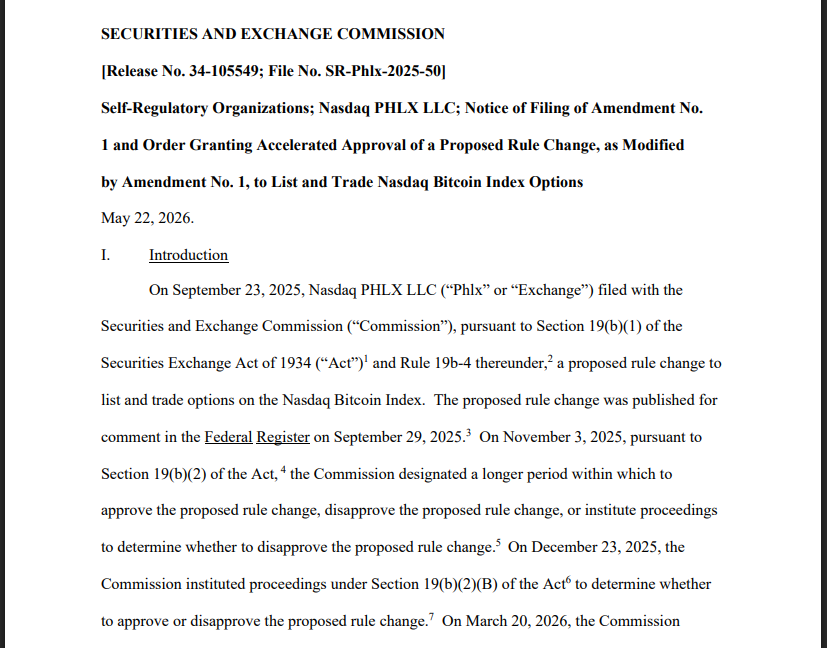
Source: SEC

The contracts will trade under the ticker QBTC, with a minimum price increment of one cent and a position limit of 24,000 contracts per side, which works out to roughly 0.12% of Bitcoin’s total outstanding supply.

They are tied to the Nasdaq Bitcoin Index, a benchmark that tracks one one-hundredth of the CME CF BTC Real Time Index, which pulls pricing data from major cryptocurrency exchanges every 200 milliseconds.

CME Group filed a comment letter last October arguing the new contracts fall under the CFTC’s exclusive authority. The SEC pushed back, writing in its order that shared jurisdiction between the two regulators is not new, citing mixed swaps and security futures as existing examples, and referencing Section 717 of the Dodd-Frank Act as the legal basis for concurrent oversight.

Bitcoin is now trading at $74,748. Chart: TradingView

A Shift In Tone At The SEC

The approval fits a broader shift underway at the SEC under Chairman Paul Atkins. The agency has moved to drop several enforcement cases against crypto firms that were launched under the previous administration, and Atkins has called publicly for clearer rules that support innovation.

Image: Economic Times

Reports indicate the SEC is also preparing what it calls an innovation exemption that would allow tokenized trading of public company shares on decentralized crypto platforms, even without consent from the companies involved.

The Philadelphia Stock Exchange will host the new QBTC contracts once both regulators have signed off, marking another step in Wall Street’s growing embrace of Bitcoin-linked financial products.

Featured image from Unsplash, chart from TradingView

Related Questions

QWhat must happen before trading of the new Nasdaq Bitcoin index options can begin, despite SEC approval?

ABefore trading can begin, the Commodity Futures Trading Commission (CFTC) must grant its own exemptive relief. This is required because Bitcoin is classified as a commodity under the CFTC's jurisdiction.

QHow do the new Nasdaq Bitcoin index options differ from options tied to spot Bitcoin ETFs in terms of structure?

AThe new Nasdaq Bitcoin index options are European-style and cash-settled, meaning no actual Bitcoin changes hands. This structure removes the risk of early assignment, which sets them apart from options tied to spot Bitcoin ETFs.

QWhat is the ticker symbol and position limit for the new Bitcoin index options approved by the SEC?

AThe new Bitcoin index options will trade under the ticker symbol QBTC. They have a position limit of 24,000 contracts per side, which is roughly 0.12% of Bitcoin's total outstanding supply.

QWhat benchmark index will the new Nasdaq Bitcoin index options be tied to?

AThe new Nasdaq Bitcoin index options will be tied to the Nasdaq Bitcoin Index. This benchmark tracks one one-hundredth of the CME CF BTC Real Time Index, which pulls pricing data from major cryptocurrency exchanges every 200 milliseconds.

QAccording to the article, what broader shift is underway at the SEC under Chairman Paul Atkins?

AUnder Chairman Paul Atkins, the SEC is undergoing a broader shift. This includes dropping several enforcement cases against crypto firms from the previous administration and advocating for clearer rules to support innovation. The agency is also reportedly preparing an 'innovation exemption' for tokenized trading of public company shares.

Related Reads

Claude Code Introduces Dynamic Workflows: Enabling AI to Form Teams and Collaborate

Claude Code introduces dynamic workflows, enabling AI to coordinate teams of specialized agents for complex tasks. This transforms Claude from a code assistant into a programmable workbench. Workflows address key limitations of single-agent systems: agentic laziness (premature task completion), self-preferential bias (favoring own outputs), and goal drift (losing sight of original objectives). The system allows Claude to dynamically create execution frameworks using JavaScript. It can split tasks, dispatch parallel agents for isolated work (e.g., in separate worktrees), implement adversarial validation, run tournaments, and synthesize results. This multi-agent approach is valuable for tasks requiring deep research, factual verification, code migration, root cause analysis, large-scale triage, and qualitative sorting. Key patterns include: classify-and-route, fan-out-and-synthesize, adversarial verification, generate-and-filter, tournaments, and loop-until-done. While token usage is higher, workflows excel where tasks resemble programming—needing problem decomposition, isolated context, hypothesis testing, and handling many details. They extend Claude Code's utility beyond technical work to areas like business plan review, resume screening, and naming brainstorm. The feature is not a universal solution but points to a future where AI tool competitiveness depends on organizing reliable, reusable, and auditable execution flows for complex goals.

marsbit20m ago

Claude Code Introduces Dynamic Workflows: Enabling AI to Form Teams and Collaborate

marsbit20m ago

Hyperliquid, Wall Street's 24/7 Trading Convenience Store

Hyperliquid: The 24/7 Trading "Convenience Store" for Wall Street Hyperliquid, a decentralized cryptocurrency exchange, has become a go-to platform for Wall Street traders seeking to trade around the clock, especially during traditional market closures. Founded by Jeff Yan, a former quantitative trader, after the FTX collapse, the platform emphasizes user self-custody of assets. It offers a wide range of perpetual contracts—leveraged derivatives with no expiry—on assets from Bitcoin and crude oil to the S&P 500 and even pre-IPO companies like SpaceX. A notable example involves a hedge fund trader who capitalized on geopolitical news over a weekend, securing a 243% return on oil derivatives before markets reopened. The platform, run by just 11 employees, generated approximately $800 million in revenue last year, and its native token HYPE has seen significant growth. Its rise highlights the merging of traditional finance and crypto. While U.S. users are currently restricted, recent CFTC rule changes could open access. The platform is known for its transparency, having processed $10 billion in liquidations during a market crash while competitors faltered. Regulators warn of the high risks and complexity of perpetual contracts for retail investors. Key to its appeal is a strong community culture, direct engagement with founders, and a simple interface. Despite rules against VPN use, it attracts global users with its permissionless approach. Hyperliquid plans to expand into prediction markets and options, aiming to eventually host all financial activity.

marsbit20m ago

Hyperliquid, Wall Street's 24/7 Trading Convenience Store

marsbit20m ago

Who Funds the Agents?

**Summary: Who Funds AI Agents?** OpenAI recently shut down a feature allowing AI agents to shop for users, highlighting the challenge of creating a secure and regulated environment for agent-driven transactions. While payment infrastructure exists, a crucial governance layer—defining spending limits, fraud detection, tax handling, and return policies—is largely missing. The potential is enormous: AI agents already processed $73M across 176M transactions last year, with McKinsey forecasting this could grow to $3-5T in global consumer commerce by 2030. The core competition isn't just about processing payments, which can be very cheap (especially with crypto-based settlement), but about controlling the rules that govern agent spending. Key players like Stripe and Coinbase are racing to dominate this governance layer. Stripe's acquisition of wallet provider Privy allows it to set spending policies, identity checks, and human-in-the-loop approvals directly at the wallet level. Similarly, Coinbase's stack, including its x402 protocol and AgentKit, embeds governance rules. This vertical integration across settlement, wallet, and governance layers is becoming the dominant strategy. Control over the governance layer is where significant future value lies. If agents handle trillions in transactions, even a small fee for managing compliance, fraud prevention, and policy enforcement could generate billions in annual revenue. The companies that successfully integrate across the payment stack will capture value from idle agent balances, transaction fees, and governance services, positioning themselves as the foundational banks of the AI agent economy.

marsbit47m ago

Who Funds the Agents?

marsbit47m ago

Trading

Spot
Futures

Hot Articles

What is $BITCOIN

DIGITAL GOLD ($BITCOIN): A Comprehensive Analysis Introduction to DIGITAL GOLD ($BITCOIN) DIGITAL GOLD ($BITCOIN) is a blockchain-based project operating on the Solana network, which aims to combine the characteristics of traditional precious metals with the innovation of decentralized technologies. While it shares a name with Bitcoin, often referred to as “digital gold” due to its perception as a store of value, DIGITAL GOLD is a separate token designed to create a unique ecosystem within the Web3 landscape. Its goal is to position itself as a viable alternative digital asset, although specifics regarding its applications and functionalities are still developing. What is DIGITAL GOLD ($BITCOIN)? DIGITAL GOLD ($BITCOIN) is a cryptocurrency token explicitly designed for use on the Solana blockchain. In contrast to Bitcoin, which provides a widely recognized value storage role, this token appears to focus on broader applications and characteristics. Notable aspects include: Blockchain Infrastructure: The token is built on the Solana blockchain, known for its capacity to handle high-speed and low-cost transactions. Supply Dynamics: DIGITAL GOLD has a maximum supply capped at 100 quadrillion tokens (100P $BITCOIN), although details regarding its circulating supply are currently undisclosed. Utility: While precise functionalities are not explicitly outlined, there are indications that the token could be utilized for various applications, potentially involving decentralized applications (dApps) or asset tokenization strategies. Who is the Creator of DIGITAL GOLD ($BITCOIN)? At present, the identity of the creators and development team behind DIGITAL GOLD ($BITCOIN) remains unknown. This situation is typical among many innovative projects within the blockchain space, particularly those aligning with decentralized finance and meme coin phenomena. While such anonymity may foster a community-driven culture, it intensifies concerns about governance and accountability. Who are the Investors of DIGITAL GOLD ($BITCOIN)? The available information indicates that DIGITAL GOLD ($BITCOIN) does not have any known institutional backers or prominent venture capital investments. The project seems to operate on a peer-to-peer model focused on community support and adoption rather than traditional funding routes. Its activity and liquidity are primarily situated on decentralized exchanges (DEXs), such as PumpSwap, rather than established centralized trading platforms, further highlighting its grassroots approach. How DIGITAL GOLD ($BITCOIN) Works The operational mechanics of DIGITAL GOLD ($BITCOIN) can be elaborated on based on its blockchain design and network attributes: Consensus Mechanism: By leveraging Solana’s unique proof-of-history (PoH) combined with a proof-of-stake (PoS) model, the project ensures efficient transaction validation contributing to the network's high performance. Tokenomics: While specific deflationary mechanisms have not been extensively detailed, the vast maximum token supply implies that it may cater to microtransactions or niche use cases that are still to be defined. Interoperability: There exists the potential for integration with Solana’s broader ecosystem, including various decentralized finance (DeFi) platforms. However, the details regarding specific integrations remain unspecified. Timeline of Key Events Here is a timeline that highlights significant milestones concerning DIGITAL GOLD ($BITCOIN): 2023: The initial deployment of the token occurs on the Solana blockchain, marked by its contract address. 2024: DIGITAL GOLD gains visibility as it becomes available for trading on decentralized exchanges like PumpSwap, allowing users to trade it against SOL. 2025: The project witnesses sporadic trading activity and potential interest in community-led engagements, although no noteworthy partnerships or technical advancements have been documented as of yet. Critical Analysis Strengths Scalability: The underlying Solana infrastructure supports high transaction volumes, which could enhance the utility of $BITCOIN in various transaction scenarios. Accessibility: The potential low trading price per token could attract retail investors, facilitating wider participation due to fractional ownership opportunities. Risks Lack of Transparency: The absence of publicly known backers, developers, or an audit process may yield skepticism regarding the project's sustainability and trustworthiness. Market Volatility: The trading activity is heavily reliant on speculative behavior, which can result in significant price volatility and uncertainty for investors. Conclusion DIGITAL GOLD ($BITCOIN) emerges as an intriguing yet ambiguous project within the rapidly evolving Solana ecosystem. While it attempts to leverage the “digital gold” narrative, its departure from Bitcoin's established role as a store of value underscores the need for a clearer differentiation of its intended utility and governance structure. Future acceptance and adoption will likely depend on addressing the current opacity and defining its operational and economic strategies more explicitly. Note: This report encompasses synthesised information available as of October 2023, and developments may have transpired beyond the research period.

363 Total ViewsPublished 2025.05.13Updated 2025.05.13

What is $BITCOIN

Discussions

Welcome to the HTX Community. Here, you can stay informed about the latest platform developments and gain access to professional market insights. Users' opinions on the price of BTC (BTC) are presented below.

活动图片















