Bitcoin Struggles Near $90K as ETFs Absorb Retail Demand and On-Chain Activity Drops

bitcoinistPublished on 2025-12-10Last updated on 2025-12-10

Abstract

Bitcoin is trading near $90,000 amid weakening momentum, influenced by macroeconomic uncertainty, thin liquidity, and structural market shifts. U.S. spot Bitcoin ETFs, such as BlackRock’s IBIT, are attracting significant institutional investment, while on-chain activity declines as retail investors increasingly opt for ETF exposure rather than direct ownership. This transition is altering Bitcoin’s economic model, with ETF issuers capturing more value than miners or network users. Price action remains subdued despite supportive events, such as large corporate purchases, with traders cautious ahead of the Federal Reserve’s policy decision. Analysts note recurring sell-offs around the U.S. market open, potentially linked to institutional trading behaviors, and warn that holding the $88,000 support level is critical to avoid further declines. Miners are also under pressure due to low profitability, leading some to shift toward AI infrastructure.

Bitcoin (BTC) is trading uncomfortably close to the $90,000 mark, as a mix of macro caution, thinning liquidity, and shifting market structure continues to weigh on price action.

Related Reading: Wall Street Storms Ripple In Explosive $500 Million Deal

What was once a retail-driven ecosystem is now increasingly shaped by institutional flows, with U.S. spot Bitcoin ETFs attracting substantial assets, while on-chain activity trends in the opposite direction. The result is a market that moves, but with participation patterns very different from those seen in earlier cycles.
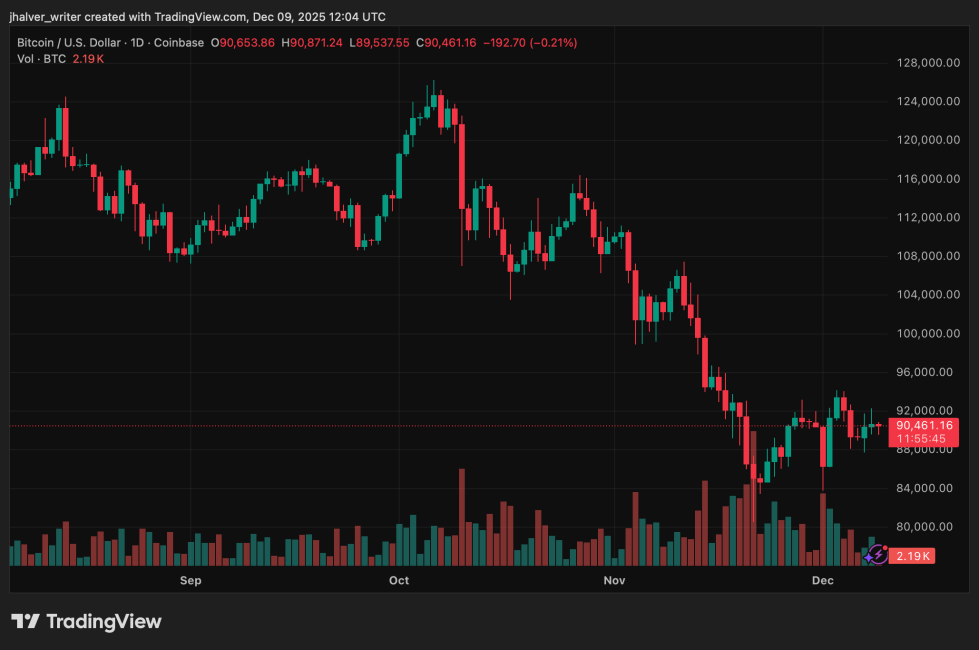
BTC's price trends to the downside on the daily chart. Source: BTCUSD on Tradingview

Bitcoin ETF Flows Rise as Retail Activity Falls

Since the launch of U.S. spot Bitcoin ETFs in early 2024, the network has experienced a steady decline in active on-chain addresses. Analysts attribute this partly to the “convenience trade,” in which retail investors opt for exposure through traditional brokerage accounts rather than managing their own Bitcoin wallets.

BlackRock’s IBIT and similar products now capture a growing share of BTC demand, even as the blockchain itself shows a decline in grassroots participation.

Industry experts argue that this shift fundamentally changes how value circulates in the Bitcoin economy. ETF issuers, not miners or network users, are now capturing a higher share of revenue.

SwanDesk CEO Jacob King describes this as a structural pivot toward off-chain monetization, with Bitcoin functioning more as a financial instrument than a peer-to-peer asset.

BTC Price Pressure Intensifies Around Macro Events

Bitcoin’s recent price behavior reflects both macro uncertainty and intraday volatility patterns. BTC has repeatedly slipped below $90,000 despite developments that historically would support bullish sentiment, such as Strategy’s (formerly MicroStrategy) latest purchase of over 10,600 BTC.

Traders remain cautious ahead of the Federal Reserve’s policy decision, where expectations for a quarter-point rate cut are high. Yet the hesitation is evident: rallies toward $92,000 continue to meet resistance, and liquidity remains thin across spot and derivatives markets.

Consequently, analysts warn that Bitcoin must hold above a key support level near $88,000 to avoid a deeper downside.

Institutional Trading Dynamics Shape Market Movements

A growing number of analysts suggest that predictable sell-offs around the U.S. market open reflect coordinated execution rather than organic selling.

Market watchers point to high-frequency firms, such as Jane Street, which hold large ETF positions, as possible contributors to these recurring patterns. While unproven, the consistency of these drops has added to trader frustration.

Meanwhile, miners face their own pressures. Hashprice has fallen to near-record lows, prompting operators to pivot toward AI infrastructure as mining profitability erodes.

Related Reading: CEOs Of Leading Banks To Discuss Crypto Market Structure With US Senators This Week

With ETFs absorbing demand, macro signals driving sentiment, and miners restructuring their businesses, Bitcoin now sits at a pivotal moment, supported by institutional capital but missing the retail pulse that once defined its cycles.

Cover image from ChatGPT, BTCUSD chart from Tradingview

Related Reads

Goldman Sachs Bows Down, Bitcoin Finally Breaks Through the Gates of Wall Street

Wall Street giants, including Goldman Sachs, Morgan Stanley, Charles Schwab, and the New York Stock Exchange, have reversed their long-standing opposition to Bitcoin and are now actively embracing it. After years of dismissing Bitcoin as a scam, a bubble, or a tool for illicit activities, these institutions are launching Bitcoin ETFs, enabling spot trading, and building dedicated crypto infrastructure. Goldman Sachs, which once called Bitcoin a "fraud tool," is now offering Bitcoin ETFs. Morgan Stanley, which internally banned the term "cryptocurrency," has launched its largest-ever ETF backed by Bitcoin. Charles Schwab has opened spot crypto trading for its retail clients, integrating Bitcoin alongside traditional assets. The NYSE is building robust infrastructure to support digital assets, signaling a long-term commitment. This dramatic shift is driven not by a change in ideology but by economic necessity. As Bitcoin repeatedly survived market crashes and grew into a multi-trillion-dollar asset class, ignoring it became too costly. Wall Street’s business model relies on capturing fees, and Bitcoin’s rise represented a massive wealth transfer occurring outside their ecosystem. The fear of missing out (FOMO) and client demand forced these institutions to capitulate. The article frames this as a historic surrender to Bitcoin’s mathematical inevitability. Unlike the trust-based traditional financial system, Bitcoin operates on decentralized, transparent, and unchangeable rules. Its scarcity and resilience make it a hedge against fiat currency devaluation and systemic risk. The narrative has flipped: not holding Bitcoin is now seen as the greater risk. The author concludes that Bitcoin has not been co-opted by Wall Street; instead, it has co-opted Wall Street, marking a fundamental shift in the global financial architecture.

marsbit53m ago

Goldman Sachs Bows Down, Bitcoin Finally Breaks Through the Gates of Wall Street

marsbit53m ago

Trading

Spot
Futures

Hot Articles

What is $BITCOIN

DIGITAL GOLD ($BITCOIN): A Comprehensive Analysis Introduction to DIGITAL GOLD ($BITCOIN) DIGITAL GOLD ($BITCOIN) is a blockchain-based project operating on the Solana network, which aims to combine the characteristics of traditional precious metals with the innovation of decentralized technologies. While it shares a name with Bitcoin, often referred to as “digital gold” due to its perception as a store of value, DIGITAL GOLD is a separate token designed to create a unique ecosystem within the Web3 landscape. Its goal is to position itself as a viable alternative digital asset, although specifics regarding its applications and functionalities are still developing. What is DIGITAL GOLD ($BITCOIN)? DIGITAL GOLD ($BITCOIN) is a cryptocurrency token explicitly designed for use on the Solana blockchain. In contrast to Bitcoin, which provides a widely recognized value storage role, this token appears to focus on broader applications and characteristics. Notable aspects include: Blockchain Infrastructure: The token is built on the Solana blockchain, known for its capacity to handle high-speed and low-cost transactions. Supply Dynamics: DIGITAL GOLD has a maximum supply capped at 100 quadrillion tokens (100P $BITCOIN), although details regarding its circulating supply are currently undisclosed. Utility: While precise functionalities are not explicitly outlined, there are indications that the token could be utilized for various applications, potentially involving decentralized applications (dApps) or asset tokenization strategies. Who is the Creator of DIGITAL GOLD ($BITCOIN)? At present, the identity of the creators and development team behind DIGITAL GOLD ($BITCOIN) remains unknown. This situation is typical among many innovative projects within the blockchain space, particularly those aligning with decentralized finance and meme coin phenomena. While such anonymity may foster a community-driven culture, it intensifies concerns about governance and accountability. Who are the Investors of DIGITAL GOLD ($BITCOIN)? The available information indicates that DIGITAL GOLD ($BITCOIN) does not have any known institutional backers or prominent venture capital investments. The project seems to operate on a peer-to-peer model focused on community support and adoption rather than traditional funding routes. Its activity and liquidity are primarily situated on decentralized exchanges (DEXs), such as PumpSwap, rather than established centralized trading platforms, further highlighting its grassroots approach. How DIGITAL GOLD ($BITCOIN) Works The operational mechanics of DIGITAL GOLD ($BITCOIN) can be elaborated on based on its blockchain design and network attributes: Consensus Mechanism: By leveraging Solana’s unique proof-of-history (PoH) combined with a proof-of-stake (PoS) model, the project ensures efficient transaction validation contributing to the network's high performance. Tokenomics: While specific deflationary mechanisms have not been extensively detailed, the vast maximum token supply implies that it may cater to microtransactions or niche use cases that are still to be defined. Interoperability: There exists the potential for integration with Solana’s broader ecosystem, including various decentralized finance (DeFi) platforms. However, the details regarding specific integrations remain unspecified. Timeline of Key Events Here is a timeline that highlights significant milestones concerning DIGITAL GOLD ($BITCOIN): 2023: The initial deployment of the token occurs on the Solana blockchain, marked by its contract address. 2024: DIGITAL GOLD gains visibility as it becomes available for trading on decentralized exchanges like PumpSwap, allowing users to trade it against SOL. 2025: The project witnesses sporadic trading activity and potential interest in community-led engagements, although no noteworthy partnerships or technical advancements have been documented as of yet. Critical Analysis Strengths Scalability: The underlying Solana infrastructure supports high transaction volumes, which could enhance the utility of $BITCOIN in various transaction scenarios. Accessibility: The potential low trading price per token could attract retail investors, facilitating wider participation due to fractional ownership opportunities. Risks Lack of Transparency: The absence of publicly known backers, developers, or an audit process may yield skepticism regarding the project's sustainability and trustworthiness. Market Volatility: The trading activity is heavily reliant on speculative behavior, which can result in significant price volatility and uncertainty for investors. Conclusion DIGITAL GOLD ($BITCOIN) emerges as an intriguing yet ambiguous project within the rapidly evolving Solana ecosystem. While it attempts to leverage the “digital gold” narrative, its departure from Bitcoin's established role as a store of value underscores the need for a clearer differentiation of its intended utility and governance structure. Future acceptance and adoption will likely depend on addressing the current opacity and defining its operational and economic strategies more explicitly. Note: This report encompasses synthesised information available as of October 2023, and developments may have transpired beyond the research period.

363 Total ViewsPublished 2025.05.13Updated 2025.05.13

What is $BITCOIN

Discussions

Welcome to the HTX Community. Here, you can stay informed about the latest platform developments and gain access to professional market insights. Users' opinions on the price of BTC (BTC) are presented below.

活动图片















