Bitcoin Spot ETFs Bleed $1.26 Billion In Largest Net Outflows In 3 Months – Details

bitcoinistPublished on 2026-05-24Last updated on 2026-05-24

Abstract

US Bitcoin Spot ETFs saw $1.26 billion in net outflows last week, marking the largest withdrawal since late January. The sector experienced six consecutive days of negative flows, with BlackRock's IBIT alone accounting for over $1 billion in net outflows. Overall, May has seen $1 billion leave these ETFs. Ethereum Spot ETFs also extended their outflow streak to 10 days, losing $215.19 million last week. Despite the capital flight, Bitcoin's price rose 1.75% to $76,735, while Ethereum increased 2.78% to $2,119 at the time of reporting.

The 13 US Bitcoin Spot ETFs closed out last week with $1.26 billion in net withdrawals, amid significant price losses in the broader crypto market. Notably, data from SoSoValue shows this is the heaviest outflow from the Bitcoin ETF market since the last week in January, when investors’ activity resulted in a net loss of $1.49 billion.

Bitcoin Spot ETFs Register Six Consecutive Red Days

More details of the last week performance shows the Bitcoin Spot ETFs market recorded a starggering $648.64 million in net outflows on Monday, representing it’s largest daily net withdrawal since January 29. Meanwhile, the following days recorded lesser but significantly negative performance such as $331.05 million on Tuesday, $70.47 million on Wednesday, $100.82 million on Thursday, and $105.19 million on Friday.

Taken together, the Bitcoin Spot ETFs translates to six consecutive trading days of net outflows while 80% of the last 10 days are also red days. Looking at individual fund performances, BlackRock IBIT investors withdrew $1.01 billion more than deposited, as its cumulative inflows reached $64.77 billion. The dominant market leader now maintains total net assets of $61.09 billion, i.e 6x its closest competitor.
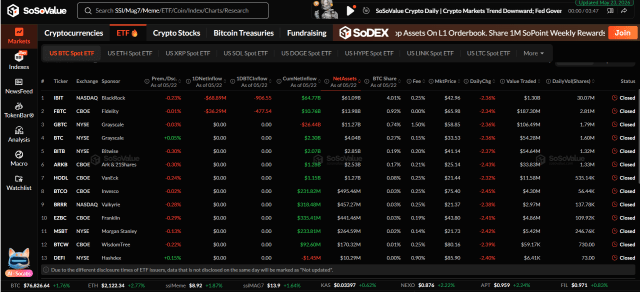
Source: SoSoValue

Meanwhile, Fidelity’s FBTC and Ark/21 Shares’ ARKB also experienced significant net outflows at $111.5 million and $106.81 million, respectively. ETFs including Bitwise’s BITB, VanEck’s HODL, Valkyrie’s BRRR, Invesco’s BTCO, and Franklin Templeton’s EZBC all registered capital outlows ranging between $3m – $10m. Notably, Morgan Stanley’s MSBT, the market’s new comer recorded the only positive performance with net inflows valued at $1.11. Other funds such as Grayscale GBTC & BTC, Hashdex’s DEFI, and Bitwise’s BTCW all registered zero net activity.

Following this performance record, the Bitcoin Spot ETFs have now recorded a combined $1.00 billion net outflows in May. Meanwhile, their total cumulative net inflows stands at $57.08 billion, with their total net assets valued at $98.87 billion.

Ethereum ETF Negative Streak Extends To 10 Days

As the Bitcoin Spot ETFs struggle with steep withdrawals, their Ethereum counterparts are faring no better after recording a cumulative net outflows of $215.19 million in the last week. Notably, data from SoSoValue shows the Ethereum Spot ETFs have now experienced 10 consecutive trading days of net withdrawals valued at $471.1 million. Total cumulative inflows in this ETF market is valued at $11.62 billion, with total net assets of $11.84 billion, i.e. 4.73% of Ethereum market cap.

At press time, Bitcoin continues to trade at $76,735 reflecting a daily 1.75% gain. Meanwhile, Ethereum is valued at $2,119 after a 2.78% increase within the same period.

BTC trading at $76,820 on the daily chart | Source: BTCUSDT chart on Tradingview.com

Related Questions

QWhat was the total net outflow from US Bitcoin Spot ETFs last week, and why is this figure significant?

AThe 13 US Bitcoin Spot ETFs experienced a total net outflow of $1.26 billion last week. This is significant because it marks the largest weekly net withdrawal from the Bitcoin ETF market since the last week of January, which saw outflows of $1.49 billion.

QHow many consecutive days of net outflows did the Bitcoin Spot ETFs experience, and what was the largest single-day outflow last week?

AThe Bitcoin Spot ETFs experienced six consecutive trading days of net outflows last week. The largest single-day outflow was $648.64 million on Monday, which was its highest since January 29.

QWhich individual Bitcoin Spot ETF had the largest net outflow last week, and what is its current cumulative inflow figure?

ABlackRock's IBIT had the largest net outflow last week, with investors withdrawing $1.01 billion more than they deposited. Its cumulative net inflows now stand at $64.77 billion.

QHow did the Ethereum Spot ETFs perform compared to the Bitcoin Spot ETFs in terms of consecutive days of outflows?

AWhile Bitcoin Spot ETFs experienced six consecutive days of net outflows, the Ethereum Spot ETFs fared worse, extending their negative streak to 10 consecutive trading days of net withdrawals, totaling $471.1 million.

QWhat were the prices of Bitcoin and Ethereum at the time the article was published?

AAt the time of publication, Bitcoin was trading at $76,735, reflecting a daily gain of 1.75%. Ethereum was valued at $2,119, after a 2.78% increase within the same period.

Related Reads

DeepSeek Announces Permanent Price Cut, But Liang Wenfeng Is Not Trying to Be a "Cyber Bodhisattva"

DeepSeek has announced a permanent 75% discount on its V4-Pro API, significantly reducing its token prices. This move stands out as a major industry-wide price cut while competitors like Anthropic, OpenAI, and Google have been quietly raising theirs. The article contrasts this strategy with the broader trend of AI becoming more expensive, citing examples of companies like Microsoft and Uber struggling with high token costs as usage soars. While CEO Liang Wenfeng is hailed by some as a "Cyber Bodhisattva" for this普惠 approach, the article argues this is a strategic business choice, not mere altruism. DeepSeek's ability to maintain low prices is attributed to several structural advantages: lower-cost AI talent in China, the impending use of domestic昇腾 hardware for further cost reductions, and, most critically, access to China's cheaper and more abundant energy infrastructure, which drastically reduces the electricity costs dominating AI operations. The analysis suggests that for many commercial applications, a "good enough" model that is radically cheaper (e.g., 1% to 11% of GPT-5.5's cost) is more valuable than the absolute top-tier model. This allows for vastly more experimentation and iteration within a budget. Therefore, as AI generally becomes more expensive, DeepSeek's cost-competitiveness—rooted in China's energy and talent advantages—becomes its core strategic value and differentiator in the global market.

marsbit4h ago

DeepSeek Announces Permanent Price Cut, But Liang Wenfeng Is Not Trying to Be a "Cyber Bodhisattva"

marsbit4h ago

The Veil of Mythos Becomes Anthropic's Lever to Move Trillions

The article discusses Anthropic's reported upcoming $30 billion funding round, which would value the company at over $900 billion. It analyzes how the company has leveraged strategic narratives around its unreleased "Mythos" model, rather than just its publicly available products, to drive this massive valuation. Key points include Google's surprising $40 billion investment in a competitor, suggesting it is buying strategic positioning. Anthropic's "Glasswing" cybersecurity project and the unreleased Mythos model are portrayed not through direct proof, but through carefully crafted narratives of being "too powerful for public release," creating an aura of exclusive, high-level capability. This is bolstered by reports of the White House and NSA seeking access to Claude/Mythos despite previous security concerns, implying indispensable technology. Furthermore, Anthropic's reported rapid revenue growth—from a $1 billion annual run-rate in late 2024 to over $30 billion by April 2026, largely driven by enterprise API and Claude Code—provides a financial story for investors. The article concludes that Anthropic's core business model is effectively converting unverifiable technical potential, government interest, and future revenue projections into a compelling narrative that secures immense capital, using the actions of wealthy investors and powerful institutions as the ultimate validation of its worth.

marsbit6h ago

The Veil of Mythos Becomes Anthropic's Lever to Move Trillions

marsbit6h ago

Google CEO Admits Lagging Behind in Coding

Google CEO Sundar Pichai acknowledged in a recent interview that Google's Gemini AI models are currently "lagging behind" in coding capabilities, particularly for complex, long-horizon tasks requiring advanced developer expertise. He noted the field is advancing at an "unprecedented" pace, where 30-60 days now brings changes equivalent to five years in the past. Pichai expressed that achieving Artificial General Intelligence (AGI) now seems closer than previously imagined due to rapid progress. While highlighting strengths in text, multimodal, and reasoning tasks, Pichai admitted competitors like Anthropic and OpenAI have focused more intently on coding. He emphasized Google's commitment to catching up, citing internal tools like Antigravity 2.0 and the newly released Gemini 3.5 Flash, which aims to address previous shortcomings. Regarding Google Search's AI-driven overhaul, Pichai stated changes will be gradual to align with user needs, not disrupt the core search experience or its advertising model. He addressed public AI anxiety as understandable, given the technology's potential to reshape jobs and society, but remained optimistic about AI augmenting human capabilities and creating new opportunities. Pichai stressed the need for broad societal dialogue and responsible development as AI approaches more advanced, potentially recursive self-improvement stages. He affirmed Google's long-term commitment to leading in AI while navigating its profound implications responsibly.

marsbit8h ago

Google CEO Admits Lagging Behind in Coding

marsbit8h ago

Trading

Spot
Futures

Hot Articles

What is $BITCOIN

DIGITAL GOLD ($BITCOIN): A Comprehensive Analysis Introduction to DIGITAL GOLD ($BITCOIN) DIGITAL GOLD ($BITCOIN) is a blockchain-based project operating on the Solana network, which aims to combine the characteristics of traditional precious metals with the innovation of decentralized technologies. While it shares a name with Bitcoin, often referred to as “digital gold” due to its perception as a store of value, DIGITAL GOLD is a separate token designed to create a unique ecosystem within the Web3 landscape. Its goal is to position itself as a viable alternative digital asset, although specifics regarding its applications and functionalities are still developing. What is DIGITAL GOLD ($BITCOIN)? DIGITAL GOLD ($BITCOIN) is a cryptocurrency token explicitly designed for use on the Solana blockchain. In contrast to Bitcoin, which provides a widely recognized value storage role, this token appears to focus on broader applications and characteristics. Notable aspects include: Blockchain Infrastructure: The token is built on the Solana blockchain, known for its capacity to handle high-speed and low-cost transactions. Supply Dynamics: DIGITAL GOLD has a maximum supply capped at 100 quadrillion tokens (100P $BITCOIN), although details regarding its circulating supply are currently undisclosed. Utility: While precise functionalities are not explicitly outlined, there are indications that the token could be utilized for various applications, potentially involving decentralized applications (dApps) or asset tokenization strategies. Who is the Creator of DIGITAL GOLD ($BITCOIN)? At present, the identity of the creators and development team behind DIGITAL GOLD ($BITCOIN) remains unknown. This situation is typical among many innovative projects within the blockchain space, particularly those aligning with decentralized finance and meme coin phenomena. While such anonymity may foster a community-driven culture, it intensifies concerns about governance and accountability. Who are the Investors of DIGITAL GOLD ($BITCOIN)? The available information indicates that DIGITAL GOLD ($BITCOIN) does not have any known institutional backers or prominent venture capital investments. The project seems to operate on a peer-to-peer model focused on community support and adoption rather than traditional funding routes. Its activity and liquidity are primarily situated on decentralized exchanges (DEXs), such as PumpSwap, rather than established centralized trading platforms, further highlighting its grassroots approach. How DIGITAL GOLD ($BITCOIN) Works The operational mechanics of DIGITAL GOLD ($BITCOIN) can be elaborated on based on its blockchain design and network attributes: Consensus Mechanism: By leveraging Solana’s unique proof-of-history (PoH) combined with a proof-of-stake (PoS) model, the project ensures efficient transaction validation contributing to the network's high performance. Tokenomics: While specific deflationary mechanisms have not been extensively detailed, the vast maximum token supply implies that it may cater to microtransactions or niche use cases that are still to be defined. Interoperability: There exists the potential for integration with Solana’s broader ecosystem, including various decentralized finance (DeFi) platforms. However, the details regarding specific integrations remain unspecified. Timeline of Key Events Here is a timeline that highlights significant milestones concerning DIGITAL GOLD ($BITCOIN): 2023: The initial deployment of the token occurs on the Solana blockchain, marked by its contract address. 2024: DIGITAL GOLD gains visibility as it becomes available for trading on decentralized exchanges like PumpSwap, allowing users to trade it against SOL. 2025: The project witnesses sporadic trading activity and potential interest in community-led engagements, although no noteworthy partnerships or technical advancements have been documented as of yet. Critical Analysis Strengths Scalability: The underlying Solana infrastructure supports high transaction volumes, which could enhance the utility of $BITCOIN in various transaction scenarios. Accessibility: The potential low trading price per token could attract retail investors, facilitating wider participation due to fractional ownership opportunities. Risks Lack of Transparency: The absence of publicly known backers, developers, or an audit process may yield skepticism regarding the project's sustainability and trustworthiness. Market Volatility: The trading activity is heavily reliant on speculative behavior, which can result in significant price volatility and uncertainty for investors. Conclusion DIGITAL GOLD ($BITCOIN) emerges as an intriguing yet ambiguous project within the rapidly evolving Solana ecosystem. While it attempts to leverage the “digital gold” narrative, its departure from Bitcoin's established role as a store of value underscores the need for a clearer differentiation of its intended utility and governance structure. Future acceptance and adoption will likely depend on addressing the current opacity and defining its operational and economic strategies more explicitly. Note: This report encompasses synthesised information available as of October 2023, and developments may have transpired beyond the research period.

363 Total ViewsPublished 2025.05.13Updated 2025.05.13

What is $BITCOIN

Discussions

Welcome to the HTX Community. Here, you can stay informed about the latest platform developments and gain access to professional market insights. Users' opinions on the price of BTC (BTC) are presented below.

活动图片