Bitcoin Speculative Activity Cooling Fast: IFP Shows Steep Slide

bitcoinistPublished on 2025-12-17Last updated on 2025-12-17

Abstract

The Bitcoin Inter-exchange Flow Pulse (IFP), an on-chain metric tracking BTC flows between spot and derivatives exchanges, has been in a steep decline since the start of 2025, signaling rapidly cooling speculative activity. A falling IFP suggests traders are reducing risk appetite by moving fewer coins to derivatives platforms. This recent accelerated downtrend, which began after a brief uptrend in late 2024, has historically signaled bearish conditions and is now accompanied by a period of declining price. Despite the IFP's bearish signal, Bitcoin treasury companies have continued to increase their holdings even as the asset's price fell from its all-time high above $126,000. At the time of writing, Bitcoin is trading around $87,500, down over 7% in the past week.

On-chain data shows the Bitcoin Inter-exchange Flow Pulse (IFP) has rapidly been going down recently, a sign of cooling derivatives interest.

Bitcoin IFP Has Witnessed A Plunge Recently

In a new post on X, CryptoQuant community analyst Maartunn has talked about the trajectory that the Bitcoin IFP has been following recently. The IFP refers to an on-chain indicator that measures the BTC flows taking place between spot and derivatives exchanges.

When the value of this metric is going up, it means investors are ramping up transactions to derivatives platforms. Such a trend can be a sign that demand for speculation is on the rise.

On the other hand, the indicator witnessing a decline implies fewer coins are traveling from spot exchanges to derivatives ones. This kind of trend can suggest traders are lowering their appetite for risk.

Now, here is the chart shared by Maartunn that shows the trend in the Bitcoin IFP and its 90-day moving average (MA) over the past decade:
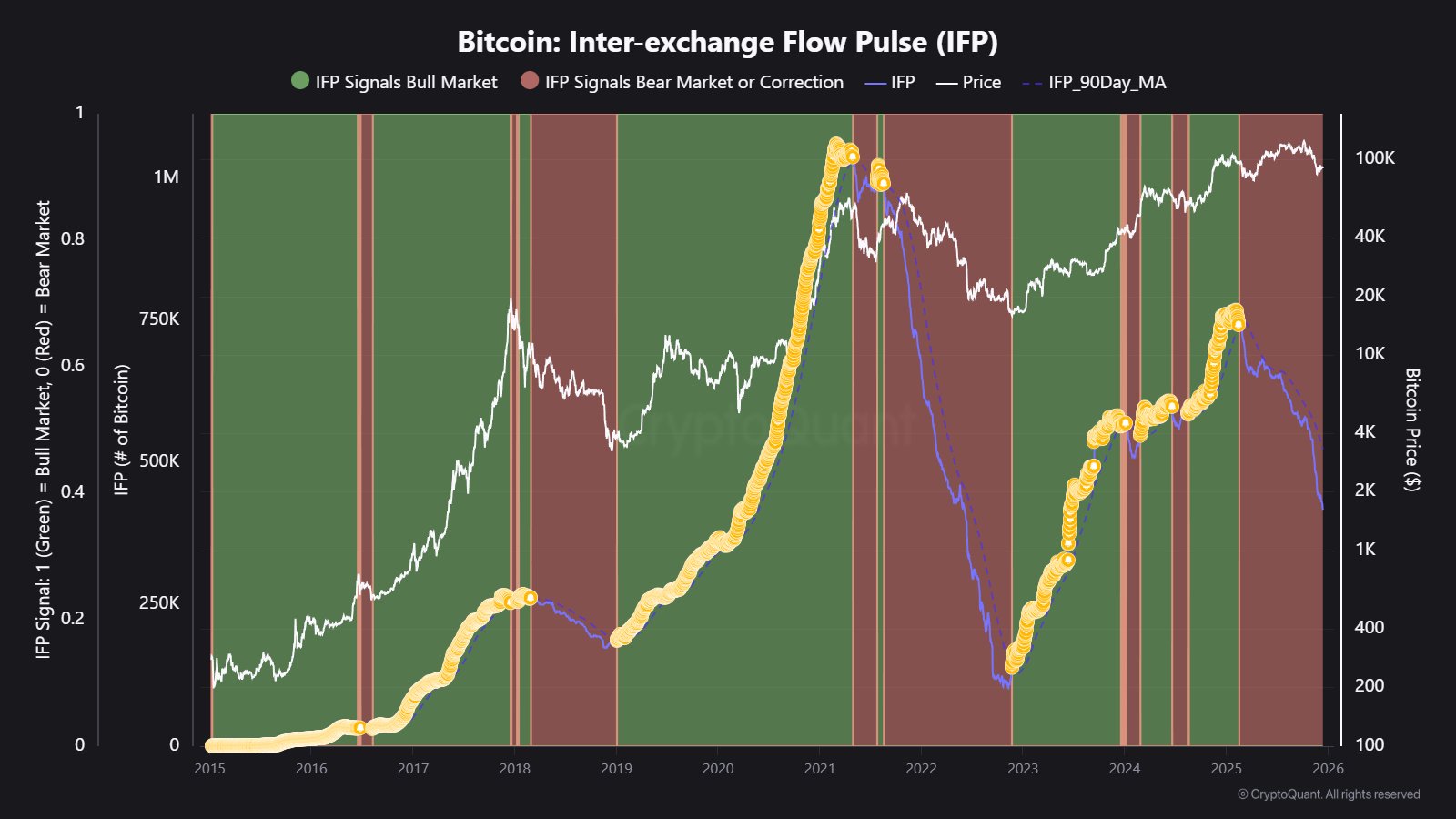
Looks like the value of the indicator has been on the way down since a while now | Source: @JA_Maartun on X

As is visible in the above graph, the Bitcoin IFP was witnessing an uptrend in the last few months of 2024, but with the start of this year, a reversal in the indicator occurred. The switch to a downtrend meant that its value slipped below the 90-day MA, something that has historically signaled bearish conditions.

Over the course of 2025, the IFP has continued its downward trajectory, but lately, the decline has accelerated, indicating that derivatives interest is cooling off fast.

Two cycles ago, the IFP sliding below its 90-day MA led into the 2018 bear market. In the 2021 bull market, the bear signal on the IFP was initially followed by the second half of that bull run, but then the 2022 bear market took over as the metric failed to recover.

A similar trend has been witnessed this year as well, with Bitcoin exploring new all-time highs (ATHs) despite the IFP suggesting bearish conditions. The recent acceleration in the indicator’s downtrend, however, has been accompanied by a bearish period in the asset’s price. Only time will tell whether this is a repeat of the pattern from the last cycle, or if risk appetite will make a comeback among investors and the IFP will reverse course.

In some other news, the Bitcoin treasury companies have seen their holdings go up recently, despite the drawdown that the market has faced, as pointed out by Glassnode co-founder Rafael in an X post.
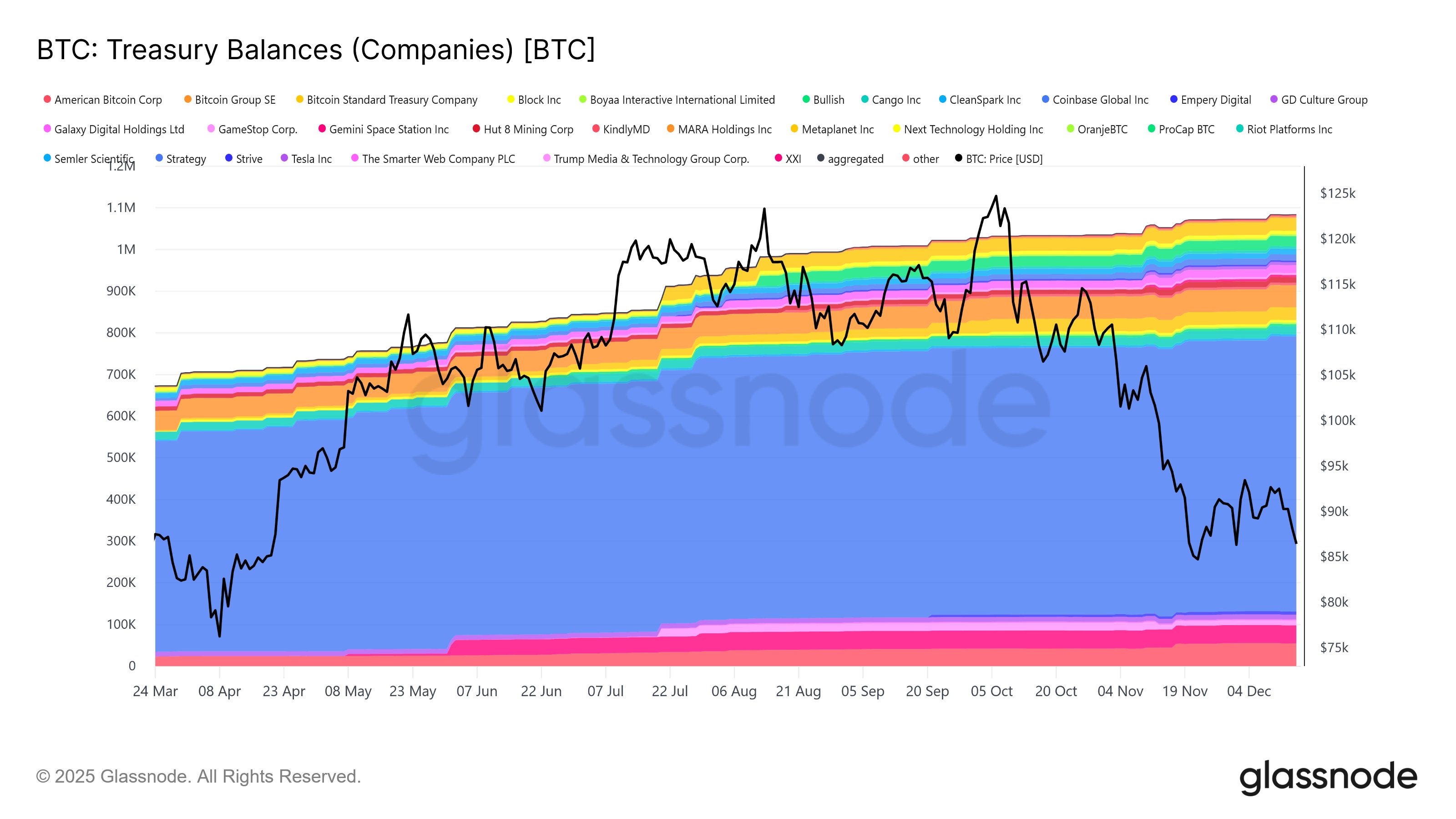
The trend in the holdings of the BTC treasury companies | Source: @n3ocortex on X

From the chart, it’s apparent that since Bitcoin started declining from its ATH above $126,000, the treasury companies have still continued a net upward trajectory. “Not seeing much of the alleged forced selling here despite some equities trading below mNAV,” noted Rafael.

BTC Price

At the time of writing, Bitcoin is trading around $87,500, down over 7% in the last week.

The price of the coin seems to have been facing bearish winds | Source: BTCUSDT on TradingView


Related Reads

Summary of Kevin Warsh's Past Remarks: How Will This Prospective 'New Head' Upend the Fed?

Kevin Warsh, nominated by President Trump to replace Fed Chair Powell, is poised to introduce sweeping reforms at the Federal Reserve. His agenda includes structural changes, advocating for lower policy rates, a fundamentally new approach to inflation, a significantly smaller balance sheet, safeguarding Fed independence, narrowing the Fed’s mandate, improving coordination with the Treasury, and reducing communication “noise” from policymakers. Warsh has criticized current monetary policy as “broken” and called for “fundamental regime change,” arguing that continuity is meaningless when the Fed has lost credibility. He believes interest rates should be lower and that a smaller balance sheet would help achieve that, describing the current one as “multiple trillions of dollars larger than necessary.” On inflation, he attributes its rise to cognitive errors at the Fed—including overreliance on flawed models, neglect of money supply, and blaming external factors rather than excessive government spending. He also suggests AI could lead to a structural decline in prices. He strongly defends Fed independence as its “most important asset” and warns against mission creep, which he says risks its core objectives and increases political vulnerability. He proposes closer coordination with the Treasury to align balance sheet and debt issuance plans, clarifying expectations for markets. Regarding communication, Warsh supports transparency but criticizes the current “cacophony of voices” and “forward guidance” that creates ambiguity. He has urged Fed officials to speak less frequently to avoid market confusion.

marsbit3m ago

Summary of Kevin Warsh's Past Remarks: How Will This Prospective 'New Head' Upend the Fed?

marsbit3m ago

Arbitrum Pretends to Be the Hacker, 'Steals' Back the Money Lost by KelpDAO

Title: Arbitrum Poses as Hacker to Recover Stolen Funds from KelpDAO Last week, KelpDAO suffered a hack resulting in nearly $300 million in losses, marking the largest DeFi security incident this year. Approximately 30,765 ETH (worth over $70 million) remained on an Arbitrum address controlled by the attacker. In an unprecedented move, Arbitrum’s Security Council utilized its emergency authority to upgrade the Inbox bridge contract, adding a function that allowed them to impersonate the hacker’s address and initiate a transfer without access to its private key. The council’s action, approved by 9 of its 12 members, moved the stolen ETH to a frozen address in a single transaction before reverting the contract to its original state. The operation was coordinated with law enforcement, which attributed the attack to North Korea’s Lazarus Group. Community reactions are divided: some praise the recovery of funds, while others question the centralization of power, as the council can upgrade core contracts without governance votes. However, such emergency mechanisms are common among major L2s. Despite the partial recovery, over $292 million was stolen in total, with more than $100 million in bad debt on Aave and remaining funds scattered across other chains. The incident highlights escalating security challenges in DeFi, with state-sponsored hackers employing advanced tactics and L2s responding with elevated countermeasures.

marsbit13m ago

Arbitrum Pretends to Be the Hacker, 'Steals' Back the Money Lost by KelpDAO

marsbit13m ago

iQiyi Is Too Impatient

The article "iQiyi Is Too Impatient" discusses the controversy surrounding the Chinese streaming platform IQiyi's recent announcement of an "AI Actor Library" during its 2026 World Conference. IQiyi claimed over 100 actors, including well-known names like Zhang Ruoyun and Yu Hewei, had joined the initiative. CEO Gong Yu suggested AI could enable actors to "star in 14 dramas a year instead of 4" and that "live-action filming might become a world cultural heritage." The announcement quickly sparked backlash. Multiple actors named in the list issued urgent statements denying they had signed any AI-related authorization agreements. This forced IQiyi to clarify that inclusion in the library only indicated a willingness to *consider* AI projects, with separate negotiations required for any specific role. The incident, which trended on social media with hashtags like "IQiyi is crazy," is presented as a sign of the company's growing desperation. Facing intense competition from short-video platforms like Douyin and Kuaishou, as well as Bilibili and Xiaohongshu, IQiyi's financial performance has weakened, with revenues declining for two consecutive years. The author argues that IQiyi is "too impatient" to tell a compelling AI story to reassure the market, especially as it pursues a listing on the Hong Kong stock exchange. The piece concludes by outlining three key "AI questions" IQiyi must answer: defining its role as a tool provider versus a content creator, balancing the "coldness" of AI with the human element audiences desire, and properly managing the interests of platforms, actors, and viewers. The core dilemma is that while AI can reduce costs and increase efficiency, it risks creating homogenized, formulaic content and devaluing human performers.

marsbit1h ago

iQiyi Is Too Impatient

marsbit1h ago

Trading

Spot
Futures

Hot Articles

What is $BITCOIN

DIGITAL GOLD ($BITCOIN): A Comprehensive Analysis Introduction to DIGITAL GOLD ($BITCOIN) DIGITAL GOLD ($BITCOIN) is a blockchain-based project operating on the Solana network, which aims to combine the characteristics of traditional precious metals with the innovation of decentralized technologies. While it shares a name with Bitcoin, often referred to as “digital gold” due to its perception as a store of value, DIGITAL GOLD is a separate token designed to create a unique ecosystem within the Web3 landscape. Its goal is to position itself as a viable alternative digital asset, although specifics regarding its applications and functionalities are still developing. What is DIGITAL GOLD ($BITCOIN)? DIGITAL GOLD ($BITCOIN) is a cryptocurrency token explicitly designed for use on the Solana blockchain. In contrast to Bitcoin, which provides a widely recognized value storage role, this token appears to focus on broader applications and characteristics. Notable aspects include: Blockchain Infrastructure: The token is built on the Solana blockchain, known for its capacity to handle high-speed and low-cost transactions. Supply Dynamics: DIGITAL GOLD has a maximum supply capped at 100 quadrillion tokens (100P $BITCOIN), although details regarding its circulating supply are currently undisclosed. Utility: While precise functionalities are not explicitly outlined, there are indications that the token could be utilized for various applications, potentially involving decentralized applications (dApps) or asset tokenization strategies. Who is the Creator of DIGITAL GOLD ($BITCOIN)? At present, the identity of the creators and development team behind DIGITAL GOLD ($BITCOIN) remains unknown. This situation is typical among many innovative projects within the blockchain space, particularly those aligning with decentralized finance and meme coin phenomena. While such anonymity may foster a community-driven culture, it intensifies concerns about governance and accountability. Who are the Investors of DIGITAL GOLD ($BITCOIN)? The available information indicates that DIGITAL GOLD ($BITCOIN) does not have any known institutional backers or prominent venture capital investments. The project seems to operate on a peer-to-peer model focused on community support and adoption rather than traditional funding routes. Its activity and liquidity are primarily situated on decentralized exchanges (DEXs), such as PumpSwap, rather than established centralized trading platforms, further highlighting its grassroots approach. How DIGITAL GOLD ($BITCOIN) Works The operational mechanics of DIGITAL GOLD ($BITCOIN) can be elaborated on based on its blockchain design and network attributes: Consensus Mechanism: By leveraging Solana’s unique proof-of-history (PoH) combined with a proof-of-stake (PoS) model, the project ensures efficient transaction validation contributing to the network's high performance. Tokenomics: While specific deflationary mechanisms have not been extensively detailed, the vast maximum token supply implies that it may cater to microtransactions or niche use cases that are still to be defined. Interoperability: There exists the potential for integration with Solana’s broader ecosystem, including various decentralized finance (DeFi) platforms. However, the details regarding specific integrations remain unspecified. Timeline of Key Events Here is a timeline that highlights significant milestones concerning DIGITAL GOLD ($BITCOIN): 2023: The initial deployment of the token occurs on the Solana blockchain, marked by its contract address. 2024: DIGITAL GOLD gains visibility as it becomes available for trading on decentralized exchanges like PumpSwap, allowing users to trade it against SOL. 2025: The project witnesses sporadic trading activity and potential interest in community-led engagements, although no noteworthy partnerships or technical advancements have been documented as of yet. Critical Analysis Strengths Scalability: The underlying Solana infrastructure supports high transaction volumes, which could enhance the utility of $BITCOIN in various transaction scenarios. Accessibility: The potential low trading price per token could attract retail investors, facilitating wider participation due to fractional ownership opportunities. Risks Lack of Transparency: The absence of publicly known backers, developers, or an audit process may yield skepticism regarding the project's sustainability and trustworthiness. Market Volatility: The trading activity is heavily reliant on speculative behavior, which can result in significant price volatility and uncertainty for investors. Conclusion DIGITAL GOLD ($BITCOIN) emerges as an intriguing yet ambiguous project within the rapidly evolving Solana ecosystem. While it attempts to leverage the “digital gold” narrative, its departure from Bitcoin's established role as a store of value underscores the need for a clearer differentiation of its intended utility and governance structure. Future acceptance and adoption will likely depend on addressing the current opacity and defining its operational and economic strategies more explicitly. Note: This report encompasses synthesised information available as of October 2023, and developments may have transpired beyond the research period.

363 Total ViewsPublished 2025.05.13Updated 2025.05.13

What is $BITCOIN

Discussions

Welcome to the HTX Community. Here, you can stay informed about the latest platform developments and gain access to professional market insights. Users' opinions on the price of BTC (BTC) are presented below.

活动图片