Bitcoin Slump Forces Metaplanet Into $728M Quarterly Loss

bitcoinistPublished on 2026-05-15Last updated on 2026-05-15

Abstract

Metaplanet, a Tokyo-listed company, reported an ordinary loss of approximately $728 million for the first quarter of 2026. This significant loss was driven by non-cash valuation markdowns on its Bitcoin holdings, as the price of BTC fell about 24% during the period. Despite the loss, the company aggressively increased its Bitcoin treasury to 40,177 BTC, making it the world's third-largest publicly listed Bitcoin holder. It funded these purchases partly through a Bitcoin-collateralized credit facility. In contrast to the bottom-line loss, Metaplanet's operating performance was strong. It reported Q1 operating income of about $14.38 million on net sales of $19.5 million, achieving a 73.6% operating margin. Revenue more than tripled year-over-year, primarily from its Bitcoin Income Generation unit. The company's preferred performance metric, Bitcoin per diluted share, increased by 2.8% for the quarter. Metaplanet maintained its full-year 2026 sales and operating profit guidance but did not provide net income guidance due to Bitcoin price sensitivity.

Metaplanet ended the first quarter of 2026 holding 40,177 Bitcoin — up from 35,102 at the close of December 2025 — after buying roughly 5,075 BTC during the period to become the third-largest publicly listed Bitcoin treasury company in the world. That aggressive accumulation came at a cost.

A Quarter Of Two Stories

The Tokyo-listed firm posted an ordinary loss of around $728 million for the three months ending March 31, driven by non-cash valuation markdowns on its Bitcoin holdings after the price of BTC dropped about 24% during the quarter — from roughly $87,000 on January 1 to around $66,000 by quarter’s end.

The loss widened sharply from the same period a year earlier, with the basic loss per share coming in at around $0.63, compared to roughly $0.078 12 months prior.
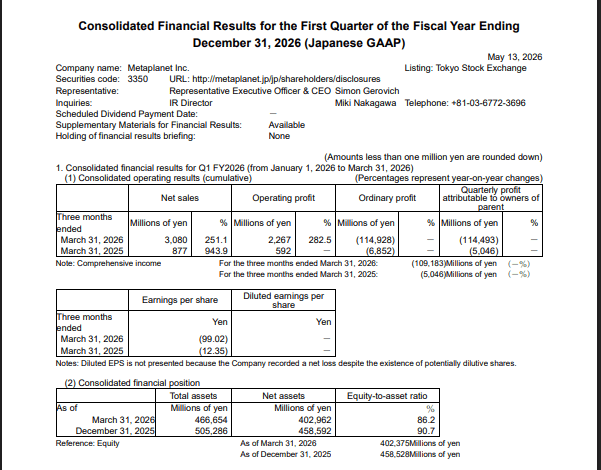
Metaplanet’s consolidated financial results for the first quarter 2026. Source: Metaplanet

The bottom-line hit stood in contrast to the company’s operating results. Metaplanet reported Q1 operating income of 2.27 billion Japanese yen, or about $14.38 million, on net sales of roughly $19.5 million.

That works out to an operating margin of 73.6%. Revenue more than tripled year over year, up from about $5.5 million in the same quarter of 2025, with most of that growth coming from its Bitcoin Income Generation unit, which books option premiums and derivative valuation gains. Hotel operations contributed a smaller, steadier slice of revenue.

Borrowing To Buy More Bitcoin

To fund its Bitcoin purchases, Metaplanet drew further on a $500 million Bitcoin-collateralized credit facility. As of May 13, the company had $302 million outstanding under that arrangement.

Bitcoin is currently trading at $79,271. Chart: TradingView

Total net assets fell from $2.96 billion at the end of December to about $2.60 billion by March 31, as valuation losses outpaced new equity raised during the quarter.

Despite the losses, Metaplanet kept its full-year 2026 guidance unchanged. The company is still forecasting net sales of about $100 million and operating profit of around $72 million for the year. It did not provide ordinary or net income guidance, citing Bitcoin price sensitivity as the reason.

BTC Yield As The Measuring Stick

The company’s preferred performance measure, Bitcoin per diluted share, rose from 0.0240486 BTC to 0.0247319 BTC over the quarter, reflecting what Metaplanet calls a BTC yield of 2.8% for Q1.

The company frames this metric as its primary indicator of shareholder value, measuring Bitcoin accumulation on a per-share basis after accounting for dilution from new equity issuances.

Featured image from Getty Images, chart from TradingView

Trending Cryptos

Related Questions

QWhat was the primary reason for Metaplanet's $728 million ordinary loss in Q1 2026?

AThe ordinary loss was primarily driven by non-cash valuation markdowns on its Bitcoin holdings, as the price of BTC dropped approximately 24% during the quarter.

QHow many Bitcoins did Metaplanet hold at the end of Q1 2026, and how does this compare to its previous holdings?

AMetaplanet held 40,177 Bitcoin at the end of Q1 2026, which was up from 35,102 Bitcoin held at the close of December 2025.

QDespite the large ordinary loss, what was Metaplanet's operating income and operating margin for Q1 2026?

AMetaplanet reported Q1 operating income of 2.27 billion Japanese yen (about $14.38 million) with an operating margin of 73.6%.

QHow did Metaplanet fund its Bitcoin purchases during the quarter, and what was the outstanding balance on this facility as of May 13?

AMetaplanet funded its Bitcoin purchases by drawing on a $500 million Bitcoin-collateralized credit facility. As of May 13, the company had $302 million outstanding under that arrangement.

QWhat is Metaplanet's preferred performance measure, and what was its Q1 2026 result for this metric?

AMetaplanet's preferred performance measure is Bitcoin per diluted share. This metric rose from 0.0240486 BTC to 0.0247319 BTC over Q1 2026, representing a BTC yield of 2.8% for the quarter.

Related Reads

Bitcoin Approaches $80,000 Milestone, HYPE Hits New All-Time High | Invited Analysis

The cryptocurrency market experienced a significant surge this week, with Bitcoin rising sharply by 26.72% to approach the key psychological level of $80,000, peaking at $79,515. Simultaneously, the token HYPE broke its all-time high, reaching $83.38. This rally has shifted market sentiment from widespread pessimism to active bullish positioning. The article provides a technical analysis of both assets. For Bitcoin, the analysis details a multi-week corrective structure since October 2025, with the current price testing the upper boundary of a wide consolidation range between $57,820 and $82,850. The primary scenario anticipates a rejection near this upper resistance, leading to a pullback within the range (Path Two), though paths for a breakout or a breakdown are also outlined. On the daily chart, Bitcoin is analyzed as being in the final stages (wave c) of a five-wave rally from the July low. For HYPE, the article recounts a successful bullish call initiated on February 23, which has yielded a maximum gain of 225.7% to date. With the price achieving a new all-time high, the analysis suggests the upward trend is intact, with the next target around $90. The weekly strategy for Bitcoin involves waiting for a potential pullback to key support zones ($73,500-$75,000 or $67,300-$69,100) for short-term long opportunities, while maintaining a neutral medium-term stance. For HYPE, the strategy advises existing long positions to trail stop-losses, while new entrants could consider buying on a successful retest of the $77 support level. The article concludes with standard risk management rules and a disclaimer that the content is for informational purposes only and not investment advice.

Odaily星球日报11m ago

Bitcoin Approaches $80,000 Milestone, HYPE Hits New All-Time High | Invited Analysis

Odaily星球日报11m ago

Goldman Sachs Research Report: China's Semiconductor Self-sufficiency Rate Rises to 70%, 2030 Capital Expenditure Target $82 Billion

Goldman Sachs Report Analysis: China's Semiconductor Self-Sufficiency Rises to 70% by Quantity, 2030 Capex Target at $82 Billion. China's semiconductor industry has achieved significant progress in "quantity," but a substantial gap remains in "quality," according to a Goldman Sachs report. The analysis notes China's IC self-sufficiency rate by unit count reached 70% as of June 2026, nearly doubling from 38% in 2010, though the value-based self-sufficiency gap persists due to bottlenecks like lithography equipment. The report significantly revises China's 2030 semiconductor capital expenditure forecast upward by 79% to $82 billion, driven by self-sufficiency goals, generative AI demand, and customer localization strategies. Capex is expected to grow 10-15% annually from 2026 to 2030. Key findings include a rapidly narrowing supply-demand gap for advanced logic nodes (7nm and below), projected to shrink from 92% in 2025 to 34% by 2035, fueled by AI server demand. The China AI chip TAM is forecast to reach $678 billion by 2030 under a base case, with the DRAM market hitting $257 billion by 2028, featuring strong HBM growth. The report initiates coverage on China's leading DRAM maker, CXMT, with a Buy rating and a 129 yuan price target, citing benefits from AI-driven demand and supply chain diversification. Equipment localization is rising, but global suppliers remain crucial for advanced node yield. Risks include intensifying competition, softer end-demand, and geopolitical uncertainty. The industry is transitioning from volume expansion to quality breakthroughs, with capex, advanced node gaps, and AI/HBM demand driving a sector re-rating.

marsbit11m ago

Goldman Sachs Research Report: China's Semiconductor Self-sufficiency Rate Rises to 70%, 2030 Capital Expenditure Target $82 Billion

marsbit11m ago

Mass Production Timelines Shift Collectively, Is Glass Substrate Facing Its First Major Test?

The article discusses the shift in the glass substrate industry from initial announcements to practical delivery and reliability testing. In mid-to-late 2026, key developments include Intel and Lens Technology advancing AI-era glass substrate packaging cooperation, Avaco launching a TGV pilot line in South Korea, and reports that Samsung Electro-Mechanics is facing delays, potentially pushing mass production beyond 2028. The core challenge has moved from material comparisons to rigorous customer reliability certifications, focusing on thermal cycling, humidity resistance, and stable electrical performance post-processing. Samsung Electro-Mechanics' reported delay, linked to client sample reliability bottlenecks, reflects a broader industry trend where timelines are being adjusted. Other players like SKC/Absolics, LG Innotek, and DNP are also targeting initial supply systems or pilot lines between 2027-2028, with mainstream adoption potentially post-2030. The delays highlight that the current hurdle is supply-side technical maturity—particularly achieving stable yields and passing client certifications—rather than a lack of demand driven by AI and HPC. The collaboration between Intel and Lens Technology focuses on establishing design and verification standards. Meanwhile, Japanese firms like Shinko Electric and DNP are progressing with multi-layer wiring and stress control. Chinese panel makers, led by BOE, are rapidly entering with automated pilot lines and customer testing. On the material side, companies like Corning are exploring glass substrates for co-packaged optics (CPO), potentially offering an earlier application path than core substrates. Ultimately, the central barrier is TGV (Through Glass Via) yield, currently around 60-70%, lower than organic substrates, with higher costs due to glass brittleness and process complexity. The industry's current phase represents its first major test in transitioning from lab R&D to volume manufacturing, with success hinging on overcoming these yield and certification challenges.

marsbit26m ago

Mass Production Timelines Shift Collectively, Is Glass Substrate Facing Its First Major Test?

marsbit26m ago

Crypto Bull Is Back, Which Assets Bounced the Hardest?

The cryptocurrency market experienced a significant surge last week, with Bitcoin rallying over 26% to nearly $79,500, its strongest weekly gain since March 2023, fueling discussions of a renewed bull market. This rebound highlighted several key market dynamics. First, short-term directional shifts are increasingly tied to U.S. policy cycles. The rally was driven by two major catalysts: the U.S. Treasury's announcement to increase long-term bond buybacks, easing macro liquidity pressures, and former President Trump's push for clearer crypto legislation, boosting regulatory certainty and risk appetite. Second, Bitcoin spot ETFs solidified their role as a leading market indicator. In the week ending August 21, U.S. Bitcoin and Ethereum spot ETFs saw a combined net inflow of $2.6 billion, the highest since October 2025, signaling strong institutional re-entry. Third, the rally followed a clear capital rotation pattern: Bitcoin's breakout ignited broader gains, with Ethereum (up nearly 30%), major altcoins, and meme coins sequentially posting larger percentage increases. Analysis of the top performers among the top 50 altcoins by market cap revealed the week's biggest gainers: ENA (Ethena) led with a 100.75% surge, fueled by a Coinbase partnership. It was followed by PUMP (Pump.fun, up 88-99%), STX (Stacks, up 82-94%), TRUMP (Official Trump, up 79-91%), and ZEC (Zcash, up 75.15%), which uniquely reached a new all-time high. Meme coins like BOME on Solana also saw explosive gains, exemplifying the high-risk, high-reward sentiment. The rally illustrated a clear path: Bitcoin set the stage, major coins like Ethereum led the charge, and altcoins/meme coins delivered the most explosive returns, mapping the gradient of returning market enthusiasm.

marsbit39m ago

Crypto Bull Is Back, Which Assets Bounced the Hardest?

marsbit39m ago

Trading

Spot

Hot Articles

What is $BITCOIN

DIGITAL GOLD ($BITCOIN): A Comprehensive Analysis Introduction to DIGITAL GOLD ($BITCOIN) DIGITAL GOLD ($BITCOIN) is a blockchain-based project operating on the Solana network, which aims to combine the characteristics of traditional precious metals with the innovation of decentralized technologies. While it shares a name with Bitcoin, often referred to as “digital gold” due to its perception as a store of value, DIGITAL GOLD is a separate token designed to create a unique ecosystem within the Web3 landscape. Its goal is to position itself as a viable alternative digital asset, although specifics regarding its applications and functionalities are still developing. What is DIGITAL GOLD ($BITCOIN)? DIGITAL GOLD ($BITCOIN) is a cryptocurrency token explicitly designed for use on the Solana blockchain. In contrast to Bitcoin, which provides a widely recognized value storage role, this token appears to focus on broader applications and characteristics. Notable aspects include: Blockchain Infrastructure: The token is built on the Solana blockchain, known for its capacity to handle high-speed and low-cost transactions. Supply Dynamics: DIGITAL GOLD has a maximum supply capped at 100 quadrillion tokens (100P $BITCOIN), although details regarding its circulating supply are currently undisclosed. Utility: While precise functionalities are not explicitly outlined, there are indications that the token could be utilized for various applications, potentially involving decentralized applications (dApps) or asset tokenization strategies. Who is the Creator of DIGITAL GOLD ($BITCOIN)? At present, the identity of the creators and development team behind DIGITAL GOLD ($BITCOIN) remains unknown. This situation is typical among many innovative projects within the blockchain space, particularly those aligning with decentralized finance and meme coin phenomena. While such anonymity may foster a community-driven culture, it intensifies concerns about governance and accountability. Who are the Investors of DIGITAL GOLD ($BITCOIN)? The available information indicates that DIGITAL GOLD ($BITCOIN) does not have any known institutional backers or prominent venture capital investments. The project seems to operate on a peer-to-peer model focused on community support and adoption rather than traditional funding routes. Its activity and liquidity are primarily situated on decentralized exchanges (DEXs), such as PumpSwap, rather than established centralized trading platforms, further highlighting its grassroots approach. How DIGITAL GOLD ($BITCOIN) Works The operational mechanics of DIGITAL GOLD ($BITCOIN) can be elaborated on based on its blockchain design and network attributes: Consensus Mechanism: By leveraging Solana’s unique proof-of-history (PoH) combined with a proof-of-stake (PoS) model, the project ensures efficient transaction validation contributing to the network's high performance. Tokenomics: While specific deflationary mechanisms have not been extensively detailed, the vast maximum token supply implies that it may cater to microtransactions or niche use cases that are still to be defined. Interoperability: There exists the potential for integration with Solana’s broader ecosystem, including various decentralized finance (DeFi) platforms. However, the details regarding specific integrations remain unspecified. Timeline of Key Events Here is a timeline that highlights significant milestones concerning DIGITAL GOLD ($BITCOIN): 2023: The initial deployment of the token occurs on the Solana blockchain, marked by its contract address. 2024: DIGITAL GOLD gains visibility as it becomes available for trading on decentralized exchanges like PumpSwap, allowing users to trade it against SOL. 2025: The project witnesses sporadic trading activity and potential interest in community-led engagements, although no noteworthy partnerships or technical advancements have been documented as of yet. Critical Analysis Strengths Scalability: The underlying Solana infrastructure supports high transaction volumes, which could enhance the utility of $BITCOIN in various transaction scenarios. Accessibility: The potential low trading price per token could attract retail investors, facilitating wider participation due to fractional ownership opportunities. Risks Lack of Transparency: The absence of publicly known backers, developers, or an audit process may yield skepticism regarding the project's sustainability and trustworthiness. Market Volatility: The trading activity is heavily reliant on speculative behavior, which can result in significant price volatility and uncertainty for investors. Conclusion DIGITAL GOLD ($BITCOIN) emerges as an intriguing yet ambiguous project within the rapidly evolving Solana ecosystem. While it attempts to leverage the “digital gold” narrative, its departure from Bitcoin's established role as a store of value underscores the need for a clearer differentiation of its intended utility and governance structure. Future acceptance and adoption will likely depend on addressing the current opacity and defining its operational and economic strategies more explicitly. Note: This report encompasses synthesised information available as of October 2023, and developments may have transpired beyond the research period.

2.1k Total ViewsPublished 2025.05.13Updated 2025.05.13

What is $BITCOIN

Discussions

Welcome to the HTX Community. Here, you can stay informed about the latest platform developments and gain access to professional market insights. Users' opinions on the price of BTC (BTC) are presented below.

活动图片