Bitcoin Slips To $79,500 As $277 Million Exits Spot ETFs

bitcoinistPublished on 2026-05-09Last updated on 2026-05-09

Abstract

Bitcoin has declined to around $79,500 following a notable shift in spot ETF flows. After a five-day streak of net inflows, U.S. spot Bitcoin ETFs saw $277 million in net outflows in a single day, breaking the positive trend that had contributed to BTC's recent rally toward $83,000. Despite this daily outflow, the week's net flow for Bitcoin ETFs remains positive at $768 million. U.S. spot Ethereum ETFs also experienced significant outflows of over $103 million on the same day, nearly erasing the week's inflows and bringing its weekly net flow down to just $66 million. Bitcoin's price action appears correlated with these ETF movements, with the asset currently trading near $79,800, reflecting a 3.5% gain over the past week.

Bitcoin has seen a pullback to levels below $80,000 as netflow data related to the US spot ETFs shows the exit of a notable amount of capital.

Bitcoin Spot ETF Netflow Has Broken Its 5-Day Green Streak

According to data from SoSoValue, the Bitcoin spot exchange-traded funds (ETFs) have just registered a red day. The spot ETFs refer to investment vehicles that allow investors to gain indirect exposure to the cryptocurrency. Whenever a trader invests into one of these products, the fund buys and custodies the digital asset on their behalf. This makes it so that the holder still gains exposure to the cryptocurrency’s price movements without having to interact with any blockchain element at all.

In the United States, the Securities and Exchange Commission (SEC) approved the spot ETFs back in January 2024. Since the spot ETFs allow for indirect investment, they have gained popularity among the more traditional traders like institutional entities, who can be cautious about digital asset infrastructure like wallets and exchanges. This traction has made the spot ETFs one of the cornerstones of the sector despite being active for only 2+ years.

Below is a chart that shows how the netflow of the US Bitcoin spot ETFs has changed over the last few months.
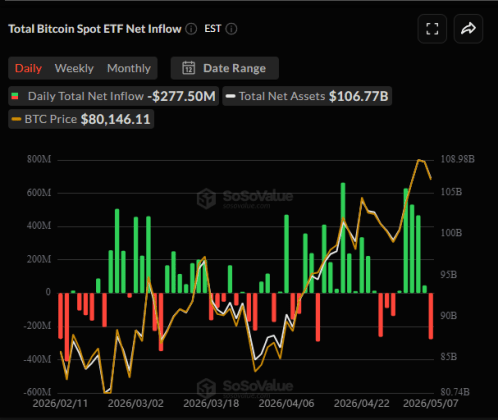
The value of the metric seems to have just turned negative | Source: SoSoValue

As displayed in the graph, the Bitcoin spot ETFs have mostly seen net inflows recently, a behavior convergent with the wider trend of recovery in the digital asset sector. April only witnessed net outflows on seven days, with the scale of withdrawals involved being notably lower than the average inflows for the month.

The month ended with a three-day net outflow spree, but the start of May came with a return of bullish momentum as these funds went on a 5-day green streak. Alongside this spike in interest from institutional traders, BTC observed a rally toward the $83,000 level.

In the past day, however, market winds have changed once more. From the chart, it’s visible that spot ETFs have broken their positive netflow run with a notable red spike. In total, $277 million exited across the funds with these outflows. The Bitcoin price has retraced back below $80,000 alongside the development.

While the outflows aren’t negligible in size, they have still not been enough to overturn the net inflows that the spot ETFs have enjoyed recently; this week’s netflow still stands at a positive $768 million.

The US Ethereum spot ETFs also saw a red spike on Thursday, with over $103 million in capital exiting the funds.
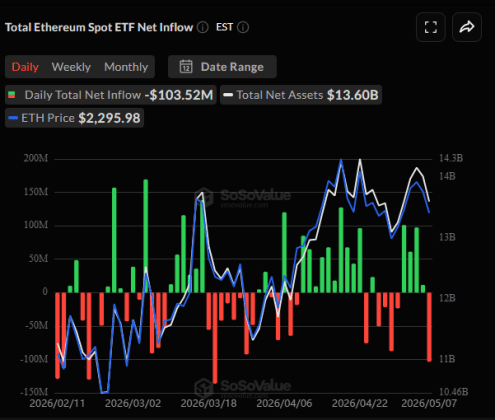
How the daily netflow has looked for the ETH funds | Source: SoSoValue

Unlike for Bitcoin, though, the outflows have been strong enough to neutralize the recent inflows for Ethereum as the weekly netflow has dropped to a value of just $66 million.

BTC Price

At the time of writing, Bitcoin is trading around $79,800, up 3.5% over the past week.

The trend in the price of the coin over the last five days | Source: BTCUSDT on TradingView


Trending Cryptos

Related Questions

QAccording to the article, what is the current Bitcoin price and what significant event has occurred with the US spot Bitcoin ETFs?

ABitcoin is currently trading around $79,800. The US spot Bitcoin ETFs have broken their 5-day streak of net inflows, registering net outflows of $277 million in a single day, which coincided with the price pulling back below $80,000.

QWhat was the netflow status for US Bitcoin spot ETFs this week according to the data from SoSoValue?

ADespite the recent daily outflow of $277 million, the netflow for the US Bitcoin spot ETFs for this week remains positive at $768 million.

QHow did the US Ethereum spot ETFs perform on Thursday, and what was the impact on their weekly netflow?

AOn Thursday, the US Ethereum spot ETFs also saw net outflows of over $103 million. These outflows were strong enough to nearly neutralize the recent inflows, bringing the weekly netflow down to just $66 million.

QWhy are spot ETFs considered popular among institutional investors according to the article?

ASpot ETFs are popular among more traditional traders like institutional entities because they allow for indirect investment in Bitcoin. This means investors gain exposure to the cryptocurrency's price movements without having to directly interact with blockchain infrastructure, such as wallets and exchanges, which they can be cautious about.

QWhat was the trend in the Bitcoin spot ETF netflows during the month of April, and how did it change at the start of May?

ADuring April, Bitcoin spot ETFs mostly saw net inflows, with outflows occurring on only seven days, and the scale of those outflows was notably lower than the average inflows. The month ended with a three-day net outflow spree, but the start of May saw a return of bullish momentum with a 5-day streak of net inflows, which contributed to a Bitcoin rally toward $83,000.

Related Reads

MSCI Again Talks About Excluding Cryptotreasuries from Global Indices

Index provider MSCI has proposed changes to its Global Investable Market Indexes (GIMI) methodology, potentially leading to the exclusion of companies that primarily accumulate investment assets instead of conducting operational business. This could affect firms like Strategy, Metaplanet, and other crypto treasuries (DATs), impacting passive investment flows into their stocks. No final decision has been made; consultations will run until September 30, 2026, with results to be announced by October 16. If approved, changes could be implemented during MSCI's November index review. This follows a previous review in early 2026 where MSCI opted against excluding DATs but committed to a broader reassessment of non-operational companies. The new methodology involves a two-step screening process. Companies failing an initial screen (where operational assets must exceed 50% of total assets) face a secondary screen with five financial criteria. A company is deemed ineligible if it meets at least four criteria, such as having operational assets below 20% of total assets, negative operating cash flow, or heavy reliance on capital raising to accumulate assets—a key factor for crypto treasury firms. An analysis of the MSCI ACWI IMI identified three potential exclusions: Strategy, Yellow Cake, and Metaplanet. JPMorgan previously estimated that excluding Strategy alone could trigger outflows of up to $8.8 billion, with broader DAT exclusions potentially causing $10-$15 billion in outflows.

cryptonews.ru1m ago

MSCI Again Talks About Excluding Cryptotreasuries from Global Indices

cryptonews.ru1m ago

ChatGPT's New Feature: AI Has Begun Monitoring Users

OpenAI has launched a new feature called "Computer History" for its macOS desktop ChatGPT application. Designed for Pro, Business, and Enterprise subscribers, the tool monitors user activity across applications and websites in the background. This data builds a temporary activity timeline, allowing the AI to reference it in subsequent conversations to provide more accurate and personalized responses while reducing the need for manual context input. The feature, an evolution of the earlier "Chronicle" project, requires explicit user activation in settings and offers privacy controls, including the ability to clear all or selected portions of the history. OpenAI emphasizes its operation is based on voluntary consent. However, the rollout is delayed for users in the European Economic Area, UK, and Switzerland as OpenAI works to align the feature with local data protection regulations like GDPR. This highlights the ongoing challenge of balancing advanced personalization with strict data privacy laws. The announcement coincides with other technical advances from OpenAI, such as the faster GPT-5.6 Ultrafast API model. The article's analysis notes that while this move intensifies competition with rivals like Claude and Gemini, it also raises questions about long-term user trust, potential security risks present in earlier versions, and whether voluntary consent remains a sufficient safeguard as the scope of collected activity data expands.

cryptonews.ru5m ago

ChatGPT's New Feature: AI Has Begun Monitoring Users

cryptonews.ru5m ago

Trading

Spot

Hot Articles

What is $BITCOIN

DIGITAL GOLD ($BITCOIN): A Comprehensive Analysis Introduction to DIGITAL GOLD ($BITCOIN) DIGITAL GOLD ($BITCOIN) is a blockchain-based project operating on the Solana network, which aims to combine the characteristics of traditional precious metals with the innovation of decentralized technologies. While it shares a name with Bitcoin, often referred to as “digital gold” due to its perception as a store of value, DIGITAL GOLD is a separate token designed to create a unique ecosystem within the Web3 landscape. Its goal is to position itself as a viable alternative digital asset, although specifics regarding its applications and functionalities are still developing. What is DIGITAL GOLD ($BITCOIN)? DIGITAL GOLD ($BITCOIN) is a cryptocurrency token explicitly designed for use on the Solana blockchain. In contrast to Bitcoin, which provides a widely recognized value storage role, this token appears to focus on broader applications and characteristics. Notable aspects include: Blockchain Infrastructure: The token is built on the Solana blockchain, known for its capacity to handle high-speed and low-cost transactions. Supply Dynamics: DIGITAL GOLD has a maximum supply capped at 100 quadrillion tokens (100P $BITCOIN), although details regarding its circulating supply are currently undisclosed. Utility: While precise functionalities are not explicitly outlined, there are indications that the token could be utilized for various applications, potentially involving decentralized applications (dApps) or asset tokenization strategies. Who is the Creator of DIGITAL GOLD ($BITCOIN)? At present, the identity of the creators and development team behind DIGITAL GOLD ($BITCOIN) remains unknown. This situation is typical among many innovative projects within the blockchain space, particularly those aligning with decentralized finance and meme coin phenomena. While such anonymity may foster a community-driven culture, it intensifies concerns about governance and accountability. Who are the Investors of DIGITAL GOLD ($BITCOIN)? The available information indicates that DIGITAL GOLD ($BITCOIN) does not have any known institutional backers or prominent venture capital investments. The project seems to operate on a peer-to-peer model focused on community support and adoption rather than traditional funding routes. Its activity and liquidity are primarily situated on decentralized exchanges (DEXs), such as PumpSwap, rather than established centralized trading platforms, further highlighting its grassroots approach. How DIGITAL GOLD ($BITCOIN) Works The operational mechanics of DIGITAL GOLD ($BITCOIN) can be elaborated on based on its blockchain design and network attributes: Consensus Mechanism: By leveraging Solana’s unique proof-of-history (PoH) combined with a proof-of-stake (PoS) model, the project ensures efficient transaction validation contributing to the network's high performance. Tokenomics: While specific deflationary mechanisms have not been extensively detailed, the vast maximum token supply implies that it may cater to microtransactions or niche use cases that are still to be defined. Interoperability: There exists the potential for integration with Solana’s broader ecosystem, including various decentralized finance (DeFi) platforms. However, the details regarding specific integrations remain unspecified. Timeline of Key Events Here is a timeline that highlights significant milestones concerning DIGITAL GOLD ($BITCOIN): 2023: The initial deployment of the token occurs on the Solana blockchain, marked by its contract address. 2024: DIGITAL GOLD gains visibility as it becomes available for trading on decentralized exchanges like PumpSwap, allowing users to trade it against SOL. 2025: The project witnesses sporadic trading activity and potential interest in community-led engagements, although no noteworthy partnerships or technical advancements have been documented as of yet. Critical Analysis Strengths Scalability: The underlying Solana infrastructure supports high transaction volumes, which could enhance the utility of $BITCOIN in various transaction scenarios. Accessibility: The potential low trading price per token could attract retail investors, facilitating wider participation due to fractional ownership opportunities. Risks Lack of Transparency: The absence of publicly known backers, developers, or an audit process may yield skepticism regarding the project's sustainability and trustworthiness. Market Volatility: The trading activity is heavily reliant on speculative behavior, which can result in significant price volatility and uncertainty for investors. Conclusion DIGITAL GOLD ($BITCOIN) emerges as an intriguing yet ambiguous project within the rapidly evolving Solana ecosystem. While it attempts to leverage the “digital gold” narrative, its departure from Bitcoin's established role as a store of value underscores the need for a clearer differentiation of its intended utility and governance structure. Future acceptance and adoption will likely depend on addressing the current opacity and defining its operational and economic strategies more explicitly. Note: This report encompasses synthesised information available as of October 2023, and developments may have transpired beyond the research period.

1.9k Total ViewsPublished 2025.05.13Updated 2025.05.13

What is $BITCOIN

Discussions

Welcome to the HTX Community. Here, you can stay informed about the latest platform developments and gain access to professional market insights. Users' opinions on the price of BTC (BTC) are presented below.

活动图片