Bitcoin sharks stack at the fastest pace in 13 years, with BTC down 30%

cointelegraphPublished on 2025-12-16Last updated on 2025-12-16

Abstract

Bitcoin (BTC) has declined 30% from its peak of $126,200 and is trading just above $85,000, raising concerns of a further drop toward $70,000. Despite this, on-chain data shows that mid-sized holders, known as "sharks" (holding 100–1,000 BTC), accumulated 54,000 BTC in the past week—the fastest pace since 2012. This suggests strong buying interest from high-net-worth and institutional investors during the dip. Historically, similar accumulation patterns in 2011 and 2012 preceded major rallies. However, large whales (holders of 10,000+ BTC) have been significant sellers over the past two months, creating selling pressure that outweighs shark demand. Analysts note record institutional buying is being absorbed by long-term holders selling at unusually high rates. This imbalance may cap near-term upside. Additionally, a breakdown below parabolic support could lead to further declines, with one analyst suggesting a potential drop to $25,000 if historical patterns repeat.

Bitcoin (BTC) is down 30% from its $126,200 peak, trading just above the $85,000 support and fueling concerns of a deeper pullback toward the $70,000 region. Still, onchain data showed institutions and high-net-worth individuals are accumulating BTC.

Key takeaways:

  • Bitcoin sharks accumulated aggressively at 2012-level speeds, signaling a dip-buying trend.

  • Heavy selling by long-term and OG whales continues to cap upside, keeping near-term downside risks elevated.
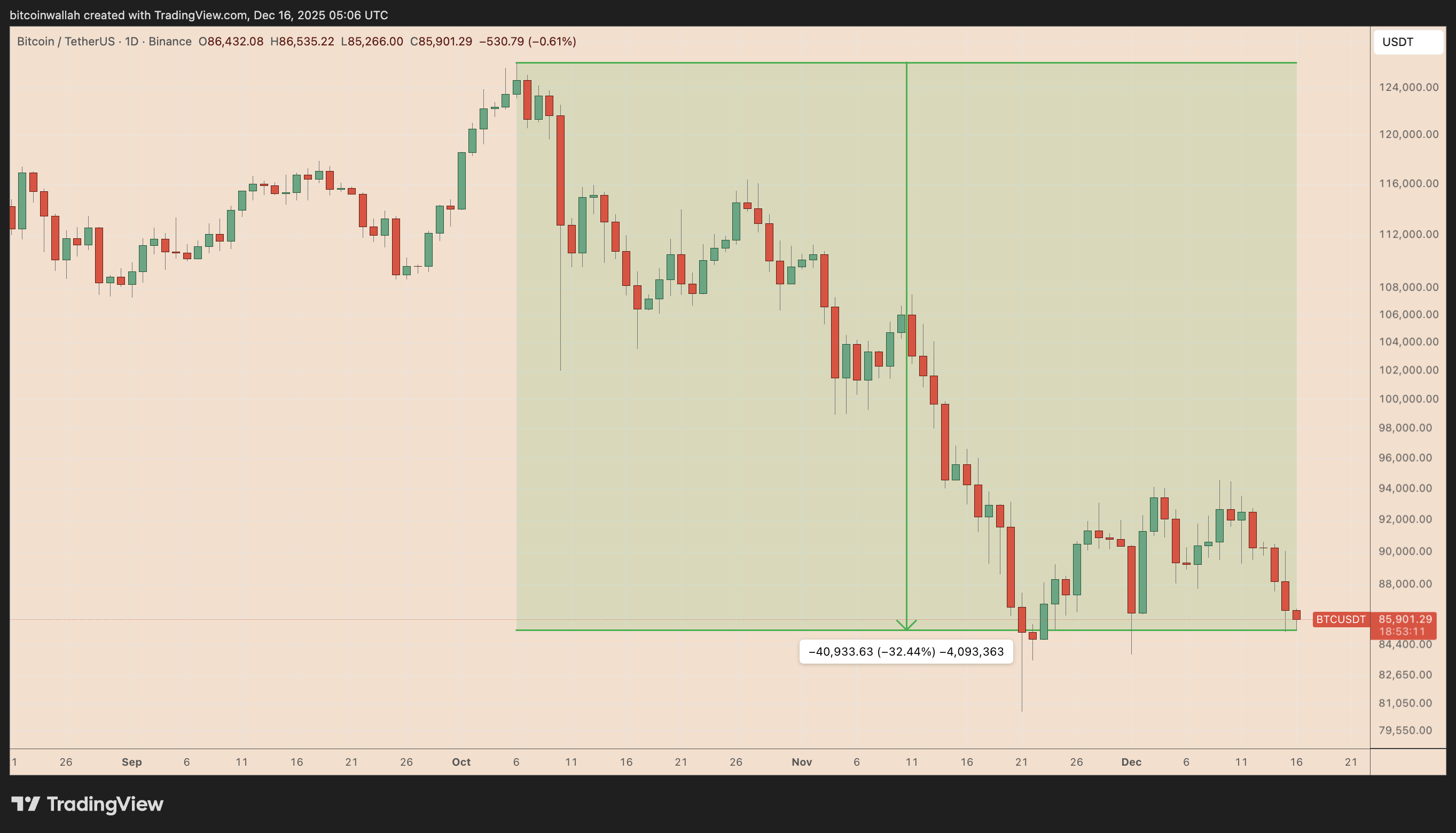
BTC/USDT daily chart. Source: TradingView

Mid-sized Bitcoin traders add 54,000 BTC in a week

Bitcoin “sharks,” entities holding between 100 and 1,000 BTC, increased their collective holdings to about 3.575 million BTC from roughly 3.521 million BTC over the past seven days, absorbing around 54,000 BTC from smaller holders, according to Glassnode.
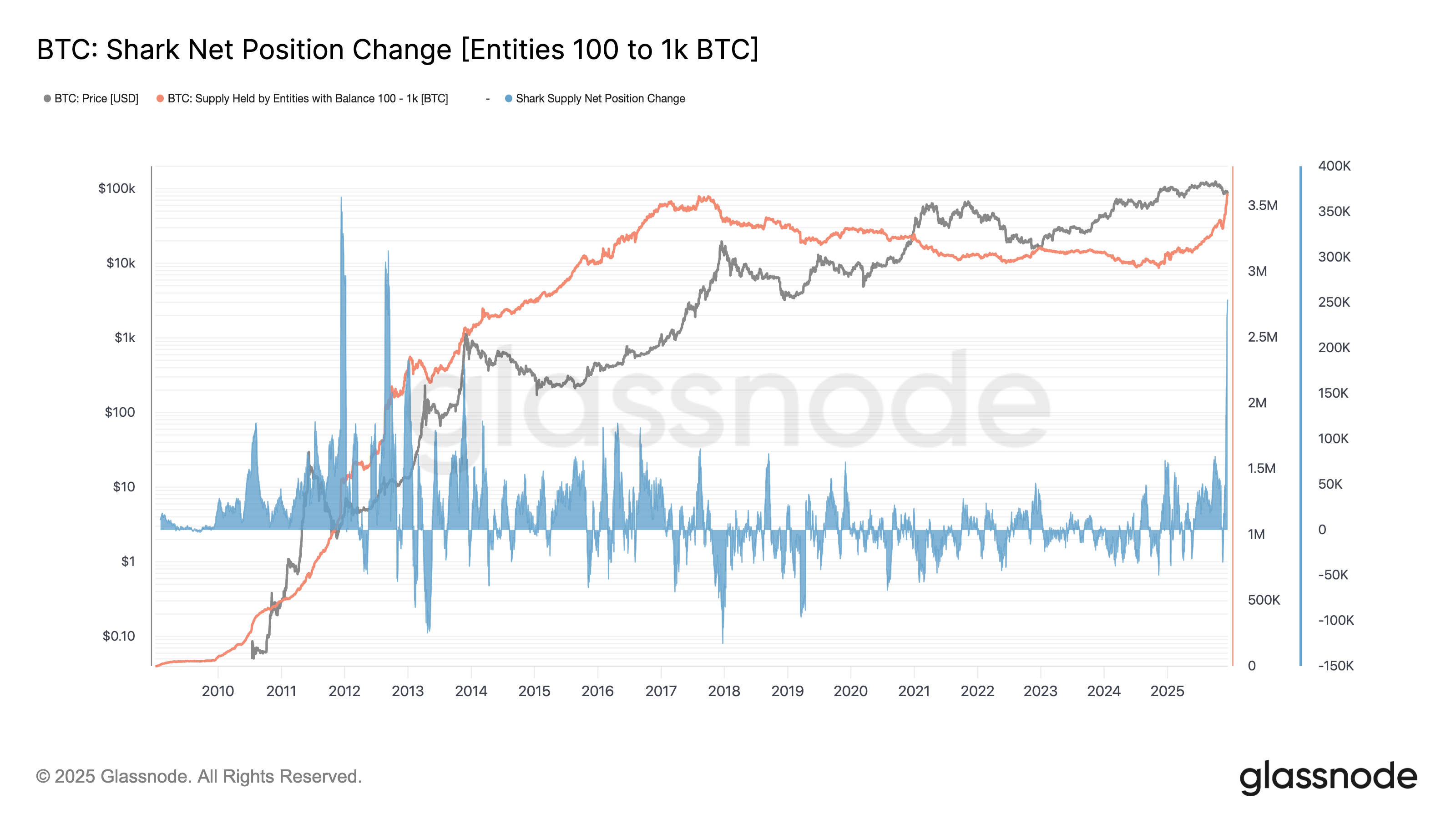
BTC shark net position change. Source: Glassnode

The move marked the fastest pace of shark accumulation since 2012, suggesting strong bullish conviction among higher-net-worth individuals and institutional players despite BTC’s 30% drawdown.

Related: Bitcoin to hit new all-time high within 6 months: Grayscale

In 2012, a comparable surge in Bitcoin accumulation preceded one of its earliest major rallies, with BTC climbing to above $100 from roughly $10 within a year, marking an approximately 900% increase.
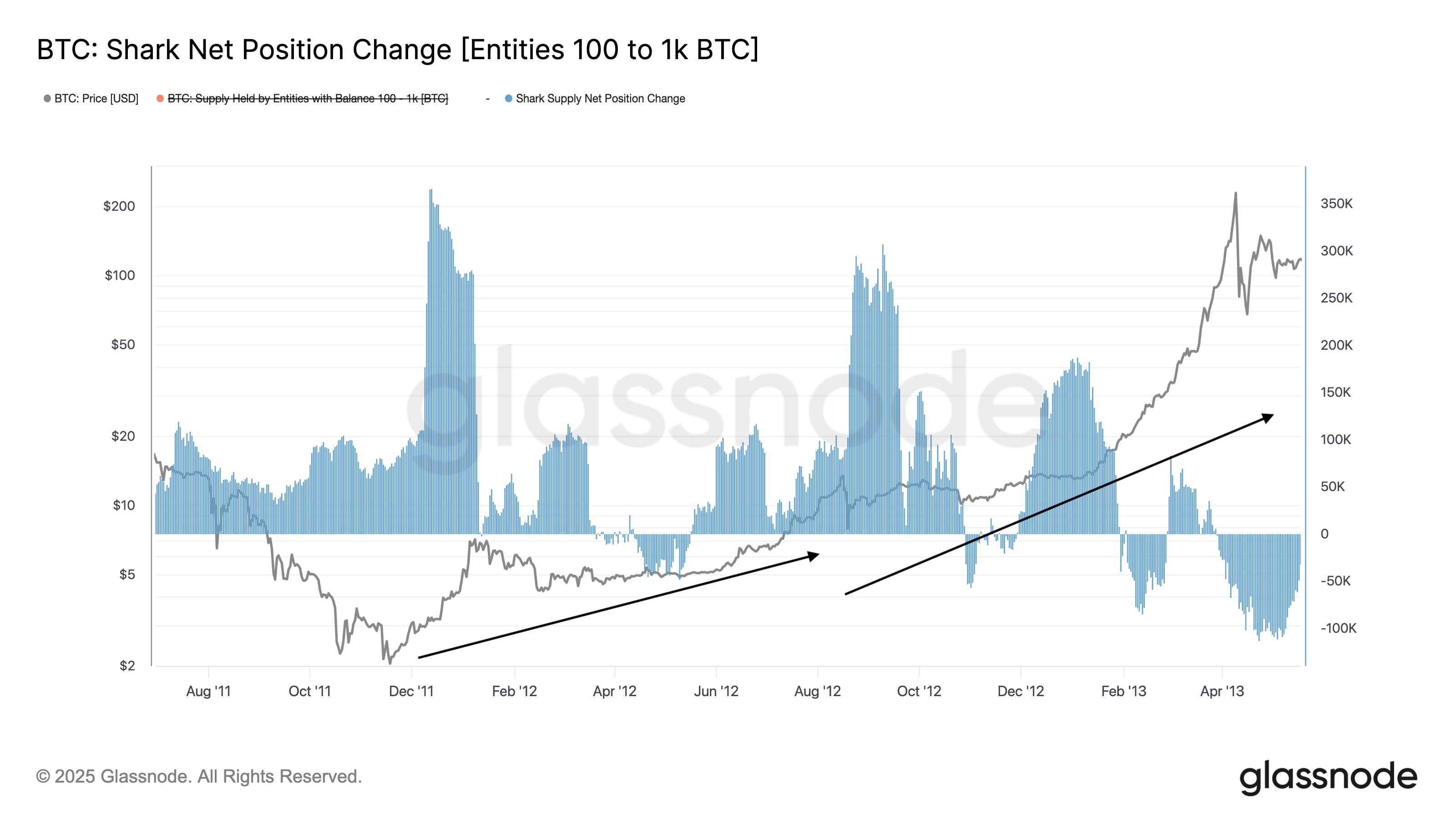
BTC shark net position change. Source: Glassnode

A similar pattern played out in 2011, when aggressive accumulation by mid-sized holders followed Bitcoin’s 350% rise to over $14 from below $3.

A repetition of this historical fractal would favor further upside.

Bitcoin faces sell pressure from long-term holders

Whales with holdings over 10,000 BTC emerged as the major driver behind the sell-off over the past two months, highlighting that the buying power of sharks was insufficient.
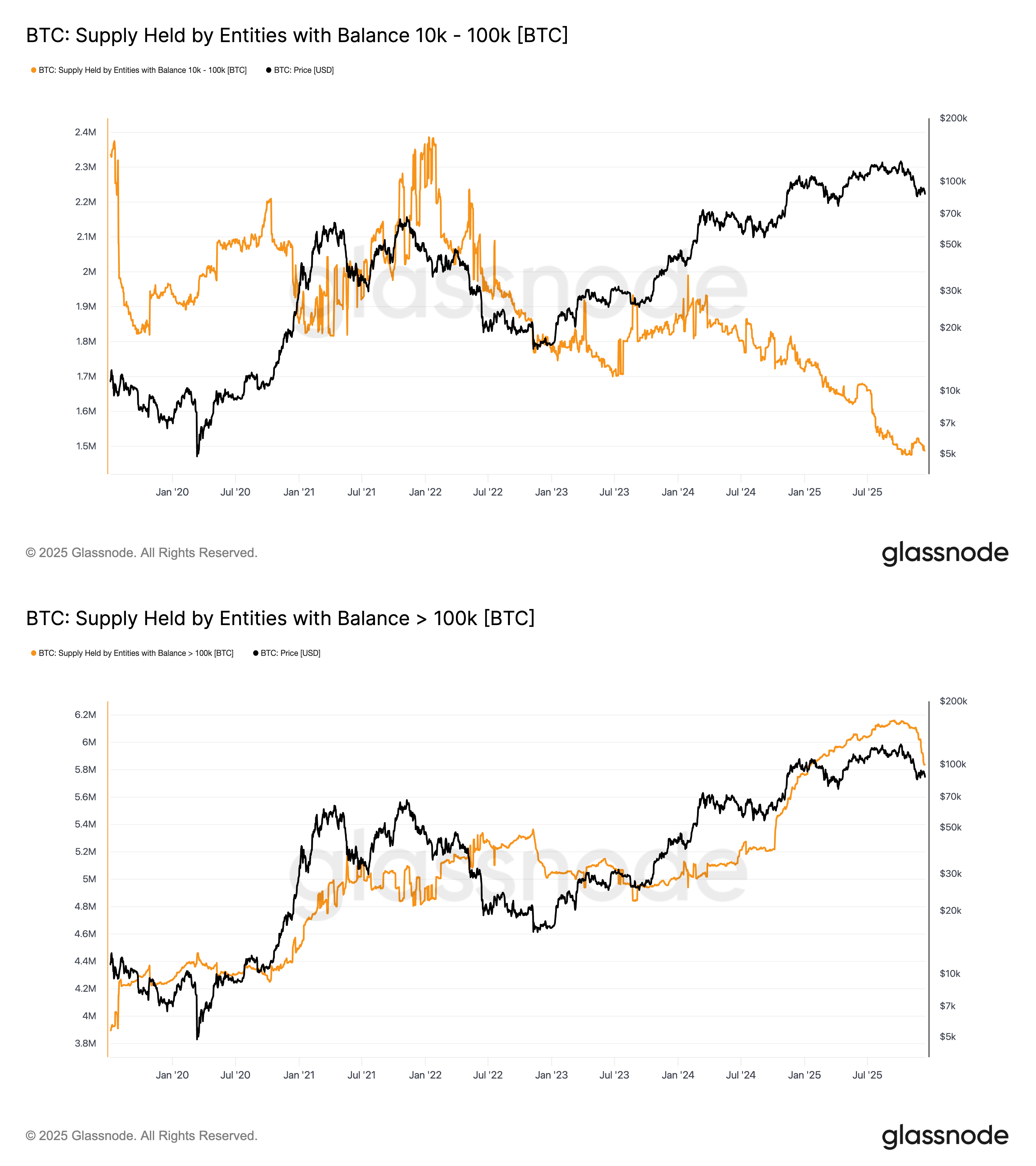
BTC supply held by entities with a balance of over 10,000 tokens. Source: Glassnode

That imbalance aligned with Capriole Investments’ assessment that record institutional buying has been met by equally historic long-term holder distribution.

Founder Charles Edwards wrote in a Tuesday post:

“While institutional buying on Coinbase has reached unprecedented levels (Z-score 15.7), it is being absorbed by 'OG' whales and long-term holders selling at rates not seen in years (Hodler Growth Rate at 0.6th percentile).”
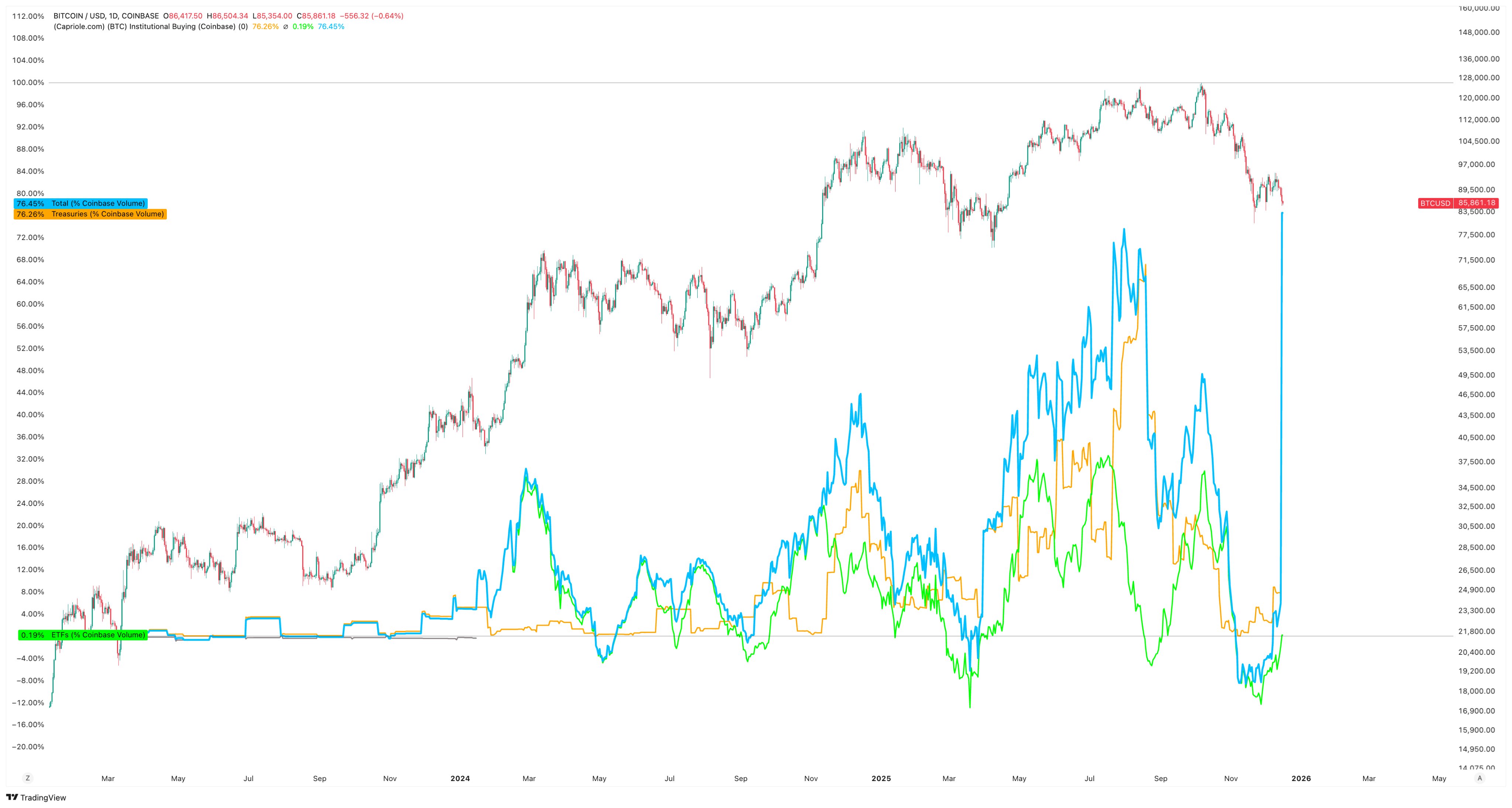
BTC/USD daily chart. Source: TradingView/Charles Edwards

The price appreciation may be capped until the heavy distribution from older coins subsides, he added.

Adding to the downside outlook, veteran trader Peter Brandt highlighted Bitcoin’s recent breakdown below its parabolic support, a move that historically led prices down by around 80%. In other words, BTC price could reach as low as $25,000 if the fractal repeats.
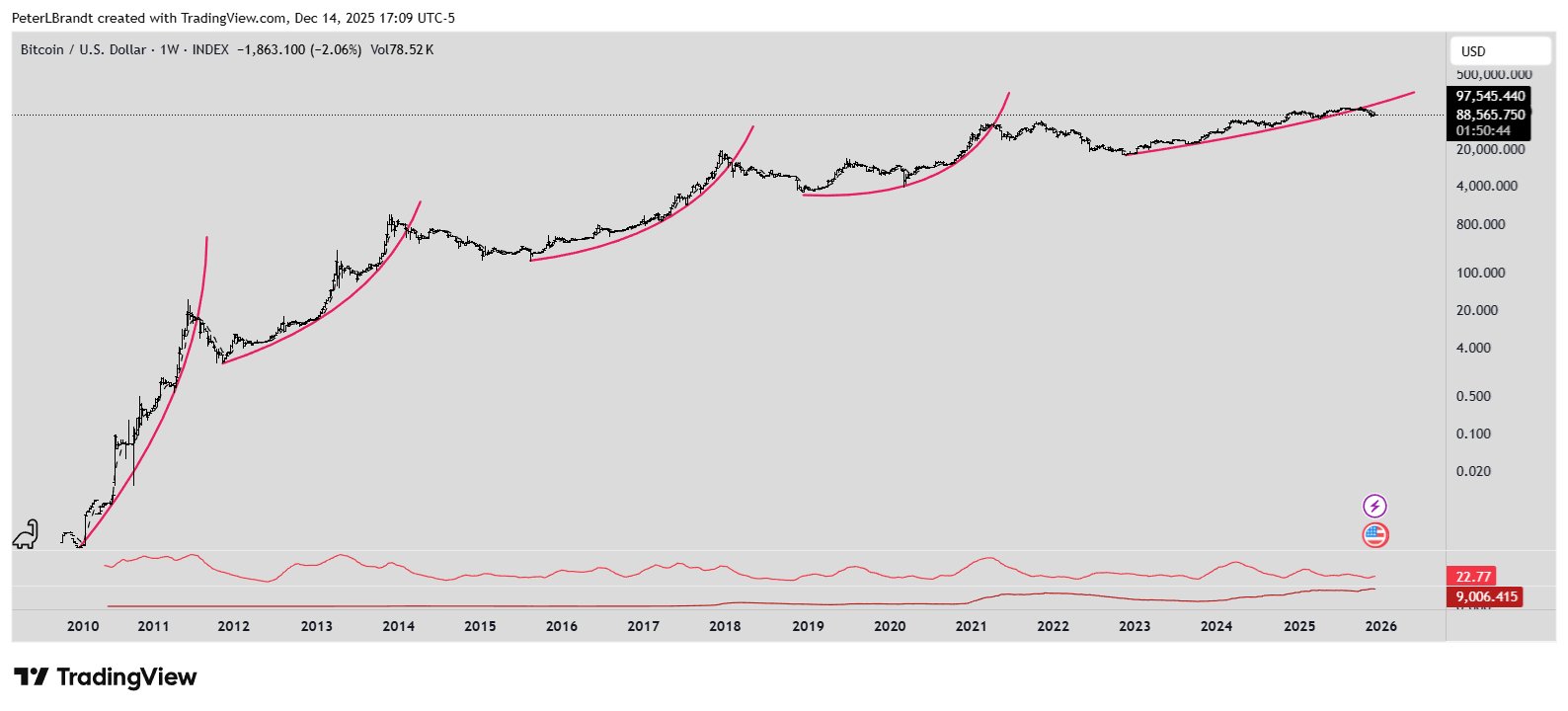
BTC/USD weekly chart. Source: TradingView/Peter Brandt

This article does not contain investment advice or recommendations. Every investment and trading move involves risk, and readers should conduct their own research when making a decision. While we strive to provide accurate and timely information, Cointelegraph does not guarantee the accuracy, completeness, or reliability of any information in this article. This article may contain forward-looking statements that are subject to risks and uncertainties. Cointelegraph will not be liable for any loss or damage arising from your reliance on this information.


Related Reads

Google and Amazon Simultaneously Invest Heavily in a Competitor: The Most Absurd Business Logic of the AI Era Is Becoming Reality

In a span of four days, Amazon announced an additional $25 billion investment, and Google pledged up to $40 billion—both direct competitors pouring over $65 billion into the same AI startup, Anthropic. Rather than a typical venture capital move, this signals the latest escalation in the cloud wars. The core of the deal is not equity but compute pre-orders: Anthropic must spend the majority of these funds on AWS and Google Cloud services and chips, effectively locking in massive future compute consumption. This reflects a shift in cloud market dynamics—enterprises now choose cloud providers based on which hosts the best AI models, not just price or stability. With OpenAI deeply tied to Microsoft, Anthropic’s Claude has become the only viable strategic asset for Google and Amazon to remain competitive. Anthropic’s annualized revenue has surged to $30 billion, and it is expanding into verticals like biotech, positioning itself as a cross-industry AI infrastructure layer. However, this funding comes with constraints: Anthropic’s independence is challenged as it balances two rival investors, its safety-first narrative faces pressure from regulatory scrutiny, and its path to IPO introduces new financial pressures. Globally, this accelerates a "tri-polar" closed-loop structure in AI infrastructure, with Microsoft-OpenAI, Google-Anthropic, and Amazon-Anthropic forming exclusive model-cloud alliances. In contrast, China’s landscape differs—investments like Alibaba and Tencent backing open-source model firm DeepSeek reflect a more decoupled approach, though closed-source models from major cloud providers still dominate. The $65 billion bet is ultimately about securing a seat at the table in an AI-defined future—where missing the model layer means losing the cloud war.

marsbit1h ago

Google and Amazon Simultaneously Invest Heavily in a Competitor: The Most Absurd Business Logic of the AI Era Is Becoming Reality

marsbit1h ago

Computing Power Constrained, Why Did DeepSeek-V4 Open Source?

DeepSeek-V4 has been released as a preview open-source model, featuring 1 million tokens of context length as a baseline capability—previously a premium feature locked behind enterprise paywalls by major overseas AI firms. The official announcement, however, openly acknowledges computational constraints, particularly limited service throughput for the high-end DeepSeek-V4-Pro version due to restricted high-end computing power. Rather than competing on pure scale, DeepSeek adopts a pragmatic approach that balances algorithmic innovation with hardware realities in China’s AI ecosystem. The V4-Pro model uses a highly sparse architecture with 1.6T total parameters but only activates 49B during inference. It performs strongly in agentic coding, knowledge-intensive tasks, and STEM reasoning, competing closely with top-tier closed models like Gemini Pro 3.1 and Claude Opus 4.6 in certain scenarios. A key strategic product is the Flash edition, with 284B total parameters but only 13B activated—making it cost-effective and accessible for mid- and low-tier hardware, including domestic AI chips from Huawei (Ascend), Cambricon, and Hygon. This design supports broader adoption across developers and SMEs while stimulating China's domestic semiconductor ecosystem. Despite facing talent outflow and intense competition in user traffic—with rivals like Doubao and Qianwen leading in monthly active users—DeepSeek has maintained technical momentum. The release also comes amid reports of a new funding round targeting a valuation exceeding $10 billion, potentially setting a new record in China’s LLM sector. Ultimately, DeepSeek-V4 represents a shift toward open yet realistic infrastructure development in the constrained compute landscape of Chinese AI, emphasizing engineering efficiency and domestic hardware compatibility over pure model scale.

marsbit1h ago

Computing Power Constrained, Why Did DeepSeek-V4 Open Source?

marsbit1h ago

Trading

Spot
Futures

Hot Articles

What is $BITCOIN

DIGITAL GOLD ($BITCOIN): A Comprehensive Analysis Introduction to DIGITAL GOLD ($BITCOIN) DIGITAL GOLD ($BITCOIN) is a blockchain-based project operating on the Solana network, which aims to combine the characteristics of traditional precious metals with the innovation of decentralized technologies. While it shares a name with Bitcoin, often referred to as “digital gold” due to its perception as a store of value, DIGITAL GOLD is a separate token designed to create a unique ecosystem within the Web3 landscape. Its goal is to position itself as a viable alternative digital asset, although specifics regarding its applications and functionalities are still developing. What is DIGITAL GOLD ($BITCOIN)? DIGITAL GOLD ($BITCOIN) is a cryptocurrency token explicitly designed for use on the Solana blockchain. In contrast to Bitcoin, which provides a widely recognized value storage role, this token appears to focus on broader applications and characteristics. Notable aspects include: Blockchain Infrastructure: The token is built on the Solana blockchain, known for its capacity to handle high-speed and low-cost transactions. Supply Dynamics: DIGITAL GOLD has a maximum supply capped at 100 quadrillion tokens (100P $BITCOIN), although details regarding its circulating supply are currently undisclosed. Utility: While precise functionalities are not explicitly outlined, there are indications that the token could be utilized for various applications, potentially involving decentralized applications (dApps) or asset tokenization strategies. Who is the Creator of DIGITAL GOLD ($BITCOIN)? At present, the identity of the creators and development team behind DIGITAL GOLD ($BITCOIN) remains unknown. This situation is typical among many innovative projects within the blockchain space, particularly those aligning with decentralized finance and meme coin phenomena. While such anonymity may foster a community-driven culture, it intensifies concerns about governance and accountability. Who are the Investors of DIGITAL GOLD ($BITCOIN)? The available information indicates that DIGITAL GOLD ($BITCOIN) does not have any known institutional backers or prominent venture capital investments. The project seems to operate on a peer-to-peer model focused on community support and adoption rather than traditional funding routes. Its activity and liquidity are primarily situated on decentralized exchanges (DEXs), such as PumpSwap, rather than established centralized trading platforms, further highlighting its grassroots approach. How DIGITAL GOLD ($BITCOIN) Works The operational mechanics of DIGITAL GOLD ($BITCOIN) can be elaborated on based on its blockchain design and network attributes: Consensus Mechanism: By leveraging Solana’s unique proof-of-history (PoH) combined with a proof-of-stake (PoS) model, the project ensures efficient transaction validation contributing to the network's high performance. Tokenomics: While specific deflationary mechanisms have not been extensively detailed, the vast maximum token supply implies that it may cater to microtransactions or niche use cases that are still to be defined. Interoperability: There exists the potential for integration with Solana’s broader ecosystem, including various decentralized finance (DeFi) platforms. However, the details regarding specific integrations remain unspecified. Timeline of Key Events Here is a timeline that highlights significant milestones concerning DIGITAL GOLD ($BITCOIN): 2023: The initial deployment of the token occurs on the Solana blockchain, marked by its contract address. 2024: DIGITAL GOLD gains visibility as it becomes available for trading on decentralized exchanges like PumpSwap, allowing users to trade it against SOL. 2025: The project witnesses sporadic trading activity and potential interest in community-led engagements, although no noteworthy partnerships or technical advancements have been documented as of yet. Critical Analysis Strengths Scalability: The underlying Solana infrastructure supports high transaction volumes, which could enhance the utility of $BITCOIN in various transaction scenarios. Accessibility: The potential low trading price per token could attract retail investors, facilitating wider participation due to fractional ownership opportunities. Risks Lack of Transparency: The absence of publicly known backers, developers, or an audit process may yield skepticism regarding the project's sustainability and trustworthiness. Market Volatility: The trading activity is heavily reliant on speculative behavior, which can result in significant price volatility and uncertainty for investors. Conclusion DIGITAL GOLD ($BITCOIN) emerges as an intriguing yet ambiguous project within the rapidly evolving Solana ecosystem. While it attempts to leverage the “digital gold” narrative, its departure from Bitcoin's established role as a store of value underscores the need for a clearer differentiation of its intended utility and governance structure. Future acceptance and adoption will likely depend on addressing the current opacity and defining its operational and economic strategies more explicitly. Note: This report encompasses synthesised information available as of October 2023, and developments may have transpired beyond the research period.

363 Total ViewsPublished 2025.05.13Updated 2025.05.13

What is $BITCOIN

Discussions

Welcome to the HTX Community. Here, you can stay informed about the latest platform developments and gain access to professional market insights. Users' opinions on the price of BTC (BTC) are presented below.

活动图片