Bitcoin Sell-Off Goes Largely Unabsorbed: Fresh Capital Is Missing

bitcoinistPublished on 2026-02-11Last updated on 2026-02-11

Abstract

Bitcoin is struggling to reclaim key resistance levels amid weakening market demand and persistent capital outflows. According to a CryptoQuant report, new investor inflows have turned negative, with cumulative 30-day flows dropping to approximately –$2.6 billion. This indicates that the current sell-off is not being absorbed by fresh capital, contrasting with typical bull-market corrections where dips attract new buyers. Instead, the market shows signs of a transitional phase often seen after a cycle peak, with price movements driven by internal capital rotation rather than new inflows. Without sustained demand, any upward price action is likely corrective rather than indicative of a trend reversal, suggesting continued resistance and volatility until new capital enters the market.

Bitcoin is struggling to reclaim key resistance levels as the broader market navigates a phase of heightened uncertainty and weakening demand. Despite multiple rebound attempts, price action remains constrained, reflecting a lack of sustained buying interest and fragile investor sentiment. According to a recent CryptoQuant report, a critical shift is occurring beneath the surface: new investor inflows have turned negative, suggesting that the ongoing sell-off is not being absorbed by fresh capital entering the market.

Data shows that cumulative 30-day flows have dropped to approximately −$2.6 billion, highlighting persistent capital outflows rather than accumulation. This dynamic contrasts sharply with typical bull-market corrections, where price dips tend to attract new participants seeking discounted entry points. Instead, current declines appear to be met with caution, reinforcing a defensive market posture.

The absence of the strong inflow spikes historically associated with sustained uptrends further underscores this shift. Liquidity conditions remain tight, and participation appears to be narrowing, with existing holders rotating positions rather than new investors driving demand. Until consistent inflows resume, upside momentum may remain limited, and Bitcoin could continue facing resistance pressure as the market searches for a clearer directional catalyst.

According to the report, Bitcoin’s current market behavior increasingly resembles the transitional phase that typically follows a cycle peak. In strong bull markets, price corrections tend to attract accelerating capital inflows, as investors view pullbacks as opportunities to accumulate. By contrast, early bear-market environments often show the opposite dynamic: weakening price action triggers capital withdrawal rather than fresh demand. Current on-chain readings suggest Bitcoin may be entering this latter phase.
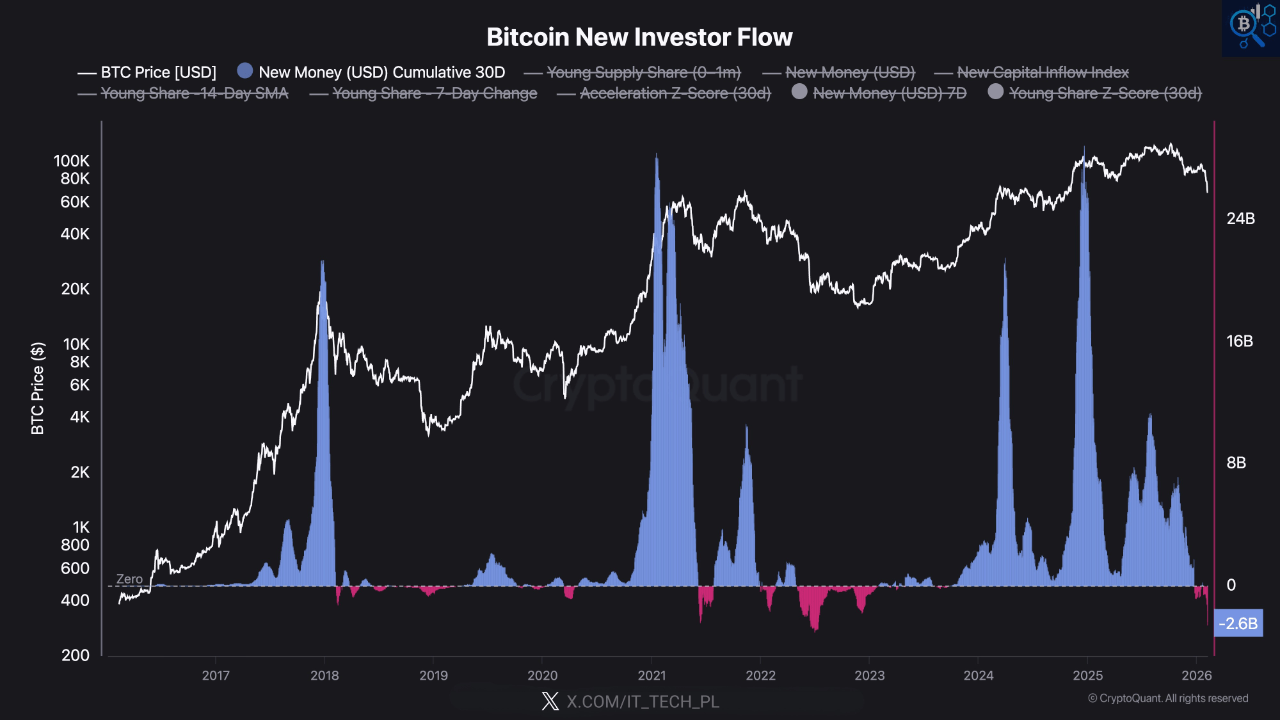
Bitcoin New Investors Flow | Source: CryptoQuant

Data indicates that marginal buyers — those who usually provide incremental liquidity during uptrends — are stepping back. As a result, price movements appear increasingly driven by internal capital rotation rather than genuine net inflows. This means existing participants are repositioning funds within the market instead of new investors entering, which typically reduces momentum and amplifies volatility.

Without renewed inflows, any upward price movement is more likely to represent corrective rebounds than sustainable trend reversals. This aligns with early bear-market conditions characterized by contracting liquidity, declining participation breadth, and cautious investor behavior. Historically, markets tend to remain fragile until new demand returns consistently.

The absence of strong inflows suggests that Bitcoin’s recovery potential may remain constrained, with price action likely dependent on whether fresh capital eventually re-enters the ecosystem.


Related Questions

QAccording to the CryptoQuant report, what is the current state of new investor inflows into the Bitcoin market?

ANew investor inflows have turned negative, with cumulative 30-day flows dropping to approximately -$2.6 billion, indicating persistent capital outflows rather than accumulation.

QHow does the current market dynamic differ from typical bull-market corrections?

AIn typical bull markets, price dips attract new participants seeking discounted entry points, whereas current declines are met with caution and capital withdrawal, reinforcing a defensive market posture.

QWhat does the data suggest about the behavior of marginal buyers in the current Bitcoin market?

AMarginal buyers, who usually provide incremental liquidity during uptrends, are stepping back, making price movements increasingly driven by internal capital rotation rather than genuine net inflows.

QWhat phase does Bitcoin's current market behavior resemble, according to the report?

ABitcoin's current market behavior increasingly resembles the transitional phase that typically follows a cycle peak, characterized by early bear-market conditions with contracting liquidity and cautious investor behavior.

QWhy are upward price movements in the current market more likely to be corrective rebounds than sustainable trend reversals?

AWithout renewed inflows from fresh capital, upward price movements lack sustained buying interest and are driven by existing participants repositioning funds, reducing momentum and amplifying volatility.

Related Reads

From Return to Resignation: Chen Hang's 437 Days at DingTalk

The 437-Day Return and Departure of Chen Hang at DingTalk This article chronicles the 437-day period from March 31, 2025, to June 11, 2026, when Chen Hang (also known as "No Move") returned as CEO of DingTalk, the enterprise communication platform he originally founded, only to later step down. Chen Hang, the creator of DingTalk in 2015, was brought back by Alibaba in 2025 after the company acquired his subsequent startup, HHO. His return was driven by Alibaba's renewed focus on AI and DingTalk's strategic role as its key to-B AI application. However, his aggressive management style, marked by strict work policies like mandatory clock-ins and extended hours, quickly caused internal friction and was criticized as being at odds with Alibaba's culture. Despite the internal turmoil, Chen Hang drove significant product launches. In August 2025, he unveiled "AI DingTalk 1.0," featuring new products like the AI-native entry point "DingTalk ONE." By March 2026, he announced "Wukong," touted as the world's first enterprise-grade AI-native work platform, representing a fundamental rebuild of DingTalk's architecture. The turning point came in early June 2026. A detailed internal post criticizing DingTalk's work culture went viral, followed by a public critique from a former executive. This prompted an unprecedented public rebuke from the Alibaba Partners Committee, which stated such management was not aligned with company values. One day later, on June 11, Alibaba announced Chen Hang's departure. He was succeeded by Chen Yusen, a 32-year-old technical expert known for founding cybersecurity firm Changting Technology. While Chen Hang's tenure laid the technical foundation for DingTalk's AI transformation with "Wukong," his leadership style ultimately led to his replacement as the company seeks a new direction under younger leadership.

marsbit12m ago

From Return to Resignation: Chen Hang's 437 Days at DingTalk

marsbit12m ago

The 2026 Landscape of Decentralized AI: Why Blockchain is the Inevitable 'Antidote' for AI?

Decentralized AI 2026 Landscape: Why Blockchain is AI's Essential "Antidote" Centralized AI faces structural bottlenecks—expensive compute, concentrated control, unverifiable outputs, and difficult data access—that cannot be solved by capital or code alone. Blockchain offers a path to make intelligence open, verifiable, and economically accessible. The decentralized AI stack comprises: * **Infrastructure:** The foundation with compute, verifiable inference, distributed training, data/storage, and privacy/verification layers. Projects like Akash, Render, and Filecoin provide cheaper, decentralized alternatives for raw resources. * **Middleware:** The coordination layer for agent discovery, identity, and commerce. Key players include Bittensor (a network of specialized AI subnets), Virtuals (an agent economy OS), and frameworks providing agent identity and tooling. * **Applications & Services:** Dominated by Agentic Finance (AI agents executing on-chain actions based on natural language) and Agentic Payments (machine-to-machine transactions using blockchain as a settlement layer). Projects like Giza, Infinit Labs, and x402 are enabling these use cases. Key trends for 2026-2027 show AI demand outgrowing infrastructure, compute becoming an asset class, and tokenomics emerging as a structural advantage for coordinating capital, compute, and data. While still early—with adoption uneven and revenue often trailing token incentives—projects like Bittensor, NEAR, and Venice demonstrate decentralized AI is evolving from a narrative into a new model for coordinating intelligence.

Foresight News32m ago

The 2026 Landscape of Decentralized AI: Why Blockchain is the Inevitable 'Antidote' for AI?

Foresight News32m ago

Trading

Spot
Futures

Hot Articles

What is $BITCOIN

DIGITAL GOLD ($BITCOIN): A Comprehensive Analysis Introduction to DIGITAL GOLD ($BITCOIN) DIGITAL GOLD ($BITCOIN) is a blockchain-based project operating on the Solana network, which aims to combine the characteristics of traditional precious metals with the innovation of decentralized technologies. While it shares a name with Bitcoin, often referred to as “digital gold” due to its perception as a store of value, DIGITAL GOLD is a separate token designed to create a unique ecosystem within the Web3 landscape. Its goal is to position itself as a viable alternative digital asset, although specifics regarding its applications and functionalities are still developing. What is DIGITAL GOLD ($BITCOIN)? DIGITAL GOLD ($BITCOIN) is a cryptocurrency token explicitly designed for use on the Solana blockchain. In contrast to Bitcoin, which provides a widely recognized value storage role, this token appears to focus on broader applications and characteristics. Notable aspects include: Blockchain Infrastructure: The token is built on the Solana blockchain, known for its capacity to handle high-speed and low-cost transactions. Supply Dynamics: DIGITAL GOLD has a maximum supply capped at 100 quadrillion tokens (100P $BITCOIN), although details regarding its circulating supply are currently undisclosed. Utility: While precise functionalities are not explicitly outlined, there are indications that the token could be utilized for various applications, potentially involving decentralized applications (dApps) or asset tokenization strategies. Who is the Creator of DIGITAL GOLD ($BITCOIN)? At present, the identity of the creators and development team behind DIGITAL GOLD ($BITCOIN) remains unknown. This situation is typical among many innovative projects within the blockchain space, particularly those aligning with decentralized finance and meme coin phenomena. While such anonymity may foster a community-driven culture, it intensifies concerns about governance and accountability. Who are the Investors of DIGITAL GOLD ($BITCOIN)? The available information indicates that DIGITAL GOLD ($BITCOIN) does not have any known institutional backers or prominent venture capital investments. The project seems to operate on a peer-to-peer model focused on community support and adoption rather than traditional funding routes. Its activity and liquidity are primarily situated on decentralized exchanges (DEXs), such as PumpSwap, rather than established centralized trading platforms, further highlighting its grassroots approach. How DIGITAL GOLD ($BITCOIN) Works The operational mechanics of DIGITAL GOLD ($BITCOIN) can be elaborated on based on its blockchain design and network attributes: Consensus Mechanism: By leveraging Solana’s unique proof-of-history (PoH) combined with a proof-of-stake (PoS) model, the project ensures efficient transaction validation contributing to the network's high performance. Tokenomics: While specific deflationary mechanisms have not been extensively detailed, the vast maximum token supply implies that it may cater to microtransactions or niche use cases that are still to be defined. Interoperability: There exists the potential for integration with Solana’s broader ecosystem, including various decentralized finance (DeFi) platforms. However, the details regarding specific integrations remain unspecified. Timeline of Key Events Here is a timeline that highlights significant milestones concerning DIGITAL GOLD ($BITCOIN): 2023: The initial deployment of the token occurs on the Solana blockchain, marked by its contract address. 2024: DIGITAL GOLD gains visibility as it becomes available for trading on decentralized exchanges like PumpSwap, allowing users to trade it against SOL. 2025: The project witnesses sporadic trading activity and potential interest in community-led engagements, although no noteworthy partnerships or technical advancements have been documented as of yet. Critical Analysis Strengths Scalability: The underlying Solana infrastructure supports high transaction volumes, which could enhance the utility of $BITCOIN in various transaction scenarios. Accessibility: The potential low trading price per token could attract retail investors, facilitating wider participation due to fractional ownership opportunities. Risks Lack of Transparency: The absence of publicly known backers, developers, or an audit process may yield skepticism regarding the project's sustainability and trustworthiness. Market Volatility: The trading activity is heavily reliant on speculative behavior, which can result in significant price volatility and uncertainty for investors. Conclusion DIGITAL GOLD ($BITCOIN) emerges as an intriguing yet ambiguous project within the rapidly evolving Solana ecosystem. While it attempts to leverage the “digital gold” narrative, its departure from Bitcoin's established role as a store of value underscores the need for a clearer differentiation of its intended utility and governance structure. Future acceptance and adoption will likely depend on addressing the current opacity and defining its operational and economic strategies more explicitly. Note: This report encompasses synthesised information available as of October 2023, and developments may have transpired beyond the research period.

363 Total ViewsPublished 2025.05.13Updated 2025.05.13

What is $BITCOIN

Discussions

Welcome to the HTX Community. Here, you can stay informed about the latest platform developments and gain access to professional market insights. Users' opinions on the price of BTC (BTC) are presented below.

活动图片














