Bitcoin RSI nears three-year lows vs. gold as analyst sees bullish comeback

cointelegraphPublished on 2025-12-20Last updated on 2025-12-20

Abstract

Bitcoin's value relative to gold has dropped to 20 ounces, its lowest level since early 2024, approaching what analysts consider a critical bull/bear market threshold. The weekly RSI has fallen to 29.5, nearing three-year lows and entering oversold territory, which historically signals a long-term bottom. Analyst Michaël van de Poppe suggests a bullish divergence is forming on the daily chart, indicating potential short-term upside. He argues gold is becoming overvalued while Bitcoin is undervalued. However, other commentators caution that losing the 20-ounce support level could signal the start of a broader bear market, with a break below likely in the coming weeks. The three-year uptrend for BTC against gold has now been broken.

Bitcoin (BTC) versus gold has entered classic bottom territory as a key support retest begins.

Key points:

  • Bitcoin drops to 20 ounces of gold for the first time since early 2024.

  • This represents a the border between bull and bear-market territory, analysis says.

  • A three-year Bitcoin uptrend versus gold is now almost lost.

Bitcoin vs. gold: Bullish divergence at support

Analysis from crypto trader, analyst and entrepreneur Michaël van de Poppe on Saturday predicted “more upside on the horizon” for Bitcoin.

Bitcoin has struggled in gold terms as the precious metal stays near all-time highs through the Q4 crypto market correction.

Data from Cointelegraph Markets and TradingView shows that BTC/XAU now trades at around 20 ounces — its lowest levels since early 2024.

For Van de Poppe, however, opportunity is in the air.

“The last times the markets have hit their low, that was the moment BTCUSD/Gold has hit the low as well. One of them is getting overvalued. One of them is getting undervalued,” he told X followers.

“In my thesis, Gold is getting overvalued, while #Bitcoin is getting undervalued.”
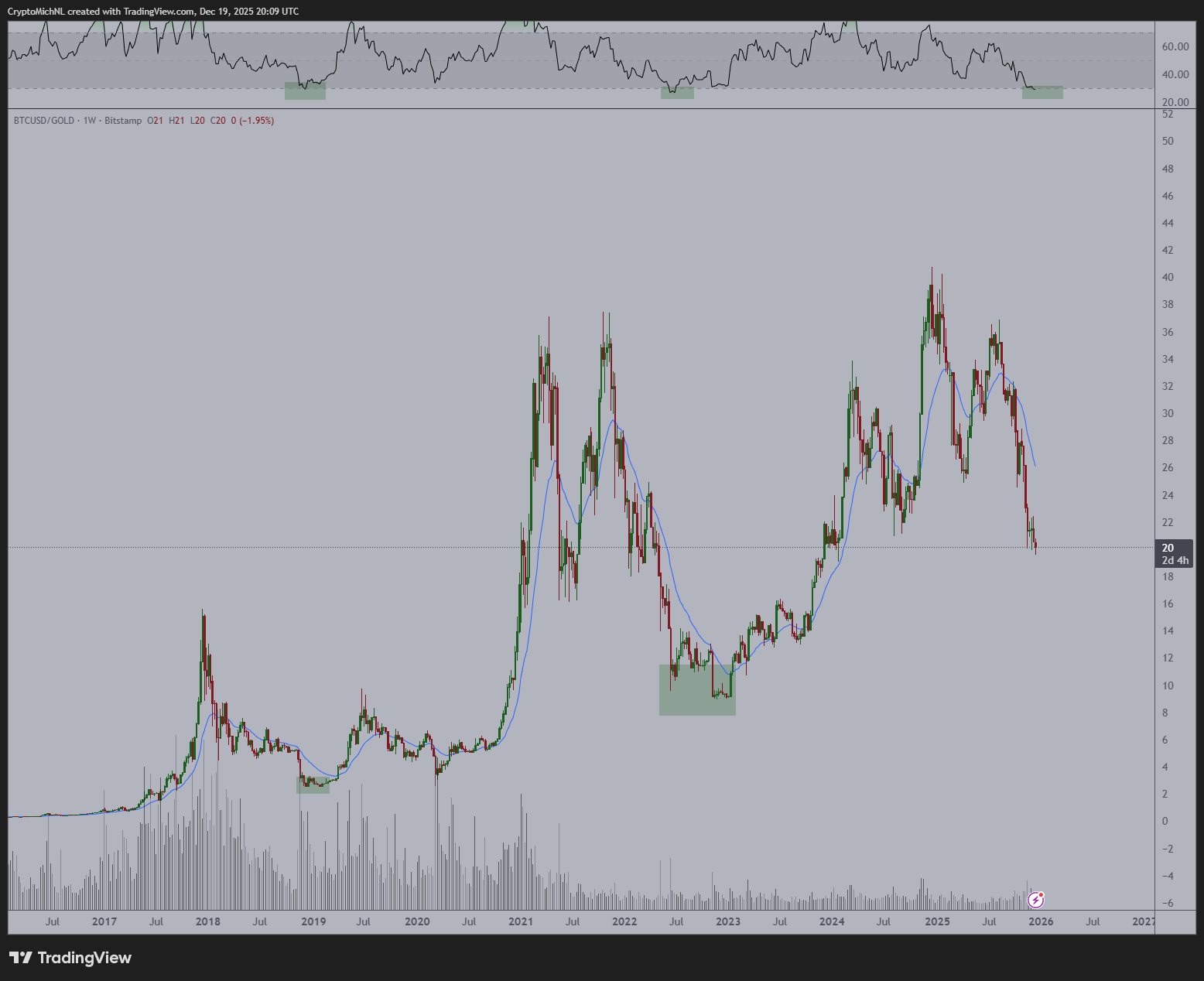
BTC/XAU one-week chart with RSI, volume data. Source: Michaël van de Poppe/X


Historical comparisons show that in each Bitcoin bear cycle, the weekly relative strength index (RSI) dropping into “oversold” territory below 30 marked a long-term bottom for the pair.

“The best part: on the daily timeframe it starts to make a bullish divergence, signalling that there's more upside on the horizon in the short term,” Van de Poppe added.
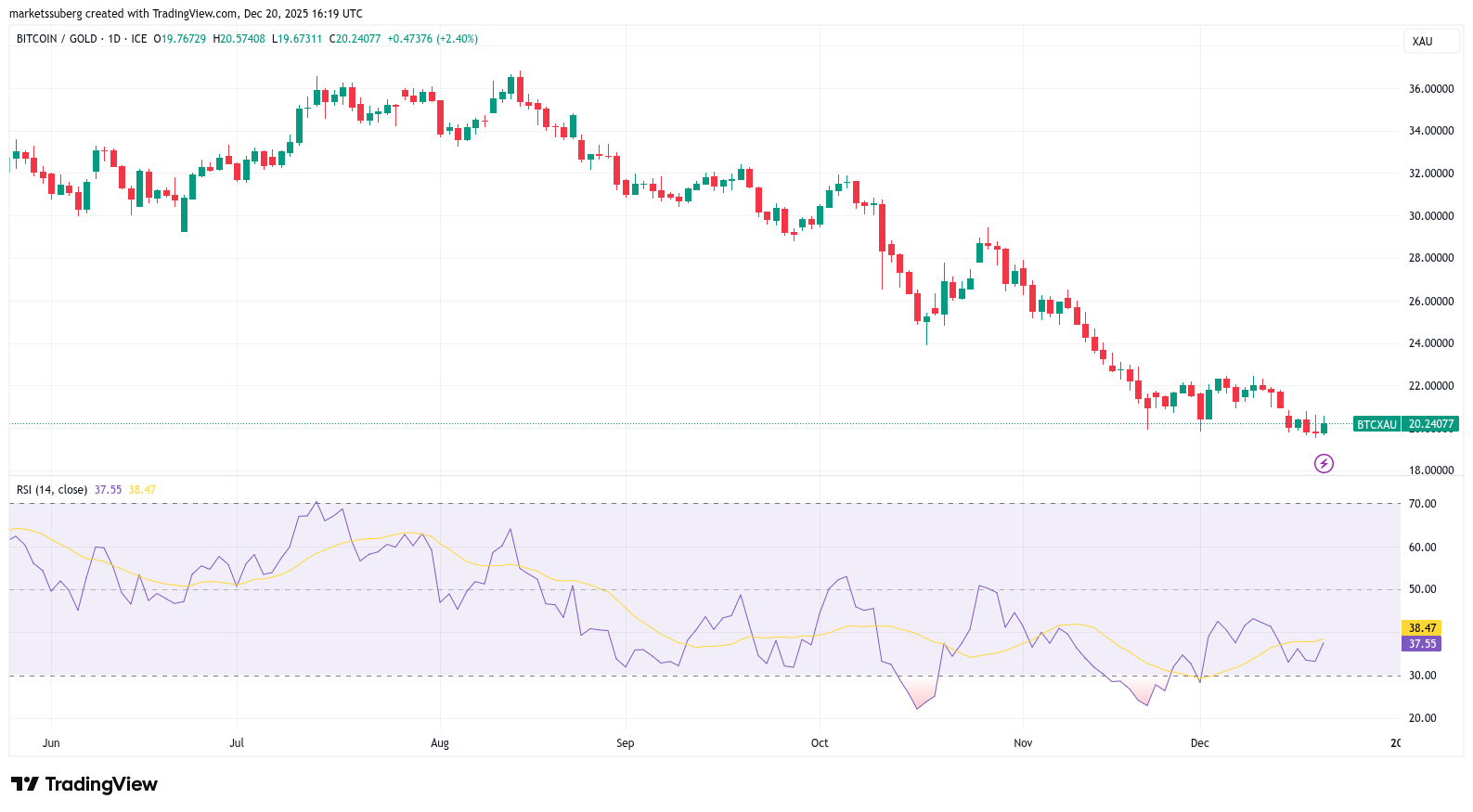
BTC/XAU one-day chart with RSI data. Source: Cointelegraph/TradingView


While the daily RSI begins to move in the opposite direction of the price, the weekly RSI currently sits at 29.5, carving out lows not seen in nearly three years.
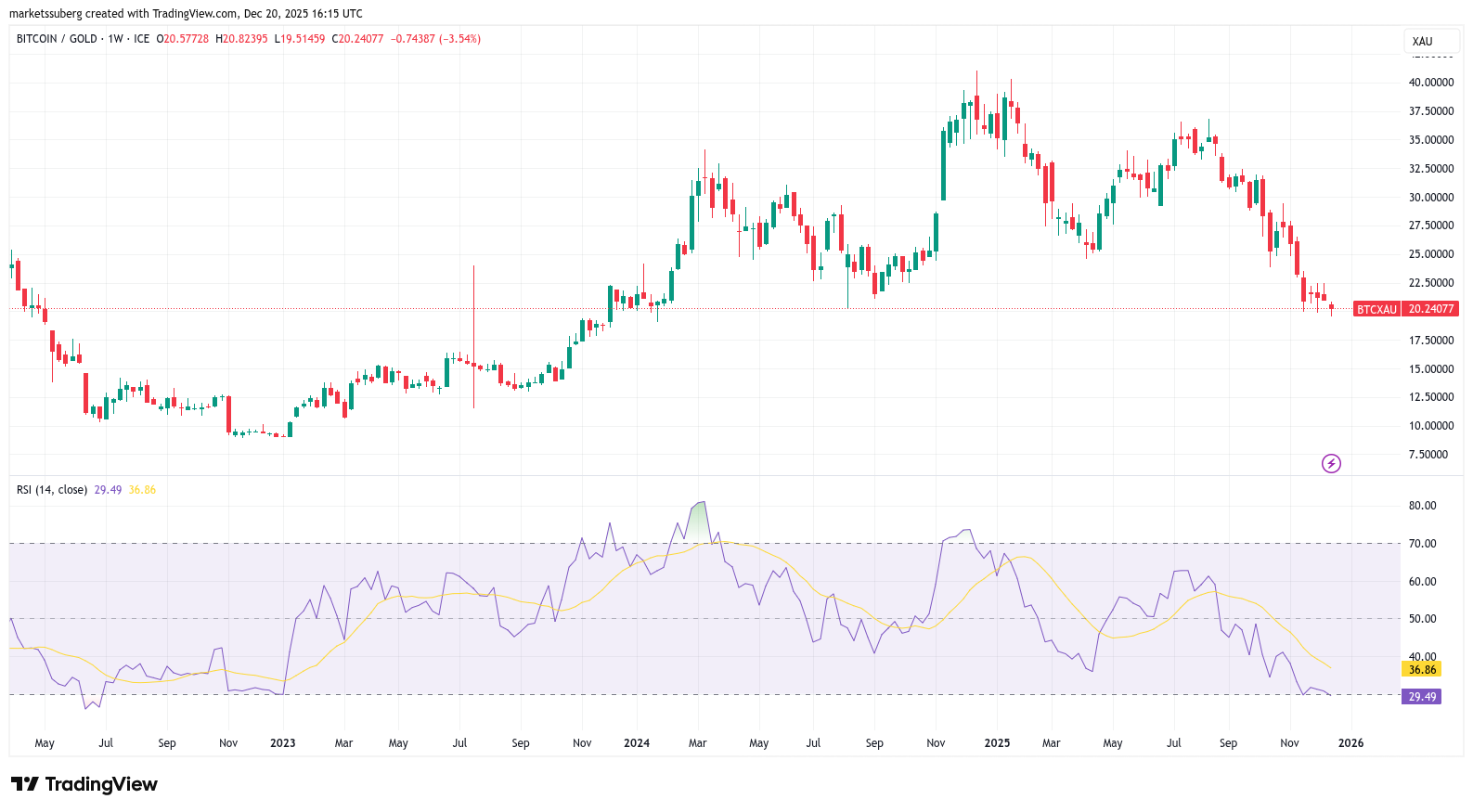
BTC/XAU one-week chart with RSI data. Source: Cointelegraph/TradingView

Support break “likely within the next few weeks”

Continuing on the topic, trading and commentary account Wealthmanager nonetheless reiterated that Bitcoin’s last bear market began thanks to the failure of BTC/XAU to hold the 20-ounce mark.

Related: Bears take over below $90K? 5 things to know in Bitcoin this week

“Bitcoin against Gold is at a crucial support level. The last Bitcoin bear market officially started when we lost this support,” an X post warned.

“I expect we will consolidate here for a while, but a break is likely within the next few weeks.”
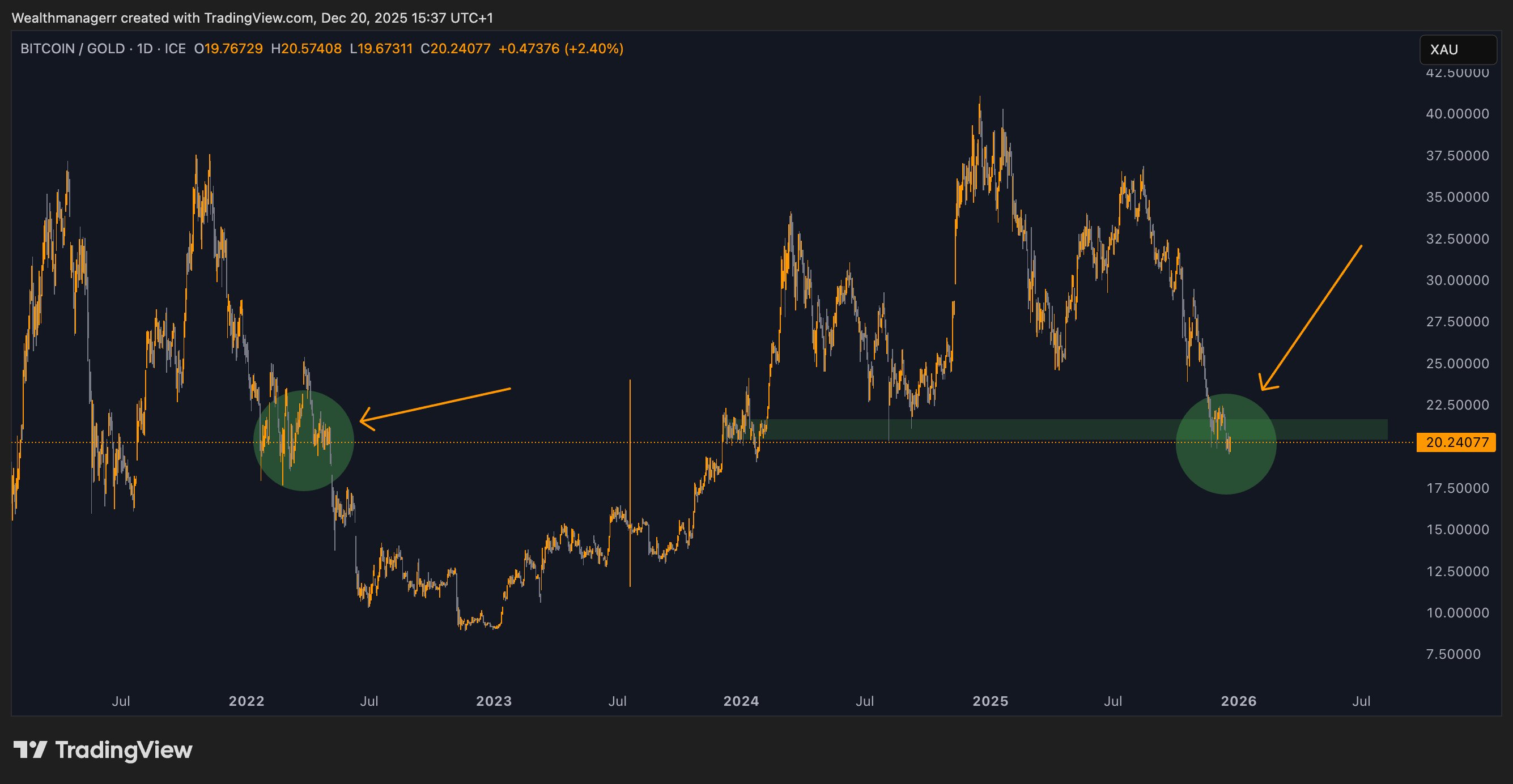
BTC/XAU one-week chart. Source: @Wealthmanager/X


Crypto trader and entrepreneur Ted Pillows, meanwhile, eyed the loss of a long-term uptrend with the latest drop.

This article does not contain investment advice or recommendations. Every investment and trading move involves risk, and readers should conduct their own research when making a decision. While we strive to provide accurate and timely information, Cointelegraph does not guarantee the accuracy, completeness, or reliability of any information in this article. This article may contain forward-looking statements that are subject to risks and uncertainties. Cointelegraph will not be liable for any loss or damage arising from your reliance on this information.




Trending Cryptos

Related Questions

QWhat key level has Bitcoin (BTC) reached against gold (XAU) for the first time since early 2024?

ABitcoin has dropped to 20 ounces of gold for the first time since early 2024.

QAccording to Michaël van de Poppe, which asset is overvalued and which is undervalued at the current BTC/XAU level?

AMichaël van de Poppe believes that gold is getting overvalued, while Bitcoin is getting undervalued.

QWhat does a bullish divergence on the daily RSI for BTC/XAU signal, according to the analyst?

AA bullish divergence on the daily RSI signals that there is more upside on the horizon for Bitcoin in the short term.

QWhat critical event does the trading account Wealthmanager say marked the start of the last Bitcoin bear market?

AWealthmanager stated that the last Bitcoin bear market officially started when BTC/XAU lost the support level of 20 ounces.

QWhat long-term trend has been lost with Bitcoin's latest drop against gold, as noted by Ted Pillows?

ATed Pillows noted that Bitcoin has lost its 3-year uptrend against gold.

Related Reads

Founder of Baixing.com: The Notion That Large Language Models Will Devour Everything, I Believe Half of It

Founder of Baixing.com: I Only Half-Believe the Saying “Large Language Models Will Devour Everything” Author: Wang Jianshuo, Founder of Baixing.com Many proclaim that large models are everything, but the author is skeptical. He argues that such sweeping claims often stem from a limited understanding of the future. Drawing parallels to past technologies like electricity and the internet—which were predicted to “devour everything” but didn’t—he suggests that large language models (LLMs) are better seen as a foundational base. Like electricity, this base is essential for modern development, but its real value emerges only when applied to specific scenarios through various “machines” or “tools” (e.g., Claude Code for programming, Claude Design for design). The author acknowledges that LLMs may indeed replace many existing software systems built on rigid rules, workflows, and forms (e.g., CRMs, SaaS tools), as these are precisely what LLMs excel at processing. However, he emphasizes that beyond software, elements like customer data, execution capabilities (e.g., booking a flight), trust, and physical-world interactions will not be “devoured.” Instead, he foresees that after streamlining existing software, LLMs will open up a larger space for innovative, next-generation applications. These new tools will likely feature fluid interfaces and rely less on fixed rules, unleashing greater creativity. The author cautions against short-sightedness, recalling how in 2004 many believed internet giants like Sina, Sohu, and NetEase would monopolize the market—only to be proven wrong by subsequent disruptions. In conclusion, while LLMs are a crucial foundation and a current focal point, the true mainstream of this wave lies in the diverse applications built atop them to solve concrete problems. The phrase “devour everything” is imprecise; the real opportunity lies in identifying and leveraging the areas where LLMs do bring transformative change.

marsbit32m ago

Founder of Baixing.com: The Notion That Large Language Models Will Devour Everything, I Believe Half of It

marsbit32m ago

Founder of Baixing.com: I Only Half Believe in the Notion that Large Language Models Devour Everything

The founder of Baixing Wang states that while large language models (LLMs) are an extremely important foundational technology—akin to electricity or the internet—he only "half believes" the notion that they will "consume everything." He argues that LLMs provide a base layer of intelligence, but real-world value and transformation come from integrating this intelligence into specific applications and devices designed for particular scenarios—like how electricity powers various appliances from washing machines to TVs. He agrees LLMs will likely consume or replace a significant portion of existing rule-based, workflow-driven software (e.g., many SaaS systems, CRMs), as these are precisely what LLMs excel at handling. However, numerous other elements—such as customer data, execution capabilities (e.g., booking a flight), trust, and physical-world interactions—will not be consumed. Wang emphasizes that after LLMs absorb certain software layers, they will open up a much larger space for innovation: new types of "streaming" software with less rigid interfaces, where fixed rules are managed by AI. This next wave of applications built on top of the stable LLM foundation is where the true mainstream opportunity lies. He cautions against the short-sightedness of declaring any technology as all-consuming, drawing parallels to past premature predictions about internet giants monopolizing the web. The key is to find opportunities within the areas LLMs do transform.

链捕手37m ago

Founder of Baixing.com: I Only Half Believe in the Notion that Large Language Models Devour Everything

链捕手37m ago

Trading

Spot

Hot Articles

What is $BITCOIN

DIGITAL GOLD ($BITCOIN): A Comprehensive Analysis Introduction to DIGITAL GOLD ($BITCOIN) DIGITAL GOLD ($BITCOIN) is a blockchain-based project operating on the Solana network, which aims to combine the characteristics of traditional precious metals with the innovation of decentralized technologies. While it shares a name with Bitcoin, often referred to as “digital gold” due to its perception as a store of value, DIGITAL GOLD is a separate token designed to create a unique ecosystem within the Web3 landscape. Its goal is to position itself as a viable alternative digital asset, although specifics regarding its applications and functionalities are still developing. What is DIGITAL GOLD ($BITCOIN)? DIGITAL GOLD ($BITCOIN) is a cryptocurrency token explicitly designed for use on the Solana blockchain. In contrast to Bitcoin, which provides a widely recognized value storage role, this token appears to focus on broader applications and characteristics. Notable aspects include: Blockchain Infrastructure: The token is built on the Solana blockchain, known for its capacity to handle high-speed and low-cost transactions. Supply Dynamics: DIGITAL GOLD has a maximum supply capped at 100 quadrillion tokens (100P $BITCOIN), although details regarding its circulating supply are currently undisclosed. Utility: While precise functionalities are not explicitly outlined, there are indications that the token could be utilized for various applications, potentially involving decentralized applications (dApps) or asset tokenization strategies. Who is the Creator of DIGITAL GOLD ($BITCOIN)? At present, the identity of the creators and development team behind DIGITAL GOLD ($BITCOIN) remains unknown. This situation is typical among many innovative projects within the blockchain space, particularly those aligning with decentralized finance and meme coin phenomena. While such anonymity may foster a community-driven culture, it intensifies concerns about governance and accountability. Who are the Investors of DIGITAL GOLD ($BITCOIN)? The available information indicates that DIGITAL GOLD ($BITCOIN) does not have any known institutional backers or prominent venture capital investments. The project seems to operate on a peer-to-peer model focused on community support and adoption rather than traditional funding routes. Its activity and liquidity are primarily situated on decentralized exchanges (DEXs), such as PumpSwap, rather than established centralized trading platforms, further highlighting its grassroots approach. How DIGITAL GOLD ($BITCOIN) Works The operational mechanics of DIGITAL GOLD ($BITCOIN) can be elaborated on based on its blockchain design and network attributes: Consensus Mechanism: By leveraging Solana’s unique proof-of-history (PoH) combined with a proof-of-stake (PoS) model, the project ensures efficient transaction validation contributing to the network's high performance. Tokenomics: While specific deflationary mechanisms have not been extensively detailed, the vast maximum token supply implies that it may cater to microtransactions or niche use cases that are still to be defined. Interoperability: There exists the potential for integration with Solana’s broader ecosystem, including various decentralized finance (DeFi) platforms. However, the details regarding specific integrations remain unspecified. Timeline of Key Events Here is a timeline that highlights significant milestones concerning DIGITAL GOLD ($BITCOIN): 2023: The initial deployment of the token occurs on the Solana blockchain, marked by its contract address. 2024: DIGITAL GOLD gains visibility as it becomes available for trading on decentralized exchanges like PumpSwap, allowing users to trade it against SOL. 2025: The project witnesses sporadic trading activity and potential interest in community-led engagements, although no noteworthy partnerships or technical advancements have been documented as of yet. Critical Analysis Strengths Scalability: The underlying Solana infrastructure supports high transaction volumes, which could enhance the utility of $BITCOIN in various transaction scenarios. Accessibility: The potential low trading price per token could attract retail investors, facilitating wider participation due to fractional ownership opportunities. Risks Lack of Transparency: The absence of publicly known backers, developers, or an audit process may yield skepticism regarding the project's sustainability and trustworthiness. Market Volatility: The trading activity is heavily reliant on speculative behavior, which can result in significant price volatility and uncertainty for investors. Conclusion DIGITAL GOLD ($BITCOIN) emerges as an intriguing yet ambiguous project within the rapidly evolving Solana ecosystem. While it attempts to leverage the “digital gold” narrative, its departure from Bitcoin's established role as a store of value underscores the need for a clearer differentiation of its intended utility and governance structure. Future acceptance and adoption will likely depend on addressing the current opacity and defining its operational and economic strategies more explicitly. Note: This report encompasses synthesised information available as of October 2023, and developments may have transpired beyond the research period.

656 Total ViewsPublished 2025.05.13Updated 2025.05.13

What is $BITCOIN

Discussions

Welcome to the HTX Community. Here, you can stay informed about the latest platform developments and gain access to professional market insights. Users' opinions on the price of BTC (BTC) are presented below.

活动图片