Bitcoin Red Team reports 5K findings in sweeping security audit

cointelegraphPublished on 2026-08-06Last updated on 2026-08-06

Abstract

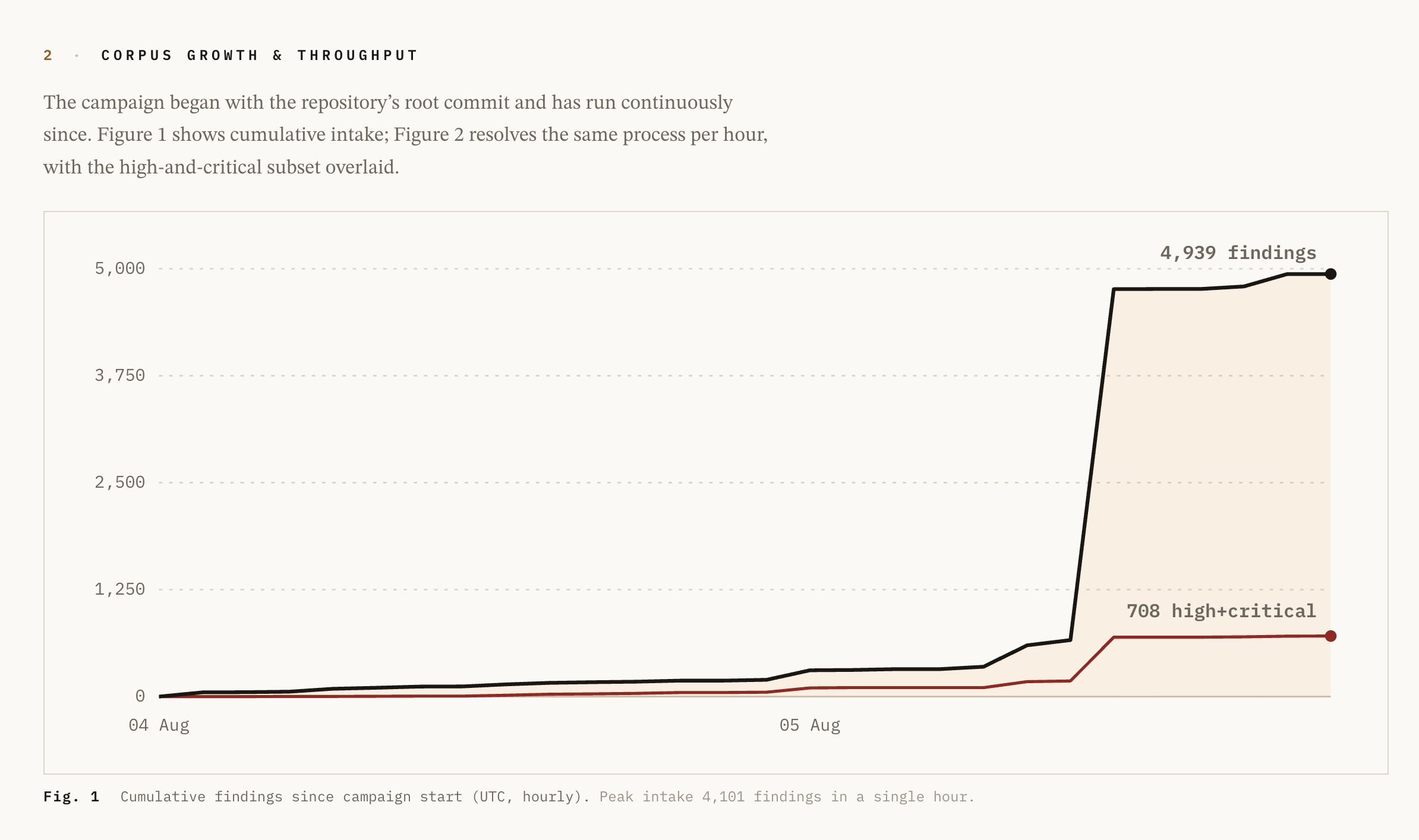
A volunteer Bitcoin security group called Bitcoin Red Team, comprised of 16 members, has reported finding nearly 5,000 potential issues during a rapid, AI-assisted audit of Bitcoin ecosystem projects. According to developer Calle, the team averaged about one critical exploit discovery per hour per person. In the first 29.8 hours of operation, they identified 4,962 potential vulnerabilities across 390 projects, with 720 classified as high- or critical-level issues. The campaign follows a recent hack of the Coldcard hardware wallet that resulted in over $100 million in Bitcoin being stolen.

A Bitcoin security group made up of just 16 volunteers said they have found nearly 5,000 potential issues during a rapid AI-assisted review of projects in the Bitcoin ecosystem.

Bitcoin Red Team is a volunteer security effort that includes Rob Hamilton, CEO of AnchorWatch and Bitcoin developer Calle, among others, which has been using AI tools and human review to scan open-source Bitcoin-related repositories for vulnerabilities.

“We’re averaging on the order of 1 critical exploit per hour per person,” said Calle in a post to X on Wednesday.

Source: Calle

The launch of the Bitcoin security review campaign comes just days after the Coldcard hardware wallet hack, which has seen over $100 million in Bitcoin stolen.

According to Calle, in the first 29.8 hours of its operation, its team has found 4,962 potential issues across 390 projects. As many as 720 of them are considered high- or critical-level issues. So far, 21.4% of findings have been able to be reproduced.

Related: At least 15 attackers exploited Coldcard vulnerability: Galaxy

Trending Cryptos

Related Questions

QWhat is the name of the volunteer security group that found nearly 5,000 potential issues in the Bitcoin ecosystem?

AThe volunteer security group is called Bitcoin Red Team.

QHow many volunteers are part of the Bitcoin Red Team security effort mentioned in the article?

AThe Bitcoin Red Team is made up of 16 volunteers.

QAccording to developer Calle, what is the approximate rate of finding critical exploits per person per hour?

AAccording to Calle, they are averaging on the order of 1 critical exploit per hour per person.

QHow many of the 4,962 potential issues found were considered high- or critical-level?

A720 of the 4,962 potential issues found were considered high- or critical-level.

QWhat recent event is mentioned as the context for the launch of this security review campaign?

AThe launch of the Bitcoin security review campaign comes just days after the Coldcard hardware wallet hack, which saw over $100 million in Bitcoin stolen.

Related Reads

A Precedent for the Prediction Markets: CFTC Aims to Prove Authority Over Polymarket via Criminal Case

A U.S. Army soldier, Gannon Ken Van Dyke, who earned $400,000 using non-public information on the crypto event-prediction platform Polymarket, is contesting the U.S. Commodity Futures Trading Commission's (CFTC) attempt to intervene in his criminal case. The CFTC, which initiated a separate civil suit against Van Dyke but has not pursued it to trial, seeks to submit arguments in the ongoing criminal proceeding. Van Dyke's lawyers filed a motion opposing this, arguing the CFTC is improperly trying to influence the criminal case as an outside expert rather than through its own lawsuit. They contend that event contracts traded on platforms like Polymarket are not swaps and thus fall outside the CFTC's jurisdiction, calling the regulator's tactics a procedural maneuver. Van Dyke faces criminal fraud charges for allegedly trading based on confidential information about potential regime change in Venezuela. His civil case with the CFTC is stayed pending the criminal trial, expected in late 2026 or early 2027. The court's decision on whether to allow the CFTC's intervention could set a precedent for how such event contracts are regulated. An AI analysis notes inconsistency in the CFTC's approach compared to a similar case involving a Google employee, raising questions about the legal strategy for the prediction market industry, which includes platforms like Kalshi. The outcome may define future regulatory standards for the entire market.

cryptonews.ru7m ago

A Precedent for the Prediction Markets: CFTC Aims to Prove Authority Over Polymarket via Criminal Case

cryptonews.ru7m ago

Nvidia's Jensen Huang, Fei-Fei Li, and Bin Lin All Invest in the Same Robotics Company

Generalist, a San Francisco-based AI startup focused on developing a "universal brain" for robots, has rapidly raised significant funding, attracting high-profile investors including Nvidia, Jeff Bezos' Bezos Expeditions, AI pioneer Fei-Fei Li, and Xiaomi co-founder Bin Lin. Founded in 2024 by former Google DeepMind researchers Pete Florence, Andy Zeng, and former Boston Dynamics engineer Andrew Barry, the company has secured approximately $750 million across four rounds, reaching a valuation surpassing $2 billion. The company's core innovation is its GEN-1.5 model, which aims to give robots powerful generalization capabilities. Unlike traditional systems requiring extensive reprogramming for each new task, GEN-1.5 can learn from a single, brief human demonstration (3-12 seconds) without needing retraining or fine-tuning. This "physical prompting" allows a robot to perform tasks like opening jars or using new tools after seeing them done once. While current single-demo success rates average 59% on simple tasks (improving to 83% with minor fine-tuning), the technology promises to drastically reduce robot deployment time from months to seconds. Generalist's strategy is to provide the AI intelligence layer that can run on various robotic hardware, rather than building robots themselves. The founding team combines DeepMind's expertise in AI model generalization with Boston Dynamics' practical robotics experience, targeting the industry bottleneck where robot "brains" lag behind advanced "bodies." Capital sees potential in this approach for creating a versatile, low-margin-cost robotic base applicable across factories, warehouses, and labs. However, GEN-1.5 remains a work in progress. Its capabilities are currently demonstrated on short, simple tasks, and significant challenges remain for reliable, long-term operation in complex, unpredictable real-world environments. Commercial viability also depends on hardware costs, maintenance, and system integration. Nevertheless, Generalist represents a shift toward "generalist" robots that can quickly adapt to new tasks, potentially redefining the robotics landscape and posing future questions about the role of human labor.

marsbit13m ago
Nvidia's Jensen Huang, Fei-Fei Li, and Bin Lin All Invest in the Same Robotics Company

marsbit13m ago

Bitcoin above $81K and altcoin surge. The top crypto news this morning

**Bitcoin Surpasses $81,000 as Altcoins Rally: Key Crypto Market Summary for the Morning** Bitcoin (BTC) traded above $80,500, briefly exceeding $81,300, its highest level since early May. Over the past 24 hours, BTC gained nearly 5%, while Ethereum (ETH) rose 3% to trade above $2,500. The total crypto market capitalization stands above $2.71 trillion. Market sentiment is bullish, with the crypto fear and greed index reaching 74 points, indicating "greed" and the highest reading since late last year. Among the top 100 cryptocurrencies, Aerodrome Finance (AERO) posted the largest gain (+18%), while Aave (AAVE) saw the biggest drop (-8%). Bitcoin ETFs recorded a net inflow of over $337 million on August 24, and Ethereum ETFs saw nearly $115 million in inflows. Analysts have turned positive, with some calling the current cycle potentially the "strongest in history." Corporate buying also continued, with mining company Lonic Digital and fintech firm Strive adding to their BTC reserves. Interest has shifted to altcoins and more speculative segments. Memecoins like CASHCAT, Dogecoin (DOGE), and Shiba Inu (SHIB) showed strong gains. Institutional interest in alts is evident, with Bitwise reporting record trading volumes for its Solana ETF. Data from Glassnode shows 85% of non-Bitcoin perpetual futures now have positive funding rates, a level last seen during previous market peaks.

cryptonews.ru17m ago

Bitcoin above $81K and altcoin surge. The top crypto news this morning

cryptonews.ru17m ago

Trading

Spot

Hot Articles

What is $BITCOIN

DIGITAL GOLD ($BITCOIN): A Comprehensive Analysis Introduction to DIGITAL GOLD ($BITCOIN) DIGITAL GOLD ($BITCOIN) is a blockchain-based project operating on the Solana network, which aims to combine the characteristics of traditional precious metals with the innovation of decentralized technologies. While it shares a name with Bitcoin, often referred to as “digital gold” due to its perception as a store of value, DIGITAL GOLD is a separate token designed to create a unique ecosystem within the Web3 landscape. Its goal is to position itself as a viable alternative digital asset, although specifics regarding its applications and functionalities are still developing. What is DIGITAL GOLD ($BITCOIN)? DIGITAL GOLD ($BITCOIN) is a cryptocurrency token explicitly designed for use on the Solana blockchain. In contrast to Bitcoin, which provides a widely recognized value storage role, this token appears to focus on broader applications and characteristics. Notable aspects include: Blockchain Infrastructure: The token is built on the Solana blockchain, known for its capacity to handle high-speed and low-cost transactions. Supply Dynamics: DIGITAL GOLD has a maximum supply capped at 100 quadrillion tokens (100P $BITCOIN), although details regarding its circulating supply are currently undisclosed. Utility: While precise functionalities are not explicitly outlined, there are indications that the token could be utilized for various applications, potentially involving decentralized applications (dApps) or asset tokenization strategies. Who is the Creator of DIGITAL GOLD ($BITCOIN)? At present, the identity of the creators and development team behind DIGITAL GOLD ($BITCOIN) remains unknown. This situation is typical among many innovative projects within the blockchain space, particularly those aligning with decentralized finance and meme coin phenomena. While such anonymity may foster a community-driven culture, it intensifies concerns about governance and accountability. Who are the Investors of DIGITAL GOLD ($BITCOIN)? The available information indicates that DIGITAL GOLD ($BITCOIN) does not have any known institutional backers or prominent venture capital investments. The project seems to operate on a peer-to-peer model focused on community support and adoption rather than traditional funding routes. Its activity and liquidity are primarily situated on decentralized exchanges (DEXs), such as PumpSwap, rather than established centralized trading platforms, further highlighting its grassroots approach. How DIGITAL GOLD ($BITCOIN) Works The operational mechanics of DIGITAL GOLD ($BITCOIN) can be elaborated on based on its blockchain design and network attributes: Consensus Mechanism: By leveraging Solana’s unique proof-of-history (PoH) combined with a proof-of-stake (PoS) model, the project ensures efficient transaction validation contributing to the network's high performance. Tokenomics: While specific deflationary mechanisms have not been extensively detailed, the vast maximum token supply implies that it may cater to microtransactions or niche use cases that are still to be defined. Interoperability: There exists the potential for integration with Solana’s broader ecosystem, including various decentralized finance (DeFi) platforms. However, the details regarding specific integrations remain unspecified. Timeline of Key Events Here is a timeline that highlights significant milestones concerning DIGITAL GOLD ($BITCOIN): 2023: The initial deployment of the token occurs on the Solana blockchain, marked by its contract address. 2024: DIGITAL GOLD gains visibility as it becomes available for trading on decentralized exchanges like PumpSwap, allowing users to trade it against SOL. 2025: The project witnesses sporadic trading activity and potential interest in community-led engagements, although no noteworthy partnerships or technical advancements have been documented as of yet. Critical Analysis Strengths Scalability: The underlying Solana infrastructure supports high transaction volumes, which could enhance the utility of $BITCOIN in various transaction scenarios. Accessibility: The potential low trading price per token could attract retail investors, facilitating wider participation due to fractional ownership opportunities. Risks Lack of Transparency: The absence of publicly known backers, developers, or an audit process may yield skepticism regarding the project's sustainability and trustworthiness. Market Volatility: The trading activity is heavily reliant on speculative behavior, which can result in significant price volatility and uncertainty for investors. Conclusion DIGITAL GOLD ($BITCOIN) emerges as an intriguing yet ambiguous project within the rapidly evolving Solana ecosystem. While it attempts to leverage the “digital gold” narrative, its departure from Bitcoin's established role as a store of value underscores the need for a clearer differentiation of its intended utility and governance structure. Future acceptance and adoption will likely depend on addressing the current opacity and defining its operational and economic strategies more explicitly. Note: This report encompasses synthesised information available as of October 2023, and developments may have transpired beyond the research period.

2.1k Total ViewsPublished 2025.05.13Updated 2025.05.13

What is $BITCOIN

Discussions

Welcome to the HTX Community. Here, you can stay informed about the latest platform developments and gain access to professional market insights. Users' opinions on the price of BTC (BTC) are presented below.

活动图片