Bitcoin Red Team, BPI, and Over 40 Companies Join Forces to Close the AI Security Gap

cryptonews.ruPublished on 2026-08-14Last updated on 2026-08-14

Abstract

More than 40 cryptocurrency companies, coordinated by the Bitcoin Policy Institute (BPI), are urging leading AI labs like OpenAI and Anthropic to grant trusted security researchers access to their most advanced AI models, which hackers already possess. This request aims to protect the over $1 trillion in assets secured by open-source financial software. The letter argues that while criminals exploit these powerful models for attacks, legitimate defenders are often restricted to weaker, open-source alternatives, creating a dangerous security gap. The signatories, including major firms like Block, Coinbase, and Galaxy, propose establishing verified access programs for qualified security experts to level the playing field. The call is driven by reports of sophisticated attackers, potentially including foreign adversaries, using advanced AI to target Bitcoin infrastructure. Data from firms like SlowMist shows a significant rise in blockchain security incidents in early 2026 (182 vs. 121 in early 2025), though total losses decreased sharply to about $956 million from $2.37 billion. This trend suggests attackers are launching more frequent, lower-impact attacks. The situation is further complicated by the U.S.-China AI race, as powerful Chinese models become more widely available. The core question remains whether granting defenders equal access to cutting-edge AI will help mitigate threats or simply accelerate a cybersecurity arms race.

More than forty cryptocurrency companies are urging leading artificial intelligence labs to allow approved Bitcoin security experts to use advanced models that are already in the hands of hackers. This request is coordinated by the Bitcoin Policy Institute (BPI) and explains that access to technologies, including from OpenAI and Anthropic, is essential to protect software that safeguards assets worth over $1 trillion.

At the core of this premise lies a risky assumption that remains unclear. If both criminals and researchers have access to the same technology, what does this mean for Bitcoin's security? The letter from BPI acknowledges that the technology is dual-use, as models that allow a programmer to search for issues in a large system also enable a malicious actor to do the same.

The Gap This Letter Seeks to Close

According to BPI, it is unclear who will be left with weaker tools. The letter states that when advanced systems ignore security requests or block certain key functions with programs that bypass the use of any open financial architecture, developers are forced to resort to weaker open-source models. Malicious actors are not subject to such restrictions.

The letter does not call for labs to remove security measures for everyone. Rather, the signatories would like to see "ongoing trusted access programs for qualified defenders of open-source financial infrastructure," where researchers undergo an evaluation process before gaining access to things forbidden to the public. The idea is that this would give Bitcoin developers a new status, similar to that of security specialists tackling complex cybercrime.

Sophisticated Malicious Actors Use Advanced AI to Conduct Attacks

BPI reported receiving various reports from open-source software developers indicating the presence of sophisticated malicious actors using advanced AI to conduct attacks, with some of these actors possibly being foreign adversaries. As previously reported by Cryptopolitan, attacks on Bitcoin infrastructure are a constant threat, not a one-off event.

Those responsible for defense speak of an uneven fight. A Bitcoin core developer wrote on X (formerly Twitter) on August 13th that the work led to some discoveries, adding that this represents a "massive collision of decades of human open-source development with two weeks of Kimi K3's work." Kimi is developed by the Chinese AI lab Moonshot, making the connection even more striking: the same class of models being tested for defense is also at the center of the broader U.S.-China AI race.

Here is Where the U.S.-China Front Comes Into Play

The availability question is tied to growing competition. Chinese models "now lag behind U.S. ones by months, not years," said CSIS analyst Yasi Atalan in July, citing a government study showing that DeepSeek V4-Pro—the best Chinese open-source model—lags about eight months behind U.S. leaders.

Data published in the 2026 Stanford AI Index shows that by 2025, the U.S. developed 59 important models, while China developed 35, but leads the world in research volume and patents.

This matters for Bitcoin, as a defensive advantage based on restricted U.S. models weakens as strong competitors with broad capabilities spread. There are precedents of real bugs found with AI: the Ethereum Foundation used coordinated AI agents in a study to identify genuine vulnerabilities, including one in libp2p later identified as CVE-2026-34219.

Whether this capability will be more on the side of defenders or attackers remains an open question that cannot be resolved on its own. SlowMist recorded 182 blockchain security incidents in the first half of 2026, with estimated losses of approximately $956 million, and warned that AI is lowering the barrier for automated attacks and social engineering.

TRM Labs provides another useful comparison: a total of 207 security incidents with losses of $972 million were recorded in the first half of 2026. This can be a great addition to the methodology, illustrating how different security companies count incidents, and while their conclusions differ, both companies show the same trend: high frequency/low loss.

I gained a ton of new knowledge about bitcoin 🟥 that I'd like to share without making vague posts. But here's what I learned, anon:

– We are experiencing a massive collision of decades of human open-source development and two weeks of Kimi K3's work (this is not good)
– everything...

— calle 🟥 (@callebtc) August 13, 2026

Why Are Arms Race Concerns Not Hypothetical?

SlowMist's data validates the request. In the first half of 2026, there were 182 incidents with losses of about $956 million, compared to 121 incidents with losses of $2.373 billion in the same period of 2025.
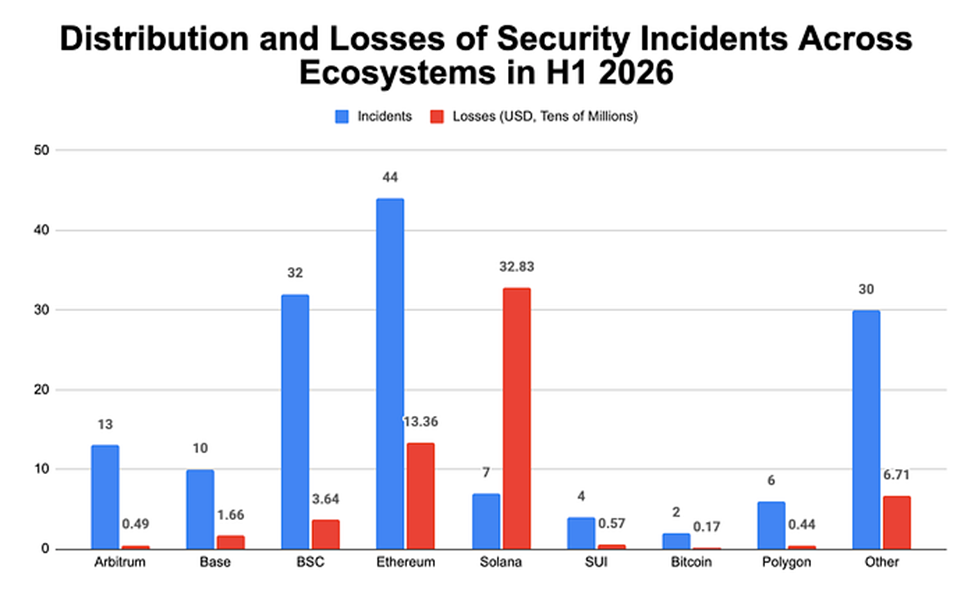
Crypto losses due to blockchain vulnerabilities | Source: Slowmist

SlowMist's data is well-supported by sources: 182 incidents with about $956 million in losses in H1 2026, compared to 121 incidents with $2.373 billion in H1 2025.
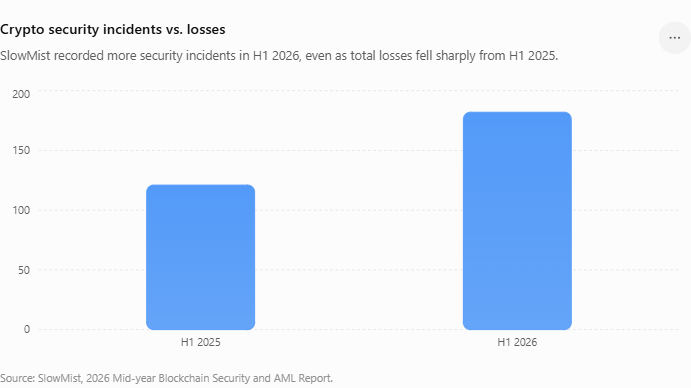
Crypto security incidents increased while losses decreased | Source: Slowmist

SlowMist recorded an increase in the number of incidents despite a sharp drop in total losses compared to H1 2025. The flip side is loss concentration: $2.373 billion in H1 2025 shrunk to about $956 million in H1 2026, despite a 50% increase in the number of incidents.
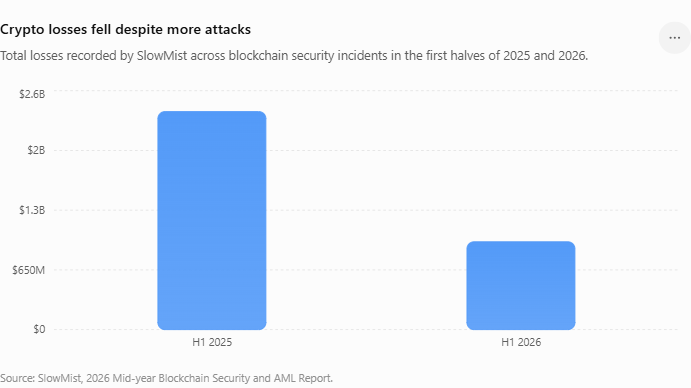
Total losses recorded by SlowMist from blockchain security incidents in H1 2025 and H1 2026.

According to SlowMist data, 182 security incidents cost the crypto industry approximately $956 million in the first half of 2026. The number of incidents increased from 121 the year before, despite a sharp decline in losses. The next question facing the industry is whether incorporating advanced AI into defense systems can accelerate this trend—reducing the severity of attacks even if AI makes attacks faster and more numerous. Beyond this chilling point, here is another prophetic thought:

"Sometimes the old must be burned for the new to grow on healthy soil" – Calle

Trending Cryptos

Related Questions

QWhat is the core demand being made by over forty crypto companies and coordinated by the Bitcoin Policy Institute (BPI)?

AThey are calling on leading AI labs (like OpenAI and Anthropic) to grant trusted, vetted Bitcoin security experts access to the advanced AI models that are already in the hands of hackers. They want to establish a program for qualified defenders to use these models to proactively find and fix vulnerabilities, rather than being limited to weaker, open-source alternatives.

QWhy do the signatories of the letter argue that they need access to the same advanced AI tools as potential attackers?

ABecause attackers (including sophisticated and potentially state-sponsored ones) are already using these advanced AI models to discover and exploit vulnerabilities in open-source financial infrastructure like Bitcoin. The defenders argue they are at a disadvantage, forced to use weaker tools while adversaries face no such restrictions, creating a security gap.

QAccording to the article, what trend in blockchain security incidents is highlighted by SlowMist's data for H1 2026 compared to H1 2025?

AThe data shows a trend of 'high frequency/low losses.' In H1 2026, there were 182 security incidents (up from 121 in H1 2025) but total losses were approximately $956 million (sharply down from $2.373 billion in H1 2025). This indicates more frequent but individually less costly attacks.

QHow is the US-China AI race context relevant to the security concerns raised in the letter from BPI?

AThe article suggests that if powerful AI models are restricted to US-based labs for security reasons, this defensive advantage erodes as strong, widely available competitors from countries like China (e.g., Moonshot's Kimi) proliferate. This means potential attackers can access advanced capabilities, making it harder for defenders to rely on a technological edge from limited US models.

QWhat specific example does the article give of AI being successfully used to find a real software vulnerability?

AThe Ethereum Foundation used coordinated AI agents in research that successfully identified a genuine vulnerability in libp2p, which was later assigned the identifier CVE-2026-34219. This demonstrates the practical potential of AI for defensive security research.

Related Reads

Trading

Spot

Hot Articles

What is $BITCOIN

DIGITAL GOLD ($BITCOIN): A Comprehensive Analysis Introduction to DIGITAL GOLD ($BITCOIN) DIGITAL GOLD ($BITCOIN) is a blockchain-based project operating on the Solana network, which aims to combine the characteristics of traditional precious metals with the innovation of decentralized technologies. While it shares a name with Bitcoin, often referred to as “digital gold” due to its perception as a store of value, DIGITAL GOLD is a separate token designed to create a unique ecosystem within the Web3 landscape. Its goal is to position itself as a viable alternative digital asset, although specifics regarding its applications and functionalities are still developing. What is DIGITAL GOLD ($BITCOIN)? DIGITAL GOLD ($BITCOIN) is a cryptocurrency token explicitly designed for use on the Solana blockchain. In contrast to Bitcoin, which provides a widely recognized value storage role, this token appears to focus on broader applications and characteristics. Notable aspects include: Blockchain Infrastructure: The token is built on the Solana blockchain, known for its capacity to handle high-speed and low-cost transactions. Supply Dynamics: DIGITAL GOLD has a maximum supply capped at 100 quadrillion tokens (100P $BITCOIN), although details regarding its circulating supply are currently undisclosed. Utility: While precise functionalities are not explicitly outlined, there are indications that the token could be utilized for various applications, potentially involving decentralized applications (dApps) or asset tokenization strategies. Who is the Creator of DIGITAL GOLD ($BITCOIN)? At present, the identity of the creators and development team behind DIGITAL GOLD ($BITCOIN) remains unknown. This situation is typical among many innovative projects within the blockchain space, particularly those aligning with decentralized finance and meme coin phenomena. While such anonymity may foster a community-driven culture, it intensifies concerns about governance and accountability. Who are the Investors of DIGITAL GOLD ($BITCOIN)? The available information indicates that DIGITAL GOLD ($BITCOIN) does not have any known institutional backers or prominent venture capital investments. The project seems to operate on a peer-to-peer model focused on community support and adoption rather than traditional funding routes. Its activity and liquidity are primarily situated on decentralized exchanges (DEXs), such as PumpSwap, rather than established centralized trading platforms, further highlighting its grassroots approach. How DIGITAL GOLD ($BITCOIN) Works The operational mechanics of DIGITAL GOLD ($BITCOIN) can be elaborated on based on its blockchain design and network attributes: Consensus Mechanism: By leveraging Solana’s unique proof-of-history (PoH) combined with a proof-of-stake (PoS) model, the project ensures efficient transaction validation contributing to the network's high performance. Tokenomics: While specific deflationary mechanisms have not been extensively detailed, the vast maximum token supply implies that it may cater to microtransactions or niche use cases that are still to be defined. Interoperability: There exists the potential for integration with Solana’s broader ecosystem, including various decentralized finance (DeFi) platforms. However, the details regarding specific integrations remain unspecified. Timeline of Key Events Here is a timeline that highlights significant milestones concerning DIGITAL GOLD ($BITCOIN): 2023: The initial deployment of the token occurs on the Solana blockchain, marked by its contract address. 2024: DIGITAL GOLD gains visibility as it becomes available for trading on decentralized exchanges like PumpSwap, allowing users to trade it against SOL. 2025: The project witnesses sporadic trading activity and potential interest in community-led engagements, although no noteworthy partnerships or technical advancements have been documented as of yet. Critical Analysis Strengths Scalability: The underlying Solana infrastructure supports high transaction volumes, which could enhance the utility of $BITCOIN in various transaction scenarios. Accessibility: The potential low trading price per token could attract retail investors, facilitating wider participation due to fractional ownership opportunities. Risks Lack of Transparency: The absence of publicly known backers, developers, or an audit process may yield skepticism regarding the project's sustainability and trustworthiness. Market Volatility: The trading activity is heavily reliant on speculative behavior, which can result in significant price volatility and uncertainty for investors. Conclusion DIGITAL GOLD ($BITCOIN) emerges as an intriguing yet ambiguous project within the rapidly evolving Solana ecosystem. While it attempts to leverage the “digital gold” narrative, its departure from Bitcoin's established role as a store of value underscores the need for a clearer differentiation of its intended utility and governance structure. Future acceptance and adoption will likely depend on addressing the current opacity and defining its operational and economic strategies more explicitly. Note: This report encompasses synthesised information available as of October 2023, and developments may have transpired beyond the research period.

1.9k Total ViewsPublished 2025.05.13Updated 2025.05.13

What is $BITCOIN

Discussions

Welcome to the HTX Community. Here, you can stay informed about the latest platform developments and gain access to professional market insights. Users' opinions on the price of BTC (BTC) are presented below.

活动图片