Bitcoin ’rallies are for selling‘: Top 3 arguments from BTC market bears

cointelegraphPublished on 2025-12-08Last updated on 2025-12-08

Abstract

Bitcoin (BTC) recently rebounded 14.50% from lows near $80,600, approaching $93,000, but bearish analysts argue this is a bull trap rather than a true recovery. Key bear arguments include a "bear flag" pattern suggesting a potential 16% drop to around $77,100, a fractal comparison to Bitcoin’s 2021 cycle that could lead to a crash toward $40,000 by early 2026, and a record spike in Google searches for "Bitcoin bear market"—a trend historically associated with major selloffs. Analysts caution that any rally toward $97,000 may be a deceptive bounce before a deeper decline, advising that rallies are for selling.

Bitcoin (BTC) climbed 14.50% from its recent lows at $80,600, inching back toward $93,000 as traders are at odds between a “comeback” by the bulls or the start of a bear market.

Key takeaways:

  • Analysts say Bitcoin’s rebound is a bull trap, with risks extending to as low as $40,000.

  • Google Trends suggests a rally toward $97,000 before the correction continues.
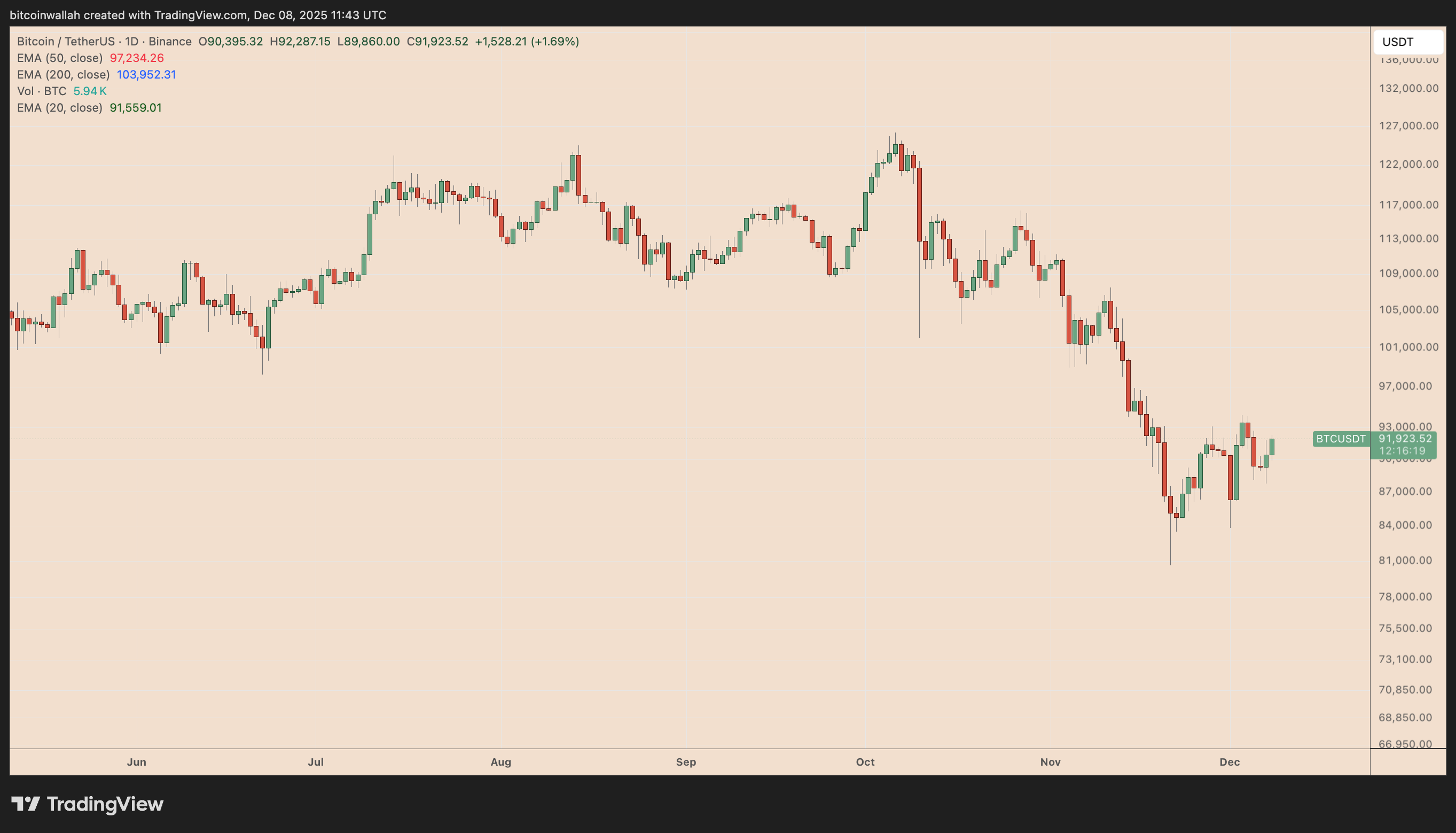
BTC/USD daily chart. Source: TradingView

Among those leaning bearish is CryptoBirb, who remained unconvinced, arguing that the current and upcoming Bitcoin price “rallies are for selling,” not signals of a renewed push toward widely cited year-end targets of $150,000 and beyond.

Bear flag hints at a 16% BTC price dip next

The top arguments in favor of a Bitcoin bull trap mentioned a classic technical pattern dubbed the “bear flag,” a structure that, during downtrends, typically resolves with another leg lower.

Mister Crypto, Celeb Franzen, and several other analysts highlighted the bearish continuation pattern during Bitcoin’s recovery, with some noting that the BTC price can easily plunge toward $80,000.
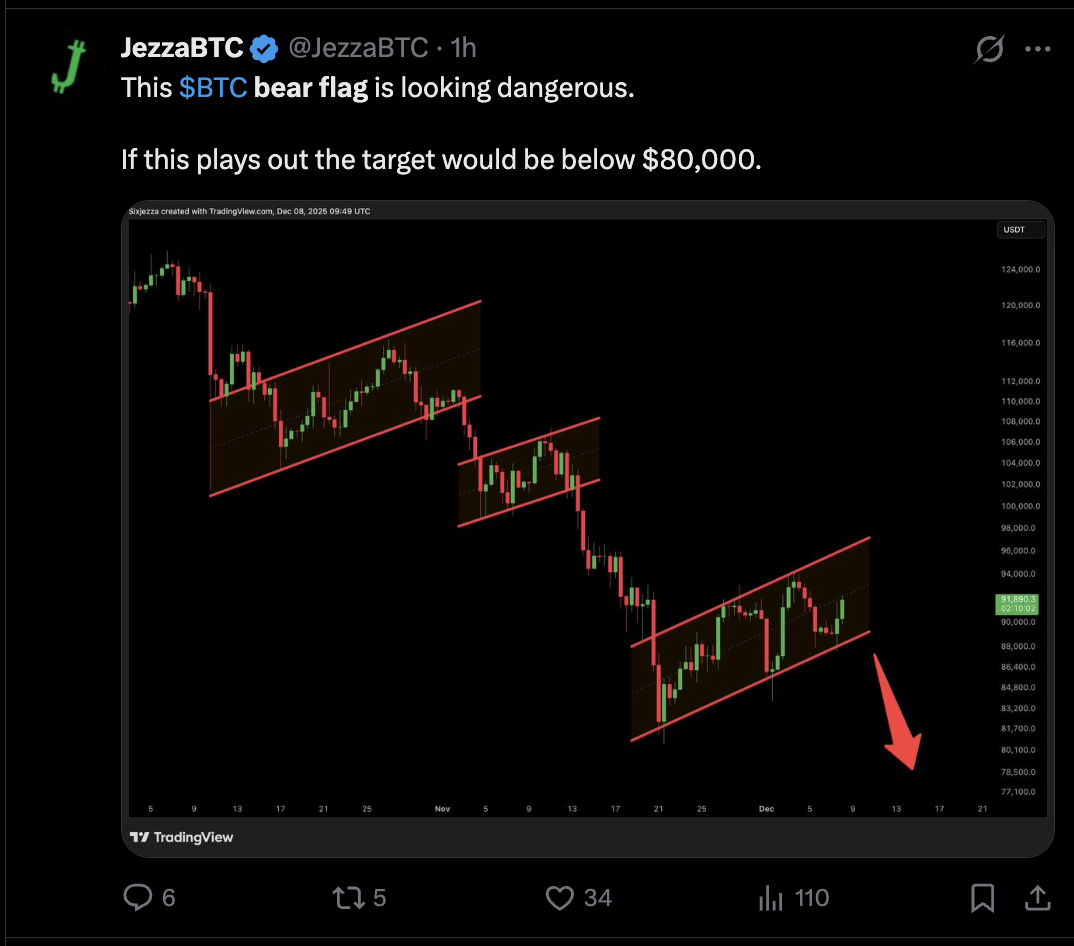
Source: X

A further examination of the bear flag revealed its technical downside target for December to be around $77,100, calculated by adding the previous downtrend’s height to a potential breakdown point near the $88,000 support.
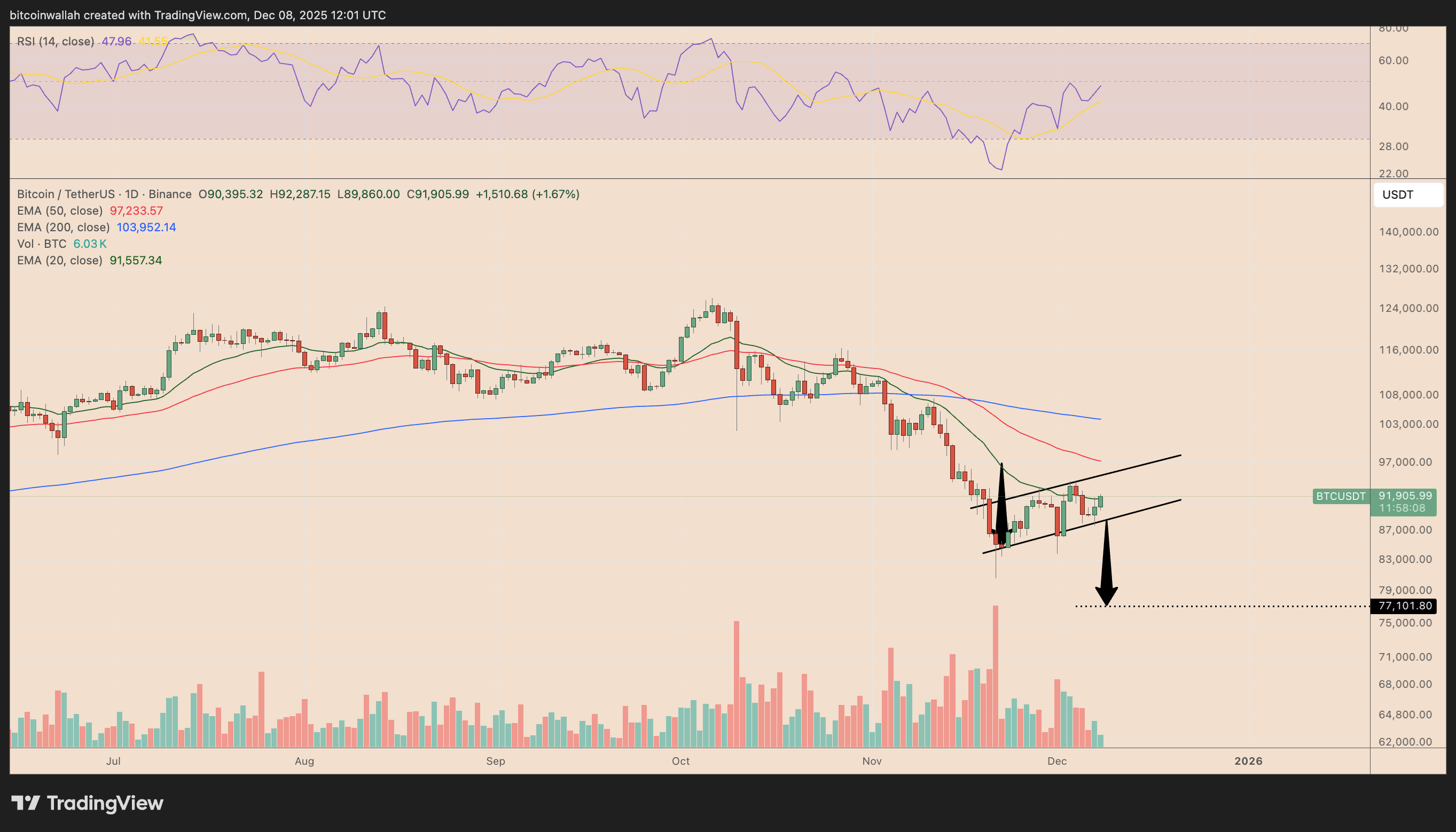
BTC/USDT daily chart. Source: TradingView

That is down about 16% from the current price levels.

Bitcoin can crash to $40,000 if 2021 fractal repeats

Bitcoin’s current structure mirrors the 2021 cycle almost “exactly,” according to analyst Leshka.

He shared a BTC fractal that consisted of a repeating double-top formation, a sharp breakdown into cycle support, and a deceptive rebound that ultimately formed a bull trap before a more resounding crash.
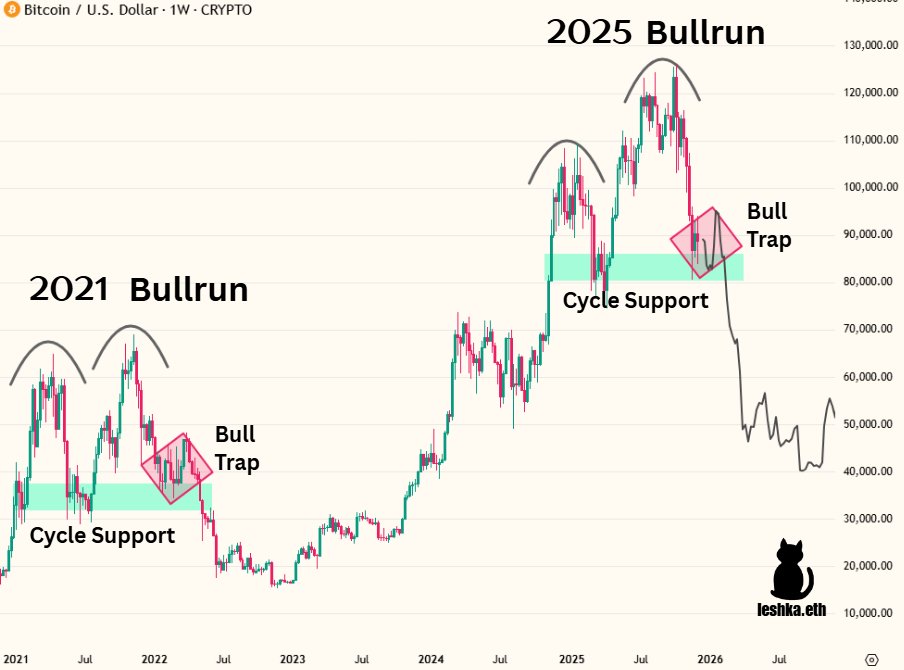
BTC/USD weekly chart. Source: TradingView/Leshka

In the 2021 analogue, that trap preceded a prolonged decline that cut BTC’s value in half. The 2025 fractal showed a nearly identical setup, with the price hovering within the same support band before an expected breakdown.

Related: 5 market patterns that repeat every December

Leshka warned Bitcoin could revisit the $40,000 region in early 2026, a drop of more than 50% from current levels, if the pattern repeats.

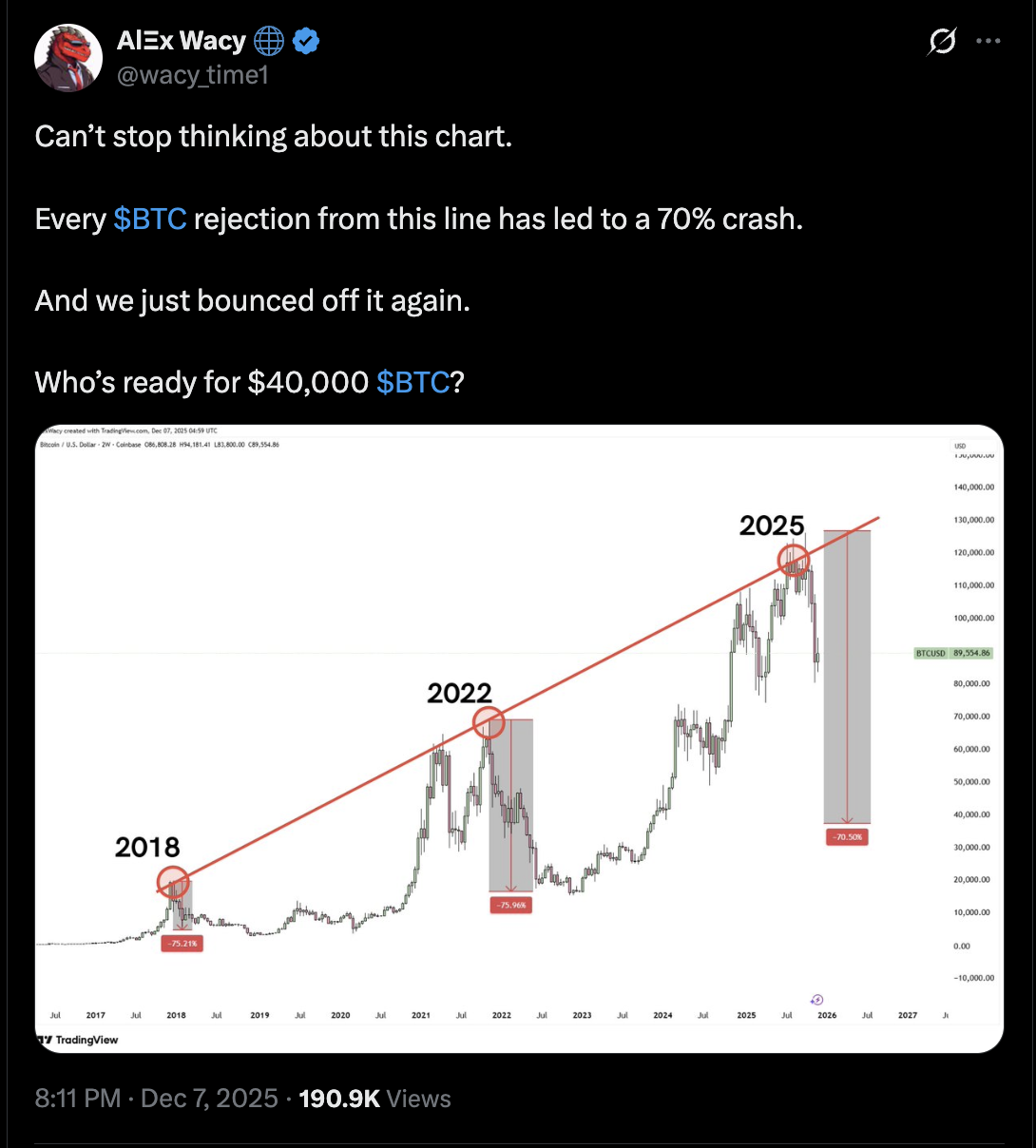
Analyst Alex Wacy highlighted the same downside target, citing Bitcoin’s retreat from its multiyear ascending trendline resistance, which typically results in 70% drawdowns.
Source: X

Bitcoin “crowd is terrified again,” per Google Trends

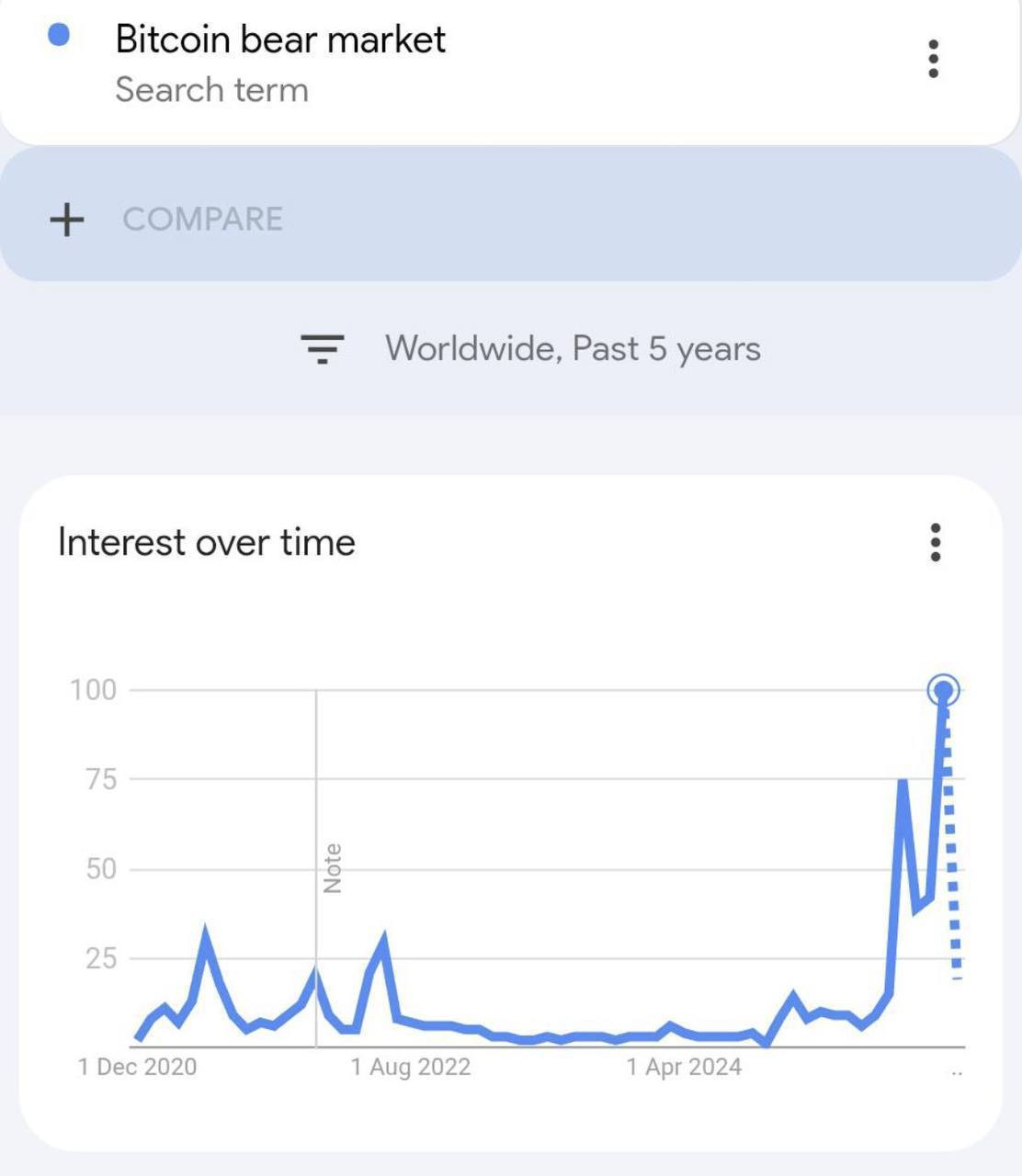
Last week, Google searches for “Bitcoin bear market” on a five-year time frame hit their highest level on record, as highlighted by analyst AndrewBTC in his Monday post on X, who said the BTC “crowd is terrified again.”
Source: Google Trends/AndrewBTC

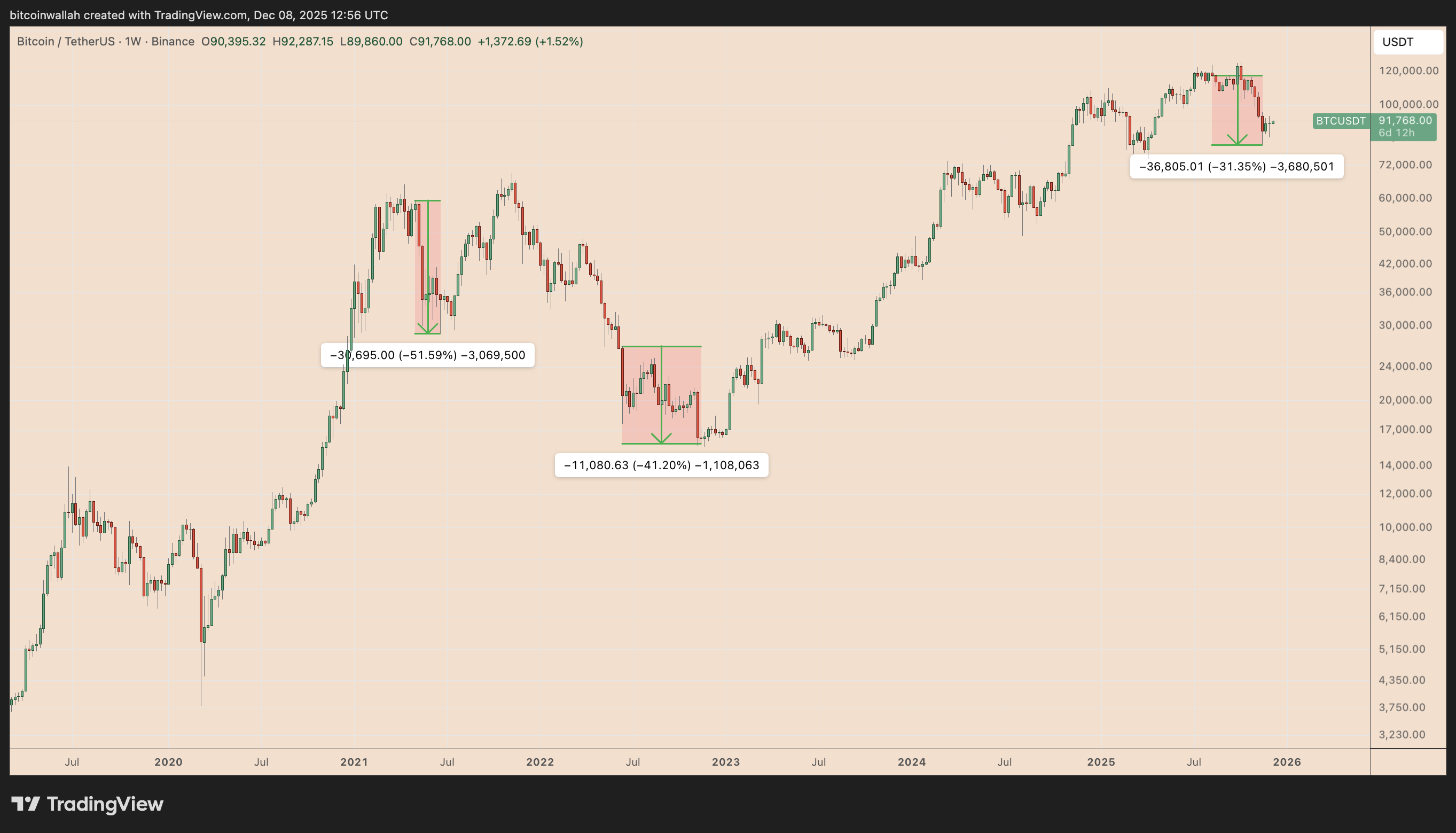
Historically, these fears appeared just ahead of BTC market selloffs.

For instance, in May 2021, when BTC hovered near $60,000 before a 50%-plus correction, and again in June 2022, around $26,000, as Bitcoin slid toward the then-cycle bottom of around $15,450.
BTC/USDT weekly chart. Source: TradingView

A spike in the “Bitcoin bear market” Google search trend in August also followed a downturn in the BTC price.

Bitcoin could easily rally toward the $97,000 zone next, but only to trap bulls, AndrewBTC warned, adding:

“Everyone will think the bull run is back, but it isn’t and bear market starts.”

This article does not contain investment advice or recommendations. Every investment and trading move involves risk, and readers should conduct their own research when making a decision.


Related Reads

Xiaohongshu's Second Great Voyage, This Time Sailing Towards AI

Xiaohongshu's Second Voyage: Navigating Towards AI Since ChatGPT's emergence, Xiaohongshu's founder Mao Wenchao has been acutely aware of AI's potential threat, recognizing that the life advice people seek from chatbots overlaps directly with his platform's core business. Founded in 2013 as a PDF shopping guide for Chinese tourists, Xiaohongshu evolved into a massive community where millions share authentic, personal experiences—from product reviews to travel tips. This vast repository of "I've tried this" human judgment became its most valuable asset. However, the rise of AI, which delivers instant answers, challenges the very need for users to sift through numerous personal notes. Fearing its treasure trove of lived experience could become mere training data for others, Xiaohongshu is proactively adapting. In 2026, it established a dedicated AI division (Dots), launched RED Skill to turn user experiences into usable AI tools, and acquired the AI search product "Diandian." Its investments now extend to AI firms like MiniMax and hardware startups, moving upstream to address needs before they even become search queries. The platform's commercialization strategy is also evolving. With a newly acquired payment license and tools like the AIPS model to track consumer decision journeys, Xiaohongshu aims to seamlessly integrate recommendations with transactions, embedding commerce within AI-generated answers. Yet, a critical tension remains. While building smarter machines to organize and leverage its human experiences, Xiaohongshu must prevent AI from drowning out the authentic, flawed, and trustworthy "I've tried this" voices that built its community. Its core challenge is to harness AI's power without letting the map—the machine's perfect, synthesized answer—replace the territory of genuine human experience. This balance between technological advancement and preserving human trust defines its current journey and its future.

marsbit25m ago

Xiaohongshu's Second Great Voyage, This Time Sailing Towards AI

marsbit25m ago

SharpLink CEO: How to Understand Ethereum Developers Just Exceeded 1 Million?

SharpLink CEO reflects on the milestone of Ethereum surpassing 1 million historical developers, emphasizing that this figure represents the largest pool of technical talent ever assembled around an open, permissionless blockchain network. While approximately 232,000 developers remain active, the key question for the crypto industry is not which chain is fastest, but where the best builders choose to build long-term. Ethereum's advantage lies in a decade-long accumulation of infrastructure, standards, tools, liquidity, and a cohesive culture, making it the default operating system for programmable finance. This developer base is tackling complex challenges: the Glamsterdam upgrade aims to enhance scalability while preserving core principles; synchronous composability seeks to unify Rollup ecosystems; and significant efforts are underway for post-quantum security. Ethereum's deeper network effects stem from composability and shared standards (like the EVM and Solidity), creating a flywheel of more developers, tools, and liquidity. Three reinforcing strengths cement Ethereum's lead: credible neutrality (secured by ~900k validators), a modular architecture with interconnected Rollups, and a culture that attracts top researchers. The ecosystem is consolidating as the trusted coordination layer for internet-native finance, favored by large institutions valuing security and liquidity. The future of Ethereum is being built by this global community of founders and architects.

链捕手40m ago

SharpLink CEO: How to Understand Ethereum Developers Just Exceeded 1 Million?

链捕手40m ago

A Clod of Chinese Soil Chokes Two Japanese Giants

"Chinese Soil Chokes Japanese Giants" The production of a key electronic specialty gas, tungsten hexafluoride (WF6), vital for manufacturing AI chips, was halted by two leading Japanese producers—Kanto Denka and Central Glass. Their shutdown was not due to a technological failure but a sudden, critical shortage of a raw material they had long taken for granted: ultra-high-purity (6N-grade) tungsten powder, which is almost entirely sourced from China. Following a quiet Chinese export announcement in January 2026, tungsten powder shipments to Japan dropped to zero for months. Despite frantic efforts, Japanese companies found no viable alternative; imported powder was three times more expensive and lacked the required purity. Their existing stockpiles were exhausted by mid-2026. WF6 is essential for depositing tungsten into the microscopic contact holes of High Bandwidth Memory (HBM) chips, which are crucial for advanced processors like those from Nvidia. While Japanese firms had mastered producing ultra-pure WF6 gas, their entire supply chain relied on China's 6N tungsten powder—a dependency now revealed as a fatal vulnerability. China's dominance in this "soil" results from decades of painstaking R&D by companies like Xiamen Tungsten and China Tungsten & Hightech. They overcame immense technical hurdles, such as separating chemically similar molybdenum from tungsten, to achieve mass production of the world's purest tungsten powder. With their primary suppliers gone, Kanto Denka and Central Glass announced a permanent halt to WF6 production starting July 1, 2026. This immediately created a supply crisis for major semiconductor manufacturers like Samsung and SK Hynix, forcing them to urgently seek and certify new Chinese suppliers for WF6 itself. The reversal marks a dramatic shift: China has moved from exporting low-value raw materials to controlling the high-purity foundation of a critical global tech supply chain, upending a long-established industrial hierarchy.

marsbit1h ago

A Clod of Chinese Soil Chokes Two Japanese Giants

marsbit1h ago

Trading

Spot
Futures

Hot Articles

What is $BITCOIN

DIGITAL GOLD ($BITCOIN): A Comprehensive Analysis Introduction to DIGITAL GOLD ($BITCOIN) DIGITAL GOLD ($BITCOIN) is a blockchain-based project operating on the Solana network, which aims to combine the characteristics of traditional precious metals with the innovation of decentralized technologies. While it shares a name with Bitcoin, often referred to as “digital gold” due to its perception as a store of value, DIGITAL GOLD is a separate token designed to create a unique ecosystem within the Web3 landscape. Its goal is to position itself as a viable alternative digital asset, although specifics regarding its applications and functionalities are still developing. What is DIGITAL GOLD ($BITCOIN)? DIGITAL GOLD ($BITCOIN) is a cryptocurrency token explicitly designed for use on the Solana blockchain. In contrast to Bitcoin, which provides a widely recognized value storage role, this token appears to focus on broader applications and characteristics. Notable aspects include: Blockchain Infrastructure: The token is built on the Solana blockchain, known for its capacity to handle high-speed and low-cost transactions. Supply Dynamics: DIGITAL GOLD has a maximum supply capped at 100 quadrillion tokens (100P $BITCOIN), although details regarding its circulating supply are currently undisclosed. Utility: While precise functionalities are not explicitly outlined, there are indications that the token could be utilized for various applications, potentially involving decentralized applications (dApps) or asset tokenization strategies. Who is the Creator of DIGITAL GOLD ($BITCOIN)? At present, the identity of the creators and development team behind DIGITAL GOLD ($BITCOIN) remains unknown. This situation is typical among many innovative projects within the blockchain space, particularly those aligning with decentralized finance and meme coin phenomena. While such anonymity may foster a community-driven culture, it intensifies concerns about governance and accountability. Who are the Investors of DIGITAL GOLD ($BITCOIN)? The available information indicates that DIGITAL GOLD ($BITCOIN) does not have any known institutional backers or prominent venture capital investments. The project seems to operate on a peer-to-peer model focused on community support and adoption rather than traditional funding routes. Its activity and liquidity are primarily situated on decentralized exchanges (DEXs), such as PumpSwap, rather than established centralized trading platforms, further highlighting its grassroots approach. How DIGITAL GOLD ($BITCOIN) Works The operational mechanics of DIGITAL GOLD ($BITCOIN) can be elaborated on based on its blockchain design and network attributes: Consensus Mechanism: By leveraging Solana’s unique proof-of-history (PoH) combined with a proof-of-stake (PoS) model, the project ensures efficient transaction validation contributing to the network's high performance. Tokenomics: While specific deflationary mechanisms have not been extensively detailed, the vast maximum token supply implies that it may cater to microtransactions or niche use cases that are still to be defined. Interoperability: There exists the potential for integration with Solana’s broader ecosystem, including various decentralized finance (DeFi) platforms. However, the details regarding specific integrations remain unspecified. Timeline of Key Events Here is a timeline that highlights significant milestones concerning DIGITAL GOLD ($BITCOIN): 2023: The initial deployment of the token occurs on the Solana blockchain, marked by its contract address. 2024: DIGITAL GOLD gains visibility as it becomes available for trading on decentralized exchanges like PumpSwap, allowing users to trade it against SOL. 2025: The project witnesses sporadic trading activity and potential interest in community-led engagements, although no noteworthy partnerships or technical advancements have been documented as of yet. Critical Analysis Strengths Scalability: The underlying Solana infrastructure supports high transaction volumes, which could enhance the utility of $BITCOIN in various transaction scenarios. Accessibility: The potential low trading price per token could attract retail investors, facilitating wider participation due to fractional ownership opportunities. Risks Lack of Transparency: The absence of publicly known backers, developers, or an audit process may yield skepticism regarding the project's sustainability and trustworthiness. Market Volatility: The trading activity is heavily reliant on speculative behavior, which can result in significant price volatility and uncertainty for investors. Conclusion DIGITAL GOLD ($BITCOIN) emerges as an intriguing yet ambiguous project within the rapidly evolving Solana ecosystem. While it attempts to leverage the “digital gold” narrative, its departure from Bitcoin's established role as a store of value underscores the need for a clearer differentiation of its intended utility and governance structure. Future acceptance and adoption will likely depend on addressing the current opacity and defining its operational and economic strategies more explicitly. Note: This report encompasses synthesised information available as of October 2023, and developments may have transpired beyond the research period.

367 Total ViewsPublished 2025.05.13Updated 2025.05.13

What is $BITCOIN

Discussions

Welcome to the HTX Community. Here, you can stay informed about the latest platform developments and gain access to professional market insights. Users' opinions on the price of BTC (BTC) are presented below.

活动图片














