Bitcoin Price Could Resume Its Downward Trend As Realized Profit Climbs To 2022 Level

bitcoinistPublished on 2026-05-17Last updated on 2026-05-17

Abstract

Bitcoin's price may be poised for a downturn, according to on-chain analysis. Despite recent signs of recovery, a key metric—the Realized Profit/Loss Margin—has reached 17%. Crypto analyst Ali Martinez highlights that this level, last seen in March 2022, previously signaled a local market top before a downtrend resumed. The indicator suggests average Bitcoin investors are sitting on significant profits and may start selling to lock in gains. Currently trading around $78,070, Bitcoin faces a critical test at the $78,000 support level. A break below could trigger further downside, aligning with the historical warning from the overheated profit margins.

Based on its performance over the past month, the Bitcoin price seems to be fighting its way out of the bear market. However, the overall market structure has yet to completely shift from a downward to a positive trend. In fact, a recent on-chain analysis suggests that the premier cryptocurrency might have recently formed a local top, with a downtrend resumption potentially on the cards.

Why The BTC Market Might Be Overheating

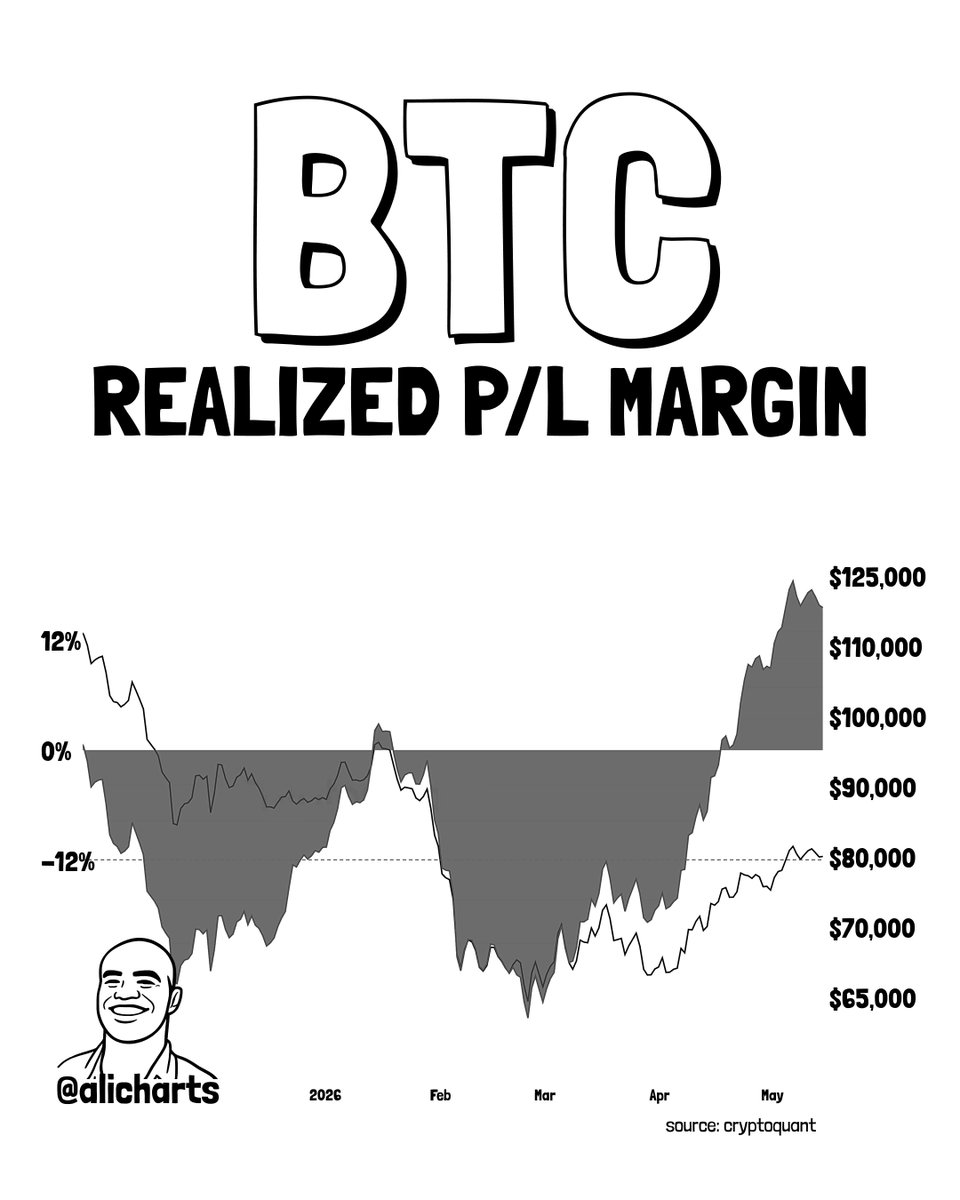
In a new post on the X platform, crypto analyst Ali Martinez revealed that the Bitcoin price is overheating and is at an increased risk of a return to the downside. This postulation is based on the Realized Profit/Loss Margin, which measures the actual return on a closed position in the cryptocurrency market.

This on-chain indicator helps evaluate general investor sentiment, offering insight into whether the market is heating up or cooling off. Typically, a high profit margin could signal an impending price top, while a negative value is often correlated with panic sell-offs and the formation of a market bottom.

According to CryptoQuant data highlighted by Martinez, the average Bitcoin trader’s realized profit margin has reached 17%, which could be seen as a warning signal. The analyst noted that, for the first time since October 2025, the average Bitcoin investor is sitting on significant returns and could be looking to lock in those gains.
Source: @alicharts on X

From a historical perspective, this profit margin level doesn’t look like good news for the Bitcoin price, as it has coincided with a market top in the past. More specifically, Martinez noted that the last time this metric reached 17% was in March 2022, when the flagship cryptocurrency was testing the 200-day moving average resistance.

The analyst explained:

That specific alignment signaled the exact moment the local top was in before the downtrend resumed in earnest.

Hence, if history is anything to go by, the current confluence of on-chain signals suggests that the Bitcoin price might have reached a local top and may be on its way down.

Bitcoin Price Overview

All in all, the $78,000 mark might be one to watch, as the price level has proven to be a good support cushion in recent weeks and falling beneath it could open the door to further downside movement. As of this writing, the price of BTC stands at around $78,070, reflecting no significant movement in the past 24 hours. According to data from CoinGecko, the flagship cryptocurrency is down by more than 3% on the weekly timeframe.

The price of BTC on the daily timeframe | Source: BTCUSDT charrt on TradingView


Trending Cryptos

Related Questions

QAccording to the article, what on-chain indicator suggests the Bitcoin market might be overheating and why?

AThe Realized Profit/Loss Margin indicator suggests the Bitcoin market might be overheating. CryptoQuant data shows the average Bitcoin trader's realized profit margin has reached 17%, which is a level that has historically signaled an impending price top.

QWhat historical event does the analyst Ali Martinez compare the current 17% profit margin to, and what was the outcome then?

AAnalyst Ali Martinez compares the current 17% profit margin to March 2022, when Bitcoin was testing the 200-day moving average resistance. That specific alignment signaled the exact moment the local top was in before the downtrend resumed.

QWhat key price level for Bitcoin does the article identify as an important support to watch?

AThe article identifies the $78,000 mark as an important support level to watch. Falling beneath it could open the door to further downside movement for Bitcoin's price.

QWhat is the current Bitcoin price and its weekly performance as mentioned in the article?

AAs mentioned in the article, the current Bitcoin price stands at around $78,070. According to CoinGecko data, it is down by more than 3% on the weekly timeframe.

QWhat does the Realized Profit/Loss Margin measure, and what do its high and negative values typically indicate?

AThe Realized Profit/Loss Margin measures the actual return on a closed position in the cryptocurrency market. Typically, a high profit margin could signal an impending price top, while a negative value is often correlated with panic sell-offs and the formation of a market bottom.

Related Reads

Anthropic Creates an AI Jailbreak 'Penal Code': Your Requests, Four Ways to Die

Anthropic has publicly detailed its security measures and a new "Cyber Jailbreak Severity" (CJS) framework following the controversial takedown of its Fable 5 model. The incident, triggered by simple user requests like counting letters or stating a profession, highlighted overzealous safety filters. Anthropic classifies cybersecurity-related prompts into four tiers: malicious activities (blocked), high-risk dual-use (like pentesting, with strict limits), low-risk dual-use (often blocked by "safety margin" errors), and harmless tasks (theoretically allowed but still frequently flagged). The company admits its classifiers are tuned for high sensitivity, leading to many false positives. The newly proposed CJS framework aims to objectively score the severity of AI "jailbreaks" (prompts that bypass safety rules) on a 0-10 scale across four dimensions: Capability Gain (does it grant new attack abilities?), Breadth (does it work across multiple attack types?), Weaponization Ease (how hard is it to turn into a real attack?), and Discoverability (how easy is it to find?). The score determines the response, from no action (CJS-0) to a potential model takedown (CJS-4). The score is context-dependent; for example, discovering a major unknown vulnerability today scores high, while asking about a well-known one scores low. The article raises concerns about Anthropic's dual role: it is both creating powerful models (like the restricted Mythos 5) and defining the rules (CJS) for judging their misuse, potentially giving it disproportionate influence. This is set against the backdrop of U.S. export controls, which for the first time directly restricted API access to a model (Fable 5), creating a "tiered" system where public models are heavily filtered and advanced ones are limited to vetted partners. The CJS framework is portrayed as potentially providing regulators with a metric to justify future API shutdowns. For users, the advice is to carefully phrase prompts, watch for signs of being downgraded to a weaker model, and wait indefinitely for promised filter improvements.

marsbit11m ago

Anthropic Creates an AI Jailbreak 'Penal Code': Your Requests, Four Ways to Die

marsbit11m ago

$100M Annual Revenue, Two Berkeley Roommates in Their 20s Build the Most Profitable AI Business

Arena, the AI model ranking platform, has become a $100 million annual revenue business just eight months after launching its commercial service. Originally a UC Berkeley open-source research project called Chatbot Arena, it created a "battle arena" where users blind-test and vote on anonymous AI model responses. This has generated a highly trusted, community-driven leaderboard based on over 10 million user evaluations and 82 million votes. Major AI companies like OpenAI, Google, and Anthropic submit their flagship models to be ranked. The core monetization strategy is its AI Evaluations service, where model developers and large enterprises pay for in-depth performance analysis from Arena's massive user community. This provides real-world feedback on model strengths, weaknesses, and hallucinations—a critical service as models become more complex. The company, spun out from Berkeley in early 2025, quickly raised $100 million in seed funding at a $600 million valuation and later secured a $150 million Series A at a $1.7 billion valuation. The founding team includes CEO Anastasios Angelopoulos, a mathematician focused on rigorous model evaluation; CTO Wei-Lin Chiang, creator of the popular Vicuna chatbot; and co-founder Ion Stoica, a renowned Berkeley professor. Arena is now expanding beyond chat benchmarks into "Agent Mode," evaluating AI agents on complex, multi-step tasks like coding and research. The company's success illustrates the growing value and cost of independent, real-world AI model evaluation as the industry intensifies.

marsbit15m ago

$100M Annual Revenue, Two Berkeley Roommates in Their 20s Build the Most Profitable AI Business

marsbit15m ago

Racking Up 24,000 Stars: With One Command, AI Can Now Find Its Own Skills

Vercel, known for its developer tools like Next.js, has launched 'skills', a package manager for AI coding agents, garnering 24,000 GitHub stars. It allows developers to add specialized capabilities, such as React best practices, to AI assistants like Claude Code or Cursor with a single command: `npx skills add <package>`. Skills are shareable, reusable modules that define an AI agent's behavior for specific tasks, moving beyond one-off prompt engineering towards standardized 'capability engineering'. A key innovation is the 'find-skills' skill, which acts as an internal search engine, allowing an agent to autonomously find and install the right skill for a user's request. This lowers the barrier for non-developers to leverage advanced AI coding assistance. However, this 'npm moment' for AI brings significant security risks. Security audits of thousands of skills on platforms like skills.sh and ClawHub found over 30% contained security flaws, with about 13% classified as severe. Threats include malicious scripts that can access local files and credentials, and prompt injection hidden within skill documentation. Unlike traditional code packages, skills blend instructions, code, and system access, posing a direct risk to user machines and data. Experts advise treating skills like code—reviewing them carefully before installation, especially their scripts, and being wary of excessive permissions. Ultimately, Vercel's initiative represents a major shift towards modular, reusable AI capabilities, but its rapid adoption requires developers to bring the same caution used in managing traditional software dependencies.

marsbit16m ago

Racking Up 24,000 Stars: With One Command, AI Can Now Find Its Own Skills

marsbit16m ago

Claude Engineer Finally Unveils Fable 5's Ultimate Strategy, Teaching You How to Bridge the Information Gap with AI Models

This article, titled "Claude Engineer Finally Releases Fable 5 'Skill-Burning' Guide, Teaching How to Bridge the Information Gap with Models," details a blog post by Claude Code engineer Thariq Shihipar. The core concept is the "information gap" or "unknowns"—the disconnect between a user's instructions (the "map") and the actual task requirements (the "territory"). The article argues that with powerful models like Claude Fable 5, work quality depends on the user's ability to identify and clarify these unknowns. Shihipar categorizes unknowns into four types: Known Knowns (explicit instructions), Known Unknowns (awareness of gaps), Unknown Knowns (implicit, unstated knowledge), and Unknown Unknowns (unforeseen issues). The blog provides a framework for addressing these gaps throughout the workflow: * **Before Implementation:** Techniques include "Blindspot Scanning" to uncover Unknown Unknowns, brainstorming/prototyping for visual or complex tasks, having Claude ask clarifying questions, using reference code/examples, and creating implementation plans. * **During Implementation:** Maintaining an "implementation notes" file for Claude to document deviations and decisions made due to encountered edge cases. * **After Implementation:** Creating summary documents for review and having Claude generate quizzes to ensure the user fully understands the completed changes. The article concludes that as models become more capable, the key to success is systematically discovering and defining these unknowns through low-cost methods like prototyping and planning, allowing for more effective collaboration.

marsbit21m ago

Claude Engineer Finally Unveils Fable 5's Ultimate Strategy, Teaching You How to Bridge the Information Gap with AI Models

marsbit21m ago

Trading

Spot

Hot Articles

What is $BITCOIN

DIGITAL GOLD ($BITCOIN): A Comprehensive Analysis Introduction to DIGITAL GOLD ($BITCOIN) DIGITAL GOLD ($BITCOIN) is a blockchain-based project operating on the Solana network, which aims to combine the characteristics of traditional precious metals with the innovation of decentralized technologies. While it shares a name with Bitcoin, often referred to as “digital gold” due to its perception as a store of value, DIGITAL GOLD is a separate token designed to create a unique ecosystem within the Web3 landscape. Its goal is to position itself as a viable alternative digital asset, although specifics regarding its applications and functionalities are still developing. What is DIGITAL GOLD ($BITCOIN)? DIGITAL GOLD ($BITCOIN) is a cryptocurrency token explicitly designed for use on the Solana blockchain. In contrast to Bitcoin, which provides a widely recognized value storage role, this token appears to focus on broader applications and characteristics. Notable aspects include: Blockchain Infrastructure: The token is built on the Solana blockchain, known for its capacity to handle high-speed and low-cost transactions. Supply Dynamics: DIGITAL GOLD has a maximum supply capped at 100 quadrillion tokens (100P $BITCOIN), although details regarding its circulating supply are currently undisclosed. Utility: While precise functionalities are not explicitly outlined, there are indications that the token could be utilized for various applications, potentially involving decentralized applications (dApps) or asset tokenization strategies. Who is the Creator of DIGITAL GOLD ($BITCOIN)? At present, the identity of the creators and development team behind DIGITAL GOLD ($BITCOIN) remains unknown. This situation is typical among many innovative projects within the blockchain space, particularly those aligning with decentralized finance and meme coin phenomena. While such anonymity may foster a community-driven culture, it intensifies concerns about governance and accountability. Who are the Investors of DIGITAL GOLD ($BITCOIN)? The available information indicates that DIGITAL GOLD ($BITCOIN) does not have any known institutional backers or prominent venture capital investments. The project seems to operate on a peer-to-peer model focused on community support and adoption rather than traditional funding routes. Its activity and liquidity are primarily situated on decentralized exchanges (DEXs), such as PumpSwap, rather than established centralized trading platforms, further highlighting its grassroots approach. How DIGITAL GOLD ($BITCOIN) Works The operational mechanics of DIGITAL GOLD ($BITCOIN) can be elaborated on based on its blockchain design and network attributes: Consensus Mechanism: By leveraging Solana’s unique proof-of-history (PoH) combined with a proof-of-stake (PoS) model, the project ensures efficient transaction validation contributing to the network's high performance. Tokenomics: While specific deflationary mechanisms have not been extensively detailed, the vast maximum token supply implies that it may cater to microtransactions or niche use cases that are still to be defined. Interoperability: There exists the potential for integration with Solana’s broader ecosystem, including various decentralized finance (DeFi) platforms. However, the details regarding specific integrations remain unspecified. Timeline of Key Events Here is a timeline that highlights significant milestones concerning DIGITAL GOLD ($BITCOIN): 2023: The initial deployment of the token occurs on the Solana blockchain, marked by its contract address. 2024: DIGITAL GOLD gains visibility as it becomes available for trading on decentralized exchanges like PumpSwap, allowing users to trade it against SOL. 2025: The project witnesses sporadic trading activity and potential interest in community-led engagements, although no noteworthy partnerships or technical advancements have been documented as of yet. Critical Analysis Strengths Scalability: The underlying Solana infrastructure supports high transaction volumes, which could enhance the utility of $BITCOIN in various transaction scenarios. Accessibility: The potential low trading price per token could attract retail investors, facilitating wider participation due to fractional ownership opportunities. Risks Lack of Transparency: The absence of publicly known backers, developers, or an audit process may yield skepticism regarding the project's sustainability and trustworthiness. Market Volatility: The trading activity is heavily reliant on speculative behavior, which can result in significant price volatility and uncertainty for investors. Conclusion DIGITAL GOLD ($BITCOIN) emerges as an intriguing yet ambiguous project within the rapidly evolving Solana ecosystem. While it attempts to leverage the “digital gold” narrative, its departure from Bitcoin's established role as a store of value underscores the need for a clearer differentiation of its intended utility and governance structure. Future acceptance and adoption will likely depend on addressing the current opacity and defining its operational and economic strategies more explicitly. Note: This report encompasses synthesised information available as of October 2023, and developments may have transpired beyond the research period.

617 Total ViewsPublished 2025.05.13Updated 2025.05.13

What is $BITCOIN

Discussions

Welcome to the HTX Community. Here, you can stay informed about the latest platform developments and gain access to professional market insights. Users' opinions on the price of BTC (BTC) are presented below.

活动图片