Bitcoin Or Ethereum To $62,000? Fundstrat Releases Contrasting 2026 Predictions

bitcoinistPublished on 2025-12-21Last updated on 2025-12-21

Abstract

Fundstrat's Tom Lee and the firm's research team present contrasting crypto predictions for 2026. While Lee has publicly reiterated a bullish $62,000 target for Ethereum, an internal Fundstrat report warns of significant bearish headwinds in the first half of the year. The report, verified by Wu Blockchain, projects potential drawdowns to $60,000-$65,000 for Bitcoin, $1,800-$2,000 for Ethereum, and $50-$75 for Solana. It suggests these levels would present attractive buying opportunities into year-end. This contrasts with Lee's previous public optimism, including a $250,000 Bitcoin and $12,000 Ethereum forecast. As of now, Bitcoin trades around $88,180 and Ethereum near $2,980.

Tom Lee, chairman of BitMine and managing partner at Fundstrat, has been a vocal optimist when it comes to the cryptocurrency market, especially for Bitcoin and Ethereum. Most recently, Fundstrat’s managing partner revived his $62,000 target call for the Ethereum price in 2026.

However, it appears that Lee and his investment firm do not align in terms of their market expectations for the coming year. Fundstrat seems to be looking at a more bearish setup for most of the large-cap digital assets, including Bitcoin, Ethereum, and Solana, in 2026.

$60,000 Is The Target, But Not For Ethereum

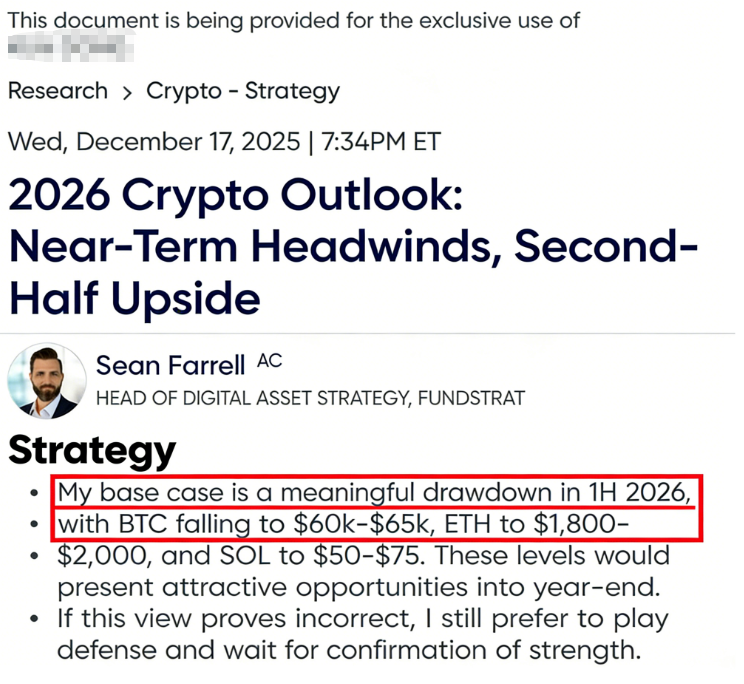
According to screenshots posted on social media platform X, Fundstrat released a 2026 crypto strategy report, warning internal clients of potential market headwinds in early 2026. The report’s title, however, also suggested that Bitcoin, Ethereum, and Solana could enjoy significant growth in the second half of next year.
Source: @WuBlockchain on X

Sean Farrell, Fundstrat’s head of digital asset strategy, projected significant drawdowns for the crypto market in the first half of 2026. The research set the target for the Bitcoin price between $60,000 to $65,000, the Ethereum price within $1,800 – $2,000, and the Solana price around $50 – $75.

Farrell wrote in the report:

These levels would present attractive opportunities into year-end. If this view proves incorrect, I still prefer to play defense and wait for confirmation of strength.

This circulating report stands in contrast to the predictions of Tom Lee, who is the chief investment officer (CIO) at Fundstrat. Speaking to attendees at the Binance Blockchain Week earlier this month, Lee stated that the price could run up to as much as $62,000 as Ethereum becomes the core infrastructure for tokenized finance.

In September, at the Korea Blockchain Week, Lee said that the price of Bitcoin could reach as high as $250,000 by year-end, while Ethereum’s value could climb toward $12,000. The rationale for this projection revolved around macro tailwinds and growing institutional interest in crypto assets.

Now, while the Fundstrat internal document has yet to be authenticated by Bitcoinist as of press time, Colin Wu-led outlet Wu Blockchain verified that this document was indeed distributed to internal clients.

Bitcoin And Ethereum Price At A Glance

As of this writing, Bitcoin, the world’s largest cryptocurrency by market cap, is valued at around $88,180, reflecting no significant movement in the past 24 hours. Meanwhile, the price of ETH stands at around $2,980.

The price of BTC on the daily timeframe | Source: BTCUSDT chart on TradingView


Trending Cryptos

Related Questions

QWhat is the contrasting 2026 price prediction for Ethereum by Fundstrat's head of digital asset strategy compared to Tom Lee's?

AFundstrat's head of digital asset strategy, Sean Farrell, projected Ethereum's price to be within $1,800 - $2,000 in 2026, contrasting sharply with Tom Lee's optimistic target of $62,000.

QWhat are the predicted price ranges for Bitcoin and Solana in the first half of 2026 according to Fundstrat's internal report?

AAccording to Fundstrat's internal report, the predicted price range for Bitcoin is $60,000 to $65,000, and for Solana, it is around $50 to $75 in the first half of 2026.

QWhat was the rationale behind Tom Lee's much higher price predictions for Bitcoin and Ethereum made in September?

ATom Lee's rationale for his high predictions of $250,000 for Bitcoin and $12,000 for Ethereum revolved around macro tailwinds and growing institutional interest in crypto assets.

QAccording to the article, what is the current price of Bitcoin and Ethereum at the time of writing?

AAs of the time of writing, Bitcoin is valued at around $88,180 and Ethereum (ETH) stands at around $2,980.

QWhat is the overall market outlook for large-cap digital assets in early 2026 as described in Fundstrat's report?

AFundstrat's report warns of potential market headwinds and projects significant drawdowns for large-cap digital assets like Bitcoin, Ethereum, and Solana in the first half of 2026, suggesting a more bearish setup.

Related Reads

Mass Production Timelines Shift Collectively, Is Glass Substrate Facing Its First Major Test?

The article discusses the shift in the glass substrate industry from initial announcements to practical delivery and reliability testing. In mid-to-late 2026, key developments include Intel and Lens Technology advancing AI-era glass substrate packaging cooperation, Avaco launching a TGV pilot line in South Korea, and reports that Samsung Electro-Mechanics is facing delays, potentially pushing mass production beyond 2028. The core challenge has moved from material comparisons to rigorous customer reliability certifications, focusing on thermal cycling, humidity resistance, and stable electrical performance post-processing. Samsung Electro-Mechanics' reported delay, linked to client sample reliability bottlenecks, reflects a broader industry trend where timelines are being adjusted. Other players like SKC/Absolics, LG Innotek, and DNP are also targeting initial supply systems or pilot lines between 2027-2028, with mainstream adoption potentially post-2030. The delays highlight that the current hurdle is supply-side technical maturity—particularly achieving stable yields and passing client certifications—rather than a lack of demand driven by AI and HPC. The collaboration between Intel and Lens Technology focuses on establishing design and verification standards. Meanwhile, Japanese firms like Shinko Electric and DNP are progressing with multi-layer wiring and stress control. Chinese panel makers, led by BOE, are rapidly entering with automated pilot lines and customer testing. On the material side, companies like Corning are exploring glass substrates for co-packaged optics (CPO), potentially offering an earlier application path than core substrates. Ultimately, the central barrier is TGV (Through Glass Via) yield, currently around 60-70%, lower than organic substrates, with higher costs due to glass brittleness and process complexity. The industry's current phase represents its first major test in transitioning from lab R&D to volume manufacturing, with success hinging on overcoming these yield and certification challenges.

marsbit9m ago

Mass Production Timelines Shift Collectively, Is Glass Substrate Facing Its First Major Test?

marsbit9m ago

Crypto Bull Is Back, Which Assets Bounced the Hardest?

The cryptocurrency market experienced a significant surge last week, with Bitcoin rallying over 26% to nearly $79,500, its strongest weekly gain since March 2023, fueling discussions of a renewed bull market. This rebound highlighted several key market dynamics. First, short-term directional shifts are increasingly tied to U.S. policy cycles. The rally was driven by two major catalysts: the U.S. Treasury's announcement to increase long-term bond buybacks, easing macro liquidity pressures, and former President Trump's push for clearer crypto legislation, boosting regulatory certainty and risk appetite. Second, Bitcoin spot ETFs solidified their role as a leading market indicator. In the week ending August 21, U.S. Bitcoin and Ethereum spot ETFs saw a combined net inflow of $2.6 billion, the highest since October 2025, signaling strong institutional re-entry. Third, the rally followed a clear capital rotation pattern: Bitcoin's breakout ignited broader gains, with Ethereum (up nearly 30%), major altcoins, and meme coins sequentially posting larger percentage increases. Analysis of the top performers among the top 50 altcoins by market cap revealed the week's biggest gainers: ENA (Ethena) led with a 100.75% surge, fueled by a Coinbase partnership. It was followed by PUMP (Pump.fun, up 88-99%), STX (Stacks, up 82-94%), TRUMP (Official Trump, up 79-91%), and ZEC (Zcash, up 75.15%), which uniquely reached a new all-time high. Meme coins like BOME on Solana also saw explosive gains, exemplifying the high-risk, high-reward sentiment. The rally illustrated a clear path: Bitcoin set the stage, major coins like Ethereum led the charge, and altcoins/meme coins delivered the most explosive returns, mapping the gradient of returning market enthusiasm.

marsbit22m ago

Crypto Bull Is Back, Which Assets Bounced the Hardest?

marsbit22m ago

Wuhan is About to Witness Its Largest IPO in History

Wuhan is poised for its largest-ever IPO as Yangtze Memory Technologies Co., Ltd. (YMTC) has officially applied for a listing on the Shanghai Stock Exchange's STAR Market, seeking to raise 33 billion yuan. The domestic leader in 3D NAND flash memory chips completed its IPO辅导 (tutoring) process in a record three months, with market expectations valuing the company at 300 billion yuan or higher. YMTC's roots trace back to 2006 with the founding of Wuhan Xinxin. After surviving the global financial crisis and periods of operational difficulty, the company was formally established in 2016 through a joint investment involving Tsinghua Unigroup, the National Integrated Circuit Industry Investment Fund (the "Big Fund"), and local Hubei government funds. With a distinct "national team" background, its major shareholders include provincial and municipal state-owned assets committees and the Big Fund. Based in Wuhan's Optics Valley (East Lake High-tech Development Zone), YMTC's potential listing highlights the region's rise as a tech hub. Optics Valley is already home to 72 listed companies and has ambitious plans to exceed 100 by 2030. The zone recently established four industry-focused母基金 (mother funds) totaling 18 billion yuan to further boost sectors like integrated circuits and optoelectronics. YMTC's IPO would complete the "Optics Valley Seven Stars," a group of leading local optoelectronic and communication giants.

marsbit22m ago

Wuhan is About to Witness Its Largest IPO in History

marsbit22m ago

Trading

Spot

Hot Articles

What is $BITCOIN

DIGITAL GOLD ($BITCOIN): A Comprehensive Analysis Introduction to DIGITAL GOLD ($BITCOIN) DIGITAL GOLD ($BITCOIN) is a blockchain-based project operating on the Solana network, which aims to combine the characteristics of traditional precious metals with the innovation of decentralized technologies. While it shares a name with Bitcoin, often referred to as “digital gold” due to its perception as a store of value, DIGITAL GOLD is a separate token designed to create a unique ecosystem within the Web3 landscape. Its goal is to position itself as a viable alternative digital asset, although specifics regarding its applications and functionalities are still developing. What is DIGITAL GOLD ($BITCOIN)? DIGITAL GOLD ($BITCOIN) is a cryptocurrency token explicitly designed for use on the Solana blockchain. In contrast to Bitcoin, which provides a widely recognized value storage role, this token appears to focus on broader applications and characteristics. Notable aspects include: Blockchain Infrastructure: The token is built on the Solana blockchain, known for its capacity to handle high-speed and low-cost transactions. Supply Dynamics: DIGITAL GOLD has a maximum supply capped at 100 quadrillion tokens (100P $BITCOIN), although details regarding its circulating supply are currently undisclosed. Utility: While precise functionalities are not explicitly outlined, there are indications that the token could be utilized for various applications, potentially involving decentralized applications (dApps) or asset tokenization strategies. Who is the Creator of DIGITAL GOLD ($BITCOIN)? At present, the identity of the creators and development team behind DIGITAL GOLD ($BITCOIN) remains unknown. This situation is typical among many innovative projects within the blockchain space, particularly those aligning with decentralized finance and meme coin phenomena. While such anonymity may foster a community-driven culture, it intensifies concerns about governance and accountability. Who are the Investors of DIGITAL GOLD ($BITCOIN)? The available information indicates that DIGITAL GOLD ($BITCOIN) does not have any known institutional backers or prominent venture capital investments. The project seems to operate on a peer-to-peer model focused on community support and adoption rather than traditional funding routes. Its activity and liquidity are primarily situated on decentralized exchanges (DEXs), such as PumpSwap, rather than established centralized trading platforms, further highlighting its grassroots approach. How DIGITAL GOLD ($BITCOIN) Works The operational mechanics of DIGITAL GOLD ($BITCOIN) can be elaborated on based on its blockchain design and network attributes: Consensus Mechanism: By leveraging Solana’s unique proof-of-history (PoH) combined with a proof-of-stake (PoS) model, the project ensures efficient transaction validation contributing to the network's high performance. Tokenomics: While specific deflationary mechanisms have not been extensively detailed, the vast maximum token supply implies that it may cater to microtransactions or niche use cases that are still to be defined. Interoperability: There exists the potential for integration with Solana’s broader ecosystem, including various decentralized finance (DeFi) platforms. However, the details regarding specific integrations remain unspecified. Timeline of Key Events Here is a timeline that highlights significant milestones concerning DIGITAL GOLD ($BITCOIN): 2023: The initial deployment of the token occurs on the Solana blockchain, marked by its contract address. 2024: DIGITAL GOLD gains visibility as it becomes available for trading on decentralized exchanges like PumpSwap, allowing users to trade it against SOL. 2025: The project witnesses sporadic trading activity and potential interest in community-led engagements, although no noteworthy partnerships or technical advancements have been documented as of yet. Critical Analysis Strengths Scalability: The underlying Solana infrastructure supports high transaction volumes, which could enhance the utility of $BITCOIN in various transaction scenarios. Accessibility: The potential low trading price per token could attract retail investors, facilitating wider participation due to fractional ownership opportunities. Risks Lack of Transparency: The absence of publicly known backers, developers, or an audit process may yield skepticism regarding the project's sustainability and trustworthiness. Market Volatility: The trading activity is heavily reliant on speculative behavior, which can result in significant price volatility and uncertainty for investors. Conclusion DIGITAL GOLD ($BITCOIN) emerges as an intriguing yet ambiguous project within the rapidly evolving Solana ecosystem. While it attempts to leverage the “digital gold” narrative, its departure from Bitcoin's established role as a store of value underscores the need for a clearer differentiation of its intended utility and governance structure. Future acceptance and adoption will likely depend on addressing the current opacity and defining its operational and economic strategies more explicitly. Note: This report encompasses synthesised information available as of October 2023, and developments may have transpired beyond the research period.

2.1k Total ViewsPublished 2025.05.13Updated 2025.05.13

What is $BITCOIN

Discussions

Welcome to the HTX Community. Here, you can stay informed about the latest platform developments and gain access to professional market insights. Users' opinions on the price of BTC (BTC) are presented below.

活动图片