Bitcoin On-Chain Users Evaporate by 30%, ETFs Bleed $4.5 Billion: Where Is It Headed in the Next 3 Months?

marsbitPublished on 2026-02-24Last updated on 2026-02-24

Abstract

Bitcoin's on-chain activity shows a concerning six-month decline in active addresses, dropping approximately 31% since August 2025 to around 536,000, while transaction counts remain stable. This divergence suggests reduced participation breadth despite sustained network throughput, indicating concentration among fewer entities like institutions and exchanges. Low transaction fees (averaging $0.24) reflect weak block space demand, contrasting with Bitcoin’s role as a macro-sensitive asset traded largely via ETFs and derivatives. U.S. Bitcoin ETFs have seen significant outflows ($45 billion year-to-date), shifting activity off-chain. Three scenarios emerge: continued stagnation in a risk-averse macro climate; recovery if ETF flows reverse and active addresses rebound; or structural evolution where Bitcoin becomes a settlement layer with reduced retail participation, while stablecoins dominate daily crypto transactions.

Author: Oluwapelumi Adejumo

Compiled by: Deep Tide TechFlow

Deep Tide Guide: Trading volume hasn't collapsed, but active addresses have been shrinking for six months, hitting a five-year low. This divergence of "superficial prosperity, internal emptiness" is a counter-signal to the structural health of a bull market.

The article uses three sets of data from Glassnode, Santiment, and CryptoQuant for cross-validation, proposing three future scenarios, providing a suitable reference framework for judging BTC's trend at present.

Full Text Below:

Bitcoin's network activity has been weakening for six consecutive months, but this trend is not reflected in the core metrics that many traders first look at.

The clearer signal is not trading volume—which has remained largely stable—but the breadth of participation. Even as the network continues to process a similar number of transactions, the number of active on-chain addresses has been consistently declining.

In a market where price discovery is increasingly happening in ETFs and derivatives, this split is crucial. It means: Bitcoin's on-chain footprint is narrowing, while market exposure remains active elsewhere.

As the bear market persists, this trend has become increasingly difficult to ignore.

Glassnode data shows that in mid-August 2025, the eight-day moving average of Bitcoin active addresses was approximately 778,680. As of February 23, this number had dropped to about 535,942, a decline of approximately 31%.

CryptoQuant has also marked low network activity for six consecutive months, describing the current phase as a period of sustained weakness in on-chain participation.
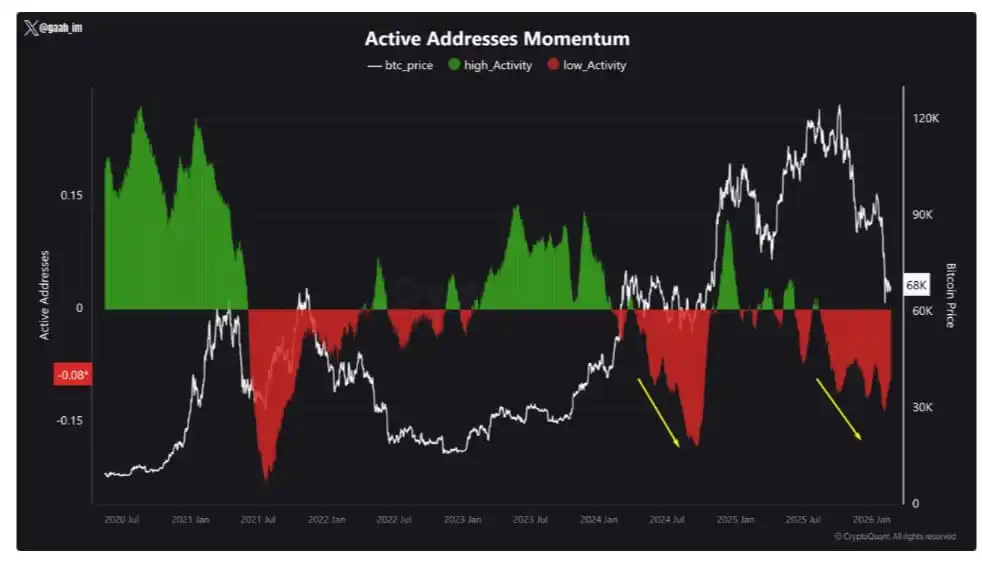
Bitcoin Active Addresses Momentum

Source: CryptoQuant

The last time the market showed a similar pattern was in 2024—Bitcoin subsequently experienced a correction of about 30%.

This doesn't mean it will necessarily repeat now, but it reinforces a historical pattern: prolonged network weakness often coincides with phases of weakening market confidence.

Breadth Declining, But Throughput Not Collapsing

Bitcoin's transaction count has not declined in sync with the number of active addresses.

In mid-August 2025, the average daily transaction count was about 444,000. Data from Blockchain.com shows the recent 30-day average is about 439,000.

Intraday data still fluctuates, ranging from about 289,000 to 702,000 transactions, but the overall throughput trend has not collapsed.

This divergence is key to understanding the current situation.

If transaction volume remains stable while active addresses decrease, it indicates that fewer entities are handling the same amount of on-chain activity.

This situation can have multiple causes, none of which involve a retail influx. Exchanges and custodians can batch withdrawals; large holders can consolidate transfers; institutional flows can be processed through fewer wallets; operational activities can also cause temporary spikes in transaction count without representing a true return of users.

The result is: the chain still looks busy, but the underlying number of participants is shrinking.

This is why the decline in breadth is more telling than raw throughput. A flat transaction count can mask a market where activity is increasingly concentrated among repeat traders, large institutions, and operational flows.

In this landscape, Bitcoin's chain still functions normally, but the breadth of user participation it represents is becoming less genuine.

Blockchain analytics firm Santiment provides a more stark description from a longer time perspective.

The firm states that since February 2021, the number of unique addresses initiating Bitcoin transactions has decreased by 42%, and new address creation has decreased by 47%.
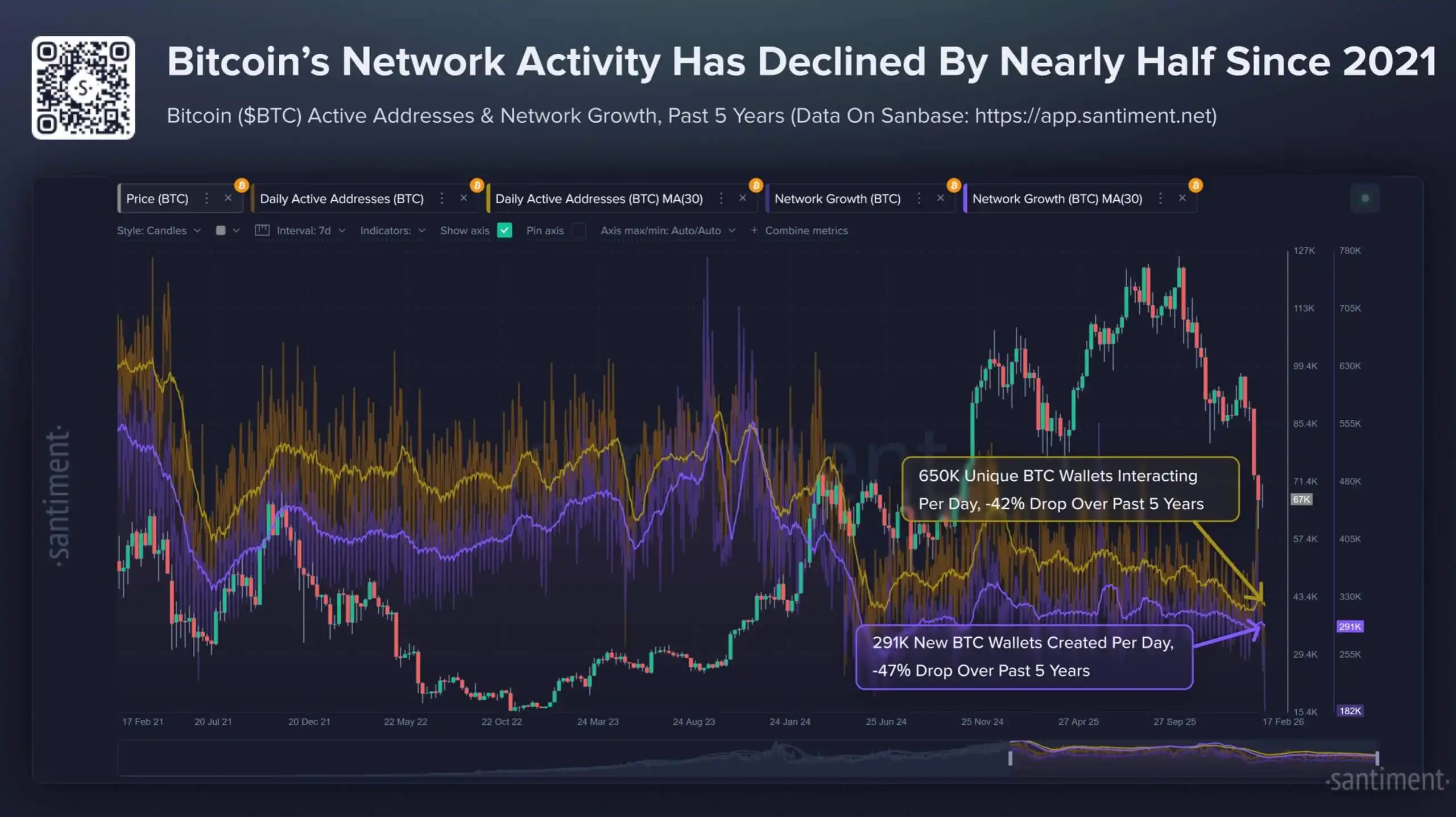
Santiment does not characterize this as evidence that crypto is dead or that a multi-year bear market is locked in, but it does describe a bearish divergence that has run through 2025—market capitalization rising while Bitcoin's utility metrics weaken.

This tension is now evident in the six-month trend. Price and market narrative can continue to hold, but the chain itself is getting quieter.

Low Fees Point to Shrinking Block Space Demand

Fee data further confirms that Bitcoin's Layer 1 is in a state of weak demand.

mempool.space data shows the network's recent average transaction fee is approximately $0.24, or about 1.8 sats/vB.

For a network that has seen sustained block space competition during past cycle peaks, this is a low level. At the current transaction pace, this fee level implies daily fee revenue of less than $100,000.

In comparison, the block subsidy is still about 450 BTC daily, with fee revenue constituting a very small portion.
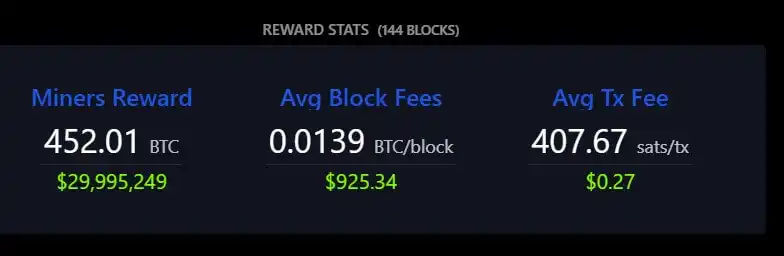
Bitcoin Average Block Fees

Source: Mempool.space

This is not an immediate security issue, nor does it mean Bitcoin's security model is under near-term pressure.

This is because the block subsidy still dominates miner revenue. But it does point to a long-term reality that Bitcoin has not yet been forced to confront at this stage of the cycle.

The topic of transitioning to a fee-supported security budget returns every cycle, but in the current environment, this transition is not being tested—because fee demand itself is weak.

Practically speaking, the quiet fee market is postponing this discussion further.

The chain is not facing sustained congestion pressure, and users are not fiercely bidding for block inclusion. This can change quickly during volatility events, speculative waves, or new demand shocks, but it hasn't happened yet.

For now, block space is in a state of明显 low usage compared to past bull phases, consistent with the broader context of declining participation breadth.
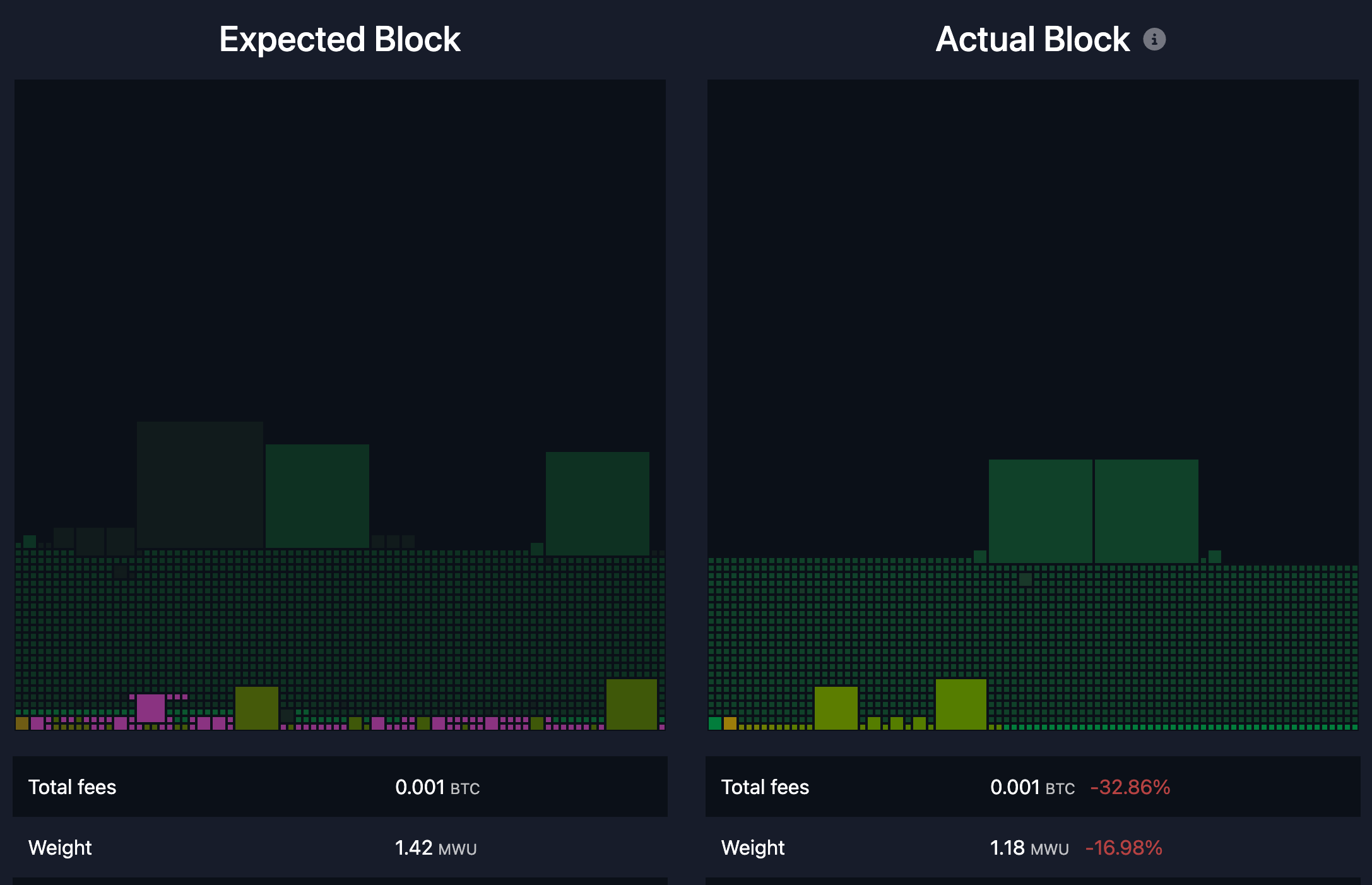
Bitcoin's Empty Mempool

Source: Mononaut

CryptoQuant's assessment also aligns with this fee environment—low network activity is typically associated with declining market interest in the asset and periods of general losses.

When interest wanes, new participants decrease, self-initiated transfers reduce, and fee pressure subsides.

Bitcoin can still be actively traded as a financial asset, but the chain itself no longer reflects broad user participation.

Macro Environment and ETF Flows Are Changing How Bitcoin Trades

The macro background helps explain why this trend persists.

Bitcoin is increasingly behaving like a macro-sensitive high-beta asset, especially prominent during risk-off periods.

Over the past year, US inflation has cooled, with January 2026 CPI year-over-year growth at 2.4%; the Fed's target rate range was cited as 3.50% to 3.75% at the end of January.

In a simpler market environment, cooling inflation might support a clearer risk asset rally.

However, market attention is focused on multiple volatility catalysts—including uncertainty around tariff policies. This factor has driven sharp swings in rates and the dollar, keeping overall risk appetite persistently unstable.

In such an environment, both retail and institutional investors tend to reduce their operational frequency. Retail participation declines, trader turnover decreases. Institutions can maintain exposure but prefer adjusting positions through products that don't require on-chain movement.

This is precisely why spot Bitcoin ETFs have become the star of the key narrative.

Coinperps data shows that US Bitcoin ETFs have seen net outflows for multiple consecutive weeks, with cumulative outflows of approximately $3.8 billion over the past five weeks, and about $4.5 billion year-to-date.
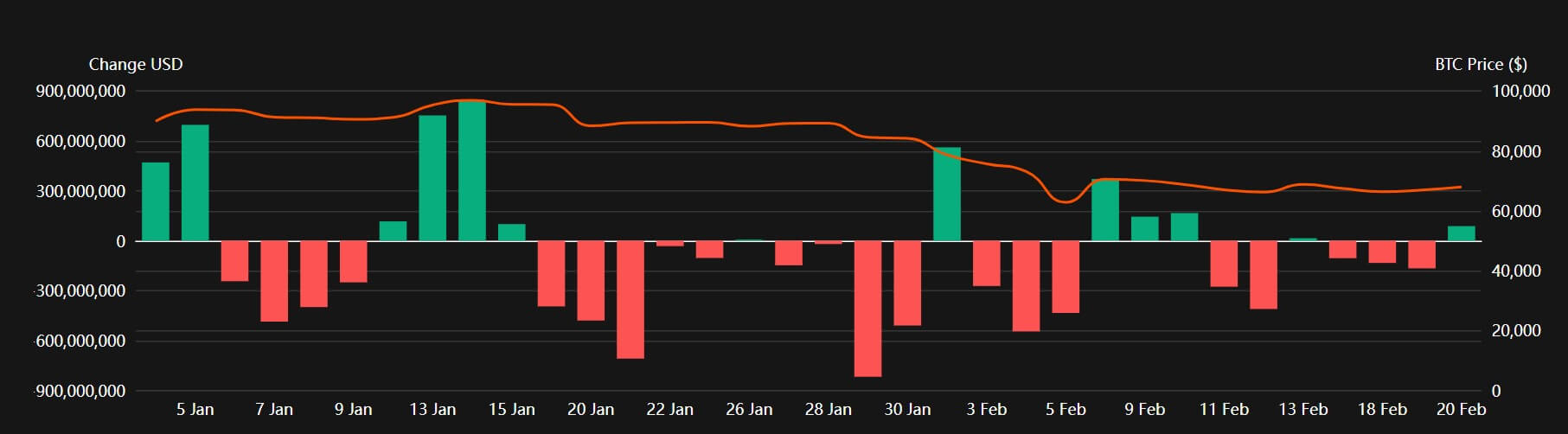
2026 US Bitcoin ETF Daily Flow Trends

Source: Coinperps

This shifts activity from self-custodied wallets to brokerage accounts.

It also explains how the market can remain active while the chain gets quieter. Exposure is still changing hands, but more of the turnover is happening off-chain.

This is a significant shift in Bitcoin's role. It is increasingly resembling a financial product wrapped in an institutional shell, while Layer 1 is used more selectively for settlement, storage, and periodic transfers.

Meanwhile, the daily trading energy in crypto is increasingly concentrated elsewhere, especially in stablecoins.

Coin Metrics lists stablecoins as a core driver of on-chain activity, with the total stablecoin supply nearing $300 billion and transaction volume continuously climbing.

If stablecoin rails on other chains absorb more daily settlement demand, Bitcoin's Layer 1 naturally becomes more functionally singular.

This itself does not weaken Bitcoin's investment thesis, but it does change its form.

Three Scenarios for the Next Three to Six Months

The current six-month decline in network breadth outlines three possible paths for Bitcoin's future trajectory.

The first is continued apathy, which looks like the baseline scenario in a risk-averse market environment.

In this scenario, active addresses remain low (450,000 to 600,000 range), transaction counts remain volatile but don't collapse, fees stay low, and ETF flows remain flat or slightly negative.

Here, Bitcoin may still experience sharp volatility due to macro headlines, but on-chain participation does not confirm a broad recovery. The asset trades more like a macro tool than a network entering a new expansion phase.

The second is a liquidity thaw, the more optimistic path.

If inflation continues to cool and easing expectations stabilize risk appetite, ETF flows could shift from net outflows to sustained net inflows. In this environment, growth in active addresses would be a key confirmation signal.

A recovery to 650,000 to 800,000 active addresses would mean participation breadth is recovering, not just price momentum returning. This looks more like a classic cyclical recovery—price increases supported by growth in on-chain user participation.

The third is a structural substitution scenario, perhaps the one most worth watching.

In this scenario, Bitcoin's price rises, but on-chain breadth remains persistently weak. ETFs, derivatives, and custodial settlement continue to dominate, while stablecoins on other parts of crypto absorb more trading demand.

Here, Bitcoin increasingly resembles a digital macro asset and settlement layer, rather than a chain with broad daily retail activity.

This scenario would mark an evolution in Bitcoin's role, reflecting the deep changes it has undergone compared to years past.


Related Questions

QWhat is the current trend in Bitcoin's on-chain user activity according to the article?

ABitcoin's on-chain user activity has been declining for six consecutive months, with active addresses dropping by approximately 31% from around 778,680 in mid-August 2025 to about 535,942 by February 23, as per Glassnode data.

QHow does the transaction volume on Bitcoin's blockchain compare to the decline in active addresses?

ATransaction volume has remained relatively stable, with daily average transactions around 444,000 in mid-August 2025 and approximately 439,000 over the past 30 days, indicating that fewer entities are handling the same amount of on-chain activity.

QWhat does the low network fee environment indicate about Bitcoin's current state?

ALow network fees, averaging around $0.24 per transaction, indicate weak demand for block space and reduced user participation, reflecting a broader decline in on-chain activity rather than network congestion.

QHow have Bitcoin ETFs impacted on-chain activity and market exposure?

ABitcoin ETFs have shifted market exposure off-chain, with continuous net outflows totaling approximately $4.5 billion year-to-date, reducing the need for on-chain transactions as trading occurs through brokerage accounts rather than self-custodied wallets.

QWhat are the three possible scenarios for Bitcoin's performance over the next three to six months as outlined in the article?

AThe three scenarios are: 1) Continued Apathy, with low active addresses and stable transactions; 2) Liquidity Thaw, where improved macro conditions lead to ETF inflows and renewed on-chain participation; and 3) Structural Substitution, where Bitcoin evolves into a macro asset with limited daily on-chain activity, driven by ETFs and derivatives.

Related Reads

If the AI Bubble Is Already Bursting, Who Will Truly Survive?

If the AI Bubble is Bursting, Who Will Remain? The debate over an AI bubble is intensifying, with figures like Ray Dalio warning of high levels and Jensen Huang seeing immense, early-stage opportunity. Both views hold truth: a speculative bubble in capital markets likely exists, mirroring the dot-com era, but the underlying technological shift is real and transformative. History shows that while bubbles burst—wiping out overvalued companies and speculative capital—they often leave behind critical physical and digital infrastructure. The dot-com bust, for instance, eliminated many firms but left the global fiber optic networks and data centers that enabled the rise of Amazon, Netflix, and cloud computing. Today's massive AI infrastructure investments (projected at trillions by 2030) in data centers, power, cooling, and GPUs may follow a similar path, creating the foundation for future applications. A key divergence from past bubbles is the "Jevons Paradox" effect in AI. As the cost of AI inference has plummeted by over 99.7% since 2023, enterprise spending on AI has skyrocketed. Cheap "tokens" have unlocked vast, previously uneconomical use cases, moving AI from simple chatbots into core business workflows—code generation, legal document review, scientific simulation, and financial analysis. The market is now in a phase of self-correction, weeding out superficial "API-wrapper" startups, but this cleansing process strengthens the ecosystem. The long-term trajectory is clear. The value is gradually shifting from capital expenditure (CapEx) on hardware to operational expenditure (OpEx) on transformative applications. As AI becomes a utility, the winners will be firms that deeply integrate it to solve vertical industry problems in law, healthcare, finance, and manufacturing. The泡沫 will recede, but the foundational shift towards an AI-powered era across all sectors is irreversible. The underlying productive force of AI contains no bubble.

marsbit23m ago

If the AI Bubble Is Already Bursting, Who Will Truly Survive?

marsbit23m ago

If the AI Bubble Is Already Bursting, Who Will Truly Remain?

**Summary: If the AI Bubble is Bursting, What Will Remain?** The debate around an AI bubble is intensifying, with figures like Ray Dalio warning of high valuations while Jensen Huang sees immense opportunity. This echoes the dot-com bubble, which saw massive wealth destruction but ultimately left behind critical infrastructure like undersea cables and broadband, enabling future giants like Amazon and Netflix. Similarly, today's AI boom involves trillions invested in data centers, power, cooling, and GPUs, while application-layer revenue remains comparatively modest. This investment-disparity signals a bubble. However, the core technological progress is real and accelerating. AI inference costs have plummeted by over 99.7% since 2023, making intelligence increasingly cheap and accessible. This cost collapse is unlocking vast new demand. Instead of reducing spending, enterprises are tripling their AI cloud expenditure. Cheap "tokens" enable AI to move beyond simple chatbots into complex workflows—automating code writing, legal document review, financial analysis, and scientific research. This follows "Jevons's paradox": improved efficiency leads to greater total consumption. The market is now undergoing a necessary purification, weeding out "API-wrapper" startups with no real moat. The deeper evolution involves a shift from capital expenditure (CapEx) on infrastructure to operational expenditure (OpEx) on value-creation in applications. While hardware vendors currently profit most, long-term value will migrate to AI-native firms solving vertical industry problems. Ultimately, a market correction will cleanse speculative excess but will not reverse the AI+ trend. The massive physical and algorithmic infrastructure being built will endure, becoming a cheap, utility-like foundation. Just as the internet became indispensable to all industries post-2000, AI is poised to empower and redefine every sector, moving society irreversibly toward an intelligence-augmented era. The bubble may burst, but the underlying productive momentum is solid.

链捕手30m ago

If the AI Bubble Is Already Bursting, Who Will Truly Remain?

链捕手30m ago

Microsoft CEO: In the AI Era, How Do You Define a Company's Moat?

Microsoft CEO Satya Nadella argues that in the AI era, a company's true competitive edge, or "moat," is not determined by choosing the single most powerful model, but by its ability to build a continuous "learning loop." This system integrates and evolves by connecting human workflows, domain expertise, organizational judgment, and employee experience. He posits that future companies will accumulate two types of capital: Human Capital (employee knowledge, judgment, creativity) and "Token Capital" (a firm's own built and owned AI capabilities). Importantly, AI amplifies rather than devalues human capital. Human direction is essential to guide progress, as computational power alone is aimless. The core opportunity lies in creating a closed-loop system where human and token capital reinforce each other in a compound, self-improving cycle. A company must be able to preserve its unique institutional knowledge—its "company veteran" expertise—even if it switches underlying general-purpose AI models. This requires private evaluation benchmarks, reinforcement learning environments based on internal data, and queryable knowledge bases. Nadella warns against a future where economic value is concentrated by a few dominant models that commoditize entire industries' knowledge. Instead, the priority should be building a broad "frontier ecosystem" where every company, industry, and nation can own its learning loop. This allows organizations to retain control of their intellectual property, amplify employee capabilities, and ensure the economic value created by AI is captured within their own businesses and communities. True corporate sovereignty in the AI age comes from turning organizational knowledge into a compounding system that creates enduring, defensible value.

marsbit1h ago

Microsoft CEO: In the AI Era, How Do You Define a Company's Moat?

marsbit1h ago

ETFs Are Just the Ticket: The True Institutionalization of Bitcoin Is Happening Where You Can't See It

Beyond the Bitcoin ETF spotlight, a deeper institutionalization is underway, leveraging Bitcoin as a foundational financial primitive. Institutions are using Bitcoin for purposes long reserved for assets like U.S. Treasuries and gold: as collateral for loans, insurance reserves, and the backbone of rated bonds. Examples include a Barbados-based insurer capitalizing with $40M in Bitcoin reserves and Ledn's $188M securitization of Bitcoin-backed loans, which received the first-ever investment-grade rating (BBB-) from S&P for a digital asset-backed security. This structure was stress-tested during a 27% price drop in early 2026, triggering automatic liquidations that functioned as designed but revealed the systemic risk of synchronized selling across leveraged positions. Infrastructure is evolving to support this, with platforms like Anchorage Digital's Atlas network enabling secure, institutional-grade settlement and collateral management. Strategies like basis trades and corporate treasuries (exemplified by companies like MicroStrategy issuing billions in equity and debt to fund Bitcoin acquisitions) further integrate Bitcoin into financial mechanics. While ETFs solved "how to own" Bitcoin, these developments answer "what to do with it," embedding the asset into the working machinery of finance—as collateral upon which loans, derivatives, and structured products are built. The real, enduring institutional shift is happening in these largely invisible plumbing and financing systems.

marsbit1h ago

ETFs Are Just the Ticket: The True Institutionalization of Bitcoin Is Happening Where You Can't See It

marsbit1h ago

ZEC Co-Founder Responds to Orchard Vulnerability: No Signs of Theft, Orchard Pool to Be Sealed

ZEC Co-Founder Addresses Orchard Vulnerability: No Signs of Theft, Plans to Sunset Orchard Pool A security vulnerability was recently discovered in Zcash's Orchard shielded pool, raising key concerns. The primary questions are whether the flaw was exploited, if user funds are safe, whether users can verify the total ZEC supply, and if other similar vulnerabilities exist. Analysis suggests the vulnerability was likely not exploited prior to its discovery. It was found proactively by a researcher using specialized tools, not due to an active breach. The development team and mining pools acted quickly to contain the issue. Typical financially-motivated attacks would likely have left visible on-chain evidence, which has not been observed. User funds in Orchard are considered safe and should be recoverable, assuming no prior exploitation. If the flaw was never used, all legitimate funds can be withdrawn. The article outlines risks associated with moving funds to transparent addresses or other pools, but concludes that leaving assets in place is a reasonable option. Currently, users cannot independently verify that the total ZEC supply hasn't been inflated due to this bug. However, the planned Ironwood network upgrade is designed to resolve this. It will permanently close the Orchard pool to new deposits and internal transfers, allowing only withdrawals. This mechanism will cap total withdrawals at the amount of legitimately deposited funds, enabling anyone to cryptographically verify the supply post-upgrade. Multiple teams, including Shielded Labs, have conducted extensive audits focused on counterfeiting vulnerabilities, assisted by advanced AI tools. No additional flaws of this type have been found so far, increasing confidence that no other similar undisclosed vulnerabilities exist. In summary, evidence indicates the Orchard bug was probably not used, user funds are secure, and no other counterfeiting flaws are currently known. The upcoming Ironwood upgrade will restore users' ability to independently verify the total ZEC supply, closing this chapter.

Foresight News1h ago

ZEC Co-Founder Responds to Orchard Vulnerability: No Signs of Theft, Orchard Pool to Be Sealed

Foresight News1h ago

Trading

Spot
Futures

Hot Articles

What is $BITCOIN

DIGITAL GOLD ($BITCOIN): A Comprehensive Analysis Introduction to DIGITAL GOLD ($BITCOIN) DIGITAL GOLD ($BITCOIN) is a blockchain-based project operating on the Solana network, which aims to combine the characteristics of traditional precious metals with the innovation of decentralized technologies. While it shares a name with Bitcoin, often referred to as “digital gold” due to its perception as a store of value, DIGITAL GOLD is a separate token designed to create a unique ecosystem within the Web3 landscape. Its goal is to position itself as a viable alternative digital asset, although specifics regarding its applications and functionalities are still developing. What is DIGITAL GOLD ($BITCOIN)? DIGITAL GOLD ($BITCOIN) is a cryptocurrency token explicitly designed for use on the Solana blockchain. In contrast to Bitcoin, which provides a widely recognized value storage role, this token appears to focus on broader applications and characteristics. Notable aspects include: Blockchain Infrastructure: The token is built on the Solana blockchain, known for its capacity to handle high-speed and low-cost transactions. Supply Dynamics: DIGITAL GOLD has a maximum supply capped at 100 quadrillion tokens (100P $BITCOIN), although details regarding its circulating supply are currently undisclosed. Utility: While precise functionalities are not explicitly outlined, there are indications that the token could be utilized for various applications, potentially involving decentralized applications (dApps) or asset tokenization strategies. Who is the Creator of DIGITAL GOLD ($BITCOIN)? At present, the identity of the creators and development team behind DIGITAL GOLD ($BITCOIN) remains unknown. This situation is typical among many innovative projects within the blockchain space, particularly those aligning with decentralized finance and meme coin phenomena. While such anonymity may foster a community-driven culture, it intensifies concerns about governance and accountability. Who are the Investors of DIGITAL GOLD ($BITCOIN)? The available information indicates that DIGITAL GOLD ($BITCOIN) does not have any known institutional backers or prominent venture capital investments. The project seems to operate on a peer-to-peer model focused on community support and adoption rather than traditional funding routes. Its activity and liquidity are primarily situated on decentralized exchanges (DEXs), such as PumpSwap, rather than established centralized trading platforms, further highlighting its grassroots approach. How DIGITAL GOLD ($BITCOIN) Works The operational mechanics of DIGITAL GOLD ($BITCOIN) can be elaborated on based on its blockchain design and network attributes: Consensus Mechanism: By leveraging Solana’s unique proof-of-history (PoH) combined with a proof-of-stake (PoS) model, the project ensures efficient transaction validation contributing to the network's high performance. Tokenomics: While specific deflationary mechanisms have not been extensively detailed, the vast maximum token supply implies that it may cater to microtransactions or niche use cases that are still to be defined. Interoperability: There exists the potential for integration with Solana’s broader ecosystem, including various decentralized finance (DeFi) platforms. However, the details regarding specific integrations remain unspecified. Timeline of Key Events Here is a timeline that highlights significant milestones concerning DIGITAL GOLD ($BITCOIN): 2023: The initial deployment of the token occurs on the Solana blockchain, marked by its contract address. 2024: DIGITAL GOLD gains visibility as it becomes available for trading on decentralized exchanges like PumpSwap, allowing users to trade it against SOL. 2025: The project witnesses sporadic trading activity and potential interest in community-led engagements, although no noteworthy partnerships or technical advancements have been documented as of yet. Critical Analysis Strengths Scalability: The underlying Solana infrastructure supports high transaction volumes, which could enhance the utility of $BITCOIN in various transaction scenarios. Accessibility: The potential low trading price per token could attract retail investors, facilitating wider participation due to fractional ownership opportunities. Risks Lack of Transparency: The absence of publicly known backers, developers, or an audit process may yield skepticism regarding the project's sustainability and trustworthiness. Market Volatility: The trading activity is heavily reliant on speculative behavior, which can result in significant price volatility and uncertainty for investors. Conclusion DIGITAL GOLD ($BITCOIN) emerges as an intriguing yet ambiguous project within the rapidly evolving Solana ecosystem. While it attempts to leverage the “digital gold” narrative, its departure from Bitcoin's established role as a store of value underscores the need for a clearer differentiation of its intended utility and governance structure. Future acceptance and adoption will likely depend on addressing the current opacity and defining its operational and economic strategies more explicitly. Note: This report encompasses synthesised information available as of October 2023, and developments may have transpired beyond the research period.

363 Total ViewsPublished 2025.05.13Updated 2025.05.13

What is $BITCOIN

Discussions

Welcome to the HTX Community. Here, you can stay informed about the latest platform developments and gain access to professional market insights. Users' opinions on the price of BTC (BTC) are presented below.

活动图片