Bitcoin nears $70K: Why BTC’s $5.95B demand gap signals trouble

ambcryptoPublished on 2026-04-07Last updated on 2026-04-07

Abstract

Bitcoin is approaching the $70,000 mark again, but underlying demand conditions remain weak. The key metric, Apparent Demand, has dropped to -86,000 BTC (approximately $5.95 billion), indicating that newly issued supply is not being sufficiently absorbed. This negative trend often aligns with downward price pressure. Furthermore, long-term holders, who typically accumulate, are now distributing coins, as signaled by the Binary Coin Days Destroyed metric. In contrast, whales have increased their market presence and are driving the short-term rebound. However, their activity is often reactive and may not be enough to sustain a rally, especially given the fundamental weakness in demand and the recent significant losses recorded by large holders in Q1.

Bitcoin [BTC] continues to present mixed directional signals, even as bulls attempt to regain control. At press time, the BTC was nearing the $70,000 level after trading below it for about eleven days.

Despite this recovery attempt, underlying demand conditions remain fragile. Both retail participants and long-term holders appear to be reducing exposure, raising questions about the sustainability of the current move.

Apparent demand highlights structural weakness

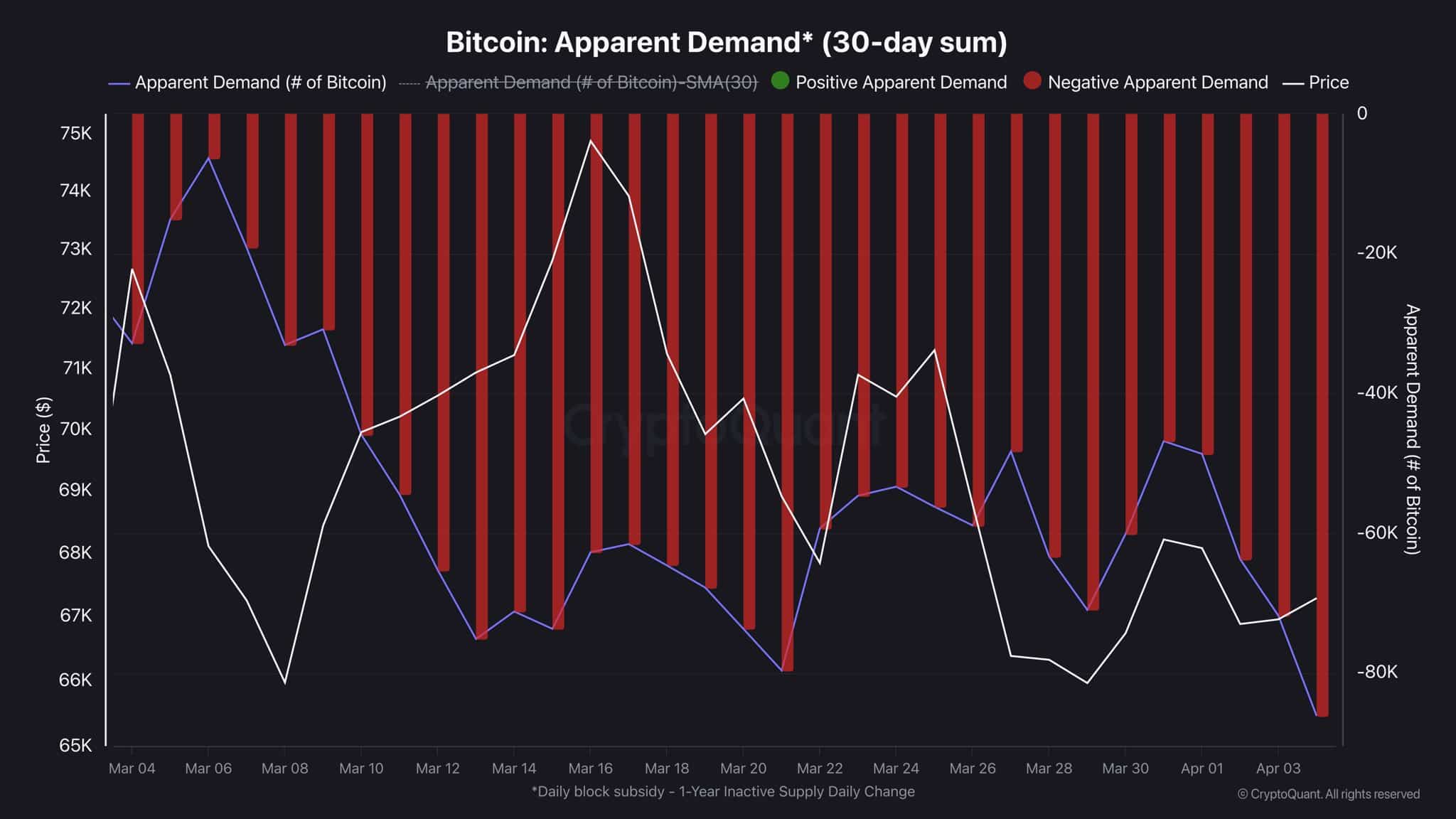
Bitcoin Apparent Demand, a key metric used to assess whether newly issued supply is being absorbed, suggests that April has opened on a weak footing. The metric measures the difference between Bitcoin issuance and the volume of coins that remain inactive for over one year.

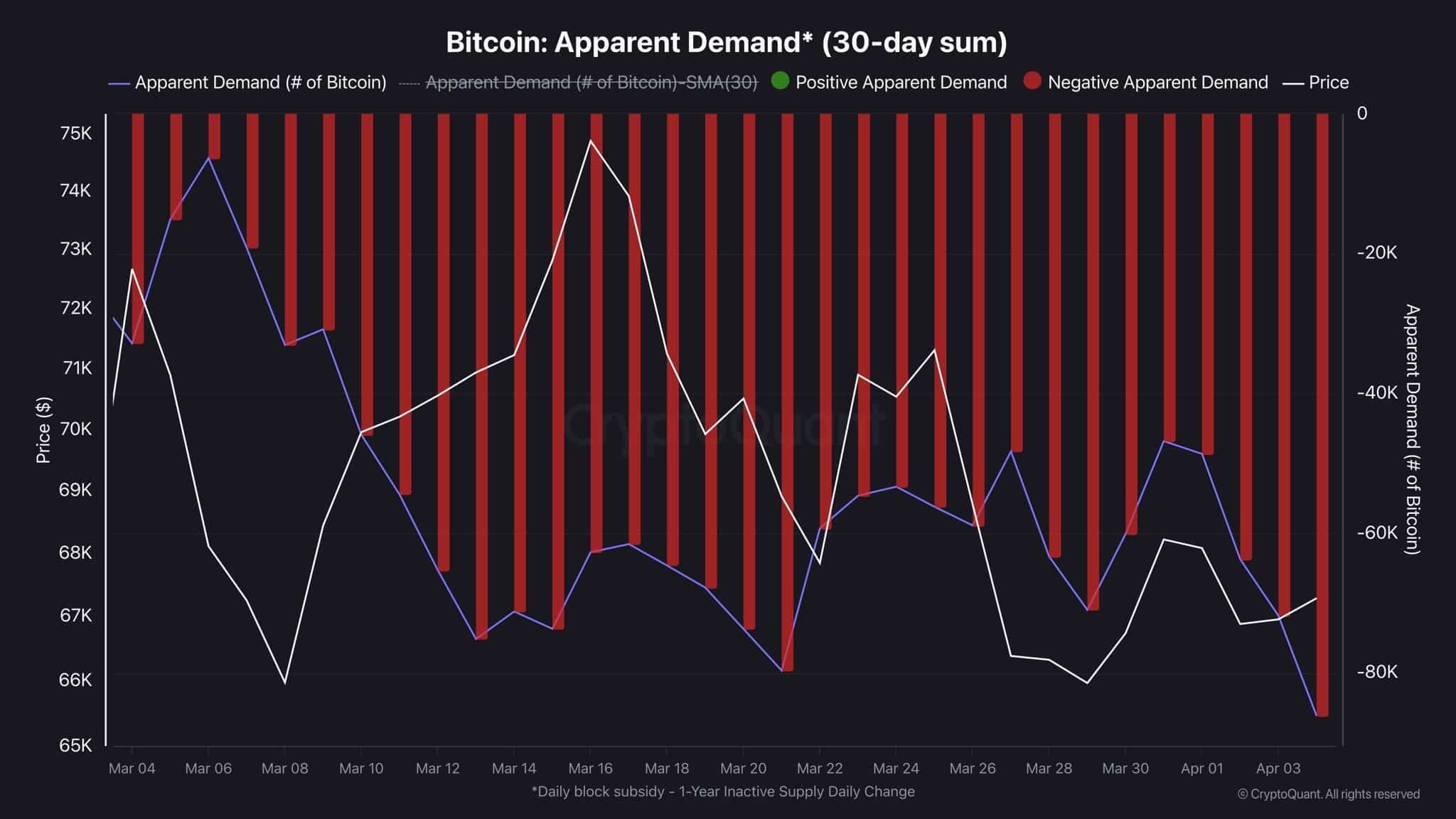
Recent data shows apparent demand has dropped to negative 86,000 BTC, equivalent to approximately $5.95 billion at press time. This indicates that newly supplied Bitcoin is not being sufficiently absorbed, reflecting weak market demand rather than strength.
Source: CryptoQuant

There is currently a clear relationship between apparent demand and price action.

A sustained negative trend in demand typically aligns with downward price pressure. Notably, this marks the weakest reading in over a month, reinforcing concerns about underlying market structure.

Long-term holders shift to distribution

Long-term holders are contributing to this weakness. This cohort, historically associated with accumulation and low selling activity, now appears to be distributing.

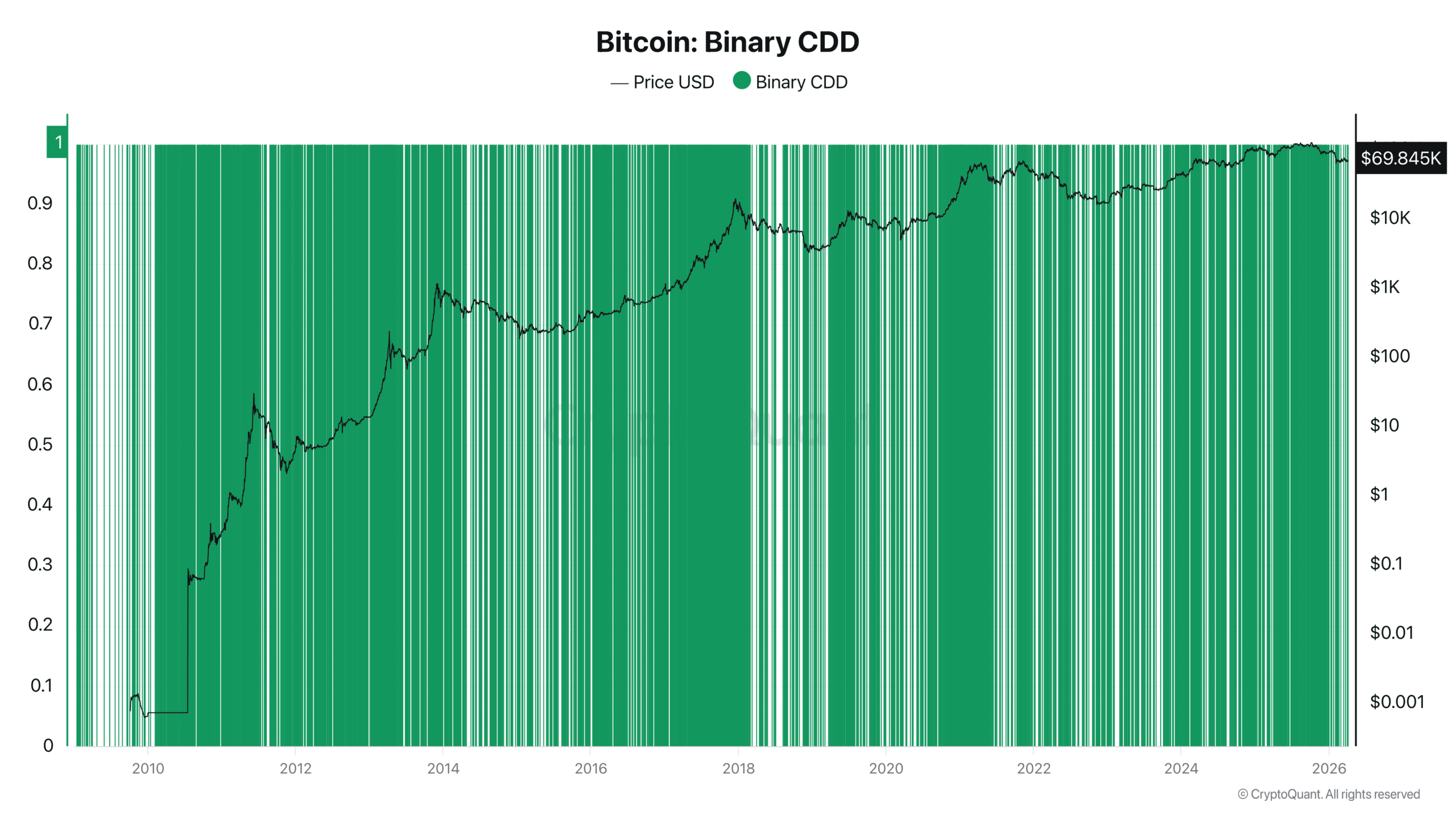
Data from CryptoQuant shows the Binary Coin Days Destroyed (CDD) has reached 1. When this metric prints 1, it signals that older coins are being moved, an event commonly associated with selling activity from long-term holders.
Source: CryptoQuant

If sustained, this behavior could weigh further on Bitcoin’s price outlook. In contrast, whales are taking the opposite stance. Large holders have increased their presence in the market as Bitcoin attempts to recover.

Spot average order size data shows that whales, particularly larger entities, have dominated trading activity across major exchanges in recent sessions. Their orders account for a significant share of volume, positioning them as key drivers of short-term momentum.

Given Bitcoin’s recent rebound, this activity suggests that whales have turned tactically bullish, at least over the past 48 hours.

Whale activity alone may not sustain the rally

However, relying on whale accumulation as a standalone signal remains risky. Whale behavior is often reactive and can shift quickly with market conditions.

AMBCrypto previously reported that in Q1, Bitcoin investors holding between 100 and 10,000 BTC recorded combined losses of $30.9 billion, with whales accounting for an average daily loss of $337 million. This context underscores that large holders are not infallible, and periods of accumulation do not always translate into sustained upward trends.

With long-term holders distributing and apparent demand reflecting weak supply absorption, the current whale-driven momentum may lack the fundamental backing required for a sustained rally.


Final Summary

  • Bitcoin’s apparent demand has fallen to negative 86,000 BTC, worth about $5.95 billion, pointing to weak absorption of supply.
  • Long-term holders are distributing while whales accumulate, creating a divergence in market behavior.


Trending Cryptos

Related Questions

QWhat is Bitcoin's Apparent Demand and what does its negative value of 86,000 BTC indicate?

ABitcoin Apparent Demand is a metric that measures the difference between Bitcoin issuance and the volume of coins that remain inactive for over one year. A negative value of 86,000 BTC, equivalent to $5.95 billion, indicates that newly supplied Bitcoin is not being sufficiently absorbed by the market, reflecting weak underlying demand rather than strength.

QWhat does a Binary Coin Days Destroyed (CDD) value of 1 signify for long-term Bitcoin holders?

AA Binary Coin Days Destroyed (CDD) value of 1 signals that older coins are being moved, an event commonly associated with selling activity from long-term holders. This indicates a shift from their historical behavior of accumulation to distribution.

QHow are whale activities contrasting with the actions of long-term holders in the current Bitcoin market?

AWhile long-term holders are distributing (selling) their coins, whales (large holders) are accumulating. Data shows that whales have dominated recent trading activity on major exchanges, positioning them as key drivers of the short-term momentum in Bitcoin's price.

QAccording to the article, why might whale accumulation alone be insufficient to sustain a Bitcoin price rally?

AWhale accumulation alone is a risky signal because whale behavior is often reactive and can shift quickly with market conditions. Furthermore, with long-term holders distributing and apparent demand remaining weak, the whale-driven momentum lacks the broad, fundamental backing required for a sustained rally.

QWhat was the financial impact on Bitcoin investors holding between 100 and 10,000 BTC in Q1, as mentioned in the article?

AIn Q1, Bitcoin investors holding between 100 and 10,000 BTC recorded combined losses of $30.9 billion. Whales within this group accounted for an average daily loss of $337 million.

Related Reads

Pax Silica vs. WAICO: The US Wants to Prohibit Europe from Using Chinese Artificial Intelligence

The United States is preparing to demand that European and other partners abandon Chinese artificial intelligence initiatives, threatening exclusion from the American-led "Pax Silica" coalition, according to a leaked U.S. State Department document. This ultimatum forces signatories of the "AI Opportunity Statement" to choose between the Western technological ecosystem and alternative frameworks, with China not explicitly named but clearly targeted. Pax Silica is a U.S. strategy for AI and semiconductor hegemony, launched in late 2025. Its European presence expanded significantly in mid-2026. Concurrently, China, Russia, and 27 other nations established the World AI Cooperation Organization (WAICO) in July 2026 as an independent intergovernmental platform promoting AI governance based on UN principles. This situation creates a difficult choice, especially for European nations balancing strategic autonomy with dependence on U.S. tech and security. It also pressures Global South countries with pragmatic ties to both Washington and Beijing. The formation of competing blocks risks fragmenting the global tech landscape, forcing companies to split supply chains, increasing costs, and potentially leading to incompatible standards and protocols. The era of open globalization in AI may be ending, replaced by geopolitical confrontation where technological sovereignty trumps economic efficiency. The decisions made will shape the global digital economy for decades.

cryptonews.ru1h ago

Pax Silica vs. WAICO: The US Wants to Prohibit Europe from Using Chinese Artificial Intelligence

cryptonews.ru1h ago

Robert Kiyosaki Shares His Mentor's Predictions About the Emergence of Bitcoin and AI

American entrepreneur and author of "Rich Dad Poor Dad," Robert Kiyosaki, discussed the influence of futurist R. Buckminster Fuller on his worldview, linking Fuller's past technological predictions to the emergence of Bitcoin and the development of artificial intelligence. In an X post, Kiyosaki also reflected on personal purpose, sharing his journey from the music business—where he worked with bands like The Police and Iron Maiden—to creating the "Cashflow" board game and writing his famous book. He described feeling an inner emptiness despite his success, a turning point that came after meeting Fuller, whom he studied with for three summers. Kiyosaki described Fuller as a "friendly genius" who foresaw world-changing developments like Bitcoin and AI. However, the core of his post focused on Fuller's philosophical impact, particularly a quote about belonging to the universe and finding purpose by dedicating one's life to the maximum benefit of others. The entrepreneur remains a vocal advocate for cryptocurrencies. He regularly advises buying Bitcoin during market panics, viewing it and assets like Ethereum, gold, and silver as hedges against traditional financial system failures. Kiyosaki has predicted a major market crash by 2026, seeing it as an opportunity for prepared investors, with long-term price targets including $750,000 for Bitcoin and $95,000 for Ethereum.

cryptonews.ru3h ago

Robert Kiyosaki Shares His Mentor's Predictions About the Emergence of Bitcoin and AI

cryptonews.ru3h ago

Etherealize CEO Calls Wall Street's Private Blockchains a 'Race to the Bottom'

Etherealize co-founder and CEO Vivek Raman criticized Wall Street's growing interest in private, permissioned blockchains, calling them a "race to the bottom." In an interview with CoinDesk, Raman argued that consortium networks fragment liquidity and return the industry to the siloed systems that blockchain technology was meant to overcome. He stated that closed networks do not interoperate, undermining two key advantages of the technology: system compatibility and liquidity concentration. Etherealize promotes Ethereum as an open, foundational layer for institutional players. Raman insists that privacy and access restrictions should be built on top of public infrastructure—at the application or L2 level—rather than creating separate, closed networks. He compared Ethereum to HTTP as a base layer, with additional permissioned and private layers akin to HTTPS. Examples of this new wave of "closed" solutions mentioned include Canton Network from Digital Asset, Circle's Arc project, and Stripe's Tempo. Raman termed this trend "consortium chains 2.0," recalling earlier initiatives like the R3 interbank consortium and the Hyperledger corporate ecosystem from 2016 that failed to gain significant traction. He reiterated his firm belief that a global, open, permissionless infrastructure is necessary as a foundational base layer. Raman previously noted in June that traditional financial institutions had begun implementing Ethereum-based solutions into real business processes.

cryptonews.ru3h ago

Etherealize CEO Calls Wall Street's Private Blockchains a 'Race to the Bottom'

cryptonews.ru3h ago

Trading

Spot

Hot Articles

What is $BITCOIN

DIGITAL GOLD ($BITCOIN): A Comprehensive Analysis Introduction to DIGITAL GOLD ($BITCOIN) DIGITAL GOLD ($BITCOIN) is a blockchain-based project operating on the Solana network, which aims to combine the characteristics of traditional precious metals with the innovation of decentralized technologies. While it shares a name with Bitcoin, often referred to as “digital gold” due to its perception as a store of value, DIGITAL GOLD is a separate token designed to create a unique ecosystem within the Web3 landscape. Its goal is to position itself as a viable alternative digital asset, although specifics regarding its applications and functionalities are still developing. What is DIGITAL GOLD ($BITCOIN)? DIGITAL GOLD ($BITCOIN) is a cryptocurrency token explicitly designed for use on the Solana blockchain. In contrast to Bitcoin, which provides a widely recognized value storage role, this token appears to focus on broader applications and characteristics. Notable aspects include: Blockchain Infrastructure: The token is built on the Solana blockchain, known for its capacity to handle high-speed and low-cost transactions. Supply Dynamics: DIGITAL GOLD has a maximum supply capped at 100 quadrillion tokens (100P $BITCOIN), although details regarding its circulating supply are currently undisclosed. Utility: While precise functionalities are not explicitly outlined, there are indications that the token could be utilized for various applications, potentially involving decentralized applications (dApps) or asset tokenization strategies. Who is the Creator of DIGITAL GOLD ($BITCOIN)? At present, the identity of the creators and development team behind DIGITAL GOLD ($BITCOIN) remains unknown. This situation is typical among many innovative projects within the blockchain space, particularly those aligning with decentralized finance and meme coin phenomena. While such anonymity may foster a community-driven culture, it intensifies concerns about governance and accountability. Who are the Investors of DIGITAL GOLD ($BITCOIN)? The available information indicates that DIGITAL GOLD ($BITCOIN) does not have any known institutional backers or prominent venture capital investments. The project seems to operate on a peer-to-peer model focused on community support and adoption rather than traditional funding routes. Its activity and liquidity are primarily situated on decentralized exchanges (DEXs), such as PumpSwap, rather than established centralized trading platforms, further highlighting its grassroots approach. How DIGITAL GOLD ($BITCOIN) Works The operational mechanics of DIGITAL GOLD ($BITCOIN) can be elaborated on based on its blockchain design and network attributes: Consensus Mechanism: By leveraging Solana’s unique proof-of-history (PoH) combined with a proof-of-stake (PoS) model, the project ensures efficient transaction validation contributing to the network's high performance. Tokenomics: While specific deflationary mechanisms have not been extensively detailed, the vast maximum token supply implies that it may cater to microtransactions or niche use cases that are still to be defined. Interoperability: There exists the potential for integration with Solana’s broader ecosystem, including various decentralized finance (DeFi) platforms. However, the details regarding specific integrations remain unspecified. Timeline of Key Events Here is a timeline that highlights significant milestones concerning DIGITAL GOLD ($BITCOIN): 2023: The initial deployment of the token occurs on the Solana blockchain, marked by its contract address. 2024: DIGITAL GOLD gains visibility as it becomes available for trading on decentralized exchanges like PumpSwap, allowing users to trade it against SOL. 2025: The project witnesses sporadic trading activity and potential interest in community-led engagements, although no noteworthy partnerships or technical advancements have been documented as of yet. Critical Analysis Strengths Scalability: The underlying Solana infrastructure supports high transaction volumes, which could enhance the utility of $BITCOIN in various transaction scenarios. Accessibility: The potential low trading price per token could attract retail investors, facilitating wider participation due to fractional ownership opportunities. Risks Lack of Transparency: The absence of publicly known backers, developers, or an audit process may yield skepticism regarding the project's sustainability and trustworthiness. Market Volatility: The trading activity is heavily reliant on speculative behavior, which can result in significant price volatility and uncertainty for investors. Conclusion DIGITAL GOLD ($BITCOIN) emerges as an intriguing yet ambiguous project within the rapidly evolving Solana ecosystem. While it attempts to leverage the “digital gold” narrative, its departure from Bitcoin's established role as a store of value underscores the need for a clearer differentiation of its intended utility and governance structure. Future acceptance and adoption will likely depend on addressing the current opacity and defining its operational and economic strategies more explicitly. Note: This report encompasses synthesised information available as of October 2023, and developments may have transpired beyond the research period.

1.9k Total ViewsPublished 2025.05.13Updated 2025.05.13

What is $BITCOIN

Discussions

Welcome to the HTX Community. Here, you can stay informed about the latest platform developments and gain access to professional market insights. Users' opinions on the price of BTC (BTC) are presented below.

活动图片