Bitcoin Miners Set To See Major Relief: 13% Difficulty Ease Coming

bitcoinistPublished on 2026-02-07Last updated on 2026-02-07

Abstract

Bitcoin mining difficulty is set to decrease by approximately 13% in the upcoming adjustment on February 6th. This reduction is a response to a recent slowdown in average block production time, which increased to 11.52 minutes—above the target 10-minute rate. The slowdown was caused by a sharp drop in the global hashrate following a major U.S. snow storm that disrupted power infrastructure, forcing American miners, including the world’s largest mining pool Foundry USA, to reduce operations. Although the hashrate has since partially recovered, the difficulty adjustment is based on the average block time over the past two weeks, making the decrease inevitable. Meanwhile, Bitcoin’s price recently dropped to $60,000 but has rebounded to around $69,300.

The Bitcoin mining Difficulty is set to see a significant reduction on Saturday, owing to the Hashrate disruption caused by the US snow storm.

Bitcoin Difficulty Is Estimated To Go Down 13% During The Next Adjustment

The Bitcoin “Difficulty” is a metric built into the blockchain that controls how hard miners will find it to mine the next block on the network. This indicator’s value automatically changes roughly every two weeks, based on the speed at which miners performed their task since the previous adjustment.

The next such adjustment is scheduled to occur tomorrow, February 6th. According to data from CoinWarz, the network will reduce the Difficulty during this event.

How the blockchain determines whether to increase or decrease the Difficulty is simple: it tries to bring block time back to the standard 10 minutes that Satoshi coded in for the network to follow. Whenever miners produce the average block in a time faster than this, the network responds by raising its Difficulty just enough that miners take 10 minutes between each block again. Similarly, the validators being slow forces BTC to ease the metric.

Since the last adjustment, the average block time has stood at 11.52 minutes, which is much slower than the expected value. As a result of this, Bitcoin is estimated to reduce its Difficulty by a massive 13% during the Saturday adjustment.
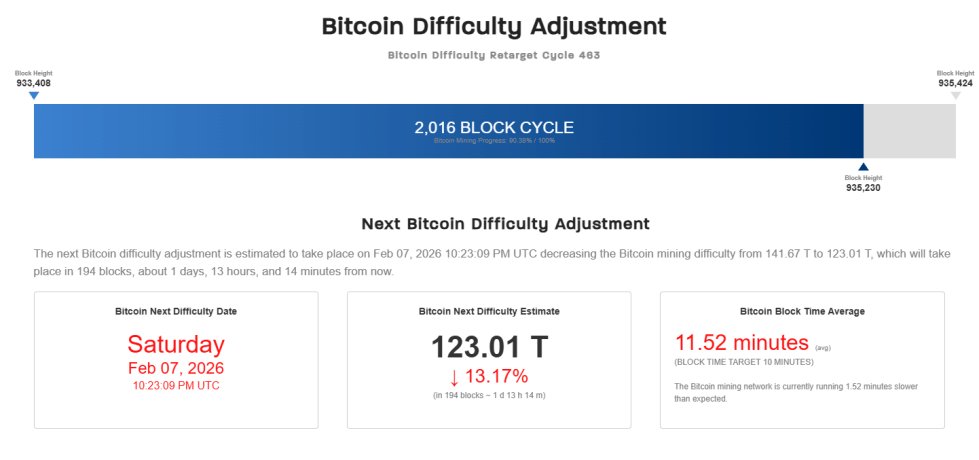
The details related to the upcoming Difficulty adjustment | Source: CoinWarz

The reason for the drastic change in Difficulty lies in the crash that the Bitcoin Hashrate has witnessed recently. The “Hashrate” is an indicator that measures the total amount of computing power that miners as a whole have connected to the network.

As data from Blockchain.com shows, this metric’s 7-day average value has observed a sharp decline since January 24th.
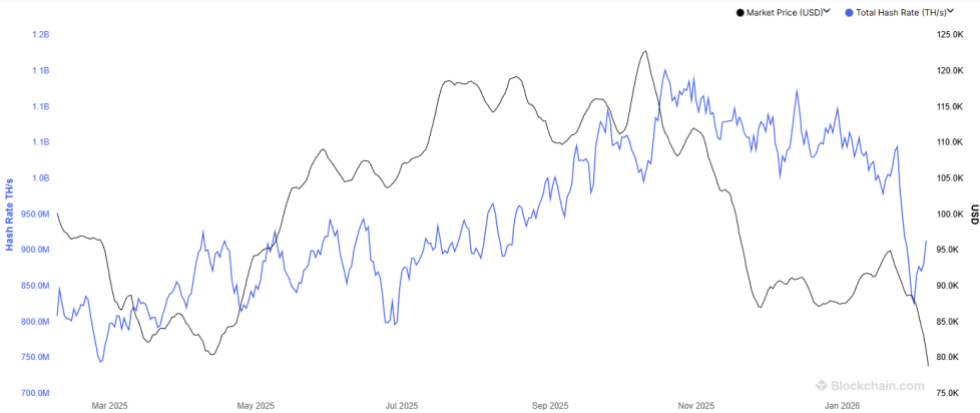
How the BTC mining Hashrate has changed during the past year | Source: Blockchain.com

On January 24th, the 7-day average Bitcoin Hashrate stood at 1,044 exahashes per second (EH/s). By the end of the month, that value had dropped to just 825 EH/s. This was an unusually rapid drawdown for the indicator, and it indeed had an unusual cause behind it: the US snow storm.

The winter storm disrupted various parts of the nation’s infrastructure, including power. To ease pressure on the grid, American Bitcoin miners curtailed their electricity consumption, which led to Foundary USA, the largest mining pool in the world, witnessing a Hashrate drop of nearly 60%.

In February so far, the US miners have started to bounce back, with the global 7-day average Hashrate returning to 913 EH/s. The decline in the Hashrate only being temporary doesn’t matter to the Difficulty, however, since the network only considers the average block time from the last two weeks.

The fact that the miners produced blocks at a slow rate during this window is already set in stone, so the Bitcoin network has no option other than reducing the Difficulty in the next adjustment.

BTC Price

Bitcoin plummeted all the way down to $60,000 on Thursday, but the cryptocurrency has since bounced back as it’s now trading around $69,300.

The trend in the price of the coin over the last five days | Source: BTCUSDT on TradingView


Related Questions

QWhat is the Bitcoin mining Difficulty and why is it set to decrease by 13%?

AThe Bitcoin mining Difficulty is a metric that controls how hard it is for miners to mine the next block. It is set to decrease by 13% because the average block time has been slower than the target 10 minutes, primarily due to a drop in Hashrate caused by the US snow storm.

QHow does the Bitcoin network determine whether to increase or decrease the Difficulty?

AThe network adjusts the Difficulty based on the average block time. If blocks are produced faster than 10 minutes, the Difficulty increases; if slower, it decreases, aiming to maintain the 10-minute block time standard.

QWhat caused the recent sharp decline in Bitcoin's Hashrate?

AThe decline was caused by the US snow storm, which disrupted power infrastructure. American Bitcoin miners reduced electricity consumption to ease pressure on the grid, leading to a significant drop in Hashrate.

QWhen is the next Bitcoin Difficulty adjustment scheduled to occur?

AThe next Difficulty adjustment is scheduled to occur on Saturday, February 6th.

QHow did the Bitcoin price react recently, and what is its current trading level?

ABitcoin plummeted to $60,000 on Thursday but has since bounced back and is now trading around $69,300.

Related Reads

Has the 'Digital Gold' Narrative for BTC Failed?

**Title: Has the "Digital Gold" Narrative for Bitcoin Failed?** The article argues that Bitcoin's "digital gold" narrative remains valid despite a recent sharp price decline (from a peak near $126k in Oct 2025 to briefly under $61k in Feb 2026). It presents a long-term investment framework based on three core points: **1. Viewing Bitcoin as an Asset:** Bitcoin is presented as a superior potential store of value compared to gold. Key arguments are its absolute scarcity (21 million cap), superior portability, and transparent auditability via its public ledger. While acknowledging its current use in early, volatile stages (~3-4% global adoption), the author draws parallels to the early, disruptive phases of the internet and e-commerce. **2. Understanding the Recent Downturn:** The current ~50% correction is framed as a predictable, consensus-driven cycle following its post-halving peak (the 2024 halving preceded the Oct 2025 high). A crucial factor is a historic "changing of hands": the influx of new institutional buyers via ETFs allowed early, low-cost holders (miners, OG believers) to take profits. The author notes that while severe, Bitcoin's historical drawdowns (e.g., 93% in 2011, 77% in 2021-22) have been progressively smaller, suggesting maturing holder structure and decreasing volatility over time. **3. The Long-Term Perspective:** The long-term thesis hinges on Bitcoin capturing a portion of gold's market value. With Bitcoin's market cap at ~$1.4 trillion (at $70k) versus gold's ~$20 trillion, significant upside potential exists if the "digital gold" narrative is partially realized. However, the author strongly cautions that short-term risks remain, the bottom is unpredictable, and high volatility is inherent. The real risk is not Bitcoin failing but poor personal position management (over-leverage, wrong capital) and a lack of deep understanding, which can force investors out during severe downturns. The conclusion uses Amazon's 95% crash post-2000 dot-com bubble and subsequent 42x recovery as an analogy. The ultimate question is not if Bitcoin's price will rise, but if an investor's strategy and conviction can withstand the volatility to see the long-term play out. The recent divergence (gold up, Bitcoin down) is posed not as a narrative failure, but as potential evidence of this ongoing, painful transition from a speculative asset to a mainstream allocation.

marsbit24m ago

Has the 'Digital Gold' Narrative for BTC Failed?

marsbit24m ago

Has BTC's 'Digital Gold' Narrative Failed?

The article discusses Bitcoin's "digital gold" narrative, its recent price drop, and long-term outlook through the perspective of "Jason". It argues the narrative is not a failure but that Bitcoin represents a superior, new asset class due to its fixed supply (21 million), portability, and auditability. The piece compares its current ~3-4% global adoption rate to early internet/e-commerce, suggesting significant growth potential. Regarding the 2025-2026 price decline (from ~$126k to briefly under $61k), the author views it as a predictable, consensus-driven sell-off within Bitcoin's ~4-year cycle post-halving, exacerbated by a major "handover" from early, low-cost holders to new institutional buyers via ETFs. A key observation is that historical peak-to-trough drawdowns have lessened over time (e.g., 93% in 2011 to ~50% in 2026), indicating maturing volatility as holder structure changes. For the long term, the author uses a simple framework: Bitcoin's total market cap (~$1.4T at $70k) is only about 7% of gold's (~$20T). Even capturing 30-50% of gold's value would imply substantial upside. However, the article strongly cautions against viewing this as investment advice, emphasizing extreme volatility and the critical importance of risk management, position sizing, and deep fundamental understanding to survive severe drawdowns. It concludes by drawing a parallel to Amazon's 95% crash in 2000 and subsequent 42x recovery, stressing that the key is surviving market cycles to realize long-term potential.

链捕手34m ago

Has BTC's 'Digital Gold' Narrative Failed?

链捕手34m ago

From Code to Cognition: A Ten-Thousand-Word Guide to the Evolution of the Robot Brain

"From Code to Cognition: The Evolution of Robot Brains" The journey of robotic intelligence has shifted dramatically from manually coded systems to AI-driven brains. For decades, robots relied on layered software stacks—perception, state estimation, planning, control—each handcrafted. While predictable, they lacked adaptability. The 2010s saw deep learning revolutionize perception (e.g., object detection) and control (via reinforcement learning), but learned skills remained narrow. The arrival of Large Language Models (LLMs) marked a turning point. LLMs acted as high-level planners, interpreting natural language instructions and generating sequences of actions for traditional robotic systems to execute. However, true integration came with Visual-Language-Action (VLA) models, which fused vision, language, and motion prediction into a single network. Pioneered by models like RT-2 and open-source projects like OpenVLA, VLAs enable robots to reason and act directly from visual input and commands. The most advanced humanoid robots now employ a "dual-brain" architecture: a slow-thinking, large VLA (System 2) for reasoning and planning, and a fast-reacting, small network (System 1) for high-frequency motion control, sometimes with an even lower-level System 0 for balance. This split balances cognition with the physics of real-time movement. Computation is split between onboard hardware (e.g., NVIDIA Jetson) for safety-critical control loops and cloud/edge servers for non-critical tasks like learning and interfaces. A crucial driver is the open-source ecosystem—models like GR00T and OpenVLA allow startups to build upon pre-trained brains and fine-tune them with their own data, accelerating development. Despite progress, current systems struggle with recovery from errors, sample inefficiency, and long-horizon tasks. This has spurred the rise of **World Models**—neural networks that predict the consequences of actions. By simulating possible futures before acting (like NVIDIA Cosmos or Meta V-JEPA), robots can plan, recover, and generalize better. This represents the next frontier: shifting intelligence from learned reactions to an internal model of physics and cause-and-effect. The field is rapidly evolving. While not yet at its "ChatGPT moment," the convergence of cheaper hardware, scalable simulation, and world models points toward robots that are increasingly capable, adaptive, and useful. The question is shifting from "what can robots do?" to "what *should* they do?"

marsbit1h ago

From Code to Cognition: A Ten-Thousand-Word Guide to the Evolution of the Robot Brain

marsbit1h ago

AI Bubble Is Bursting

The AI Bubble is Bursting: A Necessary Purge on the Path to Ubiquitous Intelligence Market volatility has reignited debates about an AI bubble, with figures like Ray Dalio pointing to high valuations. However, this parallels the dot-com bubble, which, despite its crash, laid the physical infrastructure for today's internet era. The current AI investment frenzy, with tech giants planning trillions in infrastructure spending far outstripping current AI application revenues, appears similarly imbalanced. This 'bubble' is seen as an inevitable phase for a disruptive technology, paying the "innovation tax." Critically, AI inference costs have plummeted over 99.7% since 2023, making intelligence nearly free at the margin. This hasn't reduced spending but has instead unlocked massive new demand, as seen in enterprise AI cloud expenditure tripling. This follows the Jevons Paradox: efficiency gains lead to greater total consumption. The market is now entering a cleansing phase, weeding out speculative ventures lacking real moats. The deeper shift is a move from capital expenditure (CapEx) on hardware to value creation in operational expenditure (OpEx) through AI applications that solve real industry problems. While infrastructure valuations are high, rapid earnings growth from widespread AI adoption across sectors—from manufacturing and finance to law and healthcare—may digest these valuations over time. Ultimately, this creative destruction will leave behind robust infrastructure and optimized models, cheaply powering an AI-augmented future for all industries, much as the internet became indispensable after its own bubble burst. The core productive potential remains undiminished.

链捕手1h ago

AI Bubble Is Bursting

链捕手1h ago

Trading

Spot
Futures

Hot Articles

What is $BITCOIN

DIGITAL GOLD ($BITCOIN): A Comprehensive Analysis Introduction to DIGITAL GOLD ($BITCOIN) DIGITAL GOLD ($BITCOIN) is a blockchain-based project operating on the Solana network, which aims to combine the characteristics of traditional precious metals with the innovation of decentralized technologies. While it shares a name with Bitcoin, often referred to as “digital gold” due to its perception as a store of value, DIGITAL GOLD is a separate token designed to create a unique ecosystem within the Web3 landscape. Its goal is to position itself as a viable alternative digital asset, although specifics regarding its applications and functionalities are still developing. What is DIGITAL GOLD ($BITCOIN)? DIGITAL GOLD ($BITCOIN) is a cryptocurrency token explicitly designed for use on the Solana blockchain. In contrast to Bitcoin, which provides a widely recognized value storage role, this token appears to focus on broader applications and characteristics. Notable aspects include: Blockchain Infrastructure: The token is built on the Solana blockchain, known for its capacity to handle high-speed and low-cost transactions. Supply Dynamics: DIGITAL GOLD has a maximum supply capped at 100 quadrillion tokens (100P $BITCOIN), although details regarding its circulating supply are currently undisclosed. Utility: While precise functionalities are not explicitly outlined, there are indications that the token could be utilized for various applications, potentially involving decentralized applications (dApps) or asset tokenization strategies. Who is the Creator of DIGITAL GOLD ($BITCOIN)? At present, the identity of the creators and development team behind DIGITAL GOLD ($BITCOIN) remains unknown. This situation is typical among many innovative projects within the blockchain space, particularly those aligning with decentralized finance and meme coin phenomena. While such anonymity may foster a community-driven culture, it intensifies concerns about governance and accountability. Who are the Investors of DIGITAL GOLD ($BITCOIN)? The available information indicates that DIGITAL GOLD ($BITCOIN) does not have any known institutional backers or prominent venture capital investments. The project seems to operate on a peer-to-peer model focused on community support and adoption rather than traditional funding routes. Its activity and liquidity are primarily situated on decentralized exchanges (DEXs), such as PumpSwap, rather than established centralized trading platforms, further highlighting its grassroots approach. How DIGITAL GOLD ($BITCOIN) Works The operational mechanics of DIGITAL GOLD ($BITCOIN) can be elaborated on based on its blockchain design and network attributes: Consensus Mechanism: By leveraging Solana’s unique proof-of-history (PoH) combined with a proof-of-stake (PoS) model, the project ensures efficient transaction validation contributing to the network's high performance. Tokenomics: While specific deflationary mechanisms have not been extensively detailed, the vast maximum token supply implies that it may cater to microtransactions or niche use cases that are still to be defined. Interoperability: There exists the potential for integration with Solana’s broader ecosystem, including various decentralized finance (DeFi) platforms. However, the details regarding specific integrations remain unspecified. Timeline of Key Events Here is a timeline that highlights significant milestones concerning DIGITAL GOLD ($BITCOIN): 2023: The initial deployment of the token occurs on the Solana blockchain, marked by its contract address. 2024: DIGITAL GOLD gains visibility as it becomes available for trading on decentralized exchanges like PumpSwap, allowing users to trade it against SOL. 2025: The project witnesses sporadic trading activity and potential interest in community-led engagements, although no noteworthy partnerships or technical advancements have been documented as of yet. Critical Analysis Strengths Scalability: The underlying Solana infrastructure supports high transaction volumes, which could enhance the utility of $BITCOIN in various transaction scenarios. Accessibility: The potential low trading price per token could attract retail investors, facilitating wider participation due to fractional ownership opportunities. Risks Lack of Transparency: The absence of publicly known backers, developers, or an audit process may yield skepticism regarding the project's sustainability and trustworthiness. Market Volatility: The trading activity is heavily reliant on speculative behavior, which can result in significant price volatility and uncertainty for investors. Conclusion DIGITAL GOLD ($BITCOIN) emerges as an intriguing yet ambiguous project within the rapidly evolving Solana ecosystem. While it attempts to leverage the “digital gold” narrative, its departure from Bitcoin's established role as a store of value underscores the need for a clearer differentiation of its intended utility and governance structure. Future acceptance and adoption will likely depend on addressing the current opacity and defining its operational and economic strategies more explicitly. Note: This report encompasses synthesised information available as of October 2023, and developments may have transpired beyond the research period.

363 Total ViewsPublished 2025.05.13Updated 2025.05.13

What is $BITCOIN

Discussions

Welcome to the HTX Community. Here, you can stay informed about the latest platform developments and gain access to professional market insights. Users' opinions on the price of BTC (BTC) are presented below.

活动图片