Bitcoin Long-Term Holders Lead $1.35 Billion Capitulation: Glassnode

bitcoinistPublished on 2026-06-04Last updated on 2026-06-04

Abstract

Glassnode reports that the recent Bitcoin price crash triggered a significant $1.35 billion daily capitulation event, marked by a sharp spike in Realized Loss. Notably, long-term holders (LTHs), who purchased near the 2025 bull market highs, were responsible for the majority ($770 million) of this loss-taking, a shift from previous sell-offs dominated by short-term holders. The analytics firm notes this pattern of LTH capitulation is a recurring feature in bear market bottoming processes, though the current pace suggests it may be incomplete. The crash also led to substantial long liquidations in the futures market. Bitcoin is currently trading around $65,500, down over 12% in the past week.

Glassnode has highlighted how the latest Bitcoin crash triggered a $1.35 billion capitulation event, with long-term holders contributing the majority.

Bitcoin Realized Loss Has Witnessed A Spike Recently

In its latest weekly report, on-chain analytics firm Glassnode has discussed about the loss-taking panic that has accompanied the latest drawdown in the Bitcoin price. The indicator of relevance here is the Realized Loss, which measures, as its name suggests, the total amount of loss that BTC investors are realizing through their transactions every day.

Below is the chart shared by Glassnode that shows the trend in this metric for Bitcoin over the past year.
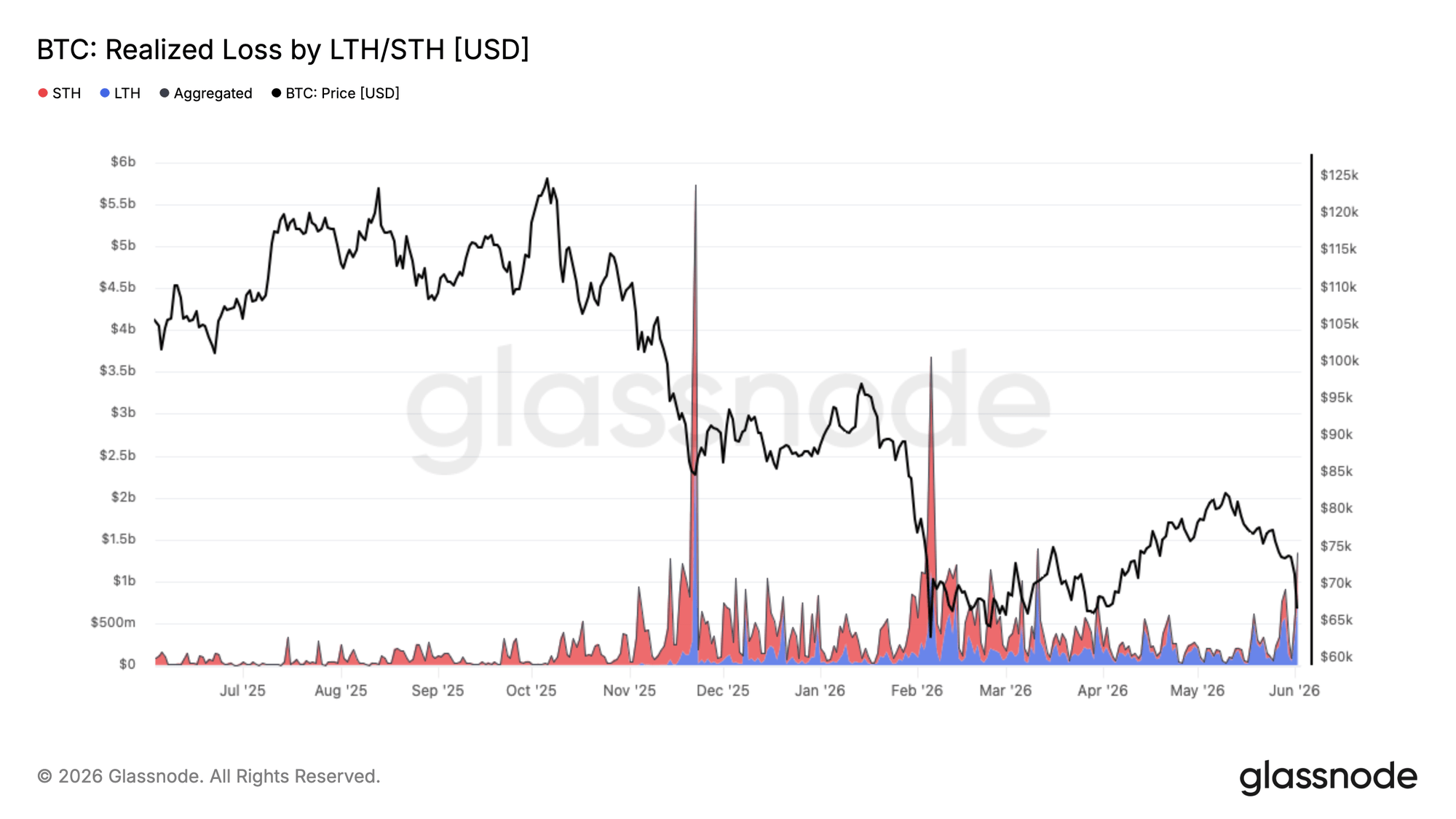
Looks like the value of the metric has shot up in recent days | Source: Glassnode's The Week Onchain - Week 22, 2026

From the graph, it’s visible that the Bitcoin Realized Loss has witnessed a sharp surge alongside the BTC price crash, indicating that investors have panic-exited the market at loss.

This isn’t anything unusual as capitulation tends to be a feature whenever the price goes down with a steep move; it’s apparent in the chart that the Realized Loss also spiked during the November and February crashes.

Compared to these two previous capitulation events, however, there are a couple of differences. The first and obvious one is the scale involved: the last two events saw loss-taking of a significantly higher level. This is naturally down to the fact that they involved price drawdowns of a larger degree.

The other difference is in the holder distribution. The last two capitulation events were dominated by short-term holders (STHs), investors who purchased their coins within the past 155 days.

These new market entrants also contributed to the latest event, but they didn’t account for the majority of the loss realization. Instead, long-term holders (LTHs) were the Bitcoin cohort driving the capitulation this time. These were the investors who bought prior to January 2026, at the highs of the 2025 bull market.

In total, the latest Realized Loss spike saw the indicator hit a value of $1.35 billion per day. Out of this, LTHs were responsible for $770 million of the daily loss-taking.

The analytics firm explained:

As the bear market matures, this pattern of long-term holder capitulation passing supply into new hands at lower prices is a recurring and necessary feature of cycle bottoming processes, though the current pace of loss realization suggests that process remains incomplete.

Another metric discussed by Glassnode in the report is the amount of liquidations in the futures market. The price plunge naturally caught out a large number of derivatives market traders, leading to a significant amount of long liquidations.
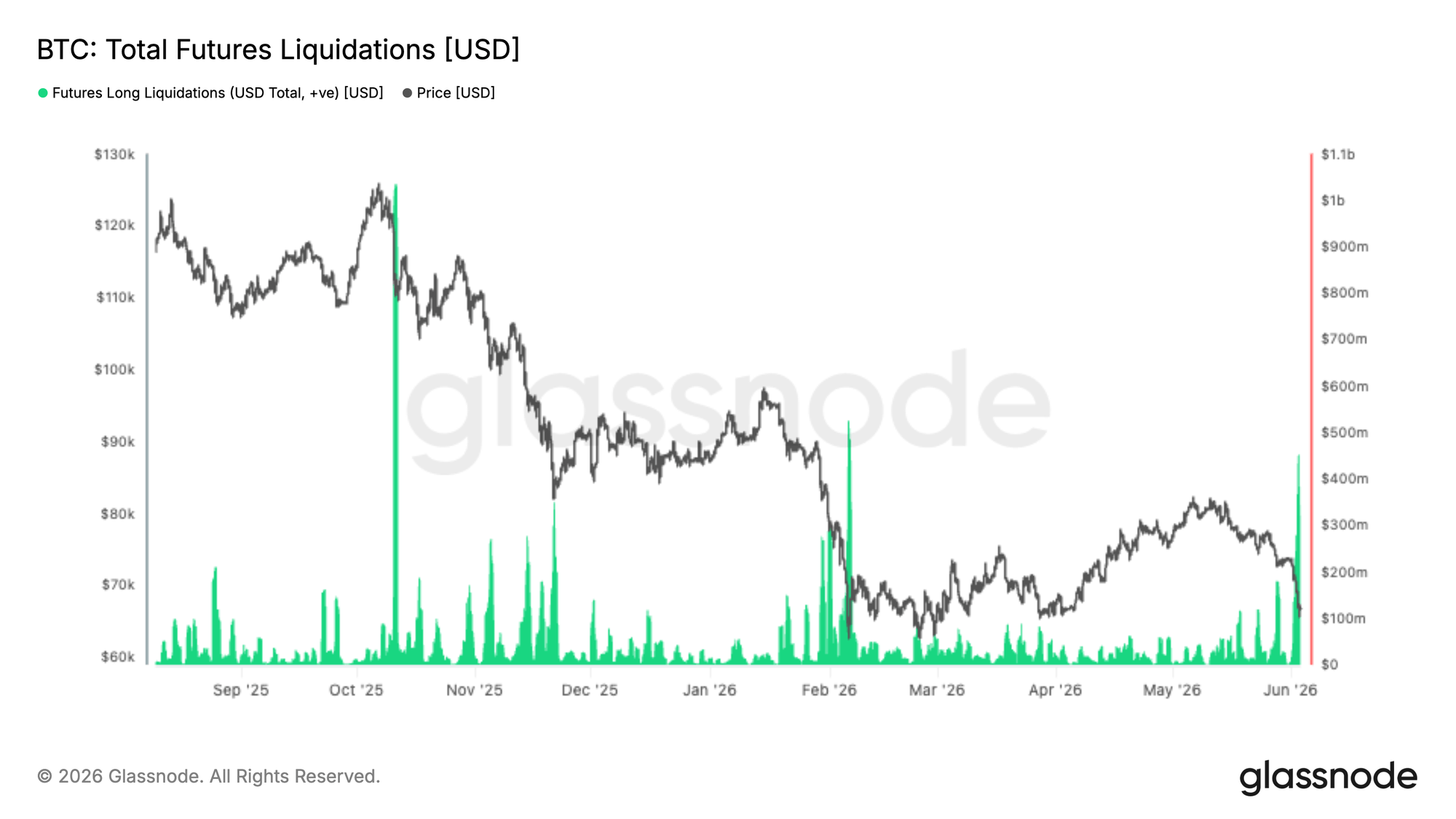
The trend in the BTC futures market liquidations over the past year | Source: Glassnode's The Week Onchain - Week 22, 2025

“Historically, large-scale long liquidations have coincided with local exhaustion points, as forced selling pressure cascades through derivatives markets and clears out weaker hands,” noted the analytics firm.

BTC Price

At the time of writing, Bitcoin is floating around $65,500, down over 12% in the last seven days.

The price of the coin seems to have declined recently | Source: BTCUSDT on TradingView


Related Questions

QWhat event triggered the $1.35 billion capitulation in the Bitcoin market according to Glassnode?

AThe latest Bitcoin crash triggered the $1.35 billion capitulation event.

QWhich group of Bitcoin holders was primarily responsible for the majority of the realized losses in the recent capitulation event?

ALong-term holders (LTHs), who bought prior to January 2026, were primarily responsible for the majority of the realized losses, accounting for $770 million of the daily loss-taking.

QHow does the scale of the recent Realized Loss spike compare to the capitulation events in November and February?

AThe scale of the recent Realized Loss spike was smaller compared to the capitulation events in November and February, which involved significantly higher levels of loss-taking due to larger price drawdowns.

QWhat is the significance of large-scale long liquidations in the futures market, as noted by Glassnode?

AAccording to Glassnode, large-scale long liquidations in the futures market have historically coincided with local exhaustion points, as forced selling pressure cascades through derivatives markets and clears out weaker hands.

QWhat was the approximate price of Bitcoin and its weekly performance at the time the article was written?

AAt the time of writing, Bitcoin was floating around $65,500, down over 12% in the last seven days.

Related Reads

What Are Some Good Paths for Chinese Web3 Entrepreneurship? (Part 5)

This article explores pathways for Chinese Web3 teams to pivot toward AI, building on a previous discussion. It focuses on two specific team profiles: **Security & Risk Control Teams:** These teams, skilled in smart contract auditing, wallet security, and on-chain monitoring, can transition to providing **Agent behavior auditing and AI security governance**. As AI Agents automate tasks, access data, and trigger payments, enterprises will need solutions to monitor permissions, audit logs, control data access, and prevent anomalies—creating a strong B2B demand. **Application & Community-Focused Teams:** Instead of completely rebranding as AI companies, these teams should use AI to **enhance their existing products**. For example, research platforms can use AI to summarize information and identify signals; community tools can automate user support and analysis; and educational products can create personalized learning paths. The key is integrating AI to solve existing user pain points, like information overload or high operational costs. The article also advises against certain AI directions for Chinese Web3 teams, such as building general-purpose large language models (too resource-intensive), creating overly broad Agent platforms (hard to monetize), developing AI traders/automated yield products (high regulatory and risk sensitivity), or simply adding superficial AI features without genuine value. The core conclusion: Successful migration depends not on chasing AI hype, but on **identifying how a team's existing Web3 capabilities—be it in data, payments, security, or user operations—can address real needs in new AI application scenarios.**

marsbit1h ago

What Are Some Good Paths for Chinese Web3 Entrepreneurship? (Part 5)

marsbit1h ago

Trading

Spot
Futures

Hot Articles

What is $BITCOIN

DIGITAL GOLD ($BITCOIN): A Comprehensive Analysis Introduction to DIGITAL GOLD ($BITCOIN) DIGITAL GOLD ($BITCOIN) is a blockchain-based project operating on the Solana network, which aims to combine the characteristics of traditional precious metals with the innovation of decentralized technologies. While it shares a name with Bitcoin, often referred to as “digital gold” due to its perception as a store of value, DIGITAL GOLD is a separate token designed to create a unique ecosystem within the Web3 landscape. Its goal is to position itself as a viable alternative digital asset, although specifics regarding its applications and functionalities are still developing. What is DIGITAL GOLD ($BITCOIN)? DIGITAL GOLD ($BITCOIN) is a cryptocurrency token explicitly designed for use on the Solana blockchain. In contrast to Bitcoin, which provides a widely recognized value storage role, this token appears to focus on broader applications and characteristics. Notable aspects include: Blockchain Infrastructure: The token is built on the Solana blockchain, known for its capacity to handle high-speed and low-cost transactions. Supply Dynamics: DIGITAL GOLD has a maximum supply capped at 100 quadrillion tokens (100P $BITCOIN), although details regarding its circulating supply are currently undisclosed. Utility: While precise functionalities are not explicitly outlined, there are indications that the token could be utilized for various applications, potentially involving decentralized applications (dApps) or asset tokenization strategies. Who is the Creator of DIGITAL GOLD ($BITCOIN)? At present, the identity of the creators and development team behind DIGITAL GOLD ($BITCOIN) remains unknown. This situation is typical among many innovative projects within the blockchain space, particularly those aligning with decentralized finance and meme coin phenomena. While such anonymity may foster a community-driven culture, it intensifies concerns about governance and accountability. Who are the Investors of DIGITAL GOLD ($BITCOIN)? The available information indicates that DIGITAL GOLD ($BITCOIN) does not have any known institutional backers or prominent venture capital investments. The project seems to operate on a peer-to-peer model focused on community support and adoption rather than traditional funding routes. Its activity and liquidity are primarily situated on decentralized exchanges (DEXs), such as PumpSwap, rather than established centralized trading platforms, further highlighting its grassroots approach. How DIGITAL GOLD ($BITCOIN) Works The operational mechanics of DIGITAL GOLD ($BITCOIN) can be elaborated on based on its blockchain design and network attributes: Consensus Mechanism: By leveraging Solana’s unique proof-of-history (PoH) combined with a proof-of-stake (PoS) model, the project ensures efficient transaction validation contributing to the network's high performance. Tokenomics: While specific deflationary mechanisms have not been extensively detailed, the vast maximum token supply implies that it may cater to microtransactions or niche use cases that are still to be defined. Interoperability: There exists the potential for integration with Solana’s broader ecosystem, including various decentralized finance (DeFi) platforms. However, the details regarding specific integrations remain unspecified. Timeline of Key Events Here is a timeline that highlights significant milestones concerning DIGITAL GOLD ($BITCOIN): 2023: The initial deployment of the token occurs on the Solana blockchain, marked by its contract address. 2024: DIGITAL GOLD gains visibility as it becomes available for trading on decentralized exchanges like PumpSwap, allowing users to trade it against SOL. 2025: The project witnesses sporadic trading activity and potential interest in community-led engagements, although no noteworthy partnerships or technical advancements have been documented as of yet. Critical Analysis Strengths Scalability: The underlying Solana infrastructure supports high transaction volumes, which could enhance the utility of $BITCOIN in various transaction scenarios. Accessibility: The potential low trading price per token could attract retail investors, facilitating wider participation due to fractional ownership opportunities. Risks Lack of Transparency: The absence of publicly known backers, developers, or an audit process may yield skepticism regarding the project's sustainability and trustworthiness. Market Volatility: The trading activity is heavily reliant on speculative behavior, which can result in significant price volatility and uncertainty for investors. Conclusion DIGITAL GOLD ($BITCOIN) emerges as an intriguing yet ambiguous project within the rapidly evolving Solana ecosystem. While it attempts to leverage the “digital gold” narrative, its departure from Bitcoin's established role as a store of value underscores the need for a clearer differentiation of its intended utility and governance structure. Future acceptance and adoption will likely depend on addressing the current opacity and defining its operational and economic strategies more explicitly. Note: This report encompasses synthesised information available as of October 2023, and developments may have transpired beyond the research period.

363 Total ViewsPublished 2025.05.13Updated 2025.05.13

What is $BITCOIN

Discussions

Welcome to the HTX Community. Here, you can stay informed about the latest platform developments and gain access to professional market insights. Users' opinions on the price of BTC (BTC) are presented below.

活动图片















