Bitcoin Gets Rejected At This Level For The First Time In 5 Years, Here Are The Targets

bitcoinistPublished on 2026-05-27Last updated on 2026-05-27

Abstract

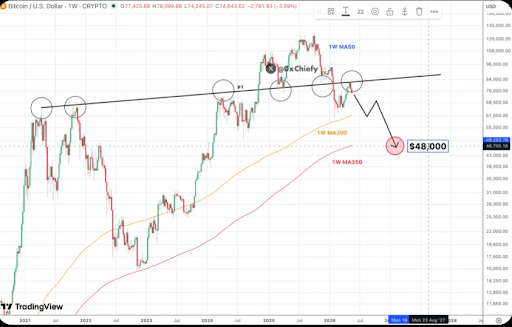
Bitcoin has been rejected at a crucial long-term resistance level around $83,000, marking its first failure at this macro price point in five years. According to analyst Chiefy, this trendline has defined major cycle tops since 2021 and acted as a key support in early 2025. The recent rejection saw Bitcoin drop to $74,000 before a slight recovery to $76,580, aligning with a significant moving average historically linked to major market turns. If the current support around $74,000 breaks, the analyst projects three potential downside targets: $68,000, $61,000, and an extreme target near $48,000, which aligns with the weekly 350 MA. Market sentiment has shifted to fear, with the Crypto Fear & Greed Index at 39, indicating growing caution among investors.

Bitcoin’s price action has been rejected at a price level that has acted as resistance and support in the past five years. This macro resistance level that has defined Bitcoin’s price ceiling for nearly five years has once again turned back the bulls, and the consequences could be far more severe than the price action is currently pricing in.

Bitcoin Rejection At Macro Resistance

Bitcoin has run into a resistance level that has not mattered this much in years, in reference to the most recent rejection at $83,000 on May 6. According to a crypto analyst that goes by the name Chiefy on the social media platform X, that rejection is not just another failed rally but a reaction from a five-year macro resistance line that has touched some of Bitcoin’s most important turning points since the last major cycle.

The analyst believes Bitcoin has now followed the structure he previously warned about, moving into a bull trap near $83,000 before rejecting and falling to as low as $74,000. The trendline behind that rejection is important because it connects the early 2021 and mid-2021 cycle tops, stretches through Bitcoin’s first breakout above it in 2024, later acted as support in early 2025, and has now returned as resistance around the $83,000 zone.
Source: Chart from Chiefy on X

Interestingly, the rejection zone also lines up with the 200MA. Rejections from this moving average have appeared around major cycle turning points in the past, including the 2014, 2018, and 2022 market phases.

The Levels That Now Matter

Now with the initial phase of Chiefy’s projection already confirmed, the next important thing is what comes next. Notably, there are three downside targets if Bitcoin continues to follow the pattern: $68,000, $61,000, and $48,000.

These levels fit the path drawn on the chart above, which shows Bitcoin first breaking lower below $76,000, then forming a brief relief bounce, before falling deeper into the red-circled $48,000 area. The most extreme bottom target of $48,000 is close to the weekly 350 moving average shown in pink and would be the final reset from the recent $83,000 bull-trap zone.

Bitcoin’s reaction around $74,000 now matters most because it could determine whether Chiefy’s bearish map will be feasible. The drop into that region came immediately after the rejection, but it has recovered back above $76,000 and is trading at $76,580 at the time of writing.

Even with that rebound, Bitcoin is still close to a support area that looks fragile. Sentiment shows that the market is no longer in a strong risk-on phase, with CoinMarketCap’s Crypto Fear & Greed Index now at 39, placing the market in a fear mood. A break below $74,000 would put $68,000 in focus as the next logical downside target.

BTC trading at $77,300 on the 1D chart | Source: BTCUSDT on Tradingview.com

Trending Cryptos

Related Questions

QAccording to the analyst Chiefy, at what key macro price level did Bitcoin face rejection for the first time in five years?

ABitcoin faced rejection at the $83,000 zone, which represents a five-year macro resistance trendline.

QWhat are the three potential downside price targets for Bitcoin mentioned in the article if it continues its bearish pattern?

AThe three potential downside targets mentioned are $68,000, $61,000, and $48,000.

QWhat other technical indicator does the $83,000 rejection zone align with, which has been significant at past cycle turning points?

AThe rejection zone at $83,000 also aligns with the 200-period moving average (200MA), which has marked major cycle turning points in the past.

QWhat does the article suggest is the significance of Bitcoin's price action around the $74,000 level?

ABitcoin's price action around $74,000 is crucial as a break below this level would shift the focus to $68,000 as the next downside target, confirming the analyst's bearish projection.

QWhat is the current market sentiment according to the Crypto Fear & Greed Index, as stated in the article?

AAccording to the article, the Crypto Fear & Greed Index is at 39, indicating that the market is in a 'fear' phase.

Related Reads

AI Token Factory Explosion: Tsinghua University Team Raises 10 Billion in Half a Year

Qijing Tech, a company founded by a Tsinghua University team of faculty and students, has rapidly become a significant player in China's AI infrastructure sector, focusing on high-quality AI token production. Over the past six months, the startup has secured over 1 billion RMB in funding. The company specializes in AI inference—the efficient use of AI models—positioning itself as a "high-quality AI token factory." Unlike many competitors initially focused on model training, Qijing Tech believes inference is where real economic value is generated. Its core technology optimizes the entire AI token production chain through innovations like "full-system heterogeneous collaboration," aiming for stable, efficient, and low-cost output suitable for enterprise use. This strategy has attracted significant investor interest. Major funding rounds have been led by institutions such as Henan Investment Group Huirong Fund, with continued backing from existing investors. The company's "less models, deeper optimization" approach, concentrating resources on key models and high-value scenarios, is resonating in a market where a few top models dominate token usage. The results are promising. Since early 2026, Qijing Tech reports a threefold increase in token production efficiency per unit of computing power and a thirtyfold increase in total high-quality token output. Monthly revenue for June 2026 alone surpassed its entire 2025 revenue. Operating on a "Token as a Service" (TaaS) model, Qijing Tech engages in both direct token sales and collaborative operations, helping partners like state-owned enterprises transition from traditional computing power leasing to high-value token production. As AI token usage in China surges, Qijing Tech aims to be a key enabler in the emerging AI token economy, building the essential infrastructure for the AI era.

marsbit20m ago

AI Token Factory Explosion: Tsinghua University Team Raises 10 Billion in Half a Year

marsbit20m ago

Financing Weekly Report | SBI Makes Consecutive Moves, Bets $125 Million on Gauntlet; Crypto Capital Continues to Flow to Trading and Infrastructure

Weekly crypto financing highlights show capital continues to flow into trading, compliance, and digital asset infrastructure, with traditional financial institutions like Japan's SBI Holdings playing a larger role. SBI made two major investments: a $125M exclusive investment in DeFi risk management and asset allocation platform Gauntlet, and leading a $76M Series C round for crypto exchange EDX Markets. Other notable crypto deals included: QIZ Security ($17M seed) for post-quantum cryptography management; TrueDAO ($10M strategic) for AI-powered DeFi infrastructure; KOR Protocol ($7.5M Series A) for an on-chain creative asset clearing platform; Tether's $20M strategic investment in Brazil's Mercado Bitcoin; and M1X Global ($5.5M seed) for sovereign financial infrastructure. The AI sector saw larger individual rounds. Prime Intellect raised $130M Series A for its decentralized AI protocol stack. AI legal services firm Norm raised $120M, reaching a $1.2B valuation. Voice AI company Gradium's total funding surpassed $100M. The report also notes a shift towards business models focused on specific enterprise-level AI infrastructure and application scenarios. Overall, the crypto primary market remains subdued, with nine deals totaling over $261M last week, centered on centralized finance, DeFi, and infrastructure.

marsbit21m ago

Financing Weekly Report | SBI Makes Consecutive Moves, Bets $125 Million on Gauntlet; Crypto Capital Continues to Flow to Trading and Infrastructure

marsbit21m ago

Valuation $1 Billion, Nvidia Doubles Down! Is Prime Intellect Washing Off Its Web3 Label?

Prime Intellect, a decentralized AI infrastructure company founded in 2024, recently announced a $130 million Series A funding round at a $1 billion valuation, with investments from NVIDIA, Intel, and Dell's venture arms. The company claims its annualized recurring revenue (ARR) has exceeded $100 million within a year, serving over 6,000 enterprise clients. Initially rooted in Web3 and decentralized science (DeSci), Prime Intellect has evolved into a full-stack AI training and deployment platform. Its core technology enables distributed training of large language models across globally dispersed, heterogeneous GPU clusters. Key milestones include releasing open-source models like INTELLECT-1 and INTELLECT-3, and launching Prime Intellect Lab, a platform allowing users to train and optimize agentic models without managing their own GPU infrastructure. The company's deep collaboration with hardware giants, particularly NVIDIA, extends beyond investment to joint optimization of software (e.g., integrating NVIDIA Dynamo) and hardware systems. A notable commercial case involves fintech company Ramp using Prime Lab to train a specialized agent, demonstrating the platform's applied value. While achieving rapid commercial growth, Prime Intellect has systematically downplayed its earlier Web3 and token-based incentives from its official documentation, repositioning itself as a mainstream AI infrastructure provider focused on enterprise adoption and potential IPO.

Foresight News1h ago

Valuation $1 Billion, Nvidia Doubles Down! Is Prime Intellect Washing Off Its Web3 Label?

Foresight News1h ago

Trading

Spot

Hot Articles

What is $BITCOIN

DIGITAL GOLD ($BITCOIN): A Comprehensive Analysis Introduction to DIGITAL GOLD ($BITCOIN) DIGITAL GOLD ($BITCOIN) is a blockchain-based project operating on the Solana network, which aims to combine the characteristics of traditional precious metals with the innovation of decentralized technologies. While it shares a name with Bitcoin, often referred to as “digital gold” due to its perception as a store of value, DIGITAL GOLD is a separate token designed to create a unique ecosystem within the Web3 landscape. Its goal is to position itself as a viable alternative digital asset, although specifics regarding its applications and functionalities are still developing. What is DIGITAL GOLD ($BITCOIN)? DIGITAL GOLD ($BITCOIN) is a cryptocurrency token explicitly designed for use on the Solana blockchain. In contrast to Bitcoin, which provides a widely recognized value storage role, this token appears to focus on broader applications and characteristics. Notable aspects include: Blockchain Infrastructure: The token is built on the Solana blockchain, known for its capacity to handle high-speed and low-cost transactions. Supply Dynamics: DIGITAL GOLD has a maximum supply capped at 100 quadrillion tokens (100P $BITCOIN), although details regarding its circulating supply are currently undisclosed. Utility: While precise functionalities are not explicitly outlined, there are indications that the token could be utilized for various applications, potentially involving decentralized applications (dApps) or asset tokenization strategies. Who is the Creator of DIGITAL GOLD ($BITCOIN)? At present, the identity of the creators and development team behind DIGITAL GOLD ($BITCOIN) remains unknown. This situation is typical among many innovative projects within the blockchain space, particularly those aligning with decentralized finance and meme coin phenomena. While such anonymity may foster a community-driven culture, it intensifies concerns about governance and accountability. Who are the Investors of DIGITAL GOLD ($BITCOIN)? The available information indicates that DIGITAL GOLD ($BITCOIN) does not have any known institutional backers or prominent venture capital investments. The project seems to operate on a peer-to-peer model focused on community support and adoption rather than traditional funding routes. Its activity and liquidity are primarily situated on decentralized exchanges (DEXs), such as PumpSwap, rather than established centralized trading platforms, further highlighting its grassroots approach. How DIGITAL GOLD ($BITCOIN) Works The operational mechanics of DIGITAL GOLD ($BITCOIN) can be elaborated on based on its blockchain design and network attributes: Consensus Mechanism: By leveraging Solana’s unique proof-of-history (PoH) combined with a proof-of-stake (PoS) model, the project ensures efficient transaction validation contributing to the network's high performance. Tokenomics: While specific deflationary mechanisms have not been extensively detailed, the vast maximum token supply implies that it may cater to microtransactions or niche use cases that are still to be defined. Interoperability: There exists the potential for integration with Solana’s broader ecosystem, including various decentralized finance (DeFi) platforms. However, the details regarding specific integrations remain unspecified. Timeline of Key Events Here is a timeline that highlights significant milestones concerning DIGITAL GOLD ($BITCOIN): 2023: The initial deployment of the token occurs on the Solana blockchain, marked by its contract address. 2024: DIGITAL GOLD gains visibility as it becomes available for trading on decentralized exchanges like PumpSwap, allowing users to trade it against SOL. 2025: The project witnesses sporadic trading activity and potential interest in community-led engagements, although no noteworthy partnerships or technical advancements have been documented as of yet. Critical Analysis Strengths Scalability: The underlying Solana infrastructure supports high transaction volumes, which could enhance the utility of $BITCOIN in various transaction scenarios. Accessibility: The potential low trading price per token could attract retail investors, facilitating wider participation due to fractional ownership opportunities. Risks Lack of Transparency: The absence of publicly known backers, developers, or an audit process may yield skepticism regarding the project's sustainability and trustworthiness. Market Volatility: The trading activity is heavily reliant on speculative behavior, which can result in significant price volatility and uncertainty for investors. Conclusion DIGITAL GOLD ($BITCOIN) emerges as an intriguing yet ambiguous project within the rapidly evolving Solana ecosystem. While it attempts to leverage the “digital gold” narrative, its departure from Bitcoin's established role as a store of value underscores the need for a clearer differentiation of its intended utility and governance structure. Future acceptance and adoption will likely depend on addressing the current opacity and defining its operational and economic strategies more explicitly. Note: This report encompasses synthesised information available as of October 2023, and developments may have transpired beyond the research period.

760 Total ViewsPublished 2025.05.13Updated 2025.05.13

What is $BITCOIN

Discussions

Welcome to the HTX Community. Here, you can stay informed about the latest platform developments and gain access to professional market insights. Users' opinions on the price of BTC (BTC) are presented below.

活动图片