Bitcoin Futures Structure Favors Bulls as Short Liquidations Accelerate

bitcoinistPublished on 2025-12-23Last updated on 2025-12-23

Abstract

Bitcoin is attempting to reclaim the $90,000 level as market structure signals suggest a tactical upside. According to analyst Axel Adler, Bitcoin’s Regime Score has entered the +15 to +30 range, historically associated with positive returns, indicating an early recovery phase. Simultaneously, derivatives data show a dominance of short liquidations, creating mechanical buying pressure that supports upward movement. The current Regime Score of +16.3 suggests a favorable risk-reward setup, with backtested 30-day returns averaging +3.8% in this zone. While moving into a full bull regime above +30 has often led to local tops, the current neutral-positive transition and prevailing short liquidations indicate improving market structure and potential near-term gains.

Bitcoin is once again attempting to reclaim the $90,000 level, as bulls cautiously rebuild a recovery narrative after weeks of volatility and heavy selling pressure. While sentiment remains fragile and many investors are still positioned defensively, recent price stabilization has opened the door for a short-term upside scenario. Rather than relying on optimism alone, analysts are increasingly pointing to structural indicators that suggest the balance of risk may be shifting.

According to a report by on-chain analyst Axel Adler, Bitcoin’s current setup shows tactical upside potential when viewed through the combined lens of market regime indicators and derivatives liquidation dynamics.

Adler highlights that Bitcoin’s Regime Score has recently transitioned into the +15 to +30 zone, a range that has historically delivered positive average returns. This zone represents an early recovery phase, where downside momentum has faded but euphoria has not yet returned, often creating favorable conditions for asymmetric upside.

At the same time, derivatives data show a clear dominance of short liquidations, meaning that recent price moves have forced bearish positions to close. This creates mechanical buying pressure, which can amplify upward moves even in the absence of strong spot demand. Together, these signals suggest that Bitcoin’s current attempt to reclaim $90,000 is not purely speculative but supported by an improving internal market structure.

Regime Score and Liquidations Point to Tactical Upside

Adler explains that Bitcoin’s composite Regime Score aggregates multiple market dimensions into a single framework, including taker imbalance, open interest pressure, funding rates, ETF flows, exchange flows, and price trend.
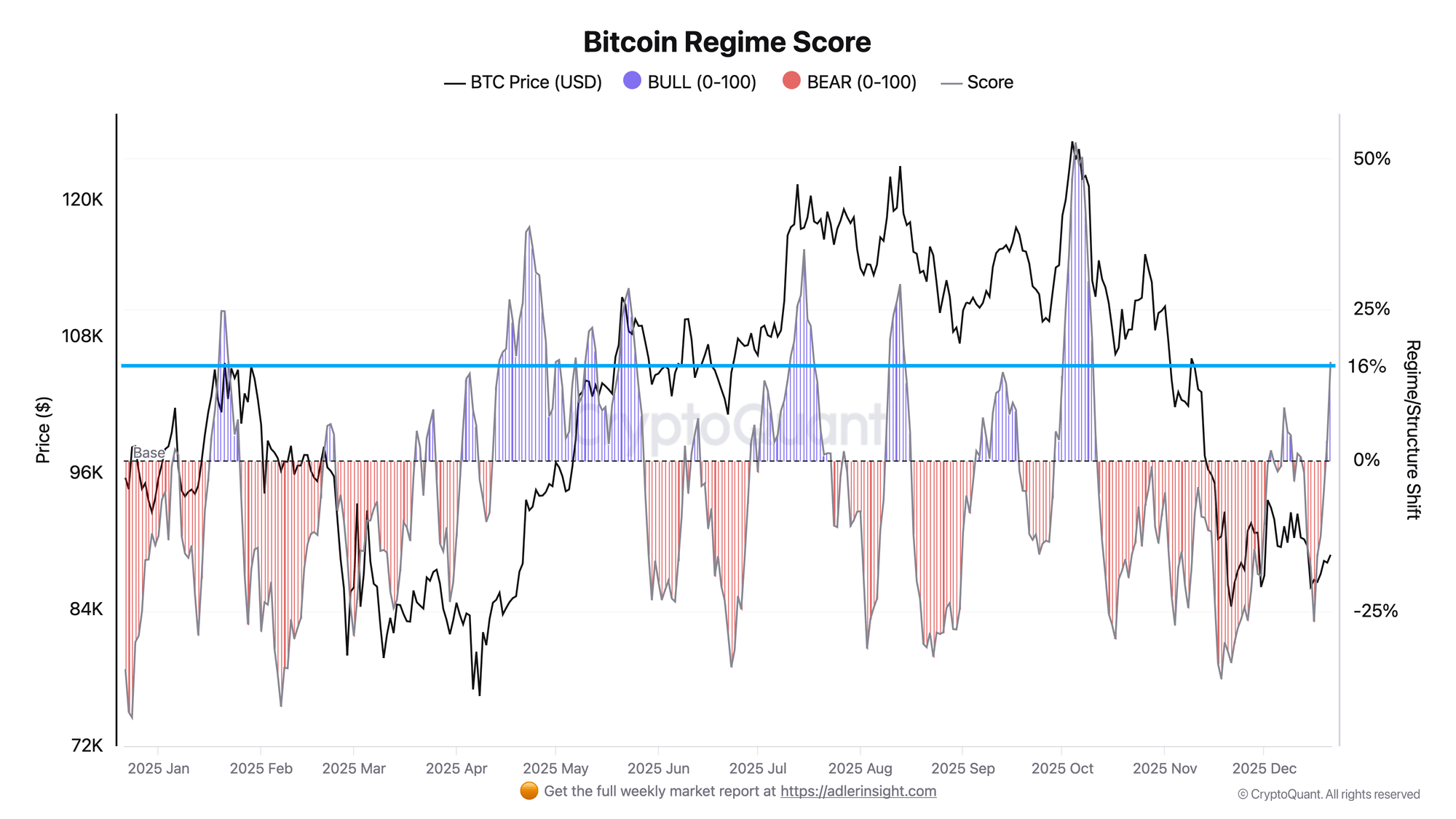
Bitcoin Regime Score | Source: CryptoQuant

The result is a unified indicator ranging from −100 to +100, designed to capture shifts in market structure rather than short-term noise. Currently, the Regime Score stands at +16.3, placing Bitcoin in the upper part of the neutral zone, defined between +15 and +30.

Backtesting data for 2025 shows that this specific subzone has historically delivered average returns of around +3.8% over a 30-day horizon. This contrasts sharply with the −15 to 0 zone, where expected returns were negative, averaging -1.5% over seven days. Importantly, the indicator has recently rebounded from a bearish extreme, after dropping to −27 just a week ago, signaling a structural recovery rather than a random bounce.

Adler highlights a critical nuance: transitions into the formal bull regime above +30 have historically coincided with local tops, often followed by negative short-term returns. This makes the current +15–30 range more attractive for tactical positioning, while aggressive accumulation above +30 may carry elevated risk.

This view is reinforced by derivatives data. The long/short liquidation dominance oscillator has turned negative at −11%, indicating a surge in forced short closures, while its 30-day average remains positive. With long liquidation dominance at just 44%, short liquidations are clearly prevailing, providing additional mechanical fuel for upside.


Trending Cryptos

Related Questions

QWhat is Bitcoin's current Regime Score and what does this value indicate about the market structure?

ABitcoin's current Regime Score is +16.3, which places it in the upper part of the neutral zone (between +15 and +30). This range represents an early recovery phase where downside momentum has faded but euphoria has not yet returned, historically creating favorable conditions for asymmetric upside and positive average returns.

QAccording to the analyst Axel Adler, what historical average return has the +15 to +30 Regime Score zone provided over a 30-day period in 2025?

ABacktesting data for 2025 shows that the +15 to +30 Regime Score zone has historically delivered average returns of around +3.8% over a 30-day horizon.

QHow do short liquidations in the derivatives market currently contribute to Bitcoin's price action?

AShort liquidations are currently dominant, with the long/short liquidation dominance oscillator at -11%. This means recent price moves have forced bearish positions to close, creating mechanical buying pressure that can amplify upward moves even without strong spot demand.

QWhat does the article suggest about the risk of aggressive accumulation when the Regime Score moves above +30?

AThe article states that transitions into the formal bull regime above +30 have historically coincided with local tops and are often followed by negative short-term returns, making aggressive accumulation at those levels carry elevated risk.

QWhat key metrics are aggregated to create Bitcoin's composite Regime Score indicator?

ABitcoin's composite Regime Score aggregates multiple market dimensions, including taker imbalance, open interest pressure, funding rates, ETF flows, exchange flows, and price trend into a single framework.

Related Reads

Musk Awaits $50 Trillion: Is There a Limit to the U.S. National Debt and What Comes Next?

Elon Musk reacted to a projection of US national debt reaching $50 trillion by 2030, labeling it a "precise timeline" with a laughing emoji. The debt has recently passed the $40 trillion mark. Skeptics note that specific debt thresholds have been breached before without immediate collapse. However, analysts warn the focus should shift from the nominal debt amount to its affordability. A key metric is when the average interest rate on the debt exceeds the economy's growth rate, a point the US Congressional Budget Office projects for 2031. Once this "debt spiral" begins, interest costs grow self-reinforcing. Currently, interest payments have already surpassed defense spending, exceeding $1 trillion annually. Ray Dalio warns a debt crisis could occur within "three years, plus or minus two," advising portfolio diversification into gold and some Bitcoin. Potential outcomes if debt becomes unmanageable include: 1) Financial repression and monetization (the "Japanese path" of controlled yields and inflation), seen as the most likely; 2) Severe austerity (the "Greek path" of spending cuts/tax hikes), considered politically unlikely; or 3) Technical default/restructuring, which would cause global financial shock. The most probable path is a hybrid of moderate financial repression and gradual inflation, leading not to a sudden crash but to long-term economic stagnation and a declining standard of living. By 2056, debt could reach 175% of GDP. Ultimately, the limit for US debt is not a fixed number but a function of market confidence in the dollar.

cryptonews.ru1h ago

Musk Awaits $50 Trillion: Is There a Limit to the U.S. National Debt and What Comes Next?

cryptonews.ru1h ago

Solana Developer Mert Mumtaz Highly Praises Altcoin!

In the world of cryptocurrencies and finance, where privacy is a major focus, significant developments are underway. Valor Group founder Dev and notable crypto ecosystem figure Mert Mumtaz participated in a program on The Rollup crypto broadcasting platform, discussing the latest developments for the Zcash (ZEC) network and its important future roadmap. The conversation covered network scalability, security updates, and measures taken against quantum threats. The recent Ironwood update implemented in the Zcash network is considered a crucial milestone for the project. During the event, Mert highlighted that internal security audits using 'red team' methods and AI identified a potential vulnerability in the Orchard pool that could have allowed the creation of counterfeit notes. Extensive work and formal verification proved the code mathematically perfect according to specifications. The seamless migration of funds from the Orchard pool to the new Ironwood pool has completely eliminated the risk of counterfeit coin creation in the network. Dev shared important technical details about Zcash's future vision, emphasizing that Valor Group's main goal is for Zcash to achieve transaction volumes comparable to credit cards. He stated they aim to process over 50,000 transactions per second with sub-second latency while maintaining the full proof-of-work mechanism. The main scaling bottleneck was identified not as the nodes themselves, but wallet scanning processes. A new wallet architecture and synchronization delay optimization are expected to resolve this issue. The upcoming Tachion update promises to provide complete protection for Zcash against quantum computing threats. This update will integrate recursive zero-knowledge proofs into the network. It is reported to reduce transaction sizes by more than five times, eliminate node data processing overhead, and address state growth issues. With Tachion, the network is claimed to achieve not just 'quantum-resilient' but a truly 'quantum-secure' privacy structure.

cryptonews.ru1h ago

Solana Developer Mert Mumtaz Highly Praises Altcoin!

cryptonews.ru1h ago

Trading

Spot

Hot Articles

What is $BITCOIN

DIGITAL GOLD ($BITCOIN): A Comprehensive Analysis Introduction to DIGITAL GOLD ($BITCOIN) DIGITAL GOLD ($BITCOIN) is a blockchain-based project operating on the Solana network, which aims to combine the characteristics of traditional precious metals with the innovation of decentralized technologies. While it shares a name with Bitcoin, often referred to as “digital gold” due to its perception as a store of value, DIGITAL GOLD is a separate token designed to create a unique ecosystem within the Web3 landscape. Its goal is to position itself as a viable alternative digital asset, although specifics regarding its applications and functionalities are still developing. What is DIGITAL GOLD ($BITCOIN)? DIGITAL GOLD ($BITCOIN) is a cryptocurrency token explicitly designed for use on the Solana blockchain. In contrast to Bitcoin, which provides a widely recognized value storage role, this token appears to focus on broader applications and characteristics. Notable aspects include: Blockchain Infrastructure: The token is built on the Solana blockchain, known for its capacity to handle high-speed and low-cost transactions. Supply Dynamics: DIGITAL GOLD has a maximum supply capped at 100 quadrillion tokens (100P $BITCOIN), although details regarding its circulating supply are currently undisclosed. Utility: While precise functionalities are not explicitly outlined, there are indications that the token could be utilized for various applications, potentially involving decentralized applications (dApps) or asset tokenization strategies. Who is the Creator of DIGITAL GOLD ($BITCOIN)? At present, the identity of the creators and development team behind DIGITAL GOLD ($BITCOIN) remains unknown. This situation is typical among many innovative projects within the blockchain space, particularly those aligning with decentralized finance and meme coin phenomena. While such anonymity may foster a community-driven culture, it intensifies concerns about governance and accountability. Who are the Investors of DIGITAL GOLD ($BITCOIN)? The available information indicates that DIGITAL GOLD ($BITCOIN) does not have any known institutional backers or prominent venture capital investments. The project seems to operate on a peer-to-peer model focused on community support and adoption rather than traditional funding routes. Its activity and liquidity are primarily situated on decentralized exchanges (DEXs), such as PumpSwap, rather than established centralized trading platforms, further highlighting its grassroots approach. How DIGITAL GOLD ($BITCOIN) Works The operational mechanics of DIGITAL GOLD ($BITCOIN) can be elaborated on based on its blockchain design and network attributes: Consensus Mechanism: By leveraging Solana’s unique proof-of-history (PoH) combined with a proof-of-stake (PoS) model, the project ensures efficient transaction validation contributing to the network's high performance. Tokenomics: While specific deflationary mechanisms have not been extensively detailed, the vast maximum token supply implies that it may cater to microtransactions or niche use cases that are still to be defined. Interoperability: There exists the potential for integration with Solana’s broader ecosystem, including various decentralized finance (DeFi) platforms. However, the details regarding specific integrations remain unspecified. Timeline of Key Events Here is a timeline that highlights significant milestones concerning DIGITAL GOLD ($BITCOIN): 2023: The initial deployment of the token occurs on the Solana blockchain, marked by its contract address. 2024: DIGITAL GOLD gains visibility as it becomes available for trading on decentralized exchanges like PumpSwap, allowing users to trade it against SOL. 2025: The project witnesses sporadic trading activity and potential interest in community-led engagements, although no noteworthy partnerships or technical advancements have been documented as of yet. Critical Analysis Strengths Scalability: The underlying Solana infrastructure supports high transaction volumes, which could enhance the utility of $BITCOIN in various transaction scenarios. Accessibility: The potential low trading price per token could attract retail investors, facilitating wider participation due to fractional ownership opportunities. Risks Lack of Transparency: The absence of publicly known backers, developers, or an audit process may yield skepticism regarding the project's sustainability and trustworthiness. Market Volatility: The trading activity is heavily reliant on speculative behavior, which can result in significant price volatility and uncertainty for investors. Conclusion DIGITAL GOLD ($BITCOIN) emerges as an intriguing yet ambiguous project within the rapidly evolving Solana ecosystem. While it attempts to leverage the “digital gold” narrative, its departure from Bitcoin's established role as a store of value underscores the need for a clearer differentiation of its intended utility and governance structure. Future acceptance and adoption will likely depend on addressing the current opacity and defining its operational and economic strategies more explicitly. Note: This report encompasses synthesised information available as of October 2023, and developments may have transpired beyond the research period.

2.0k Total ViewsPublished 2025.05.13Updated 2025.05.13

What is $BITCOIN

Discussions

Welcome to the HTX Community. Here, you can stay informed about the latest platform developments and gain access to professional market insights. Users' opinions on the price of BTC (BTC) are presented below.

活动图片