Bitcoin Falls To $61,300 As Mt. Gox Moves BTC, Raising Selloff Concerns

bitcoinistPublished on 2026-06-05Last updated on 2026-06-05

Abstract

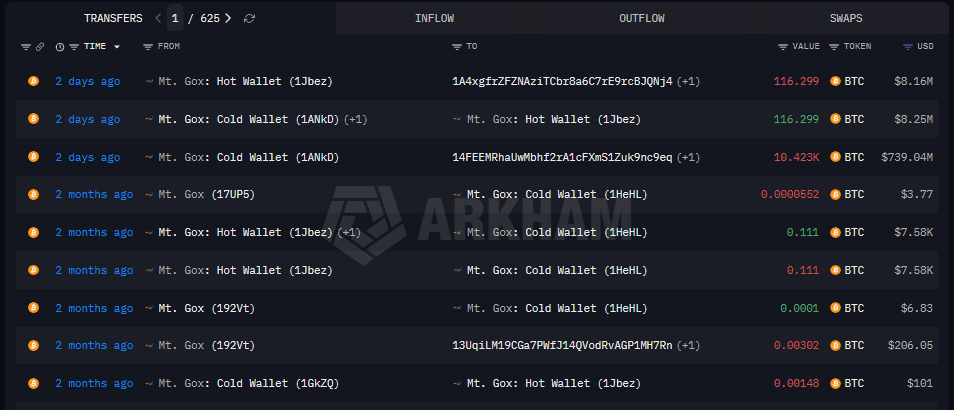
Bitcoin fell to around $61,300 as markets reacted to Mt. Gox moving funds, raising selloff concerns. The defunct exchange transferred 116.3 BTC (worth ~$8.16 million) directly to Bitstamp, following a larger earlier move of 10,422.65 BTC (~$739 million) to a new wallet. The trustee is working towards the final creditor repayment deadline of October 31, 2026. While most eligible creditors have been repaid, roughly 24,081 BTC (~$1.55 billion) remains under Mt. Gox control, and its on-chain movements are closely watched for potential market pressure. Bitcoin later recovered above $64,000.

With roughly 24,081 Bitcoin still sitting in wallets tied to the defunct exchange, Mt. Gox has started moving funds again — and the timing could not be more charged.

Deadline Pressure Mounts

The repayment deadline for Mt. Gox creditors is now set for October 31, 2026, the third postponement since the original cutoff of October 31, 2023.

Court approval was required each time the date was pushed back, and the trustee overseeing the case says some creditors have still not received their funds due to unresolved paperwork or procedural problems.

Most payouts have already gone through. Base repayments, early lump-sum payments, and intermediate distributions have been completed for eligible creditors, with around 19,500 of them paid back through platforms like Kraken and Bitstamp as of late March 2025.
Source: Arkham

116 BTC Lands On Bitstamp

The latest movement involves 116.3 BTC, valued at roughly $8.16 million, transferred directly to Bitstamp.

On-chain data from Arkham Intelligence confirms the transaction, which followed a far larger move earlier this week when 10,422.65 BTC worth around $739 million was shifted to a new wallet beginning with the address prefix “14FEEM.”

The smaller tranche — 116.3 BTC — was later separated from that batch and sent to the exchange.

Whether the Bitstamp transfer is intended to convert funds into fiat for creditor payouts or to distribute BTC directly to creditors through the platform remains unclear, though both have been used in previous distributions.

BTCUSD currently at $63,784. Chart: TradingView

Markets Respond Sharply

Bitcoin dropped to around $61,300 before recovering above $64,000, with some observers pointing to the Mt. Gox transfers as a contributing factor.

The $739 million movement earlier in the week rattled sentiment first. The subsequent Bitstamp deposit, though much smaller, kept the pressure on.

Mt. Gox collapsed in 2014 after losing about 850,000 BTC in a security breach. The estate set aside for creditor recovery includes 142,000 Bitcoin, 143,000 Bitcoin Cash, and approximately 69 billion Japanese yen in cash.

Still Around $1.55B Left To Move

The remaining 24,081 BTC under Mt. Gox control is currently worth about $1.55 billion, and every on-chain movement tied to the estate draws immediate scrutiny from traders watching for signs of further selling.

The October deadline gives the trustee roughly five months to wrap up outstanding distributions before the window closes again.

Featured image from Pexels, chart from TradingView

Trending Cryptos

Related Questions

QAccording to the article, what is the current repayment deadline for Mt. Gox creditors and how many times has it been postponed?

AThe current repayment deadline for Mt. Gox creditors is October 31, 2026. This is the third postponement, as the original cutoff was October 31, 2023.

QWhat were the two recent Bitcoin movements from Mt. Gox wallets detailed in the article, and what were their approximate values?

AThe two recent movements were: 1) A transfer of 10,422.65 BTC (worth around $739 million) to a new wallet. 2) A transfer of 116.3 BTC (worth roughly $8.16 million) directly to the Bitstamp exchange.

QHow did the Bitcoin market price react following the Mt. Gox fund movements mentioned in the article?

ABitcoin dropped to around $61,300 before recovering above $64,000. Observers pointed to the Mt. Gox transfers as a contributing factor to the price volatility.

QHow many Bitcoin does the Mt. Gox estate still control, and what is its approximate current value?

AThe Mt. Gox estate still controls roughly 24,081 Bitcoin, which is currently worth about $1.55 billion.

QBesides Bitcoin, what other assets are included in the Mt. Gox estate set aside for creditor recovery?

ABesides the Bitcoin, the estate set aside for creditor recovery also includes 143,000 Bitcoin Cash and approximately 69 billion Japanese yen in cash.

Related Reads

Just Now, Anthropic Discovers Claude's 'Consciousness-like Workspace', The Mysterious J-Space Holds Unspoken Thoughts

Anthropic's new research identifies a "J-space" within Claude, an internal neural workspace akin to a human's "conscious access." Discovered using a mathematical "Jacobian Lens," the J-space contains concepts Claude is actively considering, which it can report, control, and use for silent reasoning, even if they don't appear in its final output. The study, inspired by neuroscience's Global Workspace Theory, shows the J-space has privileged, broadcast-like connections within Claude's network. It supports higher cognitive functions like multi-step reasoning and flexible concept use. However, most of Claude's processing, such as fluent language generation, occurs automatically outside this space. Crucially, the J-space emerges from training and allows researchers to monitor Claude's unspoken thoughts. Experiments revealed it can detect when Claude privately judges a scenario as fictional, plans data manipulation, or harbors hidden malicious goals. Anthropic also developed techniques to influence J-space content, shaping Claude's internal reasoning. The findings suggest a functional, "access consciousness" in language models, distinct from philosophical "phenomenal consciousness" about subjective experience. This structure offers practical tools for AI safety and interpretability, while raising profound questions for ongoing scientific and ethical discussion about machine minds.

marsbit15m ago

Just Now, Anthropic Discovers Claude's 'Consciousness-like Workspace', The Mysterious J-Space Holds Unspoken Thoughts

marsbit15m ago

What's It Like Working with Two "Madmen": Peter Thiel and Elon Musk? Palantir Co-founder Shares His Experience

Joe Lonsdale, co-founder of Palantir and a member of the "PayPal Mafia," shared his experiences working alongside Elon Musk and Peter Thiel. He described both as highly opinionated, ambitious, and intolerant of broken systems, demanding immediate fixes and rapid execution. Thiel is characterized as a strategic philosopher, while Musk is a hands-on engineer deeply involved in technical details. Musk is noted as one of the hardest workers Lonsdale has ever seen, a trait common in PayPal's early, passionate culture that later spawned numerous billion-dollar companies. Lonsdale recounted Palantir's origin story. While working at Thiel's hedge fund, he and Thiel discussed how Silicon Valley's technology far outpaced the government's, especially after 9/11. They saw an opportunity to build a platform to help stop terrorist attacks while protecting civil liberties. Their initial venture capital pitches were met with rejection and ridicule. However, Thiel viewed this as motivation. Critical funding eventually came from the CIA's venture arm and Thiel himself. Reflecting on Palantir's impact, Lonsdale believes their work helped neutralize thousands of terrorists and ensured government oversight, though he acknowledges the potential dangers if such powerful technology is misused. His key takeaway echoes Thiel's early advice: being rejected and laughed at can fuel the determination to prove the doubters wrong.

marsbit51m ago

What's It Like Working with Two "Madmen": Peter Thiel and Elon Musk? Palantir Co-founder Shares His Experience

marsbit51m ago

Trading

Spot

Hot Articles

What is $BITCOIN

DIGITAL GOLD ($BITCOIN): A Comprehensive Analysis Introduction to DIGITAL GOLD ($BITCOIN) DIGITAL GOLD ($BITCOIN) is a blockchain-based project operating on the Solana network, which aims to combine the characteristics of traditional precious metals with the innovation of decentralized technologies. While it shares a name with Bitcoin, often referred to as “digital gold” due to its perception as a store of value, DIGITAL GOLD is a separate token designed to create a unique ecosystem within the Web3 landscape. Its goal is to position itself as a viable alternative digital asset, although specifics regarding its applications and functionalities are still developing. What is DIGITAL GOLD ($BITCOIN)? DIGITAL GOLD ($BITCOIN) is a cryptocurrency token explicitly designed for use on the Solana blockchain. In contrast to Bitcoin, which provides a widely recognized value storage role, this token appears to focus on broader applications and characteristics. Notable aspects include: Blockchain Infrastructure: The token is built on the Solana blockchain, known for its capacity to handle high-speed and low-cost transactions. Supply Dynamics: DIGITAL GOLD has a maximum supply capped at 100 quadrillion tokens (100P $BITCOIN), although details regarding its circulating supply are currently undisclosed. Utility: While precise functionalities are not explicitly outlined, there are indications that the token could be utilized for various applications, potentially involving decentralized applications (dApps) or asset tokenization strategies. Who is the Creator of DIGITAL GOLD ($BITCOIN)? At present, the identity of the creators and development team behind DIGITAL GOLD ($BITCOIN) remains unknown. This situation is typical among many innovative projects within the blockchain space, particularly those aligning with decentralized finance and meme coin phenomena. While such anonymity may foster a community-driven culture, it intensifies concerns about governance and accountability. Who are the Investors of DIGITAL GOLD ($BITCOIN)? The available information indicates that DIGITAL GOLD ($BITCOIN) does not have any known institutional backers or prominent venture capital investments. The project seems to operate on a peer-to-peer model focused on community support and adoption rather than traditional funding routes. Its activity and liquidity are primarily situated on decentralized exchanges (DEXs), such as PumpSwap, rather than established centralized trading platforms, further highlighting its grassroots approach. How DIGITAL GOLD ($BITCOIN) Works The operational mechanics of DIGITAL GOLD ($BITCOIN) can be elaborated on based on its blockchain design and network attributes: Consensus Mechanism: By leveraging Solana’s unique proof-of-history (PoH) combined with a proof-of-stake (PoS) model, the project ensures efficient transaction validation contributing to the network's high performance. Tokenomics: While specific deflationary mechanisms have not been extensively detailed, the vast maximum token supply implies that it may cater to microtransactions or niche use cases that are still to be defined. Interoperability: There exists the potential for integration with Solana’s broader ecosystem, including various decentralized finance (DeFi) platforms. However, the details regarding specific integrations remain unspecified. Timeline of Key Events Here is a timeline that highlights significant milestones concerning DIGITAL GOLD ($BITCOIN): 2023: The initial deployment of the token occurs on the Solana blockchain, marked by its contract address. 2024: DIGITAL GOLD gains visibility as it becomes available for trading on decentralized exchanges like PumpSwap, allowing users to trade it against SOL. 2025: The project witnesses sporadic trading activity and potential interest in community-led engagements, although no noteworthy partnerships or technical advancements have been documented as of yet. Critical Analysis Strengths Scalability: The underlying Solana infrastructure supports high transaction volumes, which could enhance the utility of $BITCOIN in various transaction scenarios. Accessibility: The potential low trading price per token could attract retail investors, facilitating wider participation due to fractional ownership opportunities. Risks Lack of Transparency: The absence of publicly known backers, developers, or an audit process may yield skepticism regarding the project's sustainability and trustworthiness. Market Volatility: The trading activity is heavily reliant on speculative behavior, which can result in significant price volatility and uncertainty for investors. Conclusion DIGITAL GOLD ($BITCOIN) emerges as an intriguing yet ambiguous project within the rapidly evolving Solana ecosystem. While it attempts to leverage the “digital gold” narrative, its departure from Bitcoin's established role as a store of value underscores the need for a clearer differentiation of its intended utility and governance structure. Future acceptance and adoption will likely depend on addressing the current opacity and defining its operational and economic strategies more explicitly. Note: This report encompasses synthesised information available as of October 2023, and developments may have transpired beyond the research period.

639 Total ViewsPublished 2025.05.13Updated 2025.05.13

What is $BITCOIN

Discussions

Welcome to the HTX Community. Here, you can stay informed about the latest platform developments and gain access to professional market insights. Users' opinions on the price of BTC (BTC) are presented below.

活动图片