Bitcoin Crowd Euphoria Hits Highest Level Of 2026 After CLARITY Act Progress

bitcoinistPublished on 2026-05-17Last updated on 2026-05-17

Abstract

Bitcoin surged over 3.5% after the US Senate Banking Committee advanced the CLARITY Act, a crypto regulation bill aimed at providing clearer rules. This news drove Bitcoin crowd sentiment to its most euphoric (or "greediest") level of the year, which on-chain analytics firm Santiment notes is a long-term bullish signal due to increased investor certainty. However, Santiment cautions that such extreme optimism historically precedes short-term bearish pressure, as markets often move opposite to crowd frenzy. Separately, market analyst Ali Martinez reported Bitcoin miners sold approximately 800 BTC (around $64 million) over 96 hours, adding potential near-term selling pressure. While miner selling is not massive, spikes in their outflows have historically preceded price weakness or consolidation. Combining excessive euphoria with miner selling suggests Bitcoin may face corrective movement. At press time, Bitcoin traded at $79,136, down 2.9% in 24 hours.

The price of Bitcoin spiked by over 3.5% in the early days of Thursday, May 14th, following the advancement of the CLARITY Act by the US Senate Banking Committee. However, the flagship cryptocurrency soon reversed towards the downside, thereby raising more questions concerning what is happening within the market. Recent on-chain analysis has surfaced, diving into the factors that might drive Bitcoin in the near and long terms.

Sentiment Turns Extremely Bullish Following Senate Committee Vote

In a May 15th post on the social media platform X, on-chain analytics firm Santiment Intelligence reported a sharp rise in Bitcoin’s crowd sentiment. According to the chart shared by the market analytics firm, the crowd has reached one of the greediest levels towards Bitcoin this year.

This notable spike in the emotions of Bitcoin’s market participants apparently followed news of the CLARITY Act’s advancement (in a 15–9 Bipartisan vote). For context, the CLARITY Act is a proposed US crypto regulation bill designed to create clearer legal and regulatory rules for the digital assets industry.

As Santiment Intelligence explained, the CLARITY Act’s progress should be seen as long-term bullish news for Bitcoin. This is because clearer rules create greater certainty among investors, which in turn increases their inclination to participate in the crypto market.
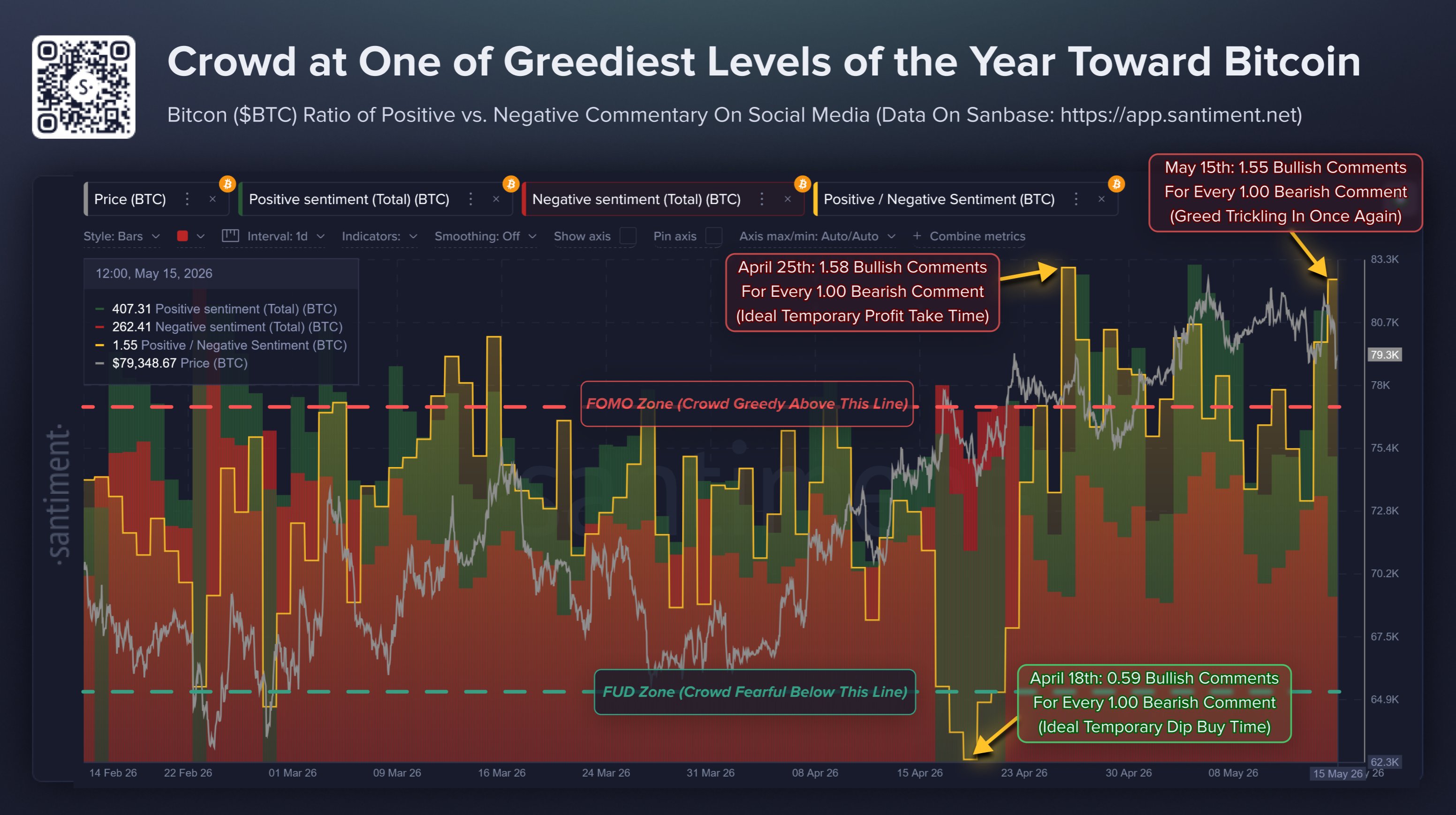
Source: @SantimentData on X

However, this development could signal bearish pressure on Bitcoin in the near term. This is due to the excessive euphoria caused by the aforementioned news.

As the analytics platform stated, “historically, when we see 1.55 bullish comments for every 1.00 bearish comment toward cryptocurrency’s top market cap, we advise caution.” This is because markets typically move in the opposite direction of the frenzied expectations of their crowds.

Bitcoin Miners Sell $64 Million BTC In 96 Hours

In a separate May 16 post on X, popular market analyst Ali Martinez reported a noticeable decline in Bitcoin miner reserves over the past four days, suggesting miners have been increasingly transferring their holdings for potential sale.

The activity of this class of market participants is important for BTC’s supply dynamics, as they generate new BTC through block rewards, which they then sell periodically to cover minor operational costs. These are unlike the mostly inactive long-term holders.

Martinez highlighted in his post that miners have sold about 800 BTC in the past 96 hours. While this is not a large amount, sudden spikes in miner selling could influence short-term market sentiment, ultimately causing a bearish injection.

Elevated miner outflows have historically preceded periods of short-term price weakness or consolidation phases. Coupled with the expected effect of a market-wide euphoria, it is apparent that Bitcoin’s price might undergo some corrective movement in the near term.

As of press time, Bitcoin is trading at $79,136, down 2.9% over the past 24 hours, according to CoinGecko data.

The price of BTC on the daily timeframe | Source: BTCUSDT chart on TradingView


Trending Cryptos

Related Questions

QWhat was the immediate price reaction of Bitcoin following the advancement of the CLARITY Act by the US Senate Banking Committee?

AThe price of Bitcoin spiked by over 3.5% following the advancement of the CLARITY Act.

QAccording to Santiment Intelligence, why is the CLARITY Act considered long-term bullish news for Bitcoin?

ASantiment Intelligence explained that clearer rules created by the CLARITY Act would generate greater certainty among investors, increasing their inclination to participate in the crypto market, which is long-term bullish for Bitcoin.

QWhat specific metric does Santiment Intelligence use to advise caution regarding market sentiment?

ASantiment Intelligence advises caution when there are 1.55 bullish comments for every 1.00 bearish comment toward the top cryptocurrency by market cap.

QWhat did market analyst Ali Martinez report about Bitcoin miner activity between May 12 and May 16?

AAli Martinez reported a noticeable decline in Bitcoin miner reserves, indicating miners sold about 800 BTC (worth approximately $64 million) over the past 96 hours.

QWhat was Bitcoin's trading price and 24-hour performance as of the article's press time?

AAs of press time, Bitcoin was trading at $79,136, down 2.9% over the past 24 hours, according to CoinGecko data.

Related Reads

Bitcoin Shifts Towards Consolidation, Long-Term Holder Selling Pressure Significantly Eases

Bitcoin's Bottoming Process Shows Signs of Shifting Dynamics Bitcoin's bottom formation is ongoing, but key characteristics are changing. The capitulation selling by long-term holders (LTHs), a primary source of selling pressure this cycle, has begun to cool from its recent peak. Buyers successfully absorbed the selling at the June lows, and price is now recovering to challenge overhead resistance. The market is testing higher resistance levels. Bitcoin reacted more strongly to soft inflation data than major equity indices, signaling sellers may be exhausted and buyers are waiting for a catalyst. Its correlation with stocks is weakening while its inverse relationship with the USD is deepening, suggesting liquidity dynamics are now more influential than risk sentiment. On-chain, price sits between the network's Realized Price (a historical bear market floor) and the Short-Term Holder (STH) cost basis near $69k, a key resistance level where recent buyers break even. LTH profit-taking has largely dried up, and losses now dominate realized on-chain volume—a typical late bear market signal. Crucially, the pace of LTH capitulation has started to decline. Derivatives markets show bearish positions are being unwound, with put/call ratios falling and crash protection costs moderating. However, this derisking hasn't been accompanied by significant spot buying, a missing link for sustained recovery. US spot ETF outflows have slowed but not reversed. In conclusion, foundational elements for a bottom are forming: LTH selling is easing, low-point selling was absorbed, and the market is responding to positive macro cues. The next critical test is whether spot-driven buying can push price through and hold above the STH cost basis near $69k. The follow-through is not yet confirmed.

marsbit15m ago

Bitcoin Shifts Towards Consolidation, Long-Term Holder Selling Pressure Significantly Eases

marsbit15m ago

Defending Champions or New Kings? World Cup Final Sees All AIs Backing the Same Side

Will the 2026 World Cup final see Argentina successfully defend their title or a new champion crowned? AI models from various platforms have made their prediction. The final in Buenos Aires pits defending champions Argentina against a resilient Spanish side that has reached this stage with a record of exceptional defensive solidity, conceding only one goal in seven matches. Argentina's path was dramatically different, filled with late comebacks and narrow victories, including a semi-final win over England secured by late goals assisted by the 39-year-old Lionel Messi. A poignant subplot adds narrative weight: a nearly 20-year-old photo shows a young Messi bathing an infant Lamine Yamal, who is now a 19-year-old key player for Spain, symbolizing a potential passing of the torch. In the semi-finals, most AI models incorrectly predicted a French victory over Spain, with only Google's Gemini correctly picking Spain's advancement and also accurately forecasting Argentina's win over England. For the final, however, all six surveyed AIs—ChatGPT, Claude, Gemini, Grok, DeepSeek, and Qwen—unanimously predict a Spanish victory. Their reasoning centers on Spain's superior defense, midfield control, and better physical preparedness after a less strenuous knockout stage journey. While consensus favors Spain as champions, five of the six AIs believe the match will be tightly contested, predicting a draw (1-1 or 0-0) within regular time, with Spain's advantage potentially telling in extra time or even a penalty shootout. Only DeepSeek forecasts a clear Spanish victory within 90 minutes. The stage is set for a clash between Argentina's legendary fighting spirit and Spain's machine-like consistency, with artificial intelligence firmly backing the latter to lift the trophy.

Odaily星球日报32m ago

Defending Champions or New Kings? World Cup Final Sees All AIs Backing the Same Side

Odaily星球日报32m ago

From a Loss of 19.2 Billion to a Profit of 7.1 Billion, ChangXin Technology States 'Downturn Cycle Remains a Concern'

Changxin Technology, China's leading domestic DRAM manufacturer, is nearing its IPO on the STAR Market. After reporting significant net losses of -192.25 billion yuan and -90.51 billion yuan in 2023 and 2024 respectively, the company achieved a net profit of 71.44 billion yuan in 2025. This turnaround is attributed to an AI-driven surge in DRAM demand and tight industry supply, leading to a 33.69% increase in average selling prices alongside reduced unit costs. Despite the improved profitability, with gross margins rising from -1.93% in 2023 to 40.99% in 2025, Chairman Zhu Yiming cautions that the strongly cyclical DRAM industry remains vulnerable. Risks include potential macroeconomic shifts, uncertain AI demand, and new capacity expansions that could trigger another downturn. The company still faces high fixed costs, with depreciation reaching 246.8 billion yuan in 2025. Changxin plans to raise 29.5 billion yuan through its IPO to fund technology upgrades, DRAM advancement, and R&D. While its capacity ranks fourth globally, its 7.67% Q4 2025 market share lags behind leaders Samsung, SK Hynix, and Micron. Analysts note the company must now prove its ability to achieve stable mass production with high yields and low cost-per-bit, especially for advanced products. Its growth currently relies on transitioning from DDR4/LPDDR4X to DDR5/LPDDR5X and increasing domestic substitution. Successfully developing and commercializing high-value AI products like HBM is seen as crucial for future competitiveness and closing the gap with international giants.

marsbit1h ago

From a Loss of 19.2 Billion to a Profit of 7.1 Billion, ChangXin Technology States 'Downturn Cycle Remains a Concern'

marsbit1h ago

Stop Writing Prompts: Claude’s Official Guide to 4 Types of Loops That Automate Work

The article discusses a shift in AI development from manually crafting prompts to designing "loops"—systems where AI agents autonomously perform tasks until a defined stopping condition is triggered. Inspired by figures like Peter Steinberger and Boris Cherny, this approach, termed "loop engineering," focuses on creating self-running systems rather than one-off interactions. Claude Code's team formally defines a loop as an agent repeatedly executing work until a stop condition is met and categorizes four primary loop types based on their stopping mechanisms: 1. **Turn-based loops:** Human-controlled, step-by-step execution for short, discrete tasks. 2. **Goal loops (/goal):** An evaluator model checks outputs against predefined, quantifiable objectives (e.g., a performance score), forcing retries until the goal is met or a limit is reached. 3. **Time loops (/loop and /schedule):** Time-triggered, like cron jobs, for recurring tasks (e.g., daily summaries) or monitoring external systems. 4. **Proactive loops:** Event or time-triggered, fully automated workflows for ongoing, bounded tasks like bug triage, running until manually stopped. The core shift is from designing prompt content to designing the behavioral system—its triggers, verification mechanisms, and termination rules. Effective verification, where the agent can self-check its output, is highlighted as crucial for loop efficiency. The article warns that uncontrolled loops risk high costs and getting stuck in unproductive cycles. It recommends implementing essential "gates": machine-verifiable completion conditions, hard limits on iterations/cost, and stagnation detection. Best practices include using smaller models where possible, testing on small scales first, and automating deterministic parts with scripts. In summary, AI programming is evolving from prompt engineering to system design, where the skill lies in architecting loops that can autonomously execute, validate, and decisively conclude their work.

marsbit1h ago

Stop Writing Prompts: Claude’s Official Guide to 4 Types of Loops That Automate Work

marsbit1h ago

Trading

Spot

Hot Articles

What is $BITCOIN

DIGITAL GOLD ($BITCOIN): A Comprehensive Analysis Introduction to DIGITAL GOLD ($BITCOIN) DIGITAL GOLD ($BITCOIN) is a blockchain-based project operating on the Solana network, which aims to combine the characteristics of traditional precious metals with the innovation of decentralized technologies. While it shares a name with Bitcoin, often referred to as “digital gold” due to its perception as a store of value, DIGITAL GOLD is a separate token designed to create a unique ecosystem within the Web3 landscape. Its goal is to position itself as a viable alternative digital asset, although specifics regarding its applications and functionalities are still developing. What is DIGITAL GOLD ($BITCOIN)? DIGITAL GOLD ($BITCOIN) is a cryptocurrency token explicitly designed for use on the Solana blockchain. In contrast to Bitcoin, which provides a widely recognized value storage role, this token appears to focus on broader applications and characteristics. Notable aspects include: Blockchain Infrastructure: The token is built on the Solana blockchain, known for its capacity to handle high-speed and low-cost transactions. Supply Dynamics: DIGITAL GOLD has a maximum supply capped at 100 quadrillion tokens (100P $BITCOIN), although details regarding its circulating supply are currently undisclosed. Utility: While precise functionalities are not explicitly outlined, there are indications that the token could be utilized for various applications, potentially involving decentralized applications (dApps) or asset tokenization strategies. Who is the Creator of DIGITAL GOLD ($BITCOIN)? At present, the identity of the creators and development team behind DIGITAL GOLD ($BITCOIN) remains unknown. This situation is typical among many innovative projects within the blockchain space, particularly those aligning with decentralized finance and meme coin phenomena. While such anonymity may foster a community-driven culture, it intensifies concerns about governance and accountability. Who are the Investors of DIGITAL GOLD ($BITCOIN)? The available information indicates that DIGITAL GOLD ($BITCOIN) does not have any known institutional backers or prominent venture capital investments. The project seems to operate on a peer-to-peer model focused on community support and adoption rather than traditional funding routes. Its activity and liquidity are primarily situated on decentralized exchanges (DEXs), such as PumpSwap, rather than established centralized trading platforms, further highlighting its grassroots approach. How DIGITAL GOLD ($BITCOIN) Works The operational mechanics of DIGITAL GOLD ($BITCOIN) can be elaborated on based on its blockchain design and network attributes: Consensus Mechanism: By leveraging Solana’s unique proof-of-history (PoH) combined with a proof-of-stake (PoS) model, the project ensures efficient transaction validation contributing to the network's high performance. Tokenomics: While specific deflationary mechanisms have not been extensively detailed, the vast maximum token supply implies that it may cater to microtransactions or niche use cases that are still to be defined. Interoperability: There exists the potential for integration with Solana’s broader ecosystem, including various decentralized finance (DeFi) platforms. However, the details regarding specific integrations remain unspecified. Timeline of Key Events Here is a timeline that highlights significant milestones concerning DIGITAL GOLD ($BITCOIN): 2023: The initial deployment of the token occurs on the Solana blockchain, marked by its contract address. 2024: DIGITAL GOLD gains visibility as it becomes available for trading on decentralized exchanges like PumpSwap, allowing users to trade it against SOL. 2025: The project witnesses sporadic trading activity and potential interest in community-led engagements, although no noteworthy partnerships or technical advancements have been documented as of yet. Critical Analysis Strengths Scalability: The underlying Solana infrastructure supports high transaction volumes, which could enhance the utility of $BITCOIN in various transaction scenarios. Accessibility: The potential low trading price per token could attract retail investors, facilitating wider participation due to fractional ownership opportunities. Risks Lack of Transparency: The absence of publicly known backers, developers, or an audit process may yield skepticism regarding the project's sustainability and trustworthiness. Market Volatility: The trading activity is heavily reliant on speculative behavior, which can result in significant price volatility and uncertainty for investors. Conclusion DIGITAL GOLD ($BITCOIN) emerges as an intriguing yet ambiguous project within the rapidly evolving Solana ecosystem. While it attempts to leverage the “digital gold” narrative, its departure from Bitcoin's established role as a store of value underscores the need for a clearer differentiation of its intended utility and governance structure. Future acceptance and adoption will likely depend on addressing the current opacity and defining its operational and economic strategies more explicitly. Note: This report encompasses synthesised information available as of October 2023, and developments may have transpired beyond the research period.

845 Total ViewsPublished 2025.05.13Updated 2025.05.13

What is $BITCOIN

Discussions

Welcome to the HTX Community. Here, you can stay informed about the latest platform developments and gain access to professional market insights. Users' opinions on the price of BTC (BTC) are presented below.

活动图片