Bitcoin buyers return, exchange supply declines: Is BTC entering accumulation?

AmbcryptoPublished on 2026-03-17Last updated on 2026-03-17

Abstract

Bitcoin’s market structure is stabilizing as buyer activity slowly returns.

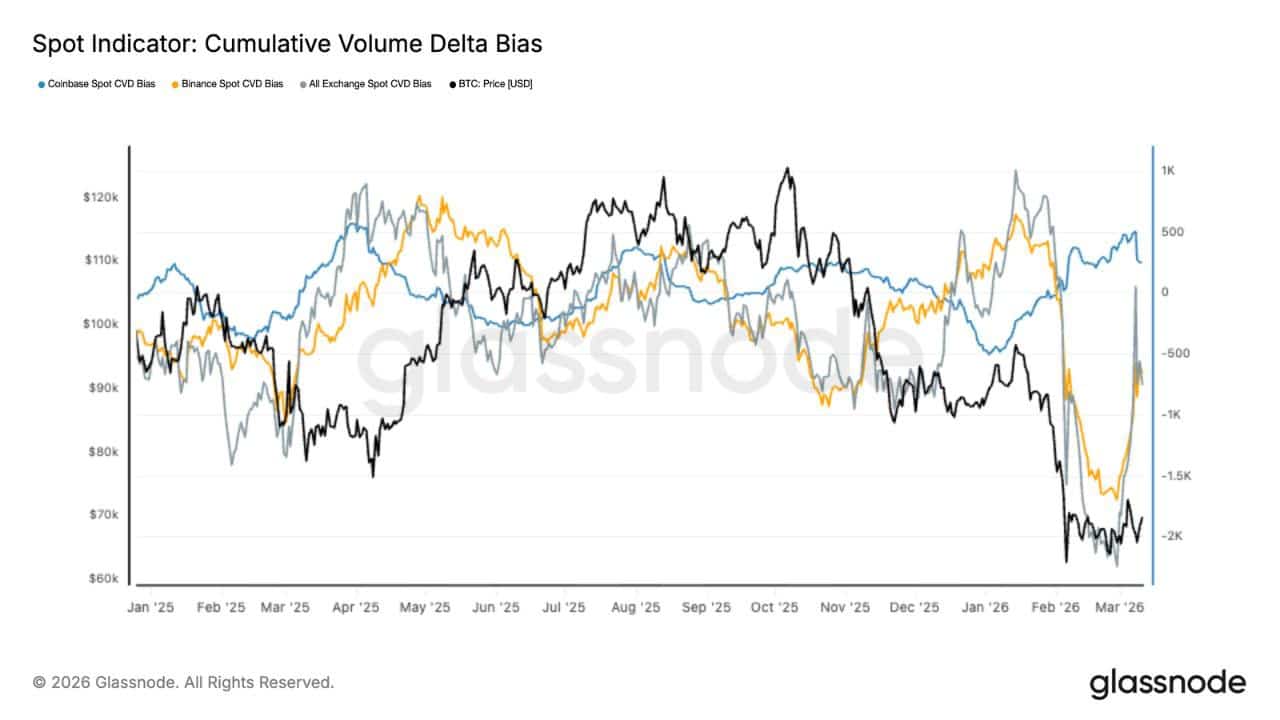
Spot Cumulative Volume Delta (CVD) is beginning to recover after a prolonged period of sell-side dominance. Earlier in the cycle, persistent negative CVD signaled that aggressive sellers were repeatedly hitting bids.

During that phase, Bitcoin’s price gradually weakened, eventually sliding from above $110,000 toward the $65,000 range.
Source: Glassnode

Recently, however, CVD lines across Coinbase aggregated exchanges have started turning upward. This shift suggests buyers are again lifting offers and absorbing available liquidity.

The recovery also appeared across multiple venues, strengthening its credibility. As CVD improved, the market showed early signs of demand returning.

Historically, sustained positive CVD often precedes broader price expansion. For now, the rebound remains tentative, yet the synchronized buyer activity marks one of the clearest stabilization signals in recent weeks.

Bitcoin leaves exchanges

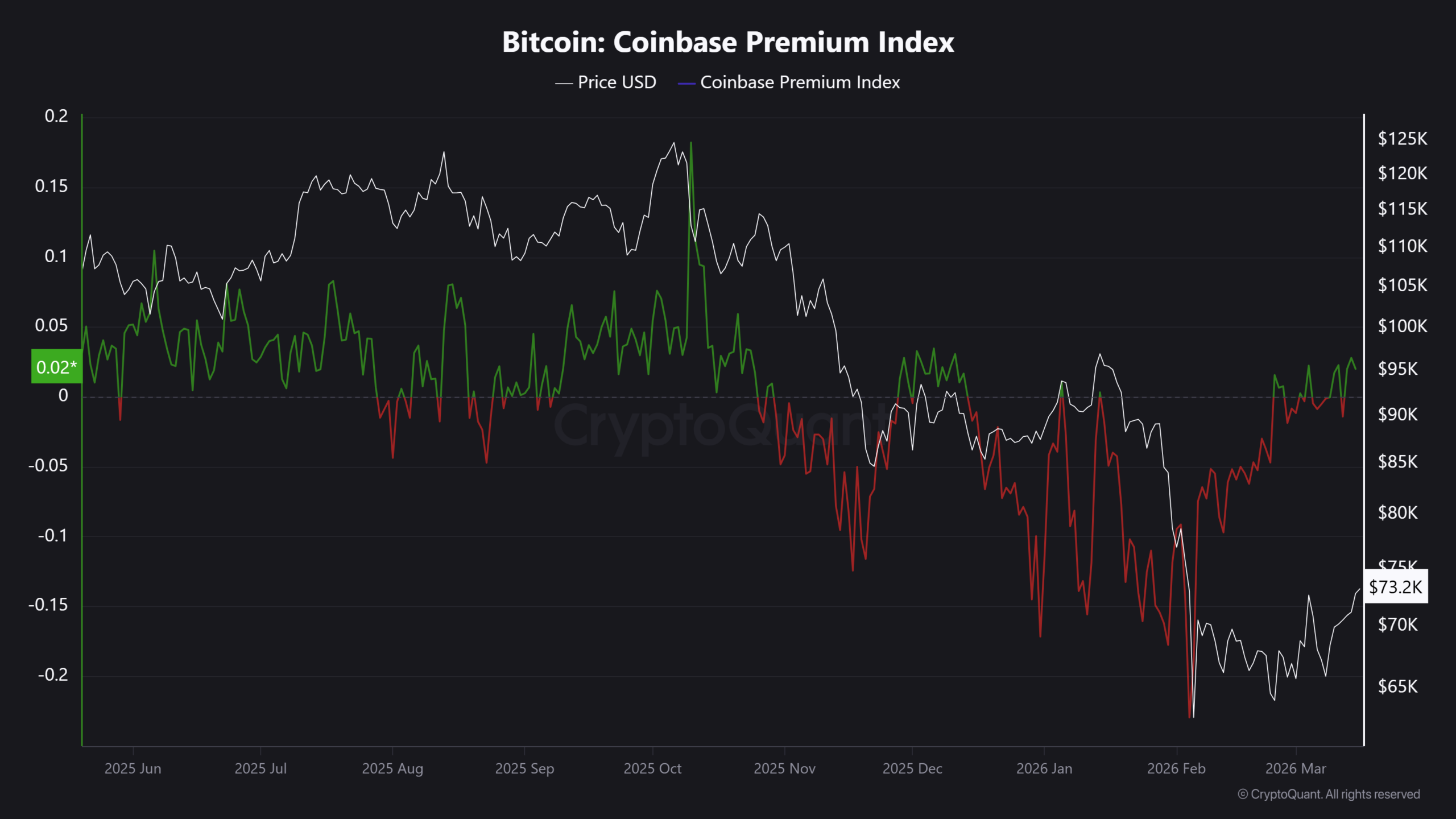
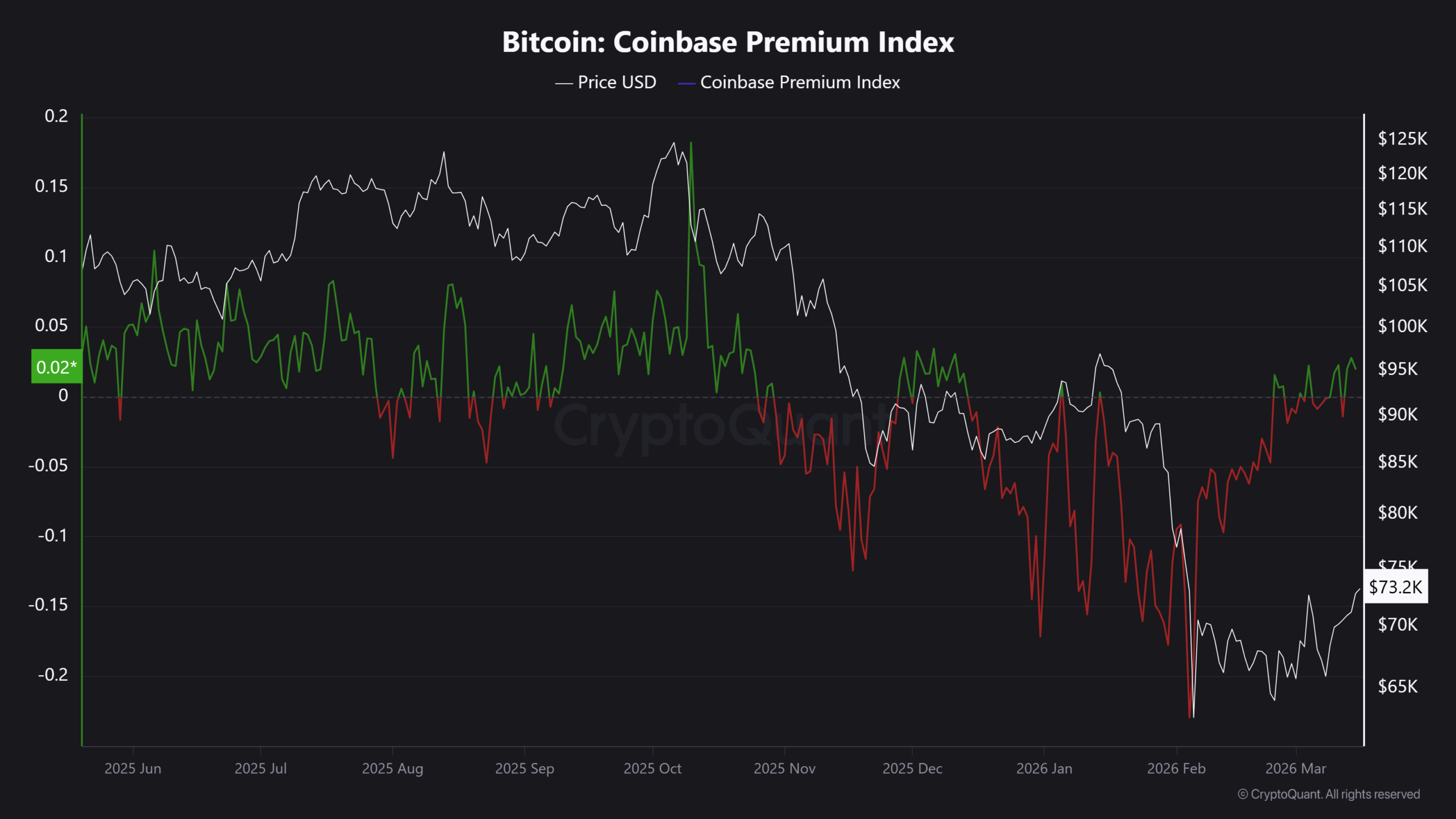
Bitcoin’s order flow is beginning to shift as institutional demand quietly returns. Recently, the Coinbase Premium Index moved back above zero to about 0.02 after nearly ten weeks in negative territory.
Source: CryptoQuant

Earlier, the index plunged near -0.20 during February’s sell-off as Bitcoin fell from above $100,000 toward the $65,000–$70,000 range. As the premium turned positive, U.S. Spot buyers on Coinbase appeared to absorb sell pressure again.

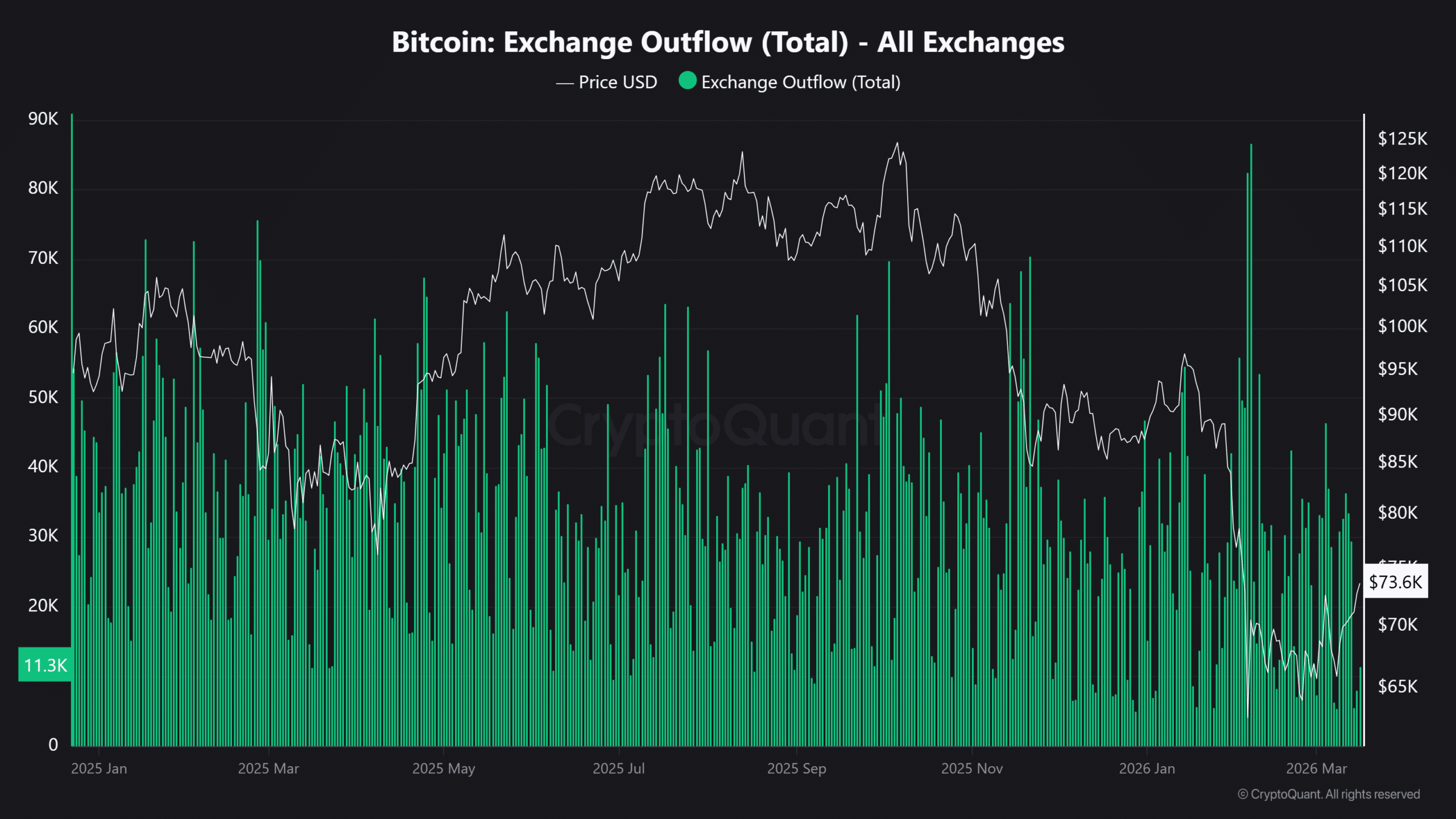
At the same time, Exchange Outflows remained elevated. Recent daily withdrawals hovered near 11,300 BTC, while earlier spikes briefly exceeded 70,000–90,000 BTC.

Such withdrawals indicate holders moving coins into self-custody rather than positioning to sell.
Source: CryptoQuant

As U.S. Spot demand strengthens while exchange supply declines, the market structure increasingly reflects accumulation behavior.

This alignment suggests larger participants may be quietly rebuilding exposure while available liquidity gradually tightens.

Bitcoin stability signals quiet accumulation

Bitcoin is holding firm near $73,500 as order flow gradually shifts toward buyers. Earlier, price briefly tested a low near $71,220 before stabilizing. Since then, the market has consolidated between $69,000 and $73,000 without sharp volatility.

This stability suggests buyers are quietly absorbing supply rather than chasing rapid rallies. Whale activity adds further nuance.

The Exchange Whale Ratio climbed to 0.74, rising 1.03% within 24 hours. Such levels indicate that larger participants are actively positioning themselves during consolidation.

At the same time, derivatives activity remains elevated. Futures volume reached roughly 217,000 BTC while Funding Rates stayed modest near 0.0017%.

This balance implies leveraged pressure remains contained, allowing gradual accumulation to develop beneath stable price action.

Final Summary

  • Bitcoin order flow is shifting as Spot CVD turns positive and exchange outflows rise, signaling buyers increasingly absorbing supply.
  • The $70,000–$73,000 zone, alongside rising whale activity, suggests early accumulation that could precede broader trend expansion.


Trending Cryptos

Related Questions

QWhat does the recent recovery in Spot Cumulative Volume Delta (CVD) indicate about Bitcoin's market dynamics?

AThe recent recovery in Spot CVD across exchanges like Coinbase and Binance indicates that buyers are returning to the market, lifting offers and absorbing available liquidity, which suggests a shift from earlier sell-side dominance and could signal early signs of demand returning and potential price stabilization.

QHow has the Coinbase Premium Index changed recently, and what does this suggest about U.S. institutional demand?

AThe Coinbase Premium Index moved back above zero to about 0.02 after nearly ten weeks in negative territory, suggesting that U.S. institutional buyers on Coinbase are again absorbing sell pressure and indicating a return of institutional demand.

QWhat do elevated Bitcoin exchange outflows indicate about holder behavior?

AElevated exchange outflows, with recent daily withdrawals near 11,300 BTC, indicate that holders are moving coins into self-custody rather than positioning to sell, reflecting accumulation behavior and a tightening of available liquidity.

QWhat does the current price stability of Bitcoin between $69,000 and $73,000 suggest about market activity?

AThe price stability in the $69,000 to $73,000 range suggests that buyers are quietly absorbing supply rather than chasing rapid rallies, indicating gradual accumulation beneath stable price action without sharp volatility.

QHow do the current levels of the Exchange Whale Ratio and Futures Funding Rates reflect market sentiment?

AThe Exchange Whale Ratio climbing to 0.74 indicates larger participants are actively positioning themselves, while modest Futures Funding Rates near 0.0017% suggest leveraged pressure remains contained, allowing for gradual accumulation without excessive speculation.

Related Reads

Famous Trader Speaks Out After Rally: "Bitcoin Needs Another Level for Further Growth"

After a period of dormancy, the crypto market showed a strong upward trend, with Bitcoin ($BTC) briefly surpassing $69,000 and Ethereum (ETH) rising above $2,100. Market capitalization grew to around $2.4 trillion. This surge has reignited speculation that Bitcoin's bear market may be nearing its end. Trader Killa, known for accurate bear market predictions, stated that BTC has begun recovering from its lows. He warned investors might miss the next rally by waiting for a "perfect bottom." Killa maintains a long-term Bitcoin target above $150,000 and suggested the traditional four-year market cycle might change. He identified the 200-day moving average near $69,500 as a critical level. A sustained break above it could confirm a return to a bull phase. Bitcoin recently faced resistance around this level, underscoring its technical importance. Institutional voices also express optimism. Matt Hougan, CIO of Bitwise, noted that blockchain-based yield-generating assets are being revalued, with some protocols poised for higher market caps. A Bitwise Europe report highlighted renewed institutional demand, citing inflows into ETPs, high long-term holder balances, and stable corporate treasury demand. Hougan further stated Bitcoin is becoming more resilient to negative news. He estimated that even a 1-2% allocation from major wealth managers like Morgan Stanley could channel hundreds of billions of dollars into the crypto sector.

cryptonews.ru13m ago

Famous Trader Speaks Out After Rally: "Bitcoin Needs Another Level for Further Growth"

cryptonews.ru13m ago

What to Expect from Bitcoin's Price After Today's Sharp Surge? Only One Hurdle Left to Overcome!

Bitcoin ($BTC) surged sharply after the U.S. Treasury Department announced expanded liquidity support for the long-term bond market, triggering one of the largest short liquidations since October 2020. According to Michael Nagye, founder of The DeFi Report, the timing of Bitcoin's jump followed the Treasury's announcement of enhanced long-term bond buyback operations starting in September. Nagye views this as a second "moderate quantitative easing" measure implemented recently to alleviate pressure on long-term Treasury yields. He noted that gold reacted first to the macroeconomic shift, followed by Bitcoin. However, a significant portion of Bitcoin's move was attributed to short liquidations and market positioning changes rather than new, sustained spot demand. As Bitcoin approaches the $68,000-$69,000 range, key technical levels are back in focus: $68,500 (short-term holder cost basis), $68,800 (21-week moving average), and $69,100 (200-day moving average). The current price action is seen as crucial in determining whether the uptrend will continue. While the rally is notable given the Treasury's actions, Nagye emphasized it remains largely liquidation-driven at this stage. The key question now is whether sustainable market demand will emerge to support further gains. If Bitcoin can break through and convert the $68,500-$69,100 resistance zone into support, it could pave the way for a new bullish rally.

cryptonews.ru1h ago

What to Expect from Bitcoin's Price After Today's Sharp Surge? Only One Hurdle Left to Overcome!

cryptonews.ru1h ago

Trading

Spot

Hot Articles

What is $BITCOIN

DIGITAL GOLD ($BITCOIN): A Comprehensive Analysis Introduction to DIGITAL GOLD ($BITCOIN) DIGITAL GOLD ($BITCOIN) is a blockchain-based project operating on the Solana network, which aims to combine the characteristics of traditional precious metals with the innovation of decentralized technologies. While it shares a name with Bitcoin, often referred to as “digital gold” due to its perception as a store of value, DIGITAL GOLD is a separate token designed to create a unique ecosystem within the Web3 landscape. Its goal is to position itself as a viable alternative digital asset, although specifics regarding its applications and functionalities are still developing. What is DIGITAL GOLD ($BITCOIN)? DIGITAL GOLD ($BITCOIN) is a cryptocurrency token explicitly designed for use on the Solana blockchain. In contrast to Bitcoin, which provides a widely recognized value storage role, this token appears to focus on broader applications and characteristics. Notable aspects include: Blockchain Infrastructure: The token is built on the Solana blockchain, known for its capacity to handle high-speed and low-cost transactions. Supply Dynamics: DIGITAL GOLD has a maximum supply capped at 100 quadrillion tokens (100P $BITCOIN), although details regarding its circulating supply are currently undisclosed. Utility: While precise functionalities are not explicitly outlined, there are indications that the token could be utilized for various applications, potentially involving decentralized applications (dApps) or asset tokenization strategies. Who is the Creator of DIGITAL GOLD ($BITCOIN)? At present, the identity of the creators and development team behind DIGITAL GOLD ($BITCOIN) remains unknown. This situation is typical among many innovative projects within the blockchain space, particularly those aligning with decentralized finance and meme coin phenomena. While such anonymity may foster a community-driven culture, it intensifies concerns about governance and accountability. Who are the Investors of DIGITAL GOLD ($BITCOIN)? The available information indicates that DIGITAL GOLD ($BITCOIN) does not have any known institutional backers or prominent venture capital investments. The project seems to operate on a peer-to-peer model focused on community support and adoption rather than traditional funding routes. Its activity and liquidity are primarily situated on decentralized exchanges (DEXs), such as PumpSwap, rather than established centralized trading platforms, further highlighting its grassroots approach. How DIGITAL GOLD ($BITCOIN) Works The operational mechanics of DIGITAL GOLD ($BITCOIN) can be elaborated on based on its blockchain design and network attributes: Consensus Mechanism: By leveraging Solana’s unique proof-of-history (PoH) combined with a proof-of-stake (PoS) model, the project ensures efficient transaction validation contributing to the network's high performance. Tokenomics: While specific deflationary mechanisms have not been extensively detailed, the vast maximum token supply implies that it may cater to microtransactions or niche use cases that are still to be defined. Interoperability: There exists the potential for integration with Solana’s broader ecosystem, including various decentralized finance (DeFi) platforms. However, the details regarding specific integrations remain unspecified. Timeline of Key Events Here is a timeline that highlights significant milestones concerning DIGITAL GOLD ($BITCOIN): 2023: The initial deployment of the token occurs on the Solana blockchain, marked by its contract address. 2024: DIGITAL GOLD gains visibility as it becomes available for trading on decentralized exchanges like PumpSwap, allowing users to trade it against SOL. 2025: The project witnesses sporadic trading activity and potential interest in community-led engagements, although no noteworthy partnerships or technical advancements have been documented as of yet. Critical Analysis Strengths Scalability: The underlying Solana infrastructure supports high transaction volumes, which could enhance the utility of $BITCOIN in various transaction scenarios. Accessibility: The potential low trading price per token could attract retail investors, facilitating wider participation due to fractional ownership opportunities. Risks Lack of Transparency: The absence of publicly known backers, developers, or an audit process may yield skepticism regarding the project's sustainability and trustworthiness. Market Volatility: The trading activity is heavily reliant on speculative behavior, which can result in significant price volatility and uncertainty for investors. Conclusion DIGITAL GOLD ($BITCOIN) emerges as an intriguing yet ambiguous project within the rapidly evolving Solana ecosystem. While it attempts to leverage the “digital gold” narrative, its departure from Bitcoin's established role as a store of value underscores the need for a clearer differentiation of its intended utility and governance structure. Future acceptance and adoption will likely depend on addressing the current opacity and defining its operational and economic strategies more explicitly. Note: This report encompasses synthesised information available as of October 2023, and developments may have transpired beyond the research period.

2.0k Total ViewsPublished 2025.05.13Updated 2025.05.13

What is $BITCOIN

Discussions

Welcome to the HTX Community. Here, you can stay informed about the latest platform developments and gain access to professional market insights. Users' opinions on the price of BTC (BTC) are presented below.

活动图片