Bitcoin: Big money buys the uncertainty as BTC defends $96K

AmbcryptoPublished on 2026-01-15Last updated on 2026-01-16

Abstract

Bitcoin’s breakout reflects structural strength as disbelief continues to fuel upside momentum.

Bitcoin rebounds near $96k as BlackRock-linked buying tops $646.6M, while Santiment flags a ten-day peak in retail FUD globally.

Institutional activity continues to diverge sharply from retail sentiment, creating a constructive backdrop.

Whale Insider data confirmed that BlackRock clients accumulated $646.62 million in BTC, signaling conviction from long-term capital.

Meanwhile, Santiment’s social metrics showed bearish commentary reaching a ten-day high, despite Bitcoin holding the $96,000–$97,000 zone.

This contrast matters because institutions rarely chase momentum. Instead, they accumulate during uncertainty. As retail traders hesitate and question the rebound, large buyers absorb available supply.

Pessimism reflects disbelief rather than distribution. Such belief gaps often appear during continuation phases, not market tops, reinforcing the underlying structure.

Buyers break out as accumulation gives way to expansion

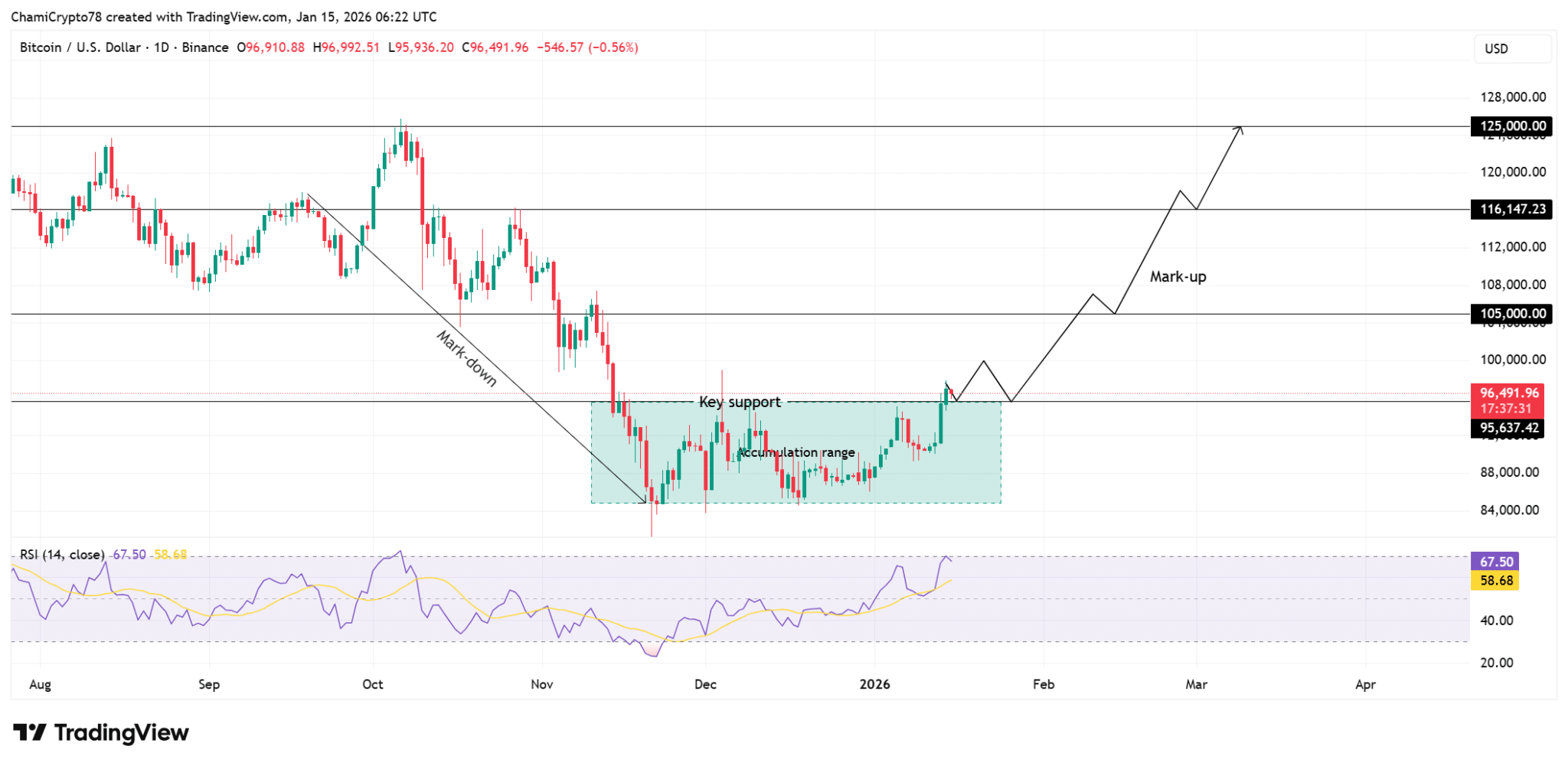
Bitcoin [BTC] has broken out of the highlighted accumulation zone, confirming a transition from the prior mark-down phase into early mark-up.

After the sharp selloff that defined the markdown, the price stabilized and consolidated between roughly $85,000 and $95,600, forming a clear accumulation base.

Bitcoin has now pushed above the range high and established acceptance above $95,637, which previously acted as resistance and now functions as key support.

Pullbacks toward this level continue to attract demand, reinforcing the role flip. Above support, price faces resistance near $105,000, followed by $116,147, both highlighted supply zones.

However, the formation of higher lows beneath these levels suggests controlled expansion rather than exhaustion.

Momentum confirms the shift, with RSI climbing into the upper 60s, reflecting strengthening upside participation without reaching overheated conditions, a typical trait of early mark-up phases.
Aggressive buyers take control of Bitcoin spot flow

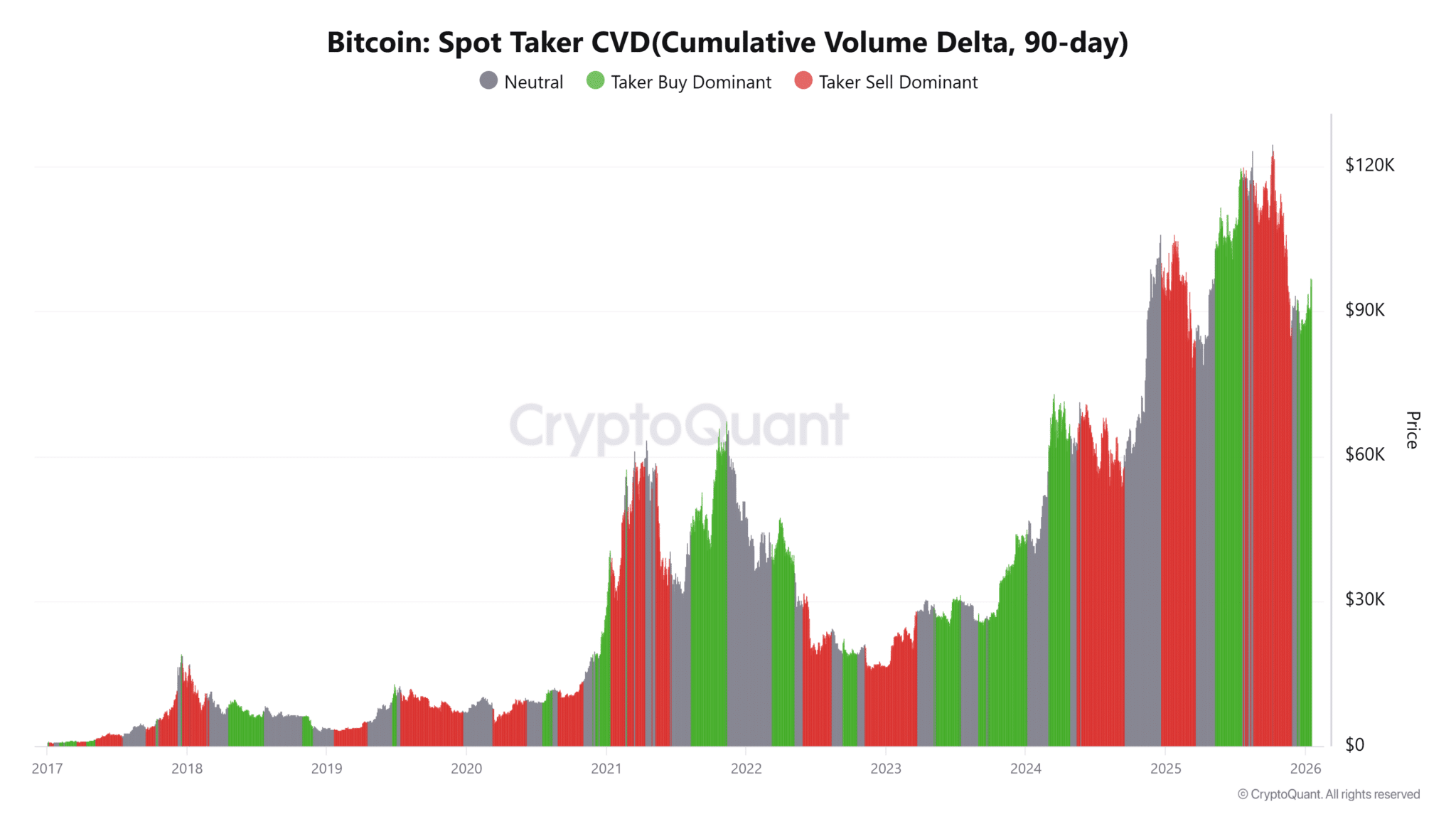
Spot Taker CVD over the 90-day window has turned decisively positive, confirming aggressive buyers dominate execution.

Rather than waiting passively, participants lift offers, signaling conviction behind the rebound. This shift matters because spot-led moves tend to hold better than leverage-driven spikes.

Sustained positive CVD during consolidation reflects accumulation instead of emotional chasing.

Additionally, buy-side dominance persists despite rising pessimism, reinforcing intent. Buyers commit capital while sentiment remains negative.

Therefore, downside pressure weakens as genuine demand absorbs sell orders. This alignment supports structural continuation, tying price recovery to real flow rather than short-term speculative positioning.
Long liquidations flush leverage without breaking structure

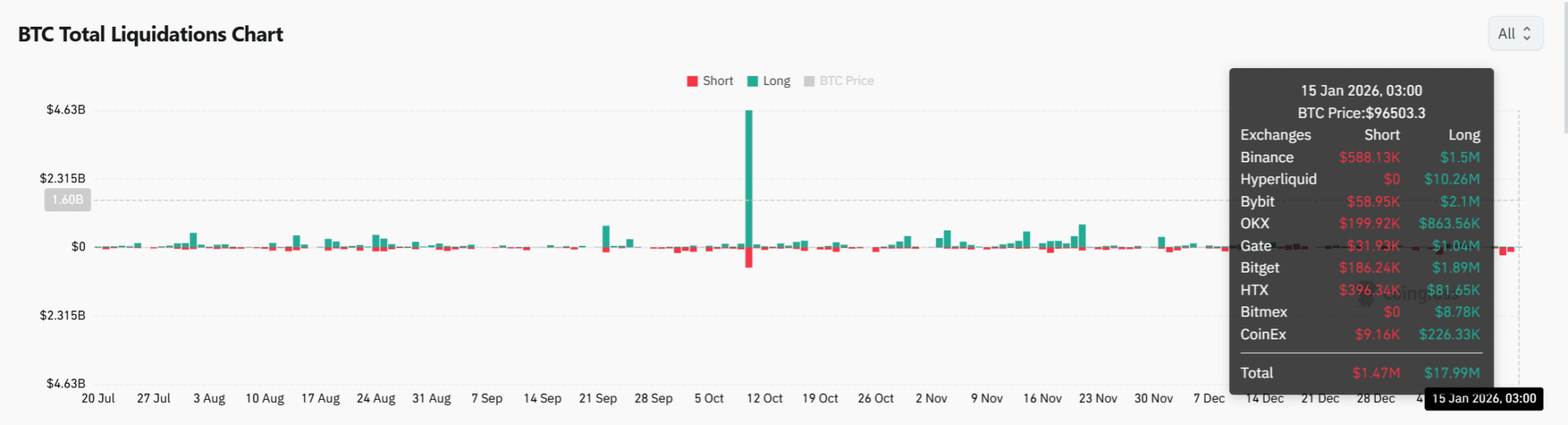
Liquidation data highlighted a leverage reset that favored stability. During the latest pullback, long liquidations reached roughly $17.99 million, while shorts accounted for only $1.47 million.

This imbalance showed that long positions absorbed most forced closures. Importantly, Bitcoin held near $96,000 despite this flush, indicating strong spot demand underneath.

When longs unwind without cascading selloffs, markets often stabilize rather than collapse. Moreover, leverage resets reduce fragility by clearing crowded positioning.

Consequently, downside risk decreases instead of rising.

This pattern supports continuation, as fewer overextended longs remain vulnerable to liquidation-driven declines.
Downside liquidity thins as pressure eases

The BTC/USDT liquidation heatmap showed that the downside liquidity below $95,000 gradually clearing, while heavier clusters remained above the current price.

Currently, as Bitcoin consolidates near $96,000, lower liquidation bands lose density, reducing downside pull. This shift matters because price often gravitates toward concentrated liquidity zones.

With downside levels increasingly consumed, selling pressure weakens.

Meanwhile, untested liquidity above the range continues to build, acting as a potential magnet if momentum strengthens. Therefore, the evolving heatmap structure favors upside exploration rather than renewed breakdowns.

To sum up, Bitcoin’s rebound reflects structural strength rather than speculative excess. Institutional accumulation, positive spot CVD, leverage resets, and thinning downside liquidity align with continuation.

As long as buyers defend the $95,600 support zone, the broader setup favors expansion over failure, with disbelief-driven momentum still intact.

Final Thoughts

  • Bitcoin has transitioned structurally into early mark-up, not a temporary rebound.
  • Persistent disbelief strengthens continuation risk rather than limiting upside.

Related Questions

QWhat key support level is Bitcoin defending according to the article?

ABitcoin is defending the $95,600 support zone.

QHow much in BTC did BlackRock clients accumulate, as mentioned in the report?

ABlackRock clients accumulated $646.62 million in BTC.

QWhat does the positive Spot Taker CVD indicate about market behavior?

AA positive Spot Taker CVD indicates that aggressive buyers are dominating execution and lifting offers, signaling conviction behind the rebound and reflecting accumulation rather than emotional chasing.

QAccording to the article, what is the significance of the high level of long liquidations compared to shorts?

AThe high level of long liquidations ($17.99M) compared to shorts ($1.47M) indicates a leverage reset that flushed out overextended long positions without causing a cascading selloff, which reduces market fragility and supports stability and continuation.

QWhat does Santiment's social metrics data show about retail trader sentiment?

ASantiment's social metrics showed that bearish commentary from retail traders reached a ten-day high, indicating widespread pessimism and disbelief in the market rebound.

Related Reads

a16z: AI's 'Amnesia', Can Continuous Learning Cure It?

The article "a16z: AI's 'Amnesia' – Can Continual Learning Cure It?" explores the limitations of current large language models (LLMs), which, like the protagonist in the film *Memento*, are trapped in a perpetual present—unable to form new memories after training. While methods like in-context learning (ICL), retrieval-augmented generation (RAG), and external scaffolding (e.g., chat history, prompts) provide temporary solutions, they fail to enable true internalization of new knowledge. The authors argue that compression—the core of learning during training—is halted at deployment, preventing models from generalizing, discovering novel solutions (e.g., mathematical proofs), or handling adversarial scenarios. The piece introduces *continual learning* as a critical research direction to address this, categorizing approaches into three paths: 1. **Context**: Scaling external memory via longer context windows, multi-agent systems, and smarter retrieval. 2. **Modules**: Using pluggable adapters or external memory layers for specialization without full retraining. 3. **Weights**: Enabling parameter updates through sparse training, test-time training, meta-learning, distillation, and reinforcement learning from feedback. Challenges include catastrophic forgetting, safety risks, and auditability, but overcoming these could unlock models that learn iteratively from experience. The conclusion emphasizes that while context-based methods are effective, true breakthroughs require models to compress new information into weights post-deployment, moving from mere retrieval to genuine learning.

marsbit2h ago

a16z: AI's 'Amnesia', Can Continuous Learning Cure It?

marsbit2h ago

Trading

Spot
Futures

Hot Articles

What is $BITCOIN

DIGITAL GOLD ($BITCOIN): A Comprehensive Analysis Introduction to DIGITAL GOLD ($BITCOIN) DIGITAL GOLD ($BITCOIN) is a blockchain-based project operating on the Solana network, which aims to combine the characteristics of traditional precious metals with the innovation of decentralized technologies. While it shares a name with Bitcoin, often referred to as “digital gold” due to its perception as a store of value, DIGITAL GOLD is a separate token designed to create a unique ecosystem within the Web3 landscape. Its goal is to position itself as a viable alternative digital asset, although specifics regarding its applications and functionalities are still developing. What is DIGITAL GOLD ($BITCOIN)? DIGITAL GOLD ($BITCOIN) is a cryptocurrency token explicitly designed for use on the Solana blockchain. In contrast to Bitcoin, which provides a widely recognized value storage role, this token appears to focus on broader applications and characteristics. Notable aspects include: Blockchain Infrastructure: The token is built on the Solana blockchain, known for its capacity to handle high-speed and low-cost transactions. Supply Dynamics: DIGITAL GOLD has a maximum supply capped at 100 quadrillion tokens (100P $BITCOIN), although details regarding its circulating supply are currently undisclosed. Utility: While precise functionalities are not explicitly outlined, there are indications that the token could be utilized for various applications, potentially involving decentralized applications (dApps) or asset tokenization strategies. Who is the Creator of DIGITAL GOLD ($BITCOIN)? At present, the identity of the creators and development team behind DIGITAL GOLD ($BITCOIN) remains unknown. This situation is typical among many innovative projects within the blockchain space, particularly those aligning with decentralized finance and meme coin phenomena. While such anonymity may foster a community-driven culture, it intensifies concerns about governance and accountability. Who are the Investors of DIGITAL GOLD ($BITCOIN)? The available information indicates that DIGITAL GOLD ($BITCOIN) does not have any known institutional backers or prominent venture capital investments. The project seems to operate on a peer-to-peer model focused on community support and adoption rather than traditional funding routes. Its activity and liquidity are primarily situated on decentralized exchanges (DEXs), such as PumpSwap, rather than established centralized trading platforms, further highlighting its grassroots approach. How DIGITAL GOLD ($BITCOIN) Works The operational mechanics of DIGITAL GOLD ($BITCOIN) can be elaborated on based on its blockchain design and network attributes: Consensus Mechanism: By leveraging Solana’s unique proof-of-history (PoH) combined with a proof-of-stake (PoS) model, the project ensures efficient transaction validation contributing to the network's high performance. Tokenomics: While specific deflationary mechanisms have not been extensively detailed, the vast maximum token supply implies that it may cater to microtransactions or niche use cases that are still to be defined. Interoperability: There exists the potential for integration with Solana’s broader ecosystem, including various decentralized finance (DeFi) platforms. However, the details regarding specific integrations remain unspecified. Timeline of Key Events Here is a timeline that highlights significant milestones concerning DIGITAL GOLD ($BITCOIN): 2023: The initial deployment of the token occurs on the Solana blockchain, marked by its contract address. 2024: DIGITAL GOLD gains visibility as it becomes available for trading on decentralized exchanges like PumpSwap, allowing users to trade it against SOL. 2025: The project witnesses sporadic trading activity and potential interest in community-led engagements, although no noteworthy partnerships or technical advancements have been documented as of yet. Critical Analysis Strengths Scalability: The underlying Solana infrastructure supports high transaction volumes, which could enhance the utility of $BITCOIN in various transaction scenarios. Accessibility: The potential low trading price per token could attract retail investors, facilitating wider participation due to fractional ownership opportunities. Risks Lack of Transparency: The absence of publicly known backers, developers, or an audit process may yield skepticism regarding the project's sustainability and trustworthiness. Market Volatility: The trading activity is heavily reliant on speculative behavior, which can result in significant price volatility and uncertainty for investors. Conclusion DIGITAL GOLD ($BITCOIN) emerges as an intriguing yet ambiguous project within the rapidly evolving Solana ecosystem. While it attempts to leverage the “digital gold” narrative, its departure from Bitcoin's established role as a store of value underscores the need for a clearer differentiation of its intended utility and governance structure. Future acceptance and adoption will likely depend on addressing the current opacity and defining its operational and economic strategies more explicitly. Note: This report encompasses synthesised information available as of October 2023, and developments may have transpired beyond the research period.

363 Total ViewsPublished 2025.05.13Updated 2025.05.13

What is $BITCOIN

Discussions

Welcome to the HTX Community. Here, you can stay informed about the latest platform developments and gain access to professional market insights. Users' opinions on the price of BTC (BTC) are presented below.

活动图片















